


Laos and Germany have agreed to expand cooperation on forest and biodiversity protection, reinforcing joint efforts to conserve natural ecosystems while supporting sustainable livelihoods for local communities.
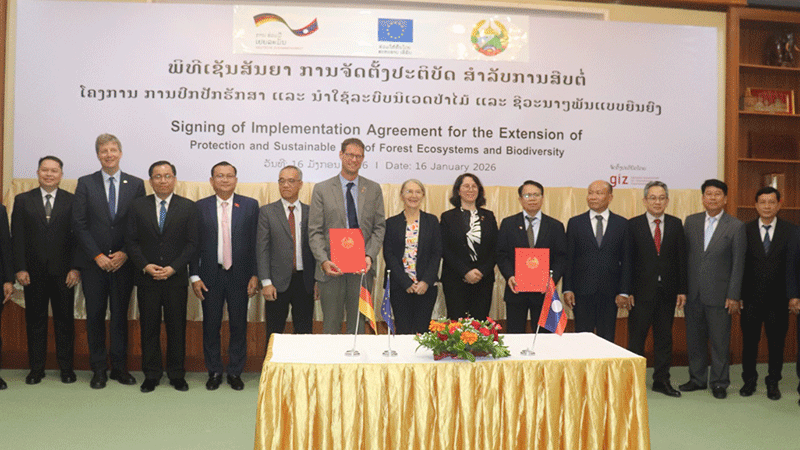
The new agreement, signed on 16 January, extends a long-running conservation initiative and brings fresh financial support for forest management, biodiversity protection, and value chain development. The German Federal Ministry for Economic Cooperation and Development will provide EUR 7 million (about USD 7.6 million) in additional funding, alongside EUR 11 million (around USD 12 million) from the European Union under its agriculture and forestry connectivity programme.
The expanded initiative will focus on strengthening forest governance, conserving biodiversity, and promoting sustainable forest-based economic activities, with particular attention given to women’s participation and community involvement.
The signing brought together representatives from Deutsche Gesellschaft für Internationale Zusammenarbeit (GIZ) and multiple Lao institutions, including the Ministry of Agriculture and Environment, the Ministry of Culture and Tourism, the Ministry of Industry and Commerce, provincial administrations from several northern and central provinces, and the National University of Laos.
Officials said the renewed cooperation builds on progress achieved in earlier phases, which contributed to improved forest management practices and biodiversity protection aligned with national development priorities and global sustainability goals.
German development officials highlighted that the next phase will place greater emphasis on institutional capacity building, private sector engagement, and civil society participation, ensuring that conservation efforts also deliver economic benefits to communities living in and around forest areas.
Multi Partner Implementation Model
The project will adopt a multi-partner implementation model and concentrate on several priority areas, including improving forest policies and legal frameworks, enhancing cooperation for wildlife protection across borders, and restoring forest landscapes to increase resilience to climate impacts.
Special attention will be given to conservation efforts in sensitive ecological zones, including areas linked to the Hin Nam No–Phong Nha–Ke Bang landscape, where biodiversity protection requires coordination across national boundaries.
Additional components include expanding research and training, strengthening technical expertise, and supporting small and medium-sized enterprises involved in sustainable forest-based products.
Implementation will cover provinces including Vientiane, Khammuan, Huaphan, Xayabouly, Luang Prabang, and Oudomxay. Authorities said the initiative is expected to contribute to long-term forest conservation while helping communities develop more resilient and sustainable livelihoods.
Information provided by GIZ Laos
