

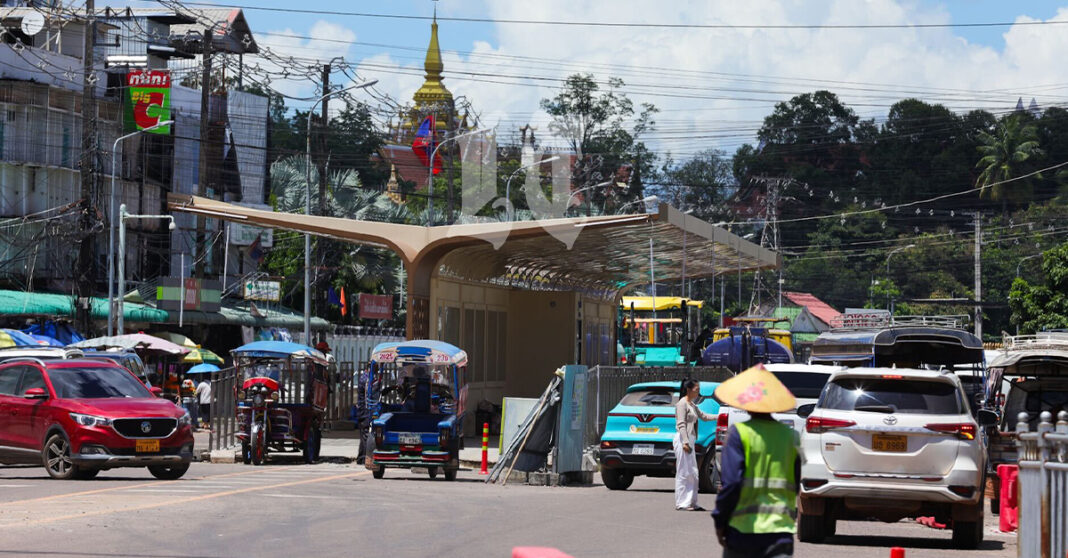
The Prime Minister has approved payments to contractors for work already completed under the Vientiane Urban Sustainable Transport Project (VSUTP), while ordering adjustments to the Bus Rapid Transit (BRT) system following public concerns over traffic and safety.
The decision was announced in an urgent notice issued by the Office of the Prime Minister on 12 December. It instructs authorities to proceed with payments based on verified work completion and to carry out project changes as directed by higher authorities, including the removal of road curbs and BRT lanes.
The notice also addresses uncertainty over external funding. If international donors suspend support for the project, responsible agencies are required to calculate total losses, close project accounts in an orderly manner, and implement measures to ease traffic conditions in Vientiane Capital.
In addition, the Prime Minister assigned the Ministry of Public Works and Transport, the Vientiane Capital Administration, and the Ministry of Public Security to work together to reduce traffic congestion during rush hours, as the city continues to assess the impact of the BRT trial.

Safety Concerns Emerged During BRT Trial
The latest directive follows public concern over safety issues linked to the BRT system during its trial phase. In November, Vientiane recorded five traffic accidents involving BRT lanes, just weeks after the city began a two-month free trial of the system.
Two accidents occurred on 23 November, including a collision between a BRT bus and a motorbike at a station in Phonsaath village, Xaysettha district, which injured a rider. Later the same day, a car crashed into a motorbike inside another BRT station.
Additional incidents occurred on 10 and 8 November, when two separate accidents at the same BRT station damaged three cars and a motorbike.
In response, authorities limited BRT lane operations to weekdays from 7:00 a.m. to 7:00 p.m. and banned private vehicles from entering or parking in the lanes during those hours, with fines imposed on violators.
The incidents sparked criticism across social media, with residents questioning the lane design and enforcement. Many called for stricter policing, while others argued the dedicated lanes had worsened congestion on already narrow roads.
Project Background and July Update
Back in July, Vientiane Capital Mayor Athsphangthong Siphandone announced that the BRT service would begin trial operations free of charge for three months by the end of August.
At the time, construction of BRT lanes and stations had reached 71.64 percent completion. It was officially launched in late November.
The BRT system features 12-meter electric, air-conditioned buses with 40 seats each, operating on dedicated routes. Of the planned 55 electric buses, 28 arrived in Laos on 5 November 2024, with the remaining units scheduled for future delivery.
The service was designed to operate daily from 6:00 a.m. to 10:00 p.m. and integrate with Vientiane’s existing bus network. The initial route includes six main stations: Chao Fa Ngum Park, Inpeng Temple, Morning Market, Patuxay, Phonekheng, and the National University of Laos.
Beyond the initial phase, authorities planned to extend the BRT route to connect Wattay International Airport and the Laos-China Railway Station by the end of 2026.
Launched in 2018 by the Department of Public Works and Transport, the VSUTP is funded by international partners, including the Asian Development Bank, alongside Lao government contributions.
The total investment amounts to USD 99.7 million, with the long-term goal of easing congestion, improving safety, and reducing air pollution by encouraging greater use of public transport.
Now, about a month after becoming operational, the BRT system now faces an uncertain future.
