

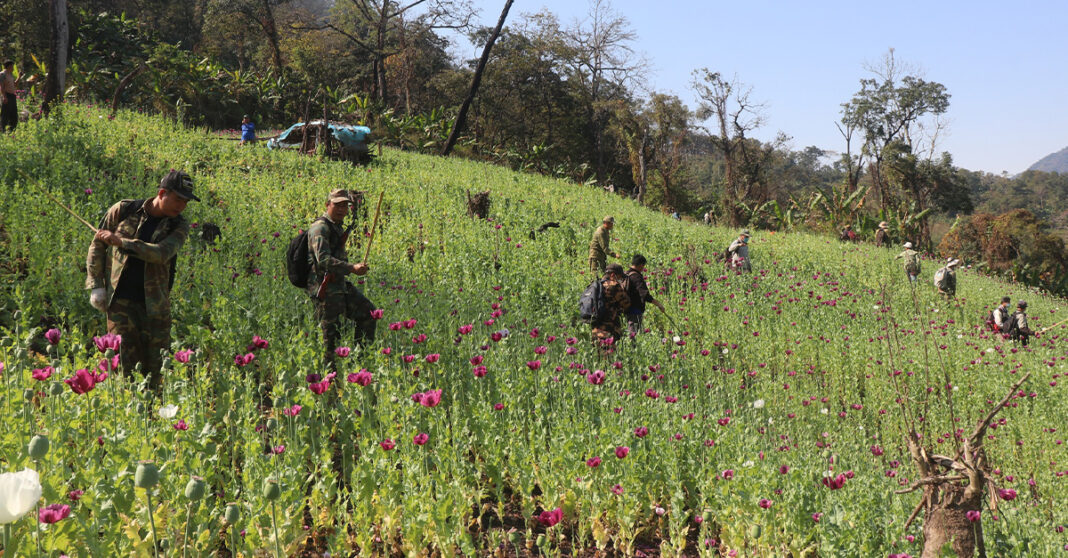
Lao authorities have stepped up enforcement against illegal opium poppy cultivation in northern Laos, destroying more than 13 hectares of illicit crops in early February, according to official reports.
The latest crackdown began in Phongsaly Province, a region historically linked to opium production. On 4 February, authorities in Yod Ou district uprooted 21 poppy plots covering 9.8 hectares in Phan village.
The operation involved provincial public security forces, national defence units, and local officials, who also conducted awareness sessions with villagers on the risks and legal consequences of opium cultivation. All fields were fully destroyed to prevent harvesting or replanting.
On the same day, authorities in Long district, Luang Namtha Province, eliminated two cultivation sites spanning 2.96 hectares. Enforcement teams travelled through mountainous terrain and crossed streams, taking nearly three hours to reach the remote locations before cutting and uprooting the crops
Earlier, on 30 January, officials in Khoun district, Xieng Khouang Province, destroyed an opium plantation covering more than 4,000 square metres, or 0.4 hectares. Those responsible were detained and face legal action under Lao law.
Despite ongoing enforcement, opium cultivation remains a persistent challenge in northern Laos. Phongsaly Province continues to feature prominently due to its geography and long-standing role in regional drug production.
According to the United Nations Office on Drugs and Crime’s World Drug Report 2023, Laos cultivated around 5,000 hectares of opium poppy in 2023, down from 5,700 hectares in 2015.
Regional trends, however, raise broader concerns. Myanmar overtook Afghanistan as the world’s largest opium producer in 2023. The Myanmar Opium Survey 2025 reported a 17 percent increase in cultivation, rising from 45,200 to 53,100 hectares, the highest level in a decade.
