

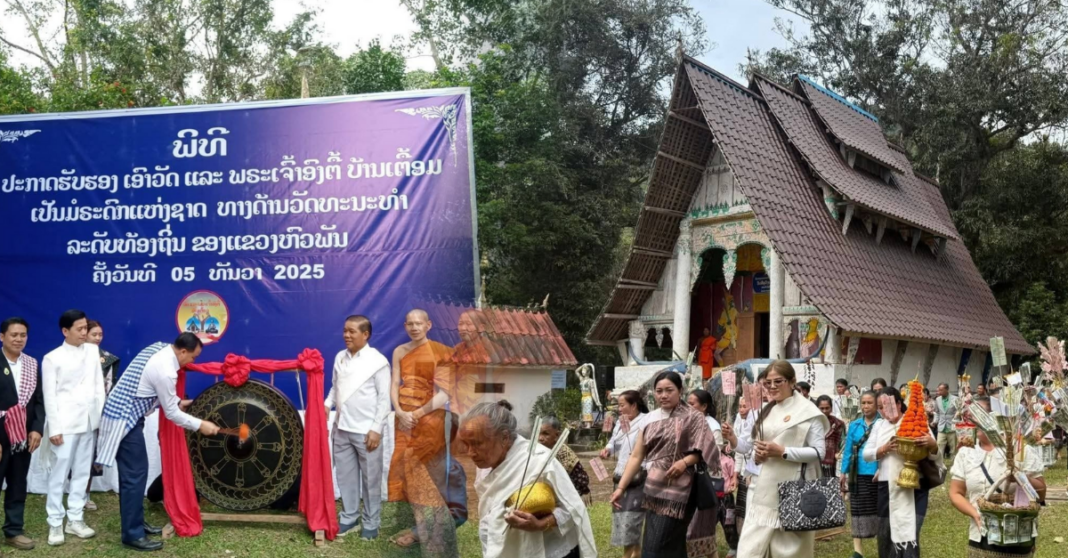
On 5 December, authorities in Houaphanh Province recognized Phra Chao Ong Tue temple and its revered Phra Chao Ong Tue (King Ong Tue) statue as National Heritage at the local level, acknowledging their profound cultural significance.
Located in Tueam village, Sam Neua district, the temple has served as a vital spiritual and cultural center for the local community for centuries. According to local legend, the temple, built in 1566 under the direction of Ong Phahao, a master craftsman from Vientiane, was established during the Lane Xang era as a symbol of cultural prosperity and religious devotion.
Lane Xang, meaning “Million of Elephants,” was the Lao kingdom that flourished from around the 13th to late 17th centuries.
The temple exemplifies traditional Lane Xang cultural and architectural artistry. Constructed with brick and mortar, it features a distinctive high, multi-tiered roof adorned with intricate wood carvings and vibrant wall murals that reflect the artistic traditions of the era. These decorative elements make it one of Houaphanh Province’s most culturally significant temples.
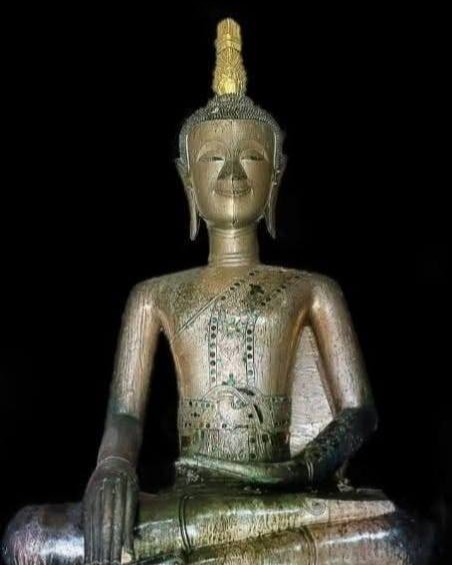
At the heart of the temple stands Phra Chao Ong Tue, a highly venerated Buddha image depicted in the Maravijaya posture. The statue measures 227 centimeters tall from its base, with a shoulder width of 85 centimeters and lap width of 122 centimeters.
Cast in 1638 with community support, the statue was ceremonially enshrined with inscriptions that preserve its cultural and historical legacy and name still preserved today.
