

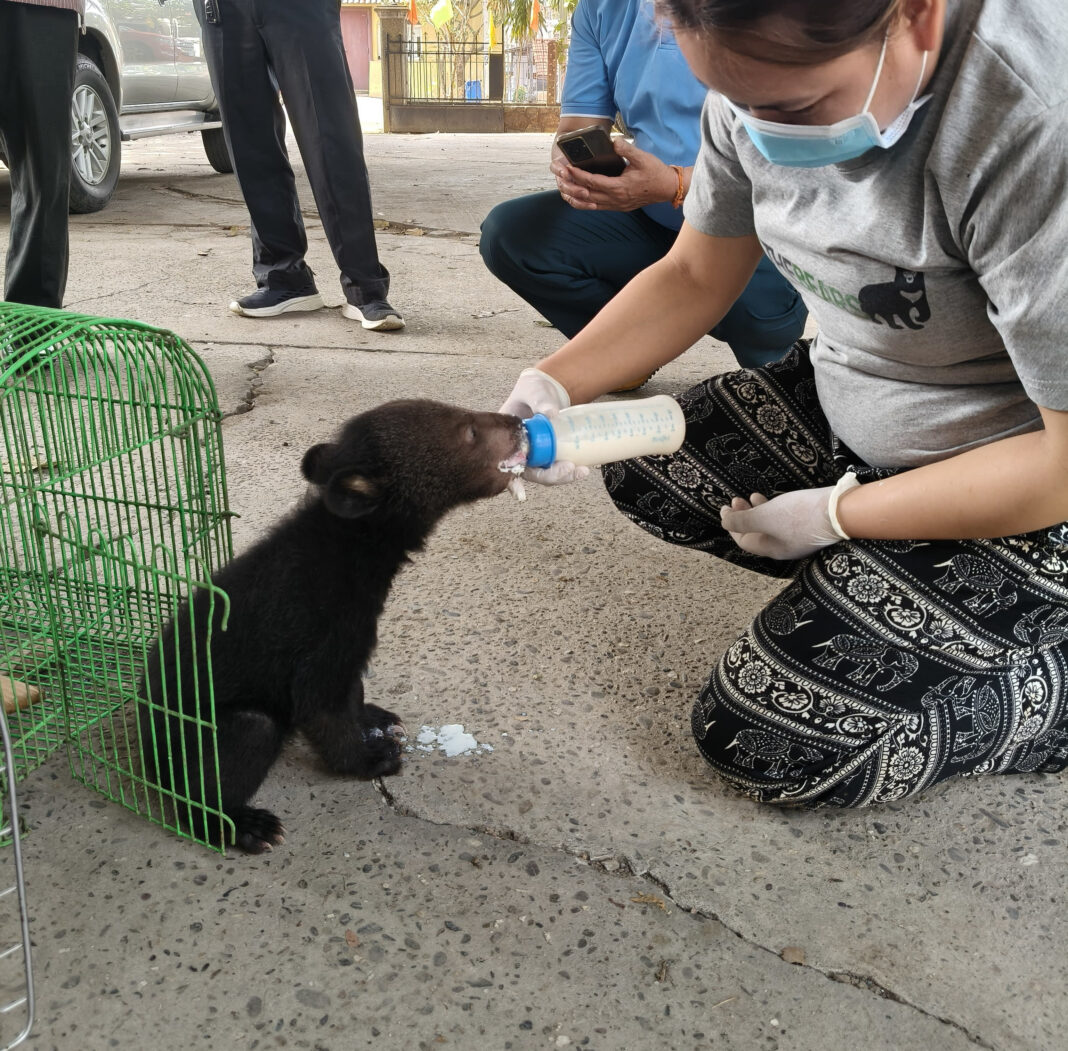
Two Asiatic black bear cubs, just two months old, are recovering at a Luang Prabang wildlife sanctuary after law enforcement confiscated them from illegal traders on the morning of 11 March.
The cubs, also known as moon bears, were being offered for sale when authorities intervened and called in a rescue team from Free the Bears’ Luang Prabang Wildlife Sanctuary, who mobilised immediately to collect them.
At two months old, the cubs should still be in a forest den with their mother. She is unlikely to be alive.
“Sadly, the reality in cases like this is that the mother is usually killed so the cubs can be taken,” says Matt Hunt, CEO of Free the Bears. “These cubs are still incredibly fragile, weighing less than 3 kilograms each. Our team at Luang Prabang Wildlife Sanctuary will be caring for them day and night over the coming months.”
The pair are the organisation’s 169th and 170th rescues in Laos, and the first of 2026. Carers are now feeding them milk formula every few hours around the clock. If the cubs cannot eventually return to the wild, they may live under sanctuary care for 30 years or more.
The rescue comes shortly before the first anniversary of the closure of Laos’ last bear bile farm. Traders typically keep bears in cages barely larger than their bodies and extract bile from their gallbladders for use in traditional medicine, despite the active compound being synthetically producible in laboratories.
Free the Bears has rescued more than 1,000 bears across Southeast Asia over the past 30 years and runs the largest bear sanctuary network in the region, with facilities in Laos, Cambodia and Vietnam.
Information from Free the Bears Laos
