

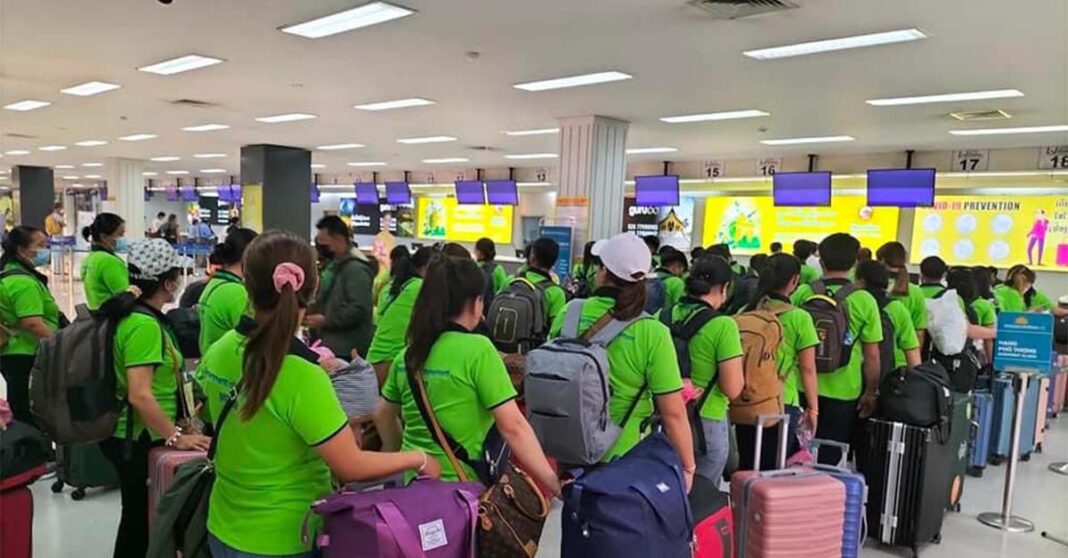
Laos is targeting the dispatch of more than 17,000 workers to South Korea this year under its seasonal work program.
According to latest state media reports, the government aim to to scale up one of its most significant labor migration schemes while grappling with the domestic workforce pressures that come with it.
Labor Minister Phoxay Sayasone chaired a consultation on 13 March reviewing the South Korea Seasonal Worker Program, confirming the 2026 target as part of a broader 2026–2030 five-year labor dispatch plan.
The minister stressed the need to improve pre-departure language and skills training, streamline bureaucratic procedures, and support returning workers in finding local employment using skills gained abroad.
On the ground in Korea
The scale of the 2026 push is already visible on the Korean side.
On 12 March, Yeongcheon City in North Gyeongsang Province welcomed its first batch of 16 Lao seasonal workers, placed across seven local farms growing tomatoes, peaches and jujubes, according to Korean media.
A further 62 workers are expected in two additional batches in April, bringing the city’s total to 78 for the year. The city has also hired a dedicated Lao-language interpreter for eight months to bridge communication gaps between workers and farmers.
A day later, on 13 March, Gokseong County in South Jeolla Province welcomed 29 Lao workers selected through local interviews under a Memorandum of Understanding with Laos. The county is also pushing to extend worker contracts from five months to eight months this year, a move aimed at increasing workers’ income and stabilizing the farm labor supply.
Fast Growth
The program’s roots go back to 2022, when the Ministry of Labor and Social Welfare began formalizing partnerships with South Korean provinces to fill labor shortages in farming and fishing.
Private recruitment companies including Buasavanh Employment Service and iJobs were authorized to manage recruitment, targeting workers aged 25 to 45. Multiple agreements were signed with Korean cities and provinces by the end of that year. The effort formed part of Laos’ 5th Five-Year Labour and Social Welfare Development Plan covering 2021 to 2025.
The numbers have climbed steadily since.
Laos had dispatched over 7,500 seasonal workers through the formal program by mid-2024, according to KPL. Across all visa categories, around 13,000 Lao nationals were working in South Korea by the same period.
Workers earn between USD 1,600 and USD 2,000 per month including social benefits, compared to the roughly USD 375 a month that university-educated workers can expect at home.
The financial impact on Laos is significant. Government figures from early 2024 put remittances from Lao workers abroad at over USD 35.5 million per month, totaling USD 426 million annually.
The cost of sending workers abroad
The program’s growth has not come without complications at home.
Laos is experiencing a labor shortage of more than 800,000 people against a working-age population of around five million. Businesses across Vientiane have struggled to retain permanent staff, with workers leaving for higher pay abroad.
Minister Phoxay acknowledged the issue directly at the 13 March consultation, stressing the need to address domestic labor shortages caused by the outflow.
Workers also bear significant upfront costs before departure, including travel, passports and recruitment agency fees, which are then deducted from monthly salaries once in Korea.
The 2026–2030 five-year plan signals that Laos sees labor export as a long-term economic strategy rather than a short-term plan. The question the government is now trying to answer is how to keep the benefits flowing home while holding onto enough of its workforce to keep the domestic economy running smoothly.
