

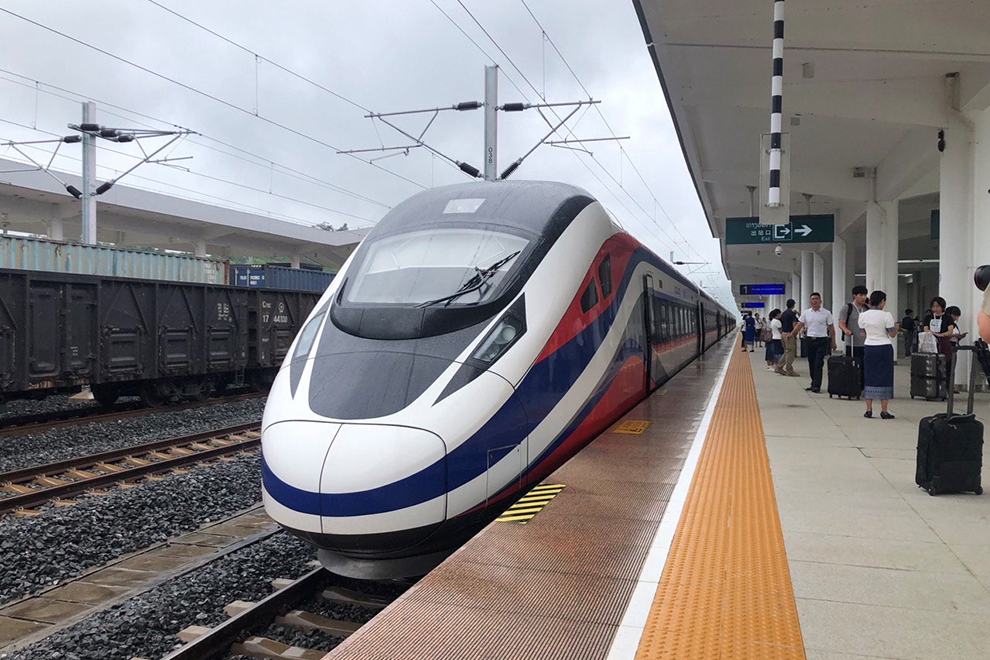
Expanding the railway to southern Laos, rolling out a new school system, reducing poverty, and improving roads and water supply were among the key issues discussed during the First Ordinary Session of the 10th National Assembly this week.
Lawmakers questioned ministers on infrastructure, education, rural development, and environmental protection as the government outlined its priorities for the remainder of 2026.
One of the main proposals came from Champasak lawmaker Alounxay Sounnalath, who urged the government to extend the railway network to southern Laos.
Speaking during the Assembly session, he said expanding the railway would improve transport, support trade and production, and help boost economic growth in the region.
He also called for clearer import management policies, better coordination between central and local authorities, and a fair distribution of the government’s proposed 2,500 new civil service positions, with priority given to healthcare workers and long-serving volunteer teachers.
Roads and Water Supply
The call for railway expansion came as the government outlined broader plans to strengthen the country’s transport infrastructure.
Minister of Public Works and Transport Leklai Sivilay said the government will continue upgrading national highways, provincial roads, district roads, and village access roads to improve transport, reduce accidents, and support trade and tourism.
He said priority will be given to projects that already have funding or signed contracts, while additional financing will come from road maintenance funds, state investment, official development assistance (ODA), and public-private partnerships.
The government also plans to expand community water supply systems, improve urban planning, reduce flooding, and strengthen waste management.
According to Leklai, ministries will also work together to improve road access to tourist attractions and agricultural production areas.
New School System From 2028
Beyond infrastructure, lawmakers also heard updates on reforms in the education sector.
Prime Minister Sonexay Siphandone confirmed that Laos will begin introducing its new 6+3+3 education system, starting with Grade 6 in the 2028–2029 academic year.
The reform will extend primary school from five years to six years, reduce lower secondary education from four years to three, and keep upper secondary education at three years.
The government is also revising the curriculum for all 12 grades, developing new textbooks and teachers’ guides, restructuring teacher training institutions into a national teacher training university, and preparing to establish the Lao-Vietnam Friendship University and the Lao-Russia Friendship School.
Sonexay said the government will continue addressing teacher shortages and expanding opportunities for volunteer teachers to become civil servants.
Poverty Reduction
The government’s social development agenda also featured prominently during the session.
Deputy Prime Minister and Minister of Finance Santiphab Phomvihane said the government is preparing a new national agenda on rural development and poverty reduction.
The plan aims to lift more than 100,000 families out of poverty by 2030, reducing the national poverty rate from 14.78 percent to a single-digit figure.
The government also plans to remove more than 1,000 villages and 25 districts from the national poverty list while creating four to five model villages in each province.
Santiphab said the strategy focuses on creating stable jobs and incomes, improving infrastructure, expanding access to education, healthcare, and clean water, allocating land, and attracting more domestic and foreign investment into rural development.
He said Laos currently has 189,792 poor families, 2,173 poor villages, and 66 poor districts.
Forest Restoration
Environmental protection was another issue raised by lawmakers during the debate.
Members of the National Assembly questioned the government about the continued loss of forest cover linked to mining, hydropower, agriculture, and other development projects.
Minister of Agriculture and Environment Linkham Douangsavanh said forests currently cover 62.56 percent of Laos, and the government aims to increase that figure to 65 percent by 2030.
To reach the target, authorities plan to restore 520,000 hectares of natural forest, plant 200,000 hectares of industrial trees, and continue surveying and allocating forest land while strengthening reforestation efforts funded by development projects.
