

HONG KONG, Oct. 16, 2026 /PRNewswire/ — Lingnan University has announced the admission of 14 outstanding students to its inaugural Samuel C.C. Ting Elite Class (CCT Class). Selected from high-achieving undergraduates awarded University Entrance Scholarships, the students come from eight countries and regions, namely the Hong Kong SAR, the Chinese Mainland, Ethiopia, Kyrgyzstan, Nepal, the Philippines, Russia, and the UK. They will receive four-year full-tuition scholarships, a guaranteed hostel place with fees covered for four years, dedicated one-to-one mentorship, artificial intelligence (AI) training provided by leading multinationals, precedence in frontier research projects, opportunities to meet Nobel laureates and leading scholars, and priority for admission to postgraduate programmes.
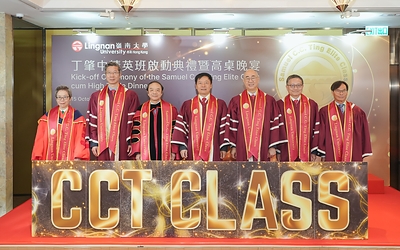
Lingnan University holds the “Kick-off Ceremony of the Samuel C.C. Ting Elite Class cum High Table Dinner” for the inaugural cohort of the CCT Class, featuring the 14 students from eight countries and regions selected for the programme. From left: Prof Emilie Yeh, Associate Vice-President (Academics) and Lam Wong Yiu Wah Chair Professor of Visual Studies; Prof Xin Yao, Vice-President (Research and Innovation) and Tong Tin Sun Chair Professor of Machine Learning; Prof Wang Yifang, Academician of the Chinese Academy of Sciences; Prof S. Joe Qin, President and Wai Kee Kau Chair Professor of Data Science at Lingnan University; Prof Raymond Chan Hon-fu, Vice-President (Academics) cum Provost and Lam Man Tsan Chair Professor of Scientific Computing; Mr Ernest Chan Chi-man, Vice-President (Administration); and Prof Sam Kwong Tak-wu, Associate Vice-President (Strategic Research) and J.K. Lee Chair Professor of Computational Intelligence.
Undergraduates in the CCT Class are studying disciplines including Animation and Digital Arts, Accounting and Corporate Governance, Business Analytics and Innovation, Cultural Studies, Data Science, Economics, Finance, Global Development and Sustainability, Government and International Affairs, Health and Social Services Management, and Marketing and Social Media.
Prof S. Joe Qin, President and Wai Kee Kau Chair Professor of Data Science at Lingnan University, officiated at the “Kick-off Ceremony of the Samuel C.C. Ting Elite Class cum High Table Dinner” on the evening of 15 October to welcome the first cohort, and said he was honoured to receive Prof Wang Yifang, Academician of the Chinese Academy of Sciences and a former student of Prof Samuel C.C. Ting, to witness the launch of the inaugural CCT Class.
President Qin said, “Named after Nobel Laureate in Physics Prof Samuel C.C. Ting, the programme, abbreviated as the CCT Class, also embodies our aspiration for students to become research-oriented individuals with creative and critical thinking. Students from different academic backgrounds will receive AI training and explore the application of AI to research and to real-world problem-solving from the perspective of their respective disciplines. I encourage the members of this inaugural cohort to carry forward Prof Ting’s commitment to scientific exploration, stay curious, have the courage to innovate, and translate their knowledge into practical solutions that address societal challenges.”
Nobel Laureate in Physics Prof Samuel C.C. Ting, who is currently overseas, thanked President Qin for the invitation in a video address, and delivered his first lecture to the students. Sharing his years of experience in ground-based and space research experiments, Prof Ting recalled his involvement in a major US particle accelerator project that was eventually terminated due to management problems, prompting him to reconsider his future research direction. He then decided to take on a field in which he had “zero experience”, one that many people at the time considered impossible, and ventured into space research.
Prof Ting noted that neither he nor any of his collaborators had ever done anything in space, and that they had no relevant experience at the time. Starting from zero, the team worked on how to send a large scientific detector into space, eventually succeeding in sending the detector to the International Space Station to collect and analyse cosmic rays over an extended period. The experiment, known as the Alpha Magnetic Spectrometer (AMS), subsequently became a long-term space research programme.
Prof Ting shared that while the detector was operating in space, the team had no Christmas, no New Year, and no holidays, as the experiment had to continue without interruption. Researchers monitored the experiment 24 hours a day, seven days a week, and 365 days a year.
Prof Ting also explained why basic research that may appear to have no direct connection with everyday life is equally important. Citing the development of science as an example, he said that research into classical mechanics, thermodynamics, and optics in the 1900s is now used in microwave technology, aerospace, and optical instruments. Research into atoms in the 1930s later contributed to the development of computers, AI, superconductors, semiconductors, and lasers. Research into atomic nuclei in the 1940s is now applied to nuclear reactors. “Only later, when uses develop and the public becomes familiar with the new phenomena, does the value of basic research become understood.”
Regarding how scientific research leads to new discoveries, Prof Ting said, “When an experiment agrees with theory, what you learn is limited. Only when experiments contradict theory do you learn something new. Theory, however elegant, cannot replace experimental results. Scientific research must be verified through experimentation to discover new knowledge.”
Prof Wang Yifang, who attended the inauguration ceremony in person, said, “The development of particle physics is closely associated with the name of Prof Samuel C.C. Ting. Over the past 20 years, through the AMS experiment on the International Space Station, Prof Ting has revolutionised the field of cosmic-ray research and made important contributions to the development of particle physics in China. I believe Prof Ting’s story and his point of view about scientific research are very inspiring for young people.”
Dawit Kidu Hailezgi, a CCT Class undergraduate from Ethiopia studying Health and Social Services Management, said, “I come from Ethiopia and always wished to gain better knowledge and skills in order to improve life in my home country. The Hong Kong SAR is a global hub for research and collaboration, and Lingnan University offers a Health and Social Services Management programme that combines healthcare and AI. Together with the scholarship, internship, and international exchange opportunities, Lingnan is the perfect fit for me. In the CCT Class, I am especially looking forward to researching the use of AI tools in medical imaging to help diagnose diseases at an early stage. Through exclusive AI training provided by multinationals and opportunities to participate in cutting-edge research, I hope to develop practical and feasible solutions to narrow the healthcare disparities faced by low-income countries.”
Jia Xinyan, a Chinese Mainland undergraduate studying Data Science, hopes to use AI to address practical challenges in healthcare and smart cities. She said, “What attracts me most about studying in the Hong Kong SAR is its two unique advantages. The city is an international hub for finance, technology and higher education, giving students access to world-class research, companies, and talent. At the same time, the Hong Kong SAR is closely connected with the Chinese Mainland and shares a similar culture with efficient transport, so I never feel completely cut off from home. I chose Lingnan because of its small-class teaching and the close relationships between students and the faculty. The CCT Class also provides state-of-the-art AI courses and training from leading multinationals. I intend to build a strong foundation in data science here, and explore how AI can address real-world challenges in healthcare and smart cities.”
Subats Nepal, an undergraduate from Nepal studying Economics, hopes to research the barriers faced by developing countries. He said, “I come from Nepal, one of the world’s less developed countries. What I look forward to most at Lingnan is conducting research to identify the bottlenecks that have been holding back the potential of countries like mine. I also hope to investigate and establish practical, realistic solutions to overcome these barriers. By drawing on successful development experiences from around the world and adapting strategies to the specific needs of different local communities, I would like to contribute to sustained prosperity.”
Prof Raymond Chan Hon-fu, Vice-President (Academics) cum Provost and Lam Man Tsan Chair Professor of Scientific Computing, and Chair of the CCT Task Force, said in his closing speech, “The CCT Class is an elite, cross-disciplinary enrichment pathway alongside our students’ degree programmes. Prof Ting and Prof Wang reminded us that true learning extends beyond the classroom. It is a lifelong commitment to discovery. Prof Ting has been a role model, devoting his life to asking bold questions that reshape our understanding of the universe. I encourage you to carry these lessons forward. Seize every opportunity, and make the most of the extraordinary mentorship.”
