

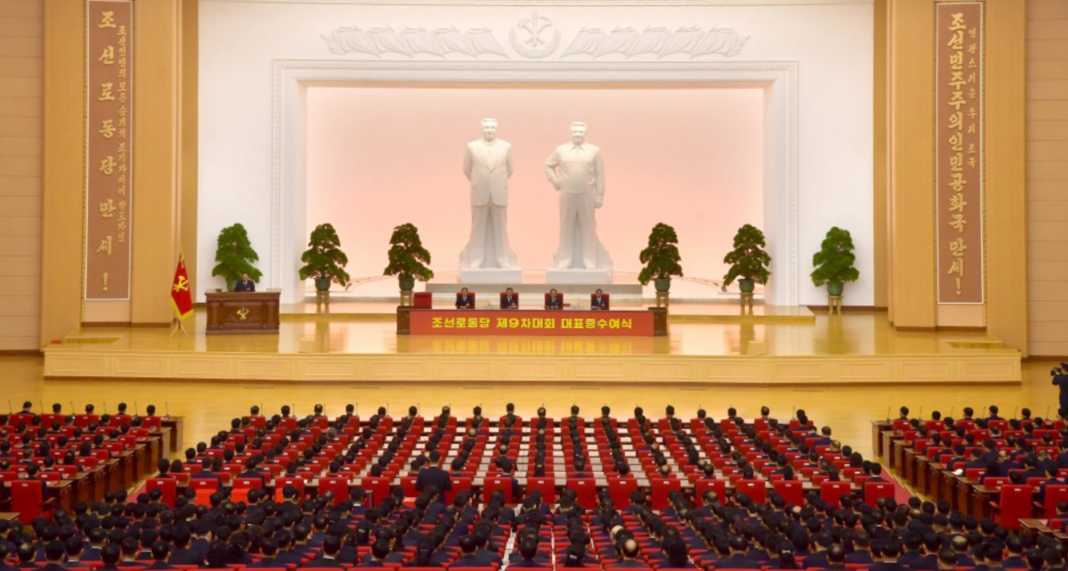
North Korea has opened the Ninth Congress of the Workers’ Party of Korea (WPK) in Pyongyang, marking its most significant political meeting in five years and setting the stage for a new five-year development strategy.
The congress began on 19 February and is expected to outline policy direction on economic management, rural reform, and party restructuring. Authorities have not announced how long the meeting will last.
According to the state-run Korean Central News Agency (KCNA), delegates are reviewing the work of the Central Committee, revising party rules, and electing new central leadership bodies. Beyond these procedural matters, the congress is expected to define economic priorities for the next five years, with state media highlighting plans to boost growth, promote regional development, improve living standards, and modernize rural and industrial infrastructure.
The gathering has drawn around 5,000 delegates, including central leadership members and representatives from party organizations nationwide.
The event comes amid heightened military messaging. A day before the congress opened, state media showed Kim Jong Un inspecting and driving a 600 millimeter-caliber multiple rocket launcher in Pyongyang.
KCNA described the system as capable of carrying tactical nuclear warheads and incorporating advanced guidance technology.
Foreign media reported that such displays ahead of major party meetings are often intended to reinforce domestic support and signal deterrence to regional rivals.
Review of the Past Five Years
In his opening address to the congress, Kim Jong Un described the congress as a “new milestone” in strengthening party control and advancing state development, signalling an effort to consolidate authority while resetting economic priorities.
He claimed that the earlier economic plan had been fulfilled, citing infrastructure projects and construction initiatives in Pyongyang and provincial areas. At the same time, he acknowledged shortcomings within party and state institutions, including bureaucratic rigidity and lack of accountability, and called for stricter discipline and more systematic economic planning.
Further announcements, including potential leadership reshuffles and detailed policy measures, are expected as the congress continues in Pyongyang.
Similarly, party congresses in Laos and Vietnam have recently served to review economic management and governance priorities, serving as platforms to consolidate leadership authority and outline medium-term development strategies
