

A landmark US Supreme Court ruling has reshaped Washington’s trade policy, but for small economies like Laos, the relief may prove temporary.
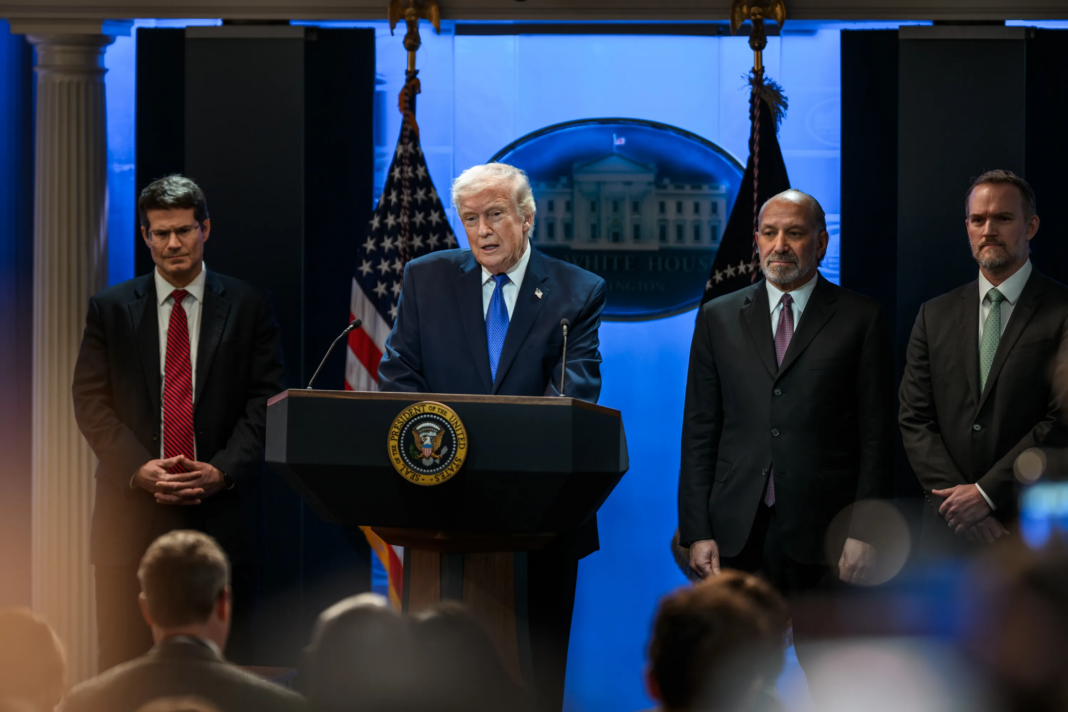
On 20 February, the United States Supreme Court struck down the legal foundation underpinning most of Trump’s sweeping tariff regime.
But within days, the President had found a workaround.
The tariffs, it seems, are here to stay. At least for now.
In a 6-3 decision, the Supreme Court invalidated all tariffs imposed under the International Emergency Economic Powers Act, the executive authority Trump had used since 2025 to impose steep, country-specific “reciprocal” duties on imports from around the world.
The ruling was a major rebuke of presidential trade power, with the court finding the administration had overreached.
Trump responded calling the decision “deeply disappointing” and accusing the justices of lacking “the courage to do what’s right for our country.”
Enter the 15 Percent Flat Tariff
Within 24 hours of the ruling, Trump invoked a different legal tool, Section 122 of the Trade Act of 1974, to impose a new 10 percent tariff on all US imports.
By 21 February, he had raised that figure to 15 percent, announcing the increase via Truth Social and warning that more levies would follow.
The emergency measure can remain in place for up to 150 days, buying the administration time to craft new country-specific duties.
What it Means for Laos
While the tariffs are evolving,
Few countries felt the original tariff regime more sharply than Laos, at least on paper.
In April last year, Washington imposed a 48 percent tariff on Lao imports, later reduced to 40 percent. The rate placed Laos among the most heavily taxed exporters to the United States, despite its small share of global trade.
The Supreme Court ruling technically nullifies that 40 percent rate, replacing it, for now, with the new 15 percent flat tariff.
That shift offers short-term breathing room for Lao exporters. But the relief may not last.
Meanwhile, the country has also faced scrutiny over its solar panel sector.
US trade authorities have investigated claims that Chinese manufacturers relocated production to Laos to bypass earlier American tariffs, raising the possibility of additional anti-subsidy measures.
Regional Ripple Effect
Perhaps more damaging than the direct tariff hit will be the broader regional impact.
Laos’s economy is closely linked with its neighbors, Thailand, Cambodia, Vietnam, and China, all of which are themselves facing US tariff pressure.
Any slowdown in regional trade, investment flows, or manufacturing output quickly affects Laos through supply chains, logistics networks, and cross-border energy trade.
Although Laos and Cambodia together account for less than one percent of total US imports, they have faced disproportionately high tariff rates.
According to the US Trade Representative, the US imported just USD 802.8 million worth of goods from Laos in 2024, less than 0.03 percent of America’s record USD 3 trillion import total that year. Numbers that are objectively too small to materially affect America’s overall deficit.
Yet, for Southeast Asia, the coming months will test economic resilience.
The 150-day tariff clock has begun to tick.
