

Home Blog Page 1044

HeyGears Launches New Clear Resin and Transparent 3D Printing Solution – Now Available on Amazon

IRVINE, Calif., March 13, 2026 /PRNewswire/ — HeyGears has launched its first clear 3D printing resin for Reflex RS & RS Turbo 3D printers, UltraPrint Production PAF10 Clear, alongside its Transparent Solution – featuring step-by-step workflows to create outstanding transparent 3D printed effects. This enables more users to 3D print high-clarity models with premium-level results. The company has also launched its HEYGEARS Official Store on Amazon, expanding access to HeyGears’ professional 3D printing products.

PAF10 Clear Resin: Achieve Superior Clarity and Precision for Every Print

PAF10 Clear resin offers 82% light transmittance, allowing 3D printed parts to achieve crystal-like clarity. It provides stunning transparency, enhancing the visual presentation of prototypes or display models. With ultra-fine detail down to 0.08 mm, it is ideal for intricate designs that require sharp edges.

PAF10 Clear resin is also formulated with yellowing resistance, for long-lasting clarity even with prolonged use. With 46% elongation at break, the resin offers an optimal balance of flexibility and strength, making it ideal for delicate accessories, miniatures, and small structures that need both resilience and precision.

The HeyGears Transparent Solution: Complete Workflows for Transparent Parts

Along with the new PAF10 Clear resin, HeyGears has introduced its Transparent Solution, offering a complete workflow for premium-grade clear 3D printed products. The Transparent Solution includes standardized processes from design guidelines to finished part post-processing steps, including sanding, dying and coating.

By following these workflows, users can efficiently turn their creative designs and models into professional-quality products with crystal-like transparency, matte transparency and colored transparent effects that can meet final expectations. HeyGears’ Transparent Solution is perfect for individual makers as well as businesses looking to reliably produce high-quality transparent 3D printed parts, such as consumer products and gaming miniatures. For more details about this solution, visit: https://store.heygears.com/pages/transparent-solutions

Shop HeyGears Products on Amazon

HeyGears has also launched its official Amazon storefront, further expanding access to its professional 3D printers, materials, and accessories, including the new PAF10 Clear resin with special savings including up to 40% off the Reflex RS, up to 30% off the Reflex RS Turbo 3D printers, up to 26% off the new PAF10 Clear resin, and even more discounts.

Explore more on Amazon.

With the launch of PAF10 Clear resin, the introduction of the Transparent Solution, and the debut of HEYGEARS Official Store on Amazon, HeyGears is further strengthening its ecosystem for professional 3D printing. These new offerings provide users with a more complete path to high-quality transparent parts, combining advanced 3D printing materials, practical workflow guidance, and broader product access worldwide.

To learn more about HeyGears products, visit store.heygears.com or contact contact@heygears.com.
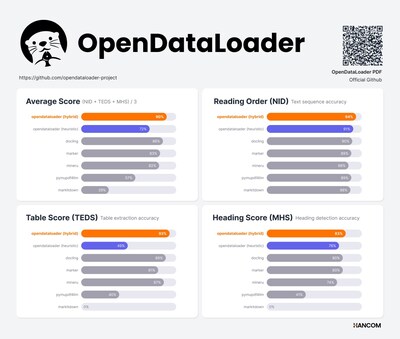
Hancom Tops Open-Source PDF Benchmarks with OpenDataLoader PDF v2.0

– Tops in benchmark test, including reading order, tables, and title inference.

– Offers a perfect local security environment with the hybrid engine that combines AI and direct extraction heuristic engine

– Four AI functions via free AI add-ons; OCR, Table AI, Chart and Formula AI

– Change to Apache-2.0 licensing from MPL-2.0

SEOUL, South Korea, March 13, 2026 /PRNewswire/ — Hancom, the South Korean software company behind the widely used Hangul word processor, has released OpenDataLoader PDF v2.0 — and the benchmark numbers back up the claim. In the company’s own internal testing, OpenDataLoader PDF outperformed competing open-source tools across reading order recognition, table extraction, and heading inference. Hancom has published the full benchmark dataset and reproducible code on its official GitHub repository, allowing developers to verify the results independently.

Hancom Tops Open-Source PDF Benchmarks with OpenDataLoader PDF v2.0

The headline engineering move is a hybrid extraction engine that pairs AI-based parsing with direct extraction. The practical upside: enterprises and developers get high-accuracy PDF data extraction that runs entirely on-premise, with no data leaving the local environment. For organizations handling sensitive documents — legal, financial, medical — that’s not a minor footnote.

Four Free AI Add-ons, Out of the Box

OpenDataLoader PDF PDF v2.0 includes the following four AI features as add-ons at no additional cost:

  • OCR— improves text recognition on image-based and scanned PDFs
  • Table Extraction— a lightweight AI model that handles merged cells and complex table structures with precision
  • Formula Extraction— recognizes mathematical and scientific notation locally, without a cloud call
  • Chart Analysis— converts chart visuals into natural-language descriptions

All four are built for compatibility with third-party open-source models, including Docling. Hancom is clear that no formal partnership or sponsorship is in place — the compatibility is purely technical, designed so developers can slot OpenDataLoader PDF into existing pipelines without rebuilding their stack.

Apache 2.0: Lowering the Barrier, Expanding the Ecosystem

The project has also shed its MPL 2.0 license in favor of Apache 2.0 — one of the most permissive open-source licenses available. The move directly reduces friction for commercial use, making it easier for global developers and enterprises to build on top of OpenDataLoader PDF without navigating license compatibility headaches. Hancom expects this to accelerate downstream business models including WebApp and SaaS applications built on the engine.

Ecosystem Expansion: LangChain Is In, More Integrations Coming

LangChain integration shipped in 2025. In 2026, Hancom is targeting Langflow, LlamaIndex, and Gemini CLI, plus MCP (Model Context Protocol) support for agentic AI workflows. The roadmap positions OpenDataLoader PDF as infrastructure for the autonomous AI agent era, not just a standalone parsing tool.

Later in 2026, a commercial AI add-on is planned — described as a concentration of Hancom’s proprietary document AI technology.

AI based auto-tagging to Tagged PDF: Start The Accessibility Play

Perhaps the most forward-looking item on the roadmap is PDF accessibility. With the European Accessibility Act (EAA) now in force, South Korea’s anti-discrimination legislation tightening, and accessibility regulations expanding globally, compliance has become a real operational burden for enterprises. Hancom says OpenDataLoader PDF will be the first open-source PDF tool to include AI-generated accessibility tagging — This will be the first open-source solution to provide a key step toward PDF/UA compliance.

What Hancom’s CTO Said

“OpenDataLoader PDF v2.0 has evolved into an open PDF data platform that anyone can freely use and build upon, through its AI hybrid engine and transition to Apache 2.0,” said Jihwan Jeong, CTO of Hancom. “With upcoming commercial AI add-ons and accessibility solutions, we aim to lead the global ecosystem — making PDF documents not only AI-ready, but accessible to everyone.”

OpenDataLoader PDF PDF v2.0 is available now. Source code, benchmark datasets, and documentation are published at the OpenDataLoader PDF official GitHub repository.

Hancom Tops Open-Source PDF Benchmarks with OpenDataLoader PDF v2.0

– Tops in benchmark test, including reading order, tables, and title inference.

– Offers a perfect local security environment with the hybrid engine that combines AI and direct extraction heuristic engine

– Four AI functions via free AI add-ons; OCR, Table AI, Chart and Formula AI

– Change to Apache-2.0 licensing from MPL-2.0

SEOUL, South Korea, March 13, 2026 /PRNewswire/ — Hancom, the South Korean software company behind the widely used Hangul word processor, has released OpenDataLoader PDF v2.0 — and the benchmark numbers back up the claim. In the company’s own internal testing, OpenDataLoader PDF outperformed competing open-source tools across reading order recognition, table extraction, and heading inference. Hancom has published the full benchmark dataset and reproducible code on its official GitHub repository, allowing developers to verify the results independently.

Hancom Tops Open-Source PDF Benchmarks with OpenDataLoader PDF v2.0

The headline engineering move is a hybrid extraction engine that pairs AI-based parsing with direct extraction. The practical upside: enterprises and developers get high-accuracy PDF data extraction that runs entirely on-premise, with no data leaving the local environment. For organizations handling sensitive documents — legal, financial, medical — that’s not a minor footnote.

Four Free AI Add-ons, Out of the Box

OpenDataLoader PDF PDF v2.0 includes the following four AI features as add-ons at no additional cost:

  • OCR— improves text recognition on image-based and scanned PDFs
  • Table Extraction— a lightweight AI model that handles merged cells and complex table structures with precision
  • Formula Extraction— recognizes mathematical and scientific notation locally, without a cloud call
  • Chart Analysis— converts chart visuals into natural-language descriptions

All four are built for compatibility with third-party open-source models, including Docling. Hancom is clear that no formal partnership or sponsorship is in place — the compatibility is purely technical, designed so developers can slot OpenDataLoader PDF into existing pipelines without rebuilding their stack.

Apache 2.0: Lowering the Barrier, Expanding the Ecosystem

The project has also shed its MPL 2.0 license in favor of Apache 2.0 — one of the most permissive open-source licenses available. The move directly reduces friction for commercial use, making it easier for global developers and enterprises to build on top of OpenDataLoader PDF without navigating license compatibility headaches. Hancom expects this to accelerate downstream business models including WebApp and SaaS applications built on the engine.

Ecosystem Expansion: LangChain Is In, More Integrations Coming

LangChain integration shipped in 2025. In 2026, Hancom is targeting Langflow, LlamaIndex, and Gemini CLI, plus MCP (Model Context Protocol) support for agentic AI workflows. The roadmap positions OpenDataLoader PDF as infrastructure for the autonomous AI agent era, not just a standalone parsing tool.

Later in 2026, a commercial AI add-on is planned — described as a concentration of Hancom’s proprietary document AI technology.

AI based auto-tagging to Tagged PDF: Start The Accessibility Play

Perhaps the most forward-looking item on the roadmap is PDF accessibility. With the European Accessibility Act (EAA) now in force, South Korea’s anti-discrimination legislation tightening, and accessibility regulations expanding globally, compliance has become a real operational burden for enterprises. Hancom says OpenDataLoader PDF will be the first open-source PDF tool to include AI-generated accessibility tagging — This will be the first open-source solution to provide a key step toward PDF/UA compliance.

What Hancom’s CTO Said

“OpenDataLoader PDF v2.0 has evolved into an open PDF data platform that anyone can freely use and build upon, through its AI hybrid engine and transition to Apache 2.0,” said Jihwan Jeong, CTO of Hancom. “With upcoming commercial AI add-ons and accessibility solutions, we aim to lead the global ecosystem — making PDF documents not only AI-ready, but accessible to everyone.”

OpenDataLoader PDF PDF v2.0 is available now. Source code, benchmark datasets, and documentation are published at the OpenDataLoader PDF official GitHub repository.

Xinhua Silk Road: 34th East China Fair highlights resilience and vitality in foreign trade

BEIJING, March 13, 2026 /PRNewswire/ — When the four-day 34th East China Fair (ECF) concluded in Shanghai recently, its bumper harvest of about 2.2 billion U.S. dollars of intent orders attested again to the vitality and resilience of China’s foreign trade.

As a major foreign trade fair held in China, the event attracted 46,450 purchasers from 126 countries and regions, a 2.9-percent on-year increase in the gross number of overseas purchasers.

By regions, European and North American buyers grew 5.5 percent from the figure in previous year and purchasers from Southeast Asia surged as high as 24.1 percent.

Both overseas and domestic purchasers were fascinated by the eye-catching exhibits featuring application of new technologies, green development, and emerging consumption trends this year.

A host of edge-cutting products that integrated AI, the Internet of Things and 3D printing such as the AI magic mirror, hydrogen-oxygen machines, plant protection drones, and 3D printed slippers were displayed.

With broad application of new materials including X-TEX fabric, new plant-dyed cloth, and RPET recycled material, exhibits on the 34th ECF embodied better environment friendliness and functions.

When new technologies like temperature-controlled layered casting technology, activated carbon and sub-nanometer fiber blending technology, and EVA integrated molding technology debuted, the 34th ECF boasted greater sci-tech content.

Showcasing a larger proportion of green technology-featuring exhibits, the 34th ECF has well illustrated the transition paths of China’s foreign trade as an upgrading from traditional manufacturing to green manufacturing is underway.

Apart from these, the event also embraced new consumption trends by housing exhibits relative to pet economy, emotional economy, sport economy, and sleep economy to foster related trade.

Setting four sub-exhibitions, the total exhibition areas covered 115,000 square meters and contained 5,291 booths. It also had two special exhibition zones to bolster cross-border e-commerce and sales of overseas exhibitors.

While offering as usual special areas for buyer-supplier matching, the ECF of this year invited 14 procurement groups consisting of 1,154 quality purchasers and hosted seven match-making activities to promote high-quality deal-making.

Original link: https://en.imsilkroad.com/p/349749.html


World’s First Self-Balancing Motorcycle OMO X Enters Mass Production: A New Era for Smart Two-Wheelers

SINGAPORE, March 13, 2026 /PRNewswire/ — At the 2026 Global Technology Launch held at Jewel Changi Airport’s Canopy Park, OMOWAY announced that its flagship self-balancing electric motorcycle, the OMO X, has officially entered mass production, with pre-orders set to open in late April. As the world’s first mass-produced self-balancing motorcycle, the rollout of the OMO X marks a pivotal transformation—evolving the motorcycle from traditional vehicles into “MotoRobots” endowed with awareness and mobility.

"Ballet on Wheels" stuns Singapore: OMOWAY debuts its manned self-balancing technology
“Ballet on Wheels” stuns Singapore: OMOWAY debuts its manned self-balancing technology

Solving Two-Wheeler Pain Points with Self-Balancing Tech

“Only embodied intelligence can truly serve humanity,” said OMOWAY founder Todd. By coupling intelligent algorithms with hardware, the OMO X solves the age-old issues of instability and handling, giving the machine an instinctive sense of balance.

  • Aerospace DNA & Reinforcement Learning: The OMO X integrates aerospace-grade gyroscope stabilization, ensuring safety, stability, and reliability. Utilizing the principle of conservation of angular momentum, it implants a robust “core muscle group” into the motorcycle. Under the OMO-Robot Universal Architecture, the system deepens its understanding of hardware-software synergy through millions of reinforcement learning iterations in virtual environments, transforming vehicle self-balancing into real-time active perception.
  • Millisecond Active Safety: Powered by vision-based sensing and deep simulation, the OMO X possesses human-like situational awareness. Its “brain” orchestrates the “limbs”—motor, steering, and brakes—into a unified response system. Whether navigating slippery roads or complex curves, the system predicts and preempts risks in milliseconds, instantaneously correcting the vehicle’s posture. This marks a fundamental leap from reactive “passive protection” to active safety.

OMO-ROBOT Universal Architecture: The Full-Link Closed-Loop on Perception, Decision, and Execution

  • See with Insight (Eyes): “Prophetic” sensing. Millions of cloud simulations enable the OMO X to foresee risks and master its surroundings.
  • Think in Depth (Brain): Millisecond-level AI decision-making. Transitioning from mechanical response to proactive, intelligent collaboration.
  • Act with Precision (Limbs): Hardware evolves by data. Precision motor-system synergy that bridges the gap between intent and action.
  • React with Lightning Speed (Nerves): A high-efficiency E/E architecture ensures that data flows between perception, decision, and execution with silk-smooth precision.

Moto 3.0: From Motorcycle to MotoRobot

“The mass production of the OMO X signifies that AI is no longer just code behind a screen; it has a physical carrier to perceive the world. This is what we define as ‘Embodied AI’, the core of the Moto 3.0 era,” said Ricky Yu, OMOWAY Head of Product and Global Brand. “This is more than a leap in vehicle morphology; it is a critical milestone in OMOWAY’s mission to make Embodied AI an accessible part of human life.”

To make this revolution within reach, OMOWAY is accelerating its delivery process. The self-balancing electric motorcycle, OMO X, will first open for pre-orders in Indonesia in late April, followed by an official sales launch in late May.

Currently, OMOWAY has established a network of dozens of local distributors, each with decades of deep expertise in the motorcycle industry. Covering core regions across East and West Java—including Jakarta, Bandung, and Surabaya—as well as Bali, these outlets will allow users to experience the disruptive riding performance firsthand.

About OMOWAY:

OMOWAY is a global intelligent tech company specializing in two-wheeled robotics. Driven by its full-stack, self-developed OMO-ROBOT Universal Architecture, the company transforms traditional two-wheelers into “Two-Wheeled Robots” capable of perception and decision-making, integrating them into all aspects of human life. By merging cutting-edge robotics with mobility tools, OMOWAY is dedicated to creating the next generation of smarter, safer, and more comfortable transportation products.

Following the successful debut of the OMO X, OMOWAY has garnered media attention from 55 countries and regions. With a mission to bring highly innovative smart experiences into every home, OMOWAY continues to drive intelligence and sustainability globally through user-centric technological breakthroughs.

Ferretti Board Recommends Against KKCG Partial Offer

This is a report from the Shandong Office of Hong Kong Business Daily. Ferretti S.p.A. has recommended shareholders reject KKCG’s voluntary conditional partial offer. Its Independent Financial Adviser concluded that the €3.50 per share offer is “not fair and not reasonable” for independent shareholders, citing unattractive valuation and structural limitations. Ferretti’s Independent Board Committee and Board also concurred and advised independent shareholders not to accept the Offer.

HONG KONG, March 13, 2026 /PRNewswire/ — The board of Italian luxury yacht maker Ferretti Group on Friday recommended that independent shareholders not to accept a voluntary partial takeover bid by Czech investment group KKCG, in a response document published on 13 March 2026.

KKCG Maritime S.A., controlled by Czech billionaire Karel Komárek, is offering €3.50 per share (approximately HK$31.71) in cash for up to 52,132,861 shares, or 15.4% of Ferretti’s issued share capital. The acceptance period runs from 16 March to 13 April 2026.

Board, IBC and IFA Unanimously Recommend Rejection
The rejection followed a three-tier review process required under Hong Kong and Italian regulatory frameworks: Independent Financial Adviser (Altus Capital) concluded that the offer, including the consideration, is “not attractive” and “not fair and not reasonable” so far as independent shareholders are concerned, and recommended the IBC to advise independent shareholders not to accept the offer. Independent Board Committee (IBC) concurred with Altus and concluded that the offer is “not fair and not reasonable”, recommending that independent shareholders not accept. Board of Directors agreed with and adopted the assessments of both the IBC and Altus, concluding that the offer does not adequately reflect Ferretti’s value and is not in the best interest of the Company and the independent shareholders.

Valuation and Structural Concerns

Altus Capital said the offer price, while at a premium to historical averages, stands at a discount to recent market prices on both exchanges. The implied EV/EBITDA ratio of 5.3 times compares unfavourably to yacht industry peers and a broader panel of luxury brand comparables. Altus also noted the partial nature of the offer as a fundamental structural weakness, as it denies shareholders a full exit while leaving them exposed to reduced liquidity and greater price volatility.

Governance and Strategic Uncertainty

Beyond pricing, the Board warned that the offer could create a duopoly of significant shareholdings (with FIH at approximately 39.4% and KKCG at 29.9%), giving rise to significant uncertainty in relation to the Company’s long-term business strategy and potentially resulting in boardroom stalemates.

Altus further noted that KKCG has not been involved in the group’s operations, has made no demonstrated contribution to its development, and has not presented a clear industry-specific strategy for the luxury yacht business.

Offer Background and Company Trajectory

KKCG announced the voluntary partial offer earlier this year as part of an effort to build a strategic stake in the Italian yacht maker, and seek to have its proposed nominees to be elected to the board. KKCG has a track record of controversial conduct toward minority shareholders at other listed companies. At Greek gaming company OPAP S.A., KKCG launched a 2019 tender offer at the statutory minimum price below market value, which the majority of shareholders rejected, and subsequently used a five-year scrip dividend programme to cross the 50% control threshold without paying any premium. In the ongoing Allwyn-OPAP merger, KKCG initially sought 85% voting control on only 78.5% economic interest through preference shares; according to Athens Times (19 December 2025), Citi called this “one of the main concerns for investors” and Eurobank Equities described it as creating “asymmetries in economic rights and control”, ultimately forcing KKCG to withdraw the scheme after investor backlash.

Ferretti, meanwhile, has undergone significant development over the past decade. Weichai Group became Ferretti’s controlling shareholder in 2012 as a long-term strategic investor, and over the following years the company returned to profitability, expanded its global market presence and completed listings in Hong Kong in 2022 and Milan in 2023.

For the year ended 31 December 2025, Ferretti reported net revenue of approximately €1,231.7 million, up 5.0% year-on-year, with net profit of approximately €90.1 million and an order backlog of approximately €1,715.7 million.

Board Voting and Abstentions

The response document was approved at a board meeting on 12 March 2026. Mr. Piero Ferrari, non-executive director, who indirectly and directly holds approximately 4.63% of the Company’s shares, abstained as required under Italian law. Mr. Ferrari has indicated that he intends to reject the Offer in respect of all the shares held by him.

Mr. Alberto Galassi, chief executive officer and executive director, also abstained, noting that accepting shareholders would only sell part of their holdings while remaining exposed to the company, echoing concerns raised by the IFA, and said he considered it more appropriate to remain neutral. Independent non-executive director Stefano Domenicali was absent from the meeting due to other commitments.
