HANOI, VIETNAM – Media OutReach – 19 October 2022 – South Korea has been, is, and will be the leading investor in Vietnam. The two parties can cooperate to achieve “Dual Goals” of US$100 billion in bilateral trade and total investment in the near future, said Do Nhat Hoang, Director of the Foreign Investment Agency under the Ministry of Planning and Investment (MPI).
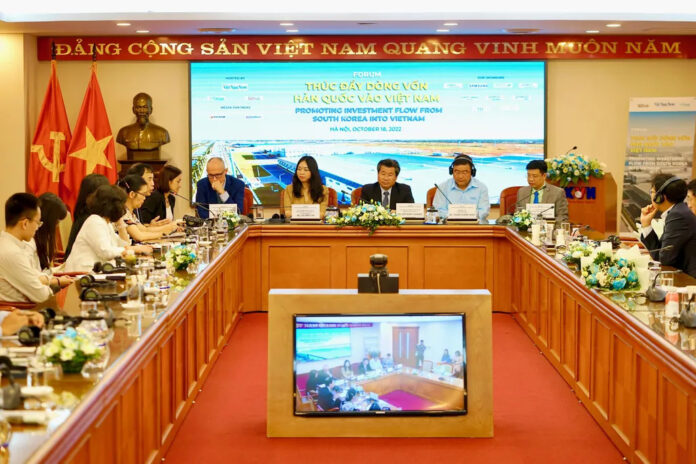
Delegates at the event on Tuesday morning. VNS Photo Phạm Thanh Hải
In his speech at the forum on “Promoting investment flows from South Korea to Vietnam” hosted by the Vietnam News Agency’s Việt Nam News on October 18, marking 30 years since the establishment of diplomatic relations between the two countries, Hoang praised the effective contributions of South Korean enterprises to the socio-economic development of Vietnam.
In particular, the country has seen a shift in capital flows from South Korean investors in basic manufacturing processes to high-tech industries, energy, banking, financial and high-quality services, and M&A over the past year.
Hoang said he believes that South Korea will maintain its position as Việt Nam’s leading source of foreign investment. “In the next one to two years, the two countries can fully realise the “Dual Goals”, which aim at the milestone of US$100 billion each in bilateral trade turnover and total accumulated investment,” said Hoang.
General director of Vietnam News Agency Vu Viet Trang said Vietnam is not only South Korea’s biggest trade partner in ASEAN but also in its New Southern Policy.
Currently, many South Korean enterprises are making effective investments in the country.
The latest data from the Ministry of Planning and Investment (MPI) shows that the accumulated registered FDI capital from South Korea from 1988 to September 2022 reached more than US$80.5 billion with more than 9,400 operating projects.
In the first nine months of 2022, South Korea ranked second among 97 countries and territories investing in Vietnam with 290 projects, worth over $3.8 billion.
Bae Yong Geun, vice president of the Korean Chamber of Business in Việt Nam (KOCHAM), said that Vietnam, the “epicentre” of the South Korean wave in Southeast Asia, is an important destination, and the countries have experienced the strongest cooperation in the world.
“South Korea is still Vietnam’s largest investor,” said Bae, adding that more than 9,000 South Korean companies are participating in various sectors, such as manufacturing, energy, culture, education and tourism.
At the event, Yoon Chang Woo, General Director of POSCO Vietnam, an enterprise with more than 30 years of investment in Vietnam, said that thanks to the support from the Government, the company was able to overcome difficulties during the COVID-19 pandemic.
Yoon suggested that southern provinces need to develop human resources and essential infrastructure. If more South Korean enterprises wish to invest in these provinces, barriers in human resources and infrastructures might make them hesitate.
Vu Kim Chi, Deputy Head of Quang Ninh’s Investment Promotion Agency, welcomed South Korean partners to comment, suggest, and promote technology transfer to achieve efficient, sustainable production and business.
“Quang Ninh Province always prioritises attracting investment, and creating the most favourable conditions for South Korean investors,” Chi said, stating eight competitive advantages of Quang Ninh Province.
The province has a geo-strategic location in terms of economy and politics; abundant natural resources; the current socio-economic infrastructure connection system; labour and human resources; the largest area of industrial parks and economic zones in the country; abundant energy resources; business investment environment and administrative reform; and a safe, friendly, attractive destination.
For his part, Koen Soenens, General Sales and Marketing Director of DEEP C Industrial Zones, said DEEP C will continue to expand new industrial parks to welcome more large investors, and these new industrial parks will ensure sustainability standards like the current five parks.
Entering Vietnam in 1997, DEEP C has been operating in the field of industrial park complex development. Striving for a greener standard to be different and providing a sustainable and reliable investment location for customers is the goal of DEEP C.
(Scan the QR code with your mobile device to get more information about the event).
SINGAPORE – Media OutReach – 19 October 2022 – Rhenus is moving towards carbon-neutral on its global full-container-load (FCL) services following its earlier commitment towards less-than-container-load (LCL) products, taking further steps in its sustainability roadmap.
As a leading global logistics service provider, the Rhenus Group will neutralise the carbon emissions of all global FCL products by 2045. Taking on a customer-driven approach, Rhenus is actively searching for sustainable transportation options, from carriers to customers. The company is also working on a tool to promote overall carbon footprint visibility for its Air & Ocean shipments globally, exploring biofuel alternatives to achieve fewer emissions and seeking more partnership opportunities as part of its plans in the pipeline.
This follows the company’s earlier announcement at the end of 2021 to commit to carbon neutrality for all its LCL products by 2030. The initiative achieved positive results soon after, as Rhenus reached its first milestone in its LCL carbon-neutral journey with the pilot project launch of all shipments from its Central European Gateway, Germany, to be carbon-neutral starting this year. To follow suit, a carbon-neutral certificate has also been issued by ClimatePartner for all the export shipments completed in the first quarter of 2022.
“Rhenus is striving to spearhead the transition of the logistics sector into a more sustainable industry. The team is constantly looking into ways to contribute and set an example in developing greener and more sustainable transportation modes for ocean freight shipments. That is why we have started to focus on delivering green solutions to the intra-Asia market, one of the fastest growing trade lanes in the world, before we further scale these initiatives to other trades,” said Alberto Martinez, COO of Ocean Freight Asia Pacific at Rhenus Air & Ocean. The new FCL initiative will complete the overall Rhenus Ocean Freight products strategy towards carbon neutrality and provide a more sustainable shipment mode for Rhenus customers starting from the intra-Asia trade lane.
The Rhenus Group is one of the leading logistics specialists with global business operations and annual turnover amounting to EUR 7.0 billion. 37,500 employees work at 970 business sites and develop innovative solutions along the complete supply chain. Whether providing transport, warehousing, customs clearance or value-added services, the family-owned business pools its operations in various business units where the needs of customers are the major focus at all times.
NetApp Partner Sphere embraces the diversity of NetApp’s partner ecosystem to facilitate co-innovation and drive transformational business outcomes for joint customers
SINGAPORE – Media OutReach – 19 October 2022 – NetApp® (NASDAQ: NTAP), a global, cloud-led, data-centric software company, today announced its intent to launch a new partner program in NetApp fiscal year 2024 (FY’24). NetApp Partner Sphere is the evolution of NetApp’s industry-leading Unified Partner Program.
Partners that can drive digital and cloud transformation are primed to capture market share, but this requires modern business models with highly specialized services, and capabilities that support the entire customer journey. The new cloud-focused and services-led NetApp Partner Sphere delivers a flexible path to advancement and growth for all partner sales motions. By consolidating and simplifying multiple programs into one that includes all partner types, business models and routes to market, this program enables partners to evolve their business in the cloud.
The program offers robust training and support to help partners capture cloud market share, brings new validation, recognition and rewards for partners’ investments in competencies and services, and the accelerated growth structure allows partners to contribute transformational value to joint customers.
“NetApp is committed to driving a partner-first culture, and the strategy behind our new partner program brings that commitment to life,” said Jenni Flinders, Senior Vice President, Worldwide Partner Organization at NetApp. “With NetApp Partner Sphere, we’re accelerating growth and customer success across our partner ecosystem by extending their reach into the cloud and offering more business opportunities with our industry-leading portfolio and flexible consumption models.”
“We are in a data-driven, digital world where enterprises face constant challenges harnessing the cloud,” said Sanjay Rohatgi, Senior Vice President and General Manager, NetApp Asia Pacific. “A strong and energized partner ecosystem well-versed in the cloud will play a key role in leading them down a path of true business impact. By appropriately incentivizing and upskilling our partners, NetApp Partner Sphere will fuel our collective innovation in the cloud and customers’ transformation journeys.
In addition, the program offers simplified, flexible, progressive tiering with clear criteria that partners can follow across objective thresholds. The program’s tiers range from Approved, to Preferred, to Prestige, to Prestige Plus – assessing, validating and recognizing partners based on value and competencies, in order to identify the right partners for the right customer opportunities. Benefits and support will grow as partners ascend tiers, with the partners generating the most impact seeing the broadest and most customized benefits, including solution specific marketing campaigns and enablement, proposal-based market development funds, and preferred value-based incentives.
As part of these strategic changes NetApp will shift away from Specializations to identify partner capabilities and utilize Solution Competencies aligned to key NetApp focus areas – Cloud Solutions, Hybrid Cloud and AI & Analytics. These competencies will be included in the NetApp Partner Sphere program requirements. Partners will be able to begin earning associated competencies within each category, showcasing their ability to deliver customer success across the NetApp portfolio by the end of the calendar year.
With NetApp Partner Sphere, partners can expect:
A simple framework supporting each partner’s unique go-to-market strategy, providing flexibility and automation to ease partner processes, and consistency for all partners and sales motions from a single program with clear tiers and objectives.
Transformativetraining, tools and support to activate their work in the hybrid multi-cloud market, enabling and building partner services and solutions competencies.
Differentiation with partners distinguished, highlighted and endorsed by their Solution Competencies and services on NetApp Partner Connect to promote each partner’s go-to-market approach.
Accelerated cloud growth leveraging NetApp’s in-demand portfolio to fuel opportunities for value-add partner-led services and co-innovation, improving profitability and maximizing partner ROI with progressive tiers.
“As a long-time NetApp partner, we’ve always valued NetApp’s partner-first approach to its business, and the maturation of its partner program to enable and contribute to GDT’s growth and profitability,” said John Woodall, Vice President, Solutions Architecture at General Datatech. “With NetApp’s new Partner Sphere program and its industry-leading cloud portfolio, we’re excited to be able to deliver immense value to our joint customers with the most effective, flexible and innovative solutions across any environment – while differentiating our business to accelerate growth and successfully monetize our best-of-breed services capabilities.”
“Cloud Bridge is a cloud-native, services-led business – so we fully support the strategy and direction for NetApp’s new partner program,” said Simon Walker, Managing Director at Cloud Bridge. “With NetApp bringing all of its partners into one consolidated program and integrating Spot partners, we can take advantage of NetApp’s full portfolio to offer a full suite of innovative solutions and services to our customers.”
Implementation of the NetApp Partner Sphere program will begin in NetApp FY’24.
Learn more about NetApp Partner Sphere at NetApp INSIGHT, November 1-3, 2022. Register here.
NetApp is a global, cloud-led, data-centric software company that empowers organizations to lead with data in the age of accelerated digital transformation. The company provides systems, software and cloud services that enable them to run their applications optimally from data center to cloud, whether they are developing in the cloud, moving to the cloud, or creating their own cloudlike experiences on premises. With solutions that perform across diverse environments, NetApp helps organizations build their own data fabric and securely deliver the right data, services, and applications to the right people—anytime, anywhere. Learn more at www.netapp.com or follow us on Twitter, LinkedIn, Facebook, and Instagram.
NETAPP, the NETAPP logo, and the marks listed at www.netapp.com/TM are trademarks of NetApp, Inc. Other company and product names may be trademarks of their respective owners.
BANGKOK, THAILAND – Media OutReach – 19 October 2022– Ms. Mook who training and Operations Manager of IFROGX’s official association, gave a speech on excellent live streamer training at a TikTok Live anchor training session in Bangkok, Thailand. Currently, TikTok Live is an entirely new market in Thailand. This speech is being conducted simultaneously on multiple channels around the world. During the speech, Ms. Mook points to several suggestions for success in the TIKTOK broadcasting industry.
Number One. Be good at expressing yourself on the air. It takes character to attract fans. Live broadcast is the art of communication, full communication to enhance the impression of the audience. Live style can be diversified. IFROGX, as the official association of Internet celebrities, has a unique vision of finding new talent, where those with excellent expression of the anchor is undoubtedly a greater potential.
The second key point is to increase the interaction with the fans, which will increase their sense of participation. Some of the common interactive tricks that fresh can try. Such small details are often the best way to endear themselves to fans and make them feel respected. IFROGX will help to know that the content requirements of the fans can provide the streamers with new topics and creative direction. Positive interaction can increase the atmosphere of the live broadcast room, and even attract more attention.
The third is to understand the platform requirements and specifications. Many new streamers will not understand the platform requirements, thus they may accidentally reach the platform’s popularity threshold and eventually be restricted. Long term can only be achieved by doing proper study and making the rules clear. In order for internet streamers to properly understand the platform rules, IFROGX and other official guilds will remind them about standards.
In short, there are three points mentioned by Ms. Mook – IFROGX which would help to become a brilliant TikTok Live Streamer, which is 1) be good at expression, 2) enhance your interaction skills, 3) understand the norms and strive to produce more excellent work.
Headquartered in Singapore, IFROGX is a global distribution of cultural media group and the first official Tiktok Association in Thailand. It is responsible for the discovery and cultivation of TikTok streamers in Thailand and has produced a large number of excellent streamers.
Hashtag: #IFROGX
The issuer is solely responsible for the content of this announcement.
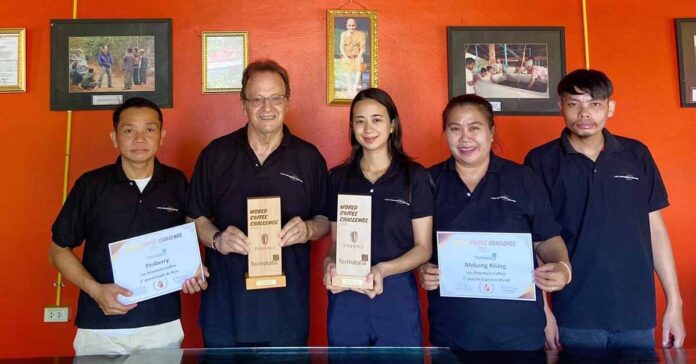
Mr. Steve Feldschneider, the founder of Lao Mountain Coffee, with his team.
The Laotian Times was in conversation with Mr. Steve Feldschneider, the founder of Lao Mountain Coffee, who recently won an award at the World Coffee Challenge in Spain.
SINGAPORE – Media OutReach – 19 October 2022 – Food tech startup, Natural Trace, names Singaporean venture builder CL Goh as their CEO. Goh, an early investor through Blue InCube Ventures in the company, will continue to work with co-founders, Dr Chantal Roth and Prof. Lukas Muller, as they focus on research and development. The company is also looking to build and expand their Singapore team.
“I look forward to leading and supporting the Natural Trace team in its mission to solve traditional food traceability and provenance issues with in-product tagging technology,” said CL Goh, CEO and Co-Founder of Natural Trace.
Natural Trace’s technology proven to be robust through rigorous testing
Just four months after the company’s launch in June 2022, Natural Trace has successfully verified the robustness of its first product, NaturalTag. This patented food-grade microbial identifier can be added to any food product for supply chain traceability. Two species of the NaturalTag have been proven to be capable of withstanding the high-pressure, high temperatures of up to 220°C, and highly aggressive process of coffee bean roasting. The product can now offer producers, roasters, and sellers around the world a tamper-proof traceability solution along the entire coffee value chain.
“This positive result with coffee beans adds to NaturalTag’s growing repertoire of successful proofs of concept. We are in discussions with a winery in New Zealand and a honey farm in Canada to incorporate NaturalTag into their products,” added Goh. “Our tests with vanilla extract and palm oil have also shown great success and we are excited to work with more growers and companies in implementing this solution for other food products.”
Natural Trace to participate in Agri-Food Tech Expo Asia 2022
Goh will be speaking as a panellist on the future of food safety and supply chain traceability at the Agri-Food Tech Expo Asia 2022, held from 26-28 October in Singapore. The panel will explore the different elements of the digital ecosystems that drive its food safety outcomes. Natural Trace will be presenting NaturalTag and its solution ecosystem that aims to tackle food safety, provenance, and traceability as an exhibitor at the Expo.
Hashtag: #NaturalTrace #FoodSafety
About Natural Trace
Natural Trace was founded by Dr Chantal Roth and Prof Lukas Muller in 2022 through a convergence of food science, bioinformatics and DNA sequencing expertise. Backed by experienced veterans in the food industry, the company developed NaturalTag, the world’s first food-safe in-product tag solution, to assure traceability and transparency at every step of the supply chain. NaturalTag works with a cloud-based database for consumers to quickly access information on the ingredients’ origins.
Both Easy Access and Variable products see rate increases for minimum GBP25,000 deposit
GUERNSEY, UK – Media OutReach – 19 October 2022 – Skipton International, the award-winning Guernsey-licensed bank with customers in over 100 countries worldwide, has announced an interest rate increase for its Personal Access and Variable product offshore savings accounts. A minimum opening balance of GBP25,000 is required for new customers. Skipton International (Skipton) Personal Access accounts allow funds to be withdrawn without notice, whereas Variable means interest rates may change. The current Fixed Notice accounts remain, with the highest paying a competitive rate of 4.00% annual equivalent rate (maturing in 31 October 2024).
Available immediately, the new rates are:
SKIPTON INTERNATIONAL ACCOUNTS
INTEREST RATE %
WITHDRAWAL NOTICE
Fixed Rate Bond, Maturing 31 October 2024
4.00%
Not Applicable
Fixed Rate Bond, Maturing 15 March 2024
3.50%
Not Applicable
Fixed Rate Bond, Maturing 15 September 2023 – Issue 2
Commenting on the increased rates, Aaron Walden, Senior Commercial Manager at Skipton International, said:
“These increased savings interest rates give new and existing Skipton customers a competitive return on their savings during market and currency rate volatility. A sterling offshore account enables customers to diversify their investment portfolios, leverage opportunities in the UK market, and access opportunities not available through their domestic bank accounts.”
Offshore banking has become increasingly popular over the years because it offers protection from currency exchange volatility, economic uncertainty, and taxation.
“There are many practical reasons for opening an offshore bank account. For example, UK universities attract international students and tuition, accommodation and any living expenses incurred have to be made in pounds sterling. An offshore bank account means that payments can be made in sterling rather than having to convert funds and risk exchange rate fluctuations and fees,” added Walden.
For over 20 years, Skipton International has served both British expatriates and non-UK citizens worldwide. Apart from offering offshore savings accounts, Skipton is a market leader in buy-to-let mortgages, giving investors the opportunity to own and rent out a UK property, gaining an additional revenue stream. In this case, an offshore bank account can fund the repayments, legal, management and other fees.
According to Skipton’s 2021 Buy-To-Let mortgage charts, London’s Canary Wharf, Poplar and Limehouse region were the most popular for rental, followed by SW11 (Wandsworth) and W3 (Acton). Please see here for popular postcodes in London for rental properties.
Skipton International is licensed under the Banking Supervision (Bailiwick of Guernsey) Law, 1994, as amended, and a participant in the Guernsey Banking Deposit Compensation Scheme offering protection for ‘qualifying deposits’ up to GBP50,000, subject to certain limitations.
More Information and Account Opening
For more information about opening a Skipton International offshore bank account or buy-to-let mortgages, please visit www.skiptoninternational.com
Hashtag: #SkiptonInternational
The issuer is solely responsible for the content of this announcement.
About Skipton International
Headquartered in Guernsey, Skipton International is a bank wholly owned by Skipton Building Society, the fourth largest building society in the UK. We are a leading offshore bank and winner of multiple awards, including the Moneyfacts best mortgage provider and named as Guernsey Business Of The Year at the Guernsey Awards for Achievement.
Our aim is to help customers achieve their property owning and savings goals, by offering quality products and excellent customer service.




 www.netapp.com or follow us on
  Twitter,
  LinkedIn,
  Facebook, and
  Instagram.

 https://natural-trace.com.


