Home Blog Page 6340

Australia Supports School Expansion in Xaythany

Somsamay Secondary School in Xaythany district, Vientiane, now has new classrooms for an additional 100 students so they can enjoy a better learning environment.

The handover of the new school building and furniture took place in the community on November 4 in the presence of Australian Ambassador to Laos John Williams, local authorities and other guests.

The 330 million kip (US$40,903) project was funded by the Australian Embassy’s small grants programme (DAP – Direct Aid Programme) and WIG’s long-running programme to build and repair schools across Laos. The school community, including parents and other villagers, helped to build the new facilities.

Speaking at the handover ceremony, Ambassador Williams said the project was in keeping with Australia’s aid priority in Laos, to improve education outcomes for all Lao children.

“We want all Lao children to get the education they need to achieve their full potential,” Mr Williams said. “In our view, there is no more important issue in Laos’ socio-economic development. It’s not just about the quality of teaching they receive. The environment in which children are learning  matters too.”

The construction of a new school building was needed to keep pace with the growing population in neighbouring villages. More than 100 new students have enrolled at Somsamay Secondary School this year thanks to the additional space and new facilities.

Ambassador Williams praised WIG’s ongoing support for poor communities across Laos, and noted the long history of collaboration between the Australian Embassy and WIG in fundraising and aid delivery.

Australia’s DAP is a flexible scheme to fund quality small-scale projects that will deliver “practical and tangible” benefits for poor communities in Laos.

In 2015, Australia funded 19 projects in eight provinces from the 200 DAP proposals received. The projects ranged from sustainable water supply for remote villages in Oudomxay, national awareness campaigns to promote road safety and combat violence against women, and support for hygiene education and mobile libraries in northern Laos.

Last year, Australia’s small grants scheme helped refurbish school buildings and dormitories in Luang Namtha, Xieng Khuang, Vientiane and Luang Prabang, and upgraded health facilities and equipment in Savannakhet and Vientiane provinces.

The DAP also supported a $A20,000 renovation of facilities at the Vientiane Autism Centre to help provide better quality services, education, therapy and specialists to a greater number of children who live with autism in Laos.

The Vientiane Youth Centre for Health and Development, Foundation for Assisting Poor People in the Lao PDR and the Health Centre in Thapene village in Luang Prabang all received DAP funding to purchase new medical equipment.


Source: Vientiane Times

Gov’t Promotes Small-scale Rice, Fish Production

The Department of Livestock and Fisheries last week held a meeting to discuss the results of an experimental initiative to increase the yield of aquatic animals and plants in rice farms as a means to address food and nutrition security.

The policy consultation meeting took place in Vientiane and was attended by Director General of the Department of Livestock and Fisheries, Mr Somphanh Chanphengxay, and the Representative of the Food and Agriculture Organisation of the United Nations (FAO) to Laos, Dr Stephen Rudgard.

The trials are part of a larger collaborative project between FAO and the government called the Regional Rice Initiative.

The trials were conducted in Xieng Khuang and Savannakhet provinces. They included over 20 family farms in each province with the goal of refining simple aquaculture techniques to address the issue of food and nutrition security.

The recommendations tested and developed in the trials improved the way farmers manage aquatic animals and plants in rice fields. Aquatic animals and plants play a crucial role in supplementing many rural people’s diets. The development of advanced aquaculture techniques means farmers can increase their yield of safe and nutritious food for their families.

A workshop was held prior to the official meeting in which government officers and farmers summarised the results of the trial. They discussed the results for two days before presenting them at the policy consultation meeting.

The presentations included technical data (e.g. fish growth), in addition to the benefits experienced at both the individual family level and within the wider community. The possibilities of implementing the project on a wider level were also discussed.

The information presented by the participating farmers and the subsequent discussion with policy makers highlighted the importance of aquatic animals and plants in rice fields for the food and nutrition security of many rural families.

Surveys of daily consumption undertaken by farmers during both the dry and wet seasons demonstrated that the value of aquatic animals and weed (e.g. fish, frogs, snails and aquatic plants) exceeds the value of the actual rice crop.

However, the increasing use of pesticides and herbicides is causing a decline in the number of these animals and plants. Farmers are keen to explore ways in which this decline can be reversed.

Higher nutritional yields are especially important for young children, and policy makers discussed how the new techniques could be more widely disseminated and integrated into government strategies to improve nutrition security and achieve poverty reduction.

Senior representatives from key departments in the Ministry of Agriculture and Forestry, who attended the Policy Consultation Meeting, agreed that small-scale aquaculture farming has an important role to play in improving nutrition security.

Low-cost and simple techniques in farming fish and frogs in rice fields, like the ones tested in Savannakhet and Xieng Khuang, must now be more widely promoted.


Source: Vientiane Times

Trailer Carrying Excavator Causes Champassak Bridge Collapse

The Sahalao Service Company, owners of a low loader trailer that was carrying an excavator, has agreed to fund repairs to the old metal Huaychampy Bridge which collapsed in Champassak province on Sunday.

The bridge collapsed into the Champy stream when the trailer attempted to cross the bridge whilst carrying a load in excess of the weight limit.

Governor of Pakxong district Mr Vicith Keobuapha told Vientiane Times on Monday after viewing the damage that the bridge had a weight limit of about 20 tonnes but the trailer together with the excavator weighed nearly 40 tonnes.

Fortunately, no one was killed or injured when the bridge collapsed.

If it is found that the bridge cannot be repaired, the company will have to rebuild it, Mr Vicith said.

After the bridge collapsed, the trailer remained upright but an excavator that it had been carrying fell into the water.

The bridge, which crosses the stream at Km 36 and links Pakxe district with Pakxong district, is now impassable to traffic so drivers must take a detour via Saravan province to get to Pakxong.

The company has accepted responsibility for the accident and is building a temporary dirt road next to the bridge so that pick-up trucks can cross the stream. Coffee growers in particular use this crossing as it is now harvest time and their pick-ups are delivering the beans to processing factories.

Mr Vicith said the cost of the repairs could not yet be estimated because the damage had not been fully assessed.

According to the Ministry of Public Works and Transport, heavy vehicles are the main cause of damage to roads and bridges, which are deteriorating on a daily basis. Increasingly, trucks carrying timber, cement, rocks, excavators and other heavy loads are plying the country’s somewhat fragile roads.

In 2014, the Huayphabang Bridge in Champassak province collapsed when a truck carrying a heavy load of timber tried to cross it. The truck belonged to the Khamseng Commerce Company, which repaired the bridge at a cost of about one billion kip (US$125,000).


Source: Vientiane Times

Police Issue Security Warning to Festival Goers

Vientiane Public Security Headquarters is warning That Luang festival goers to take precautions regarding their safety and security and to be on the lookout for pickpockets and bag snatchers.

This year’s festival runs from November 8-14 and Vientiane police are cautioning the public to take good care of their possessions to deter thieves. A senior official at the Vientiane Public Security Headquarters, Major Khamko Pathabchai, told Vientiane Times on Monday that during this year’s event they will station 2,487 police, soldiers and students around the festival and Lao-ITECC areas to ward off criminals and prevent antisocial behaviour.

Police said most of the petty criminals picked up in previous years were pickpockets and bag snatchers who worked in teams and appeared to be well prepared. However, police are planning to have a strong presence at this year’s festival and will be deployed at 20 stations around the capital.

The Vientiane Traffic Police Department under the Ministry of Public Security will today outline additional security measures for the That Luang Festival as well as parking options.

According to a report from police headquarters, 21 crimes were reported during last year’s festival from November 19-25. Thirteen cases of pickpocketing were recorded, along with five cases of bag snatching, and one case each of disturbing the peace, obscenity, and general theft.

The thefts involved losses of more than 15 million kip and additional items, and police arrested two suspects.

Every November, the colourful That Luang festival is staged to celebrate the stupa, which is the most revered in Laos. This year’s festivities are extra special as they mark the stupa’s 450th anniversary. People engage in many traditional activities and ritual ceremonies to pay homage to the stupa.

These include a wax castle’ procession, almsgiving, a game of traditional Lao hockey, and candlelit processions, to honour both the stupa and King Xaysetthathirath.

Celebrations last for at least three days and the culmination always falls on the 15th full moon day of the 11th lunar month, which this year is November 14. The wax castle procession is the most colourful activity and always attracts large crowds.


Source: Vientiane Times

NA Members Want New Law to Ban Import of Discarded Electronic Goods

Service fees and product standards offered by telecommunications companies as well as the import of discarded electronic products were among the concerns raised by National Assembly (NA) members during a debate on the newly drafted Law on Information and Communication Technology.

The draft law was made available for NA consideration yesterday, with NA Vice President Dr Bounpone Bouttanavong presiding over the debate.

The available 3G and 4G internet signals have been a source of public complaint, with consumers saying that the quality of these services does not match what is advertised.

But many Assembly members found the explanation given by telecoms officials reasonable as they said that numerous customers are sharing a small bandwidth because providers cannot invest in the installation of larger bandwidth in this small market of about 5 million users.

Speaking at the debate, NA member for Savannakhet province Mr Sanya Praseuth referred to the explanation given by the Ministry of Posts and Telecommunications but said users were being taken advantage of as the services were not appropriate with the amount of money invested in obtaining 3G and 4G coverage.

He called on the drafting sub-committee to review the matter and make more comprehensive laws and standards governing the provision of 3G and 4G services.

NA member for Vientiane, Ms Valy Vetsaphong, said she agreed with the NA member for Savannakhet regarding service fees charged and standards upheld.

She pointed to the first point of Article 41 in the draft, which says service providers have an obligation to ensure full provision of the services, ensuring good quality and fast and fair services.

She questioned whether customers could check whether the speed of the internet package they used matched what they had ordered, asking for the matter to be stipulated by law.

“How can we check if the [megabytes] we have received from the provider equals what we paid for?” Ms Valy asked.

The use of old electronic equipment was another focus of the debate on the draft law, which mentions this matter in its eighth part, saying service providers may not import discarded electronic products or substandard ICT equipment.

Ms Valy and many others spoke out against the importation of items discarded by other countries, pointing to factories in Vientiane that recycle mobile phones and battery appliances, which they said caused environmental damage .

NA member for Xieng Khuang province, Mr Vilaysouk Phimmasone, said he wanted the importation of discarded electronic goods and substandard ICT equipment to be absolutely prohibited by this law.

But some NA members suggested that a prohibition on the importation of electronic waste should be reviewed and suggested it might be stipulated in another law.

They said such items do not comprise only ICT equipment but also household appliances.

The draft law was introduced to the session by the Minister of Posts and Telecommunications, Dr Thansamay Kommasith.

NA member for Vientiane, Ms Valy, who is also from the Lao National Chamber of Commerce and Industry, lodged her concerns on behalf of the Chamber and the ICT Business Operators Association.

Ms Valy said stakeholders in the sector who will be affected by any changes were not able to participate effectively in the drafting of the law.


Source: Vientiane Times

Vientiane Authorities Seize Illegally Imported Vehicles

Vientiane customs officials have impounded vehicles that were illegally imported from a third country into Laos, the tax inspection unit reported recently.

In September, local officials found 15 illegally imported vehicles which are now in the possession of the capital’s tax inspection unit waiting for their owners to come forward.

The vehicles include a Toyota Vigo, Fortuner and Landcruiser; Mitsubishi Triton, Audi Mark II, Lexus XL 570 and a Suzuki Smash motorcycle.

An officer from the Vientiane customs inspection unit, who asked not to be named, told Vientiane Times yesterday that most of the vehicles were luxury vehicles that had been ordered by individuals, not an import company.

He said some had been imported from third countries for use in Laos, by various means. They had falsified documents to avoid customs payments, which is illegal, so customs officials impounded them.

He explained that some had fake importation documents which claimed the vehicles would be used in various projects around the country, which proved not to be the case.

Officials also told Vientiane Times that so far no one had come forward to claim the vehicles.

However, officials are making repeated calls through the media for the vehicles’ owners to make themselves known. If no one comes forward within four months the vehicles will become the property of the state.

According to the customs inspection team, to prevent illegal imports they are targeting their investigations around border areas and are continuing to deal with their remaining cases to alleviate the problem.

Authorities have called on the public to comply with the Customs Department’s regulations regarding vehicle imports. Interested car buyers should connect with local companies if they want to import a vehicle.


Source: Vientiane Times

Fish Experts to Confer on Enhanced Regional Fisheries Productivity

Lao and international fish experts are set to discuss ways to promote greater fisheries productivity in the region to push for food security, at an upcoming conference scheduled to take place in Vientiane.

The International Fishway Conference scheduled to take place from November 14-17 will bring together more than 150 experts to discuss innovative approaches to securing regional fisheries productivity as irrigation and other river development projects expand.

Hosted by the Ministry of Agriculture and Forestry, the Lower Mekong Fish Passage Conference will discuss how applied research can be used to enhance policy and decision-making across the region, according to the Living Aquatic Resources Research Centre (LARRC).

Drawn from the public and private sectors as well as academic institutions, the experts in river development, fish passage and aquatic ecosystem management are mainly from Australia, United States, Europe, South America and the neighbouring countries of Cambodia, Myanmar, Thailand, Vietnam, and Indonesia.

Director General of the National Agriculture and Forestry Research Institute (NAFRI), Dr Bounthong Bouahom, was quoted as saying that the region is currently experiencing an unprecedented boom in river development projects which will increase agricultural and power generation output for years to come, so there is a need to ensure these projects do not affect food security.

“It is important that our development activities do not impact our most important food source – fish,” Dr Bounthong said. “Mekong fish species are highly migratory, requiring access to different habitats at many life stages.

“As governments, we need to produce power and supply water to our communities. But at the same time, we must ensure effective fish passage to maintain the fisheries resource for generations to come.”

The four-day conference is being hosted by the LARRC, NAFRI and the Ministry of Agriculture and Forestry, with the support of the Australian Centre for International Agricultural Research (ACIAR) and the United States Agency for International Development (USAID). ACIAR has long been involved in Lao fishway research. In April, the Australian government agency launched a five-year project to quantify biophysical and community impacts of improved fish passage. This is among the largest ACIAR fisheries projects since it began supporting research in the sector in 1997.

During the conference, USAID is sponsoring a dialogue seminar aimed at agreeing on an approach to develop national guidelines for monitoring fish passage at mainstream dams along the Mekong River. The discussion is expected to involve fisheries and other international experts as well as representatives of the Lao energy, fisheries and natural resource management sectors.

The conference aims to bring together government agencies, developers, researchers, local provincial and district leaders and natural resource managers to help share knowledge on the successes and opportunities regarding fisheries sustainability in the region.

LARRC and NAFRI are organising the conference with Australia’s Charles Sturt University and the United States Department of the Interior. Other partners are the New South Wales Department of Primary Industries i n Australia, the National University of Laos, and the Pacific Northwest National Laboratory in the United States.


Source: Vientiane Times

New Border Crossings between Laos, Cambodia to Boost Trade and Investment

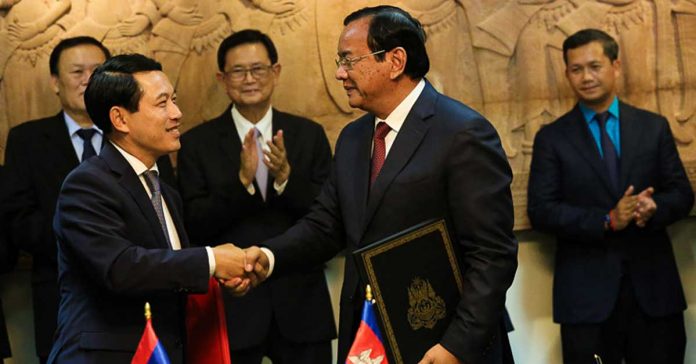
Laos and Cambodia have agreed to open new border crossings to link the two nations more closely and enhance trade and investment cooperation.

The plans were agreed to during Prime Minister Thongloun Sisoulith’s meeting with his Cambodian counterpart Hun Sen in Phnom Penh in June.

Delegates from the two countries visited the field sites from November 2 to 4 to see where the planned new bridge and border crossings will link Laos and Cambodia.

The Lao side was led by Foreign Affairs Minister, Mr Saleumxay Kommasith, while the Cambodian side was led by Deputy Minister of Foreign Affairs and International Cooperation, Mr Long Visalo.

The two countries plan to build a 145-metre bridge across the Xe Lam Phao River in Mounlapamok district, Champassak province, to connect to northern Cambodia.

A 78-kilometre road linking Mounlapamok district to the Xe Lam Phao bridge is also planned, according to the agreement between the two countries’ prime ministers.

The joint action delegates of the two countries also visited a new border checkpoint in the area of Veunyang village, Mounlapamok district and the Veunkham border in Khong district, Champassak province. The committees also continued their survey to Xe Pien border (border-48) in Hadyai village, Sanamxay district, Attapeu province.

After completing the joint survey, the delegates shared their ideas before the details were handed over to the leaders of both countries to make a decision.

Both parties believe the new border crossings and bridge will boost tourism and economic development as well as make people-to-people exchanges easier, especially among those living in nearby areas.

Both nations are planning to open a border crossing linking the Nong Nok Khiene area in Khong district, Champassak province, and the Trapeang Kriel area in Cambodia’s Stung Treng province, which is scheduled to officially open this month.

Laos and Cambodia also agreed to promote investment and trade cooperation between their neighbouring provinces after the value of bilateral trade reached US$24.5 million last year.

In the field of education, it was agreed to increase the number of government-to-government bachelor degree exchange scholarships to 15 annually.

In addition, the two countries will continue to cooperate in border security and prevent the illegal trade in timber and drugs in border areas. They also agreed to speed up border demarcation.


Source: Vientiane Times