Japan has been back in the news this week with furious winds and thundering shakes claiming a tragic toll in lives and property.
At the same time, a power of a different and more positive kind has been felt in the nation’s south.
Lao Paralympic weightlifters have been in Japan’s Oita prefecture on the southern island of Kyushu to compete at the Kitakyushu 2018 World Para-Powerlifting Asia Oceania Open Championship, which will be held from September 8th.
While the conventional narrative about Luang Prabang is one of adoration and admiration, especially for the old town’s storied tranquility and architectural charms, the sleepy UNESCO World Heritage Listed city has as yet not been duly celebrated as a destination for international fine dining.
All that is set to change in November as the team of chefs behind the Michelin-starred Paste Bangkok open a fine dining experience at their restaurant specializing in Lao cuisine, marrying contemporary mores with the city and country’s own collated culinary wisdom.
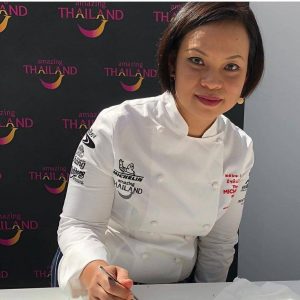
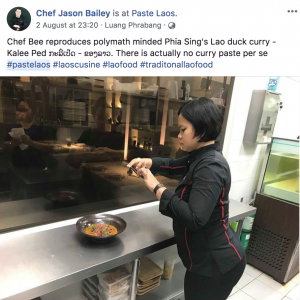
Paste Bangkok’s celebrity Chef Bee Satongun and co-owner and husband Chef Jason Bailey — whose restaurant was awarded a Michelin star in the inaugural edition of the Bangkok Michelin Guide as well as recognized as one of Asia’s 50 Best Restaurants in 2018 — have set their eyes on Laos and Luang Prabang in particular.
Bee’s personal and historical connection to the country and region is enjoyed through the prism of her Hmong roots.
“I chose Laos because of its nature and the countryside, which I adore. At Paste, we use tremendous amounts of cultivated and wild ingredients. Plants, shoots, sprouts, flowers – you name it.”
“Our dishes will be based on Lao cuisine for the most part. The Hmong side of my cuisine manifests itself in the use of cultivated and foraged wild ingredients.”
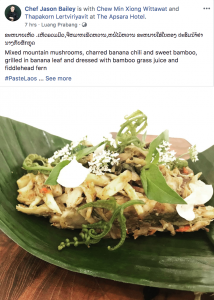
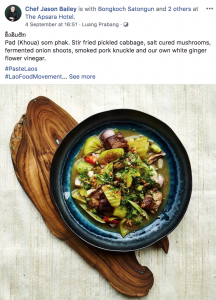
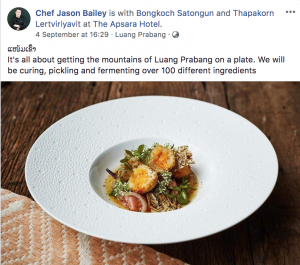
“By smoking, curing, pickling, and fermenting over 100 different types of plant species, we will be making gastronomical strides into what was once purely reserved for the realm of medicine.”
“However, the cuisine of Paste, which is predominantly plant-based, will still be using a high variety and quality of meats and proteins.”
“We will employ modern scientific techniques such as extreme precision of temperature control and other cooking processes that are in accordance with scientific and international principles of gastronomy.”
Michelin-starred Paste Bangkok’s menu is essentially heirloom creative Thai cuisine, based at its core on numerous old Thai family recipes from 1870 to 1930.
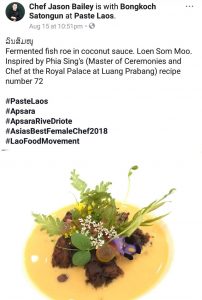
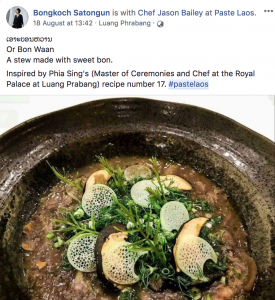
Likewise, Paste Laos will be inspired by traditional recipes from Phia Sing’s book of dishes served at the Royal Palace in Luang Prabang over many generations.
These traditional dishes will be slightly updated to bring about a fresher appeal to modern audiences.
The new restaurant will also carry several signature dishes from Paste Bangkok.
“Over time, we will include some dishes from various ethnic minorities of Laos, because our creativity and menus are never set in stone and always remain in a state of flux year on year.”
Like the boutique hotel where the restaurant will be located, Paste at The Apsara will be sure to pay the greatest possible attention to detail.
As in Bangkok, the discerning diner in Luang Prabang will be pleased to take note of the processes taken to create memorable dishes with a focus on preserving old-fashioned ways where possible.
Sauces may contain over 20 layers of flavor and over 30 ingredients.
Culinary critics and connoisseurs hungrily await further detail on the menu set to be offered at Paste at the Apsara.
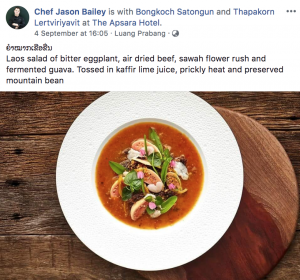
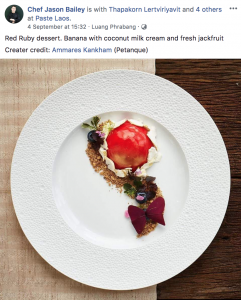
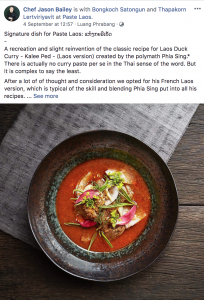
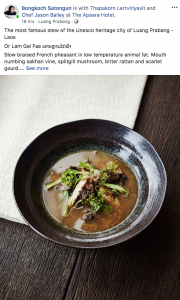
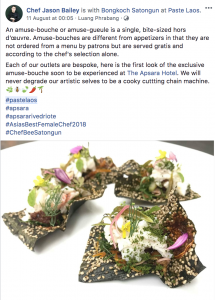
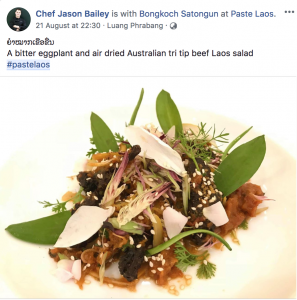
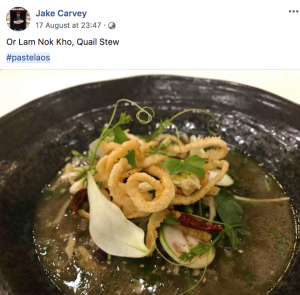
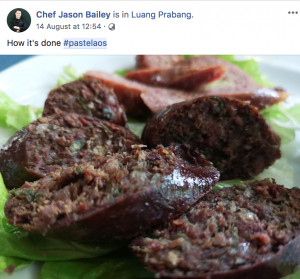
Fortunately, several stunning images have surfaced on social media with the hashtag #pastelaos that offer tantalizing teases to tempt the palate.
Meanwhile, owner of the Apsara, hotelier Ivan Scholte, has been in Luang Prabang since 2001.
Opening in 2002, the Apsara was Luang Prabang’s first foreign-owned hotel and was also the first boutique hotel of its time.
Hosting Laos’ first Michelin-caliber restaurant will no doubt add further luster to the ongoing allure of the Apsara.
The rain-swollen Mekong River and its sediments are affecting capacity to meet the daily demand for water in the Lao capital Vientiane and its surrounds, the water supply authority warns.
The State Water Supply Enterprise has called on Vientiane residents to conserve water and consider storing additional supplies for later use.
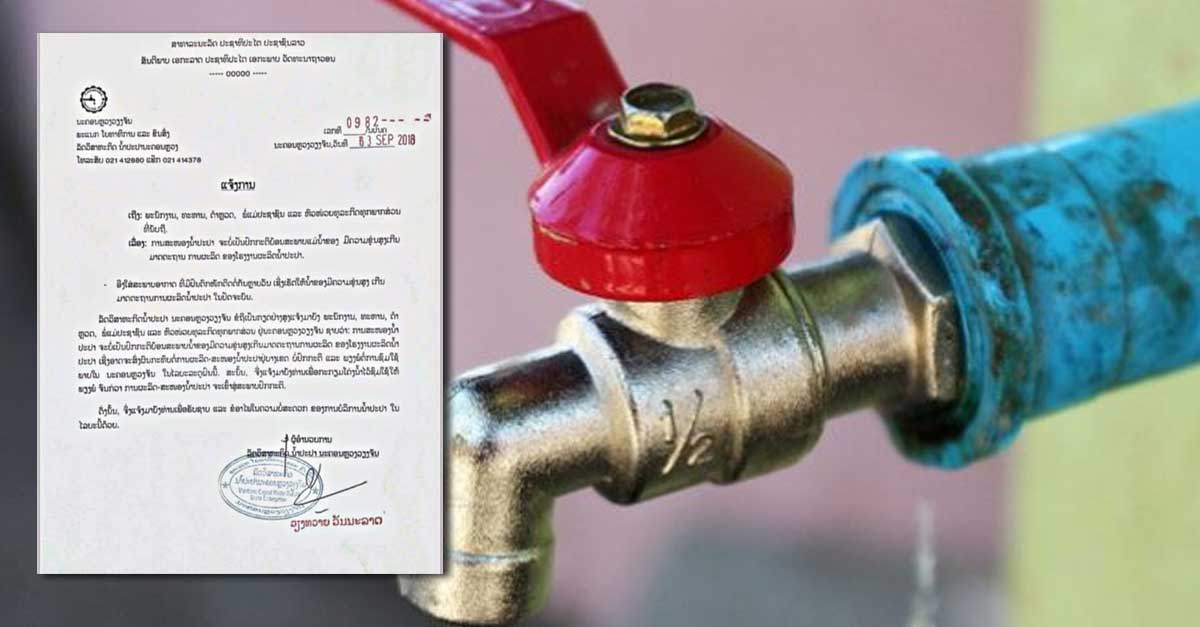
Vientiane’s water supplies are expected to be affected by the high levels of turbidity in the Mekong which exceed the production standards of water production plants, a public notice from the State Water Supply Enterprisedated Tuesday, September 6 informed.
“The Vientiane capital water supply state enterprise would like to inform employees, soldiers, police, citizens and businesspeople in Vientiane Capital that: the provision of water supply will be irregular because of high levels of turbidity, which may affect production and provision of the city’s water supply in some areas, with irregular or insufficient supply until the end of the rainy season.” the notice read.
“Therefore, citizens are urged to store water for household use until regular production can resume.”
“Therefore, this notice is to inform you and apologize for any inconvenience in the facilitation of water supply during this time.”
The warning comes as Luang Prabang continues to face challenges arising from a swollen Nam Khan River which rose to temporarily flood water supply production facilities at Phanom and at Phou Luang in Luang Prabang city last week.
“Regarding the water production facilities at Phou Pheung and Phou Xang Kham, these are still in regular service, but water supply within Luang Prabang City may face shortages in certain areas due to demand,“ a notice from the provincial Department of Public Works and Transport’s Water Supply State Enterprise (WSSE) on August 31 read.
Development of domestic capacities in the field of water supply for Laos’ Ministry and provincial departments of Public Works and Transport and WSSEs has long benefited from cooperation and expertise from Japan provided via the Japan International Cooperation Agency (JICA).
According to a JICA factsheet entitled “Safe and Sustainable Water Supply: From the water source to the tap”, the relatively turbid nature of rivers in the region provides additional challenges, and particularly as a result of extreme events.
“Many rivers in Asia are more turbid than Japanese rivers and necessitate different treatment and operation methods,” it reads.
“Reviewing the technology nurtured in Japan and developing it according to the overseas needs is an opportunity to improve the current technology.”
Improved domestic cross-border transport and logistics, coupled with widening and deepening demand for clean, green vegetables and fruit both in neighboring China and across the emerging economies of Asia presents a host of potential niche opportunities for Laos to capitalize upon, an audience in Vientiane has heard.
Laos’ geographical position, economic potential, road and rail transport development and relatively high rate of rural dwellers make the need for a more productive agricultural sector inevitable and imperative as well as desirable, the ANZ Food, Beverage and Agriculture Forum was told in the capital.
Despite updates on the risks from global economic headwinds on trade, the mood remained upbeat in Vientiane last week at the forum organised by the Lao institutional arm of the Melbourne, Australia headquartered ANZ Bank, one of Australia’s big four financial institutions.
Increased interest in the agriculture, food and beverage production sectors come at a time when Lao policy is attempting to walk a fine fiscal line, seeking increased investment into the landlocked country to make the most of opportunities afforded by improved regional transport and infrastructure links and the demand driven by consumer trends in much larger neighboring markets.
Existing strengths such as the country’s famed coffee and tea crops, and potentials such as milk production were important areas on which to focus, ANZ Agribusiness Insights head Mr Michael Whitehead told the forum.
High-quality products based on clean and green production and carefully niche targeting alongside the development of “Brand Lao / Brand Laos” were ways to thrive and prosper in a competitive global environment as consumer tastes and relative supply capacities continue to rapidly evolve across the region.
The forum saw attendance from Lao and international firms large, medium, small as were representatives of ministerial bodies, the diplomatic corps and international organizations.
Advice and experience of established firms in Laos was also aired and shared by business in the form of the Carslberg-invested Lao Brewery Company, producer of the popular Beerlao and Tigerhead Water brands as well as Lao franchisee for Pepsi Cola was joined by firms including Mekong Timber Plantations.
Hosted by Crowne Plaza Hotel Vientiane, forum attendees included Vice Minister of Industry and Commerce H.E. Phanthong Phitthoumma, Vice Minister of Finance, Mme Thipphakone Chanthavongsa, Vice President of LNCCI, Mr Daovone Phachanthavong, along with Australia’s Ambassador to the Lao PDR, Mr Jean-Bernard Carrasco.
Joining Mr Whitehead were ANZ’s Head of Food, Beverage and Agribusiness, Patrick Vizzone, and CEO ANZ Laos Rufus Pinto for the August 30 event.
Holders of diplomatic passports from the Kingdom of Norway and the Lao PDR have now been exempt from applying for entry visas to each others’ countries since the two nations signed an agreement in Singapore on the sidelines of the 51st ASEAN Foreign Ministers’ Meeting. The visa exemption has taken effect since the 1st of September.
The agreement stipulates that diplomatic passport holders from both countries that have not been posted to the territory of the other country are permitted to travel freely between the two countries for a period of no more than 90 days.
Under the agreement, a visa will not be granted to the holders of diplomatic passports, or their family members, working at embassies or consulates or international organizations located in the other country.
The Bank of Laos (BOL) has issued a notice warning the public against the use of cryptocurrencies, including Bitcoin, Ethereum, and Litecoin, which are unregulated currencies that are not tied to physical cash reserves.
The notice, dated 29 August, is addressed to traders, merchants and ordinary citizens alike, warning against the purchase and sale of cryptocurrencies. It warns of the risks of cryptocurrency, and urges Lao people to study the issue in depth prior to making any investment or purchase of such products.
According to the notice, the rate of global technological advancement is ever-increasing, including the use of Blockchain technology, which is used in electronic financial transactions and is the basis for the rise of cryptocurrency.
Some Lao businesses have already begun acceptance of payment for goods and services in cryptocurrencies, as well as advertising investment or trade in these digital monies.
The Bank of Laos states in its notice that in accordance with the Law on Payment Systems, No. 32/NA, dated 07 November 2017, cryptocurrencies are not real currencies and should not be used for payment of debt. This is because the cryptocurrencies do not meet the standards required for use as currency and are not currently regulated by any legislation in Laos.
Secondly, Lao people are urged to take precautions before making any investment or trade in cryptocurrencies because of the significant risk attached to them, such as its potential use in money laundering or the funding of terrorist activities.
Traders are also warned that the currency suffers severe price volatility, and may be offered as payment for fraudulent activities.
A source at the Bank of Laos told the Laotian Times in a telephone interview that while there is no regulation governing the use of cryptocurrencies in Laos, such currencies can not to be used as a legitimate form of payment, making them effectively illegal.
An official from the Ministry of Energy and Mines revealed that Laos placed second in the list of the most expensive ASEAN countries in which to buy fuel.
The government officer released the startling statistic (dated May 2018) during a workshop aimed at sharing information and knowledge about electric vehicles and its application in and relevance to the Lao market. The workshop was organized by the Transport Department of the Ministry of Public Works and Transport and sponsored by EVLAO and CHOSEN Energy.
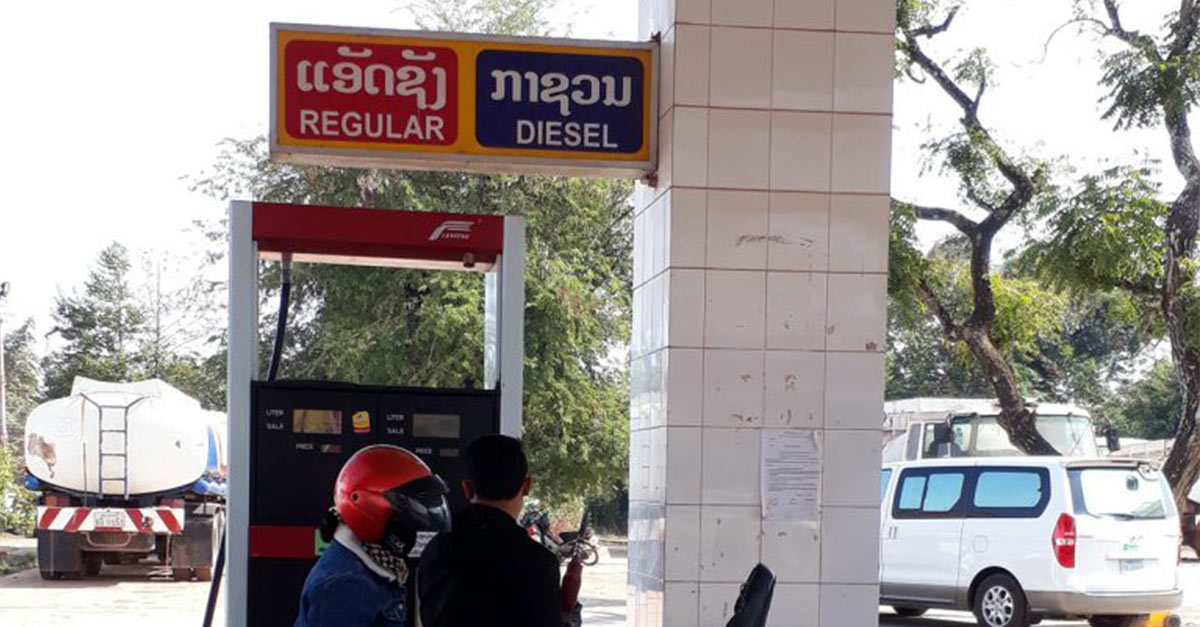
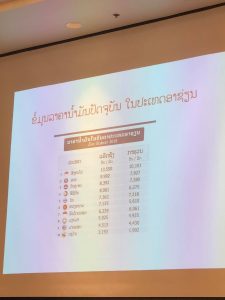
While Singapore topped the list at 13,550 kip/liter (gasoline) and 10,101 kip/liter (diesel) as the most expensive place to buy fuel, Laos came second at 9,992 kip/liter (gasoline) and 7,927 kip/liter (diesel).
Cambodia, the Philippines and Thailand placed 3rd, 4th and 5th, respectively. The cheapest place to buy fuel was oil-rich Brunei at 3,193 kip/liter (gasoline) and 1,902 kip/liter (diesel).
How do fuel prices differ in the ASEAN countries?
Transport Department Deputy Director General Boualith Pathomthong told workshop participants that the world was at present confronting the dual challenges of climate change and air pollution caused in part by the presence of an increasing number of traditional motor vehicles.
Many workshop speakers noted that many countries around the world were currently adopting policies and practices aimed at curbing the use of internal combustion engine-based vehicles, citing electric vehicles as a viable, environmentally-friendly alternative. They also noted that the use of electric vehicles could dramatically reduce Laos’ dependency on oil imports.
The biggest and most powerful smartphone is back in its latest iteration, the Samsung Galaxy Note 9, and comes with the new intelligent S Pen to really blow away the competition.
The product was officially launched in Laos by Lao Samsung Electronics on Tuesday.
The Samsung Galaxy Note 9 is possibly the highest performance Android device on the market, and includes a 4000 mAh battery with fast power charge, for long life and use.
It features a dual rear camera system including two 12-megapixel cameras, one wide angle with dual aperture and the other a 2x telephoto camera.
The phone includes 128 GB of internal memory and RAM at 6\8 GB, and features a 6.4 inch Super AMOLED Infinity Display screen size with QHD resolution and HDMI connectivity.
The latest addition to the newest in the Galaxy series is the Bluetooth-enabled S Pen, which uses a supercapacitor to operate the S Pen away from the phone for up to 30 minutes. Users can then simply slide the S Pen back into the phone body for a full charge.
The Intelligent S Pen can be used to activate functions on the phone itself, such as video or camera remote control, power point slide control, etc.
According to Managing Director of Lao Samsung Electronics, Mr. Seungho Choi, Samsung not only leads the smartphone market, but continually focuses on developing new functions for the convenience of users.
The Samsung Galaxy Note 9 was launched at an official ceremony in Vientiane, attended by Mr. Seungho Choi, alongside members of the business community, government officials, and invited guests.
The Samsung Galaxy Note 9 is now available at all Samsung retailers across the country.