Home Blog Page 66

Senao Networks Launches x86 Enterprise Server Series for Enterprise AI

Portfolio spans high-performance enterprise computing and edge AI, supporting deployment in customers’ own IT environments.

TAIPEI, Oct. 10, 2026 /PRNewswire/ — Senao Networks Inc. today announced the launch of its new x86 enterprise server portfolio, featured on the company’s Senao Computing website at www.senaocomputing.com.

Senao Computing’s new x86 enterprise server portfolio spans data center and edge deployments, with NVIDIA RTX GPU support in selected configurations.

The portfolio, which includes the SR810, SR710, SR610, SE210, and SE110, is designed to support a broad range of enterprise computing and AI workloads, including generative AI, AI inference, model fine-tuning, data analytics, visualization, and intelligent edge computing. NVIDIA RTX GPU support is available in selected configurations.

Bringing AI Closer to Enterprise Data

As enterprises accelerate AI adoption, organizations increasingly need computing infrastructure that can address different workload requirements while maintaining greater control over sensitive corporate data.

Senao Networks’ scalable x86 platforms allow enterprises to deploy computing resources according to their workload, performance, and deployment requirements.

For organizations that prefer to operate AI applications within their own IT environments, on-premises deployment can provide greater control over enterprise data, infrastructure, security policies, and AI workloads. Meeting data governance and regulatory requirements depends on the deployment, operational controls, and applicable rules.

“Enterprises are looking for practical ways to bring AI closer to their data and business operations,” said Dr. Bou Lin, President at Senao Networks Inc. “Our new x86 enterprise server portfolio provides flexible computing building blocks that allow customers to deploy AI according to their own performance, security, and infrastructure requirements—from the data center to the edge.”

Computing Platforms for Enterprise AI Workloads

The portfolio addresses different enterprise computing and AI requirements, with GPU acceleration available in selected configurations:

High-Performance Enterprise Compute – SR810 & SR710                         

Designed for demanding enterprise computing and AI workloads, including generative AI applications, LLM inference, model fine-tuning, data analytics, visualization, and other GPU-accelerated workloads.

Mainstream Enterprise Compute – SR610

Optimized for enterprise AI inference, data analytics, virtualization, and general-purpose enterprise computing applications.

Edge Intelligence – SE210 & SE110

Compact and efficient platforms designed for localized AI inference, intelligent edge applications, real-time processing, and deployments closer to where enterprise data is generated.
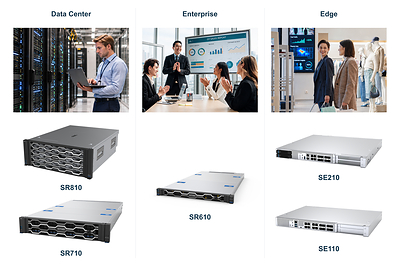
Senao Computing platforms span high-performance computing (SR810 and SR710), enterprise computing (SR610), and edge intelligence (SE210 and SE110).

From Enterprise Computing to Edge AI

The portfolio expands Senao Networks’ enterprise computing offering.

Building on decades of experience in networking, security appliances, system engineering, and global manufacturing, Senao Networks is extending its capabilities into enterprise computing and AI infrastructure.

The company aims to provide customers and technology partners with flexible computing platforms spanning enterprise servers, AI servers, edge servers, network appliances, and AI infrastructure solutions—helping organizations build practical and scalable computing environments from the data center to the edge.

Explore Senao Computing

The Senao Computing website brings together the company’s computing platforms, product specifications, AI solutions, and information on its engineering and manufacturing capabilities for customers and partners.

Senao Computing

https://www.senaocomputing.com

Product Information and Inquiries

For detailed product information, technical specifications, or business inquiries, please visit Senao Computing at www.senaocomputing.com.

About Senao Networks Inc.

Senao Networks Inc. is a provider of networking, security, computing, and AI infrastructure solutions. With extensive capabilities in system design, hardware engineering, software integration, manufacturing, and global supply-chain management, Senao Networks delivers infrastructure platforms for enterprises and technology partners worldwide.

As AI continues to reshape enterprise infrastructure, Senao Networks is expanding its capabilities from networking and security into enterprise computing, AI servers, and intelligent edge platforms—supporting customers as they build the infrastructure required for the AI era.

Media Contact

Contact Name: Jean Chen
Title: Product Marketing
Company: Senao Networks Inc.
Email: jean.chen@senao.com
Phone: +886-3-3289289 #6188

Intel, the Intel logo, and Xeon are trademarks of Intel Corporation or its subsidiaries. NVIDIA and RTX are trademarks and/or registered trademarks of NVIDIA Corporation in the U.S. and other countries. All other trademarks are the property of their respective owners.

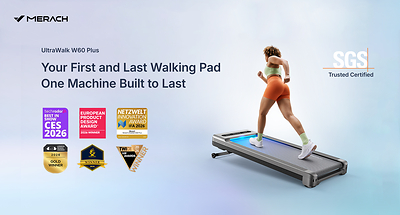
MERACH UltraWalk W60 Plus Walking Pad Passes SGS Testing, Athlete Annie Kunz Shows How It Fits Into Everyday Life

Built for everyday use, the W60 Plus combines third-party-tested performance with a compact design that makes room for movement as routines change.

WASHINGTON, Oct. 10, 2026 /PRNewswire/ — MERACH, a global home fitness brand, today announced that its UltraWalk W60 Plus Walking Pad has passed SGS testing across key product performance specifications, reinforcing the brand’s focus on durability, reliability, and everyday usability.

Merach UltraWalk W60 Plus Walking Pad

Designed as an under-desk walking pad, the W60 Plus combines a 330-lb weight capacity, a 3.5 HP peak brushless motor, a 12-level automatic incline, and a speed range of 0.6–4.0 MPH in a compact platform designed for walking and light jogging at home.

But for MERACH, proven performance is only part of the equation. The W60 Plus was also designed around a broader question: How can fitness equipment continue to support movement when life—and the way people exercise—changes?

SGS-Tested Performance, Built for Everyday Use

At the core of the W60 Plus is a 3.5 HP peak / 1.25 CHP brushless motor, designed to deliver stable, long-lasting performance for everyday walking and light jogging. Its 12-level automatic incline brings hill-style training indoors, giving users the flexibility to turn an ordinary walk into a more challenging one without requiring a full-size treadmill.

According to the product’s SGS-tested noise specifications, the walking pad operates at less than 54 dB at medium speed with a 75 kg test load. At maximum speed, noise levels are ≤60 dB with a 75 kg test load and ≤55 dB under no-load conditions, supporting use in shared home environments, including while working or watching television.

With a 330 lb weight capacity, the W60 Plus is built to provide stable support while maintaining a compact footprint suitable for apartments, home offices, and other multifunctional spaces.

Built-in transport wheels make the unit easier to move, while vertical storage can reduce its floor-space requirement by up to 80%. Users can control the W60 Plus through the MERACH App or remote and track speed, incline, time, distance, calories, and steps through its LED display.

The test results describe what the W60 Plus can do. Athlete Annie Kunz’s experience shows what that can look like in the middle of an ordinary day.

When an Athlete’s Routine Changes, Movement Changes With It

That focus on accessible, everyday movement is also reflected in how athletes are incorporating the W60 Plus into their daily routines.

Athlete Annie Kunz recently brought the W60 Plus into her home as a convenient way to keep moving throughout the day. Its durable construction and stable performance make it well suited to her everyday movement needs.

Rather than approaching every workout as a dedicated training session, Kunz described looking for ways to make movement more accessible at home—whether that means fitting in a short walk while working at her computer or stepping onto the walking pad when she has the energy.

“I’m trying to figure out ways that I can just have things easily accessible so I can just get my steps in,” Kunz said.

For Kunz, incline walking is already a familiar part of her routine. She also highlighted the W60 Plus’s incline functionality, step tracking, and ability to make shorter periods of movement easier to fit into her day.

“I just feel like having this in the house will be so much easier for me to jump on here and there when I feel a burst of energy,” she said.

That spontaneity is part of the appeal: movement does not have to wait for a clear schedule or a full workout.

From Structured Training to Everyday Movement

The W60 Plus offers 12 automatic incline levels, allowing users to move between everyday walking and more challenging incline sessions. Its non-slip 420 × 1050 mm deck is designed to support stable uphill walking and light jogging.

That flexibility is particularly relevant as routines change. An athlete may use walking as lower-intensity movement outside structured training; a professional may walk during part of the workday; and another user may simply want an accessible way to get more steps without leaving home.

For MERACH, that reflects a broader approach to home fitness: making daily movement easier to maintain, whether through a quick walk, an incline session, or simply adding more steps while working, watching television, or enjoying downtime.

“We believe consistency becomes easier when movement fits naturally into everyday life,” said Xue, Co-Founder of MERACH. “The W60 Plus was designed to provide the durability people expect from serious fitness equipment while giving them the flexibility to move in ways that work for their space, schedule, and stage of life.”

A Walking Pad Designed to Stay

Beyond performance, the W60 Plus integrates features intended to make the machine easier to live with every day, including smart workout tracking, app and remote control, built-in transport wheels, RGB ambient lighting, and a 5W Bluetooth speaker.

Together, the SGS-tested performance specifications and everyday-focused design support MERACH’s broader goal: creating home fitness equipment that users don’t have to outgrow when their routines change.

Built for every day. Proven to last.

About MERACH

MERACH is a global home fitness brand focused on making effective exercise more accessible through thoughtfully designed fitness equipment and connected workout experiences. Its product portfolio spans cardio, strength, and recovery solutions designed to help users build more consistent movement into everyday life.

For more information, visit merachfit.com.

Pine AI Introduces Pine Computer, a Computer Built for AI

Developers can give their products a cloud computer with the intelligence to use it built in. It reads a web page as structure rather than as a picture, and hands back finished work.

SAN FRANCISCO, Oct. 10, 2026 /PRNewswire/ — Pine AI today introduced Pine Computer, a computer built for AI, now in private beta for developers. Through an SDK, a developer’s product creates a Pine Computer when a job needs one and hands it the job. Pine Computer carries the work itself, across websites, files and business software, and the finished work comes back into the product.


Dylan Wang, co-founder and chief architect of Pine AI, introduces Pine Computer and shows how developers can use its SDK to run AI tasks faster, at lower cost and in parallel.

AI got smarter. Its computer didn’t.

AI today works through computers designed for people: a screen to look at, a mouse to point with. At each step they look at a picture of the screen, work out what is on it, act, and look again. Models have grown far more capable, but they still spend much of that capability working around a machine built for someone else.
Pine Computer starts from the model instead. It reads a web page as structure (what is on it, what can be done with it, what just changed) rather than reconstructing it from a picture each time. Pictures stay for people, who can watch the live screen, take the controls and hand them back.

A computer a product can put to work

For developers, the entry point is the SDK. A product hands Pine Computer a task, follows its progress, and receives the result: the files, records and answers the task produced. Pine runs the computer, the intelligence in it, the browser and the isolation; the developer builds the experience around it.
Each Pine Computer runs sealed in its own sandbox, and the developer’s keys stay with them. A live screen can sit inside the product, so its users can step in when a task needs them. Developers who want to bring their own model can connect it too; it works from screenshots today.
Pine AI uses Pine Computer in its own assistant and enterprise work. In one enterprise deployment it helps automate audits, for a customer whose team now takes on 50% more work with the same people.
Andrew Mackenzie, co-founder of Subliminal, which evaluated Pine Computer for its product, said Pine had “thought about all of this and built it all in.”

The results

In Pine’s tests, Pine Computer is 2–5× faster than AI on conventional computers.[1] On UniPat AI’s SaaS-Bench v1.1, a public benchmark of 106 business workflows across 23 applications, it has the highest checkpoint score in the publisher’s table: 78.3%, against 74.3% for Opus 5 with Claude Code and 71.1% for GPT-5.6 Sol with Codex. It ran GPT-5.6 Luna, a lower-cost model, at about $1.02 per task in model cost, against $26.50 and $20.50 for those systems. A checkpoint score is the share of a task’s checkpoints passed, not tasks finished: Pine Computer completed fewer whole tasks than those systems (27.4%, against 31.1% and 29.2%), and these are comparisons between whole systems, each with its own software and budget, not a test of the computer alone. The evaluation notes give the definitions, and the run data is published. For more on Pine Computer’s architecture, capabilities and benchmark results, read the launch blog.

“We spent years making the model smarter. Now, we’re making the computer worthy of the model,” said Dylan Wang, Pine AI’s co-founder and chief architect.
Wang said Pine plans to open its designs, implementations and specifications, and to work with others on what a computer built for AI should be. “We don’t believe the future of computing for AI should belong to one company,” he said.

Availability

Pine Computer is in private beta. Developers can join the waitlist at pinecomputer.io.

[1]Pine’s preliminary internal tests against AI on conventional computers, including SaaS-Bench tasks against Claude Code with Opus 5. Results vary by task.

About Pine AI

Pine AI builds AI that gets real-world work done for people and businesses, across phone calls, websites, software and other digital systems. Its systems have handled millions of real-world tasks, where reliability, latency and permissions matter.
Earlier in 2026, Pine Voice reached No. 1 on τ³-Voice, a benchmark from researchers at Sierra and Princeton that tests whether real-time voice AI can hold a conversation while completing real-world tasks. At the time, it ranked ahead of published systems from xAI, OpenAI and Google.

OPPO Find X10 Pro Max to Debut Globally with MediaTek’s 2nm Flagship Dimensity 9600 Pro


SHENZHEN, CHINA – Media OutReach Newswire – 9 October 2026 – OPPO, a leading global smart device brand, today announced that the upcoming Find X10 Pro Max will be among the first smartphones to feature the flagship MediaTek Dimensity 9600 Pro and launch in international markets.

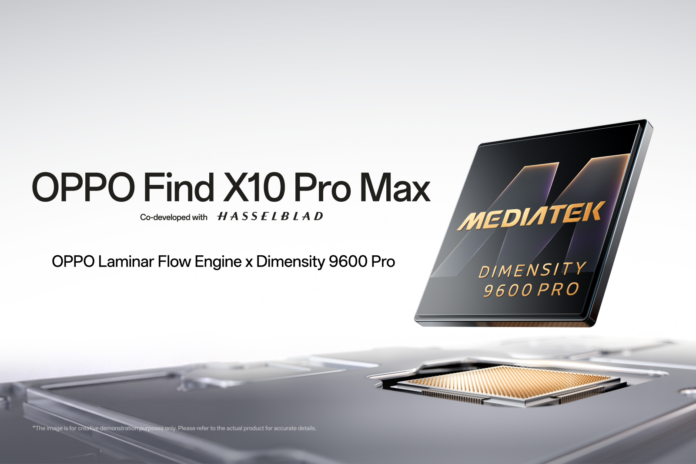
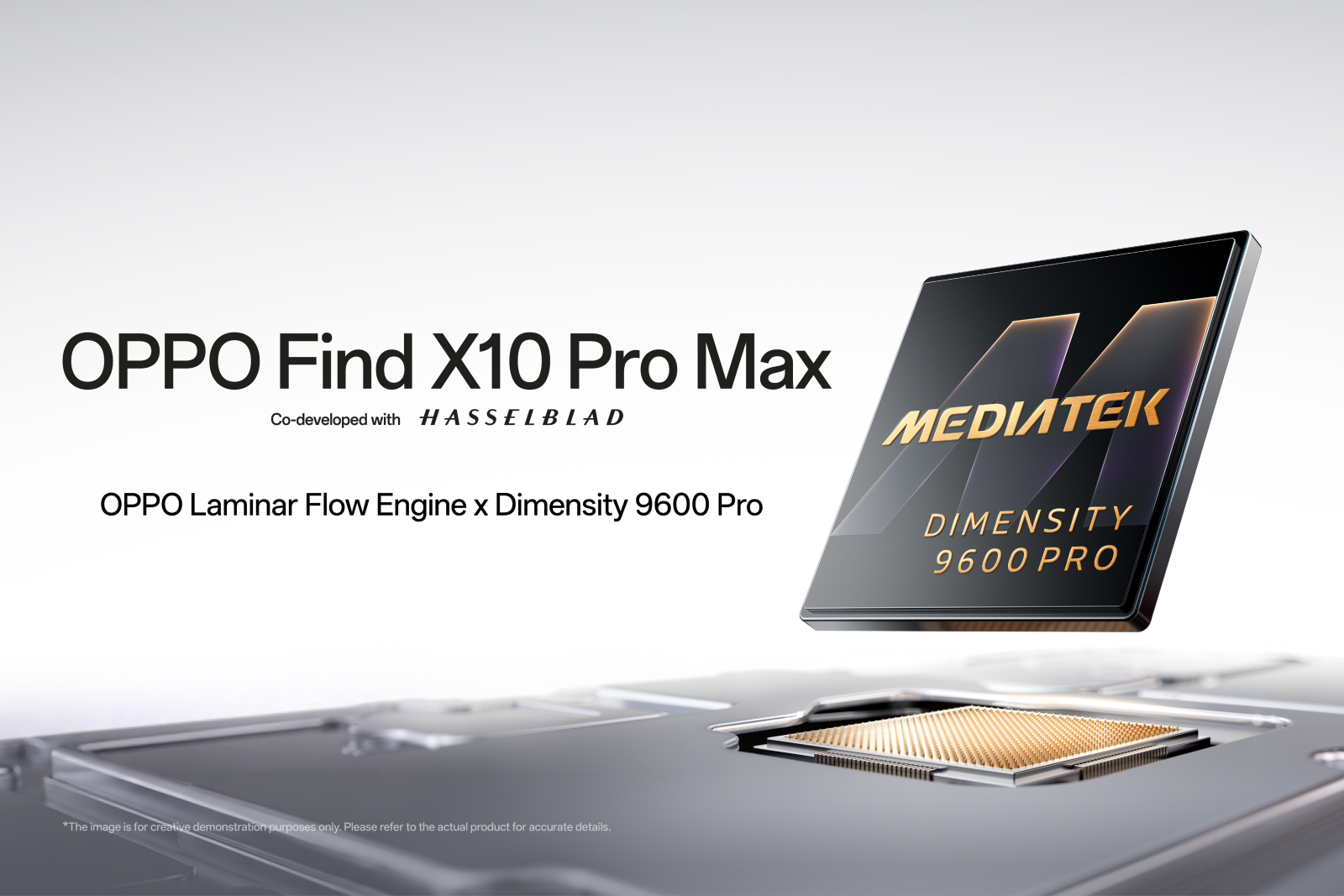
OPPO Find X10 Pro Max Chipset-16-9.png

Built on TSMC’s advanced 2nm N2P process, the MediaTek Dimensity 9600 Pro delivers a significant generational leap in performance and power efficiency. Compared with the previous-generation process, it delivers up to a 61% improvement in CPU multi-core energy efficiency, providing a stronger foundation for sustained flagship performance and increasingly demanded on-device AI workloads on Find X10 Pro Max.

For CPU performance, the Dimensity 9600 Pro continues MediaTek’s All-Big-Core architecture with a new configuration featuring two 4.55GHz C2-Ultra cores and six performance cores. The new CPU delivers an overall performance improvement of 17%, while independent frequency control for each core enables more precise workload scheduling, helping Find X10 Pro Max balance sustained performance with outstanding power efficiency.

Graphics performance takes another step forward with the latest flagship G2-Ultra NX GPU, introducing enhanced ray tracing and new neural graphics capabilities. Under sustained heavy workloads, the Dimensity 9600 Pro delivers approximately 27% higher performance, enabling richer visual detail and more immersive gaming experiences on Find X10 Pro Max.

The Dimensity 9600 Pro also brings a major upgrade to on-device AI with its latest-generation dual-NPU design, combining a powerful NPU with a Super Efficient NPU. The new high-performance NPU delivers 51% faster LLM prefill performance, providing powerful support for workloads including large-model inference and computational imaging. Meanwhile, the Super Efficient NPU is 40% more power efficient, enabling persistent AI capabilities to run at ultra-low power for more responsive and always-available AI experiences.

Further enhancing the platform is OPPO Laminar Flow Engine, jointly developed by OPPO and MediaTek and making its debut on Find X10 Pro Max. By restructuring the underlying rendering architecture and coordinating it more closely with system scheduling, the technology achieves a better balance between ultra-smooth system responsiveness and low power consumption. It also helps accelerate app launches and maintain smooth and stable content loading during demanding scenarios such as rapid photo browsing.

Further details about OPPO Find X10 Pro Max, powered by the MediaTek Dimensity 9600 Pro, will be revealed at the upcoming global launch event.

Hashtag: #OPPO

The issuer is solely responsible for the content of this announcement.

About OPPO

OPPO is a leading global smart device brand. Since the launch of its first mobile phone – “Smiley Face” – in 2008, OPPO has been in relentless pursuit of the perfect synergy of aesthetic satisfaction and innovative technology. Today, OPPO provides a wide range of smart devices spearheaded by the Find and Reno series. Beyond devices, OPPO also provides its users with ColorOS operating system and internet services. OPPO has footprints in more than 90 countries and regions, with more than 40,000 employees dedicated to creating a better life for customers around the world.

KONST Raises $30M Series B funding Led by ADATA Technology to Scale Up AI Data Center Buildout in Asia and Advance Its Token Factory Strategy

Funds will also advance KONST’s Token Factory strategy as the company serves large enterprises through a three-layer model of compute supply, cloud delivery and AI governance

TAIPEI, Oct. 9, 2026 /PRNewswire/ — KONST, a Taiwan-based next-generation AI compute operator, announced that it has raised $30 million Series B funding led by ADATA Technology (TPEx: 3260), with strategic participation from M Mobility, Pegatron Venture Capital, and several other corporate investors.

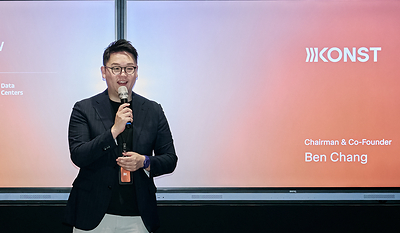
Ben Chang, co-founder and chairman of KONST. Photo: KONST

KONST will use the proceeds to scale up its AI data center buildout across Asia and accelerate its Token Factory strategy, aiming to meet fast-growing enterprise demand for AI adoption.

Note: Investors are listed in alphabetical order by company name 

Series B Round: Strategic Participation from Multiple Corporate Groups

The round’s principal investors come from memory and storage, electrification solutions, and electronics manufacturing, while other participants span energy, semiconductors, and thermal management — groups that are themselves on the demand side of enterprise AI adoption. KONST said that beyond the capital itself, it places even greater value on the synergies its investors offer across industry use cases and customer applications, which will help connect KONST’s services with real-world deployments more quickly.

“This round is about more than the amount raised. What matters most is that we and our investors share the same vision: AI must make its way into how enterprises actually operate, not stall at proof of concept,” said Ben Chang, co-founder and chairman of KONST. “Once AI is part of operations, computing power is no longer a one-time project expense. It becomes essential infrastructure that enterprises rely on every day. Our investors understand this better than anyone, because they are on the demand side, too.”

From Data Centers to Usage Governance: KONST’s Three Layers Turn Compute into a Service

Enterprise demand for AI is shifting from trials by individual teams to routine use across departments, and compute demand is shifting with it, from one-off project procurement to continuous, fluctuating day-to-day consumption. Fixed-capacity provisioning is finding it increasingly difficult to keep pace with variable usage patterns. Meanwhile, as agentic AI matures, workloads are placing higher demands on computing performance, stability, and reliability. Demand is rising in both volume and quality at the same time, which is precisely why AI infrastructure has become so much more important.

The Token Factory concept treats compute as production equipment and tokens as its output. KONST is building toward it in three layers:

At the foundation is compute supply. Konstra AI takes projects from site selection and the buildout of mechanical, electrical, and environmental control systems through to GPU cluster tuning and acceptance, followed by ongoing operations and maintenance. Proceeds from this round will be used to expand its build capacity across Asia.

In the middle is the conversion layer. Glows.ai breaks cluster compute into smaller units that enterprises access with per-second billing, paying only for what they use.

At the top are governance and delivery. Horizon AI’s (k) ATP Token handles this layer, determining who can use what, how much, and how it is charged.

KONST believes this three-layer division of labor also shows how Taiwan’s existing strengths in hardware and supply chains can extend further up the value chain — from manufacturing compute to delivering it.

(k) ATP Token: One Key to Access Every Model and Manage Team Usage

Governance is the most easily overlooked of the three layers, and it is also where enterprise AI adoption often stalls. The problem isn’t that the models fall short; it’s that no one can say clearly which department used which models, how much was spent, or what happened with each request.

(k) ATP Token is designed around the principle of “One key. Every model.” With a single project key, enterprises can connect to every authorized model, without having to negotiate contracts and build integrations with each vendor one by one.

The platform’s four-tier structure — organization, workspace, project and key — allocates quotas down the organizational hierarchy, sets model access at the project level and flags budgets before they are exceeded. The model and usage of every request are recorded in audit logs. For enterprises already operating at scale, (k) ATP Token goes a step further, bringing every model on the platform under one contract and one invoice, with custom contract pricing based on actual usage. KONST emphasized that (k) ATP Token is not a standalone product but the governance foundation built into every AI adoption project. From day one of a proof of concept, cost tracking, permissions, and request logs are already in place, so going live is simply a matter of scaling up traffic.

“Buying GPUs is only the beginning,” said Chang. “You need data centers you can build, compute you can break down finely, and usage you can keep under control. Only when all three layers are connected do you get what we call delivering compute.”

Focused on AI Adoption at Large Enterprises

KONST said Horizon AI focuses on sizable business groups and large organizations. AI adoption at these customers typically involves multiple departments, integration with existing systems, and long-term governance requirements. What they need is not a point solution but a partner that can work alongside them through the entire adoption cycle. Horizon AI has completed deployments for several enterprises and institutions and is conducting needs assessments with large customers across multiple industries.

As its business grows, KONST continues to expand its team, bringing in talent across a range of disciplines to meet increasingly diverse customer needs. To learn more about open positions, visit KONST’s LinkedIn page: https://www.linkedin.com/company/konsttech

About KONST

KONST Co., LIMITED is a next-generation AI compute operator headquartered in Taipei, Taiwan. Through its One KONST brand and strategic partner ecosystem, KONST brings together the capabilities of three brands — Konstra AI, Glows.ai, and Horizon AI — to deliver the complete AI compute value chain as one integrated service. Konstra AI provides compute buildout services for AI data centers, covering end-to-end construction from mechanical, electrical, and environmental control systems to GPU clusters. It also provides equipment operations and maintenance, as well as compute delivery. Glows.ai provides an enterprise-grade GPU cloud platform with per-second billing. Horizon AI is dedicated to AI application adoption and model asset governance. Customers work with one team on one order, whether their needs sit at the compute, platform, or application layer.

Building on Taiwan’s engineering strength and supply-chain advantages, KONST combines capabilities in GPU cluster operations, data center operations and maintenance, cloud platforms, and AI services. Amid the global AI wave, it works with enterprises, developers, research institutions, and international partners to build compute supply that is available, reliable, and sustainably scalable.

Related Links

(k) ATP Token, Horizon AI’s enterprise AI governance platform: https://www.horizon-ai.ai/en/atp

(k) ATP Token console: https://atptoken.ai/

Media Contact
KONST Co., LIMITED
PR Contact: Jora Huang, Chief Public Relations Officer
Email: jora.huang@konsttech.ai


“AI Is Shifting From Understanding to Getting Things Done”: China Telecom’s TeleAgent Hits 1.5 Million Users


HONG KONG SAR – Media OutReach Newswire – 9 October 2026 – China Telecom’s office AI agent, TeleAgent, has passed 1.5 million registered users and over 200,000 daily active users (DAUs), marking a steep acceleration from just 27,000 registered users in mid-June. Liu Guiqing, Executive Director, President and Chief Operating Officer of China Telecommunications Corporation, announced the milestone at the opening of PT Expo China 2026. The product was first unveiled at the World Artificial Intelligence Conference (WAIC) 2026.

“TeleAgent marks the shift of AI from understanding what is said to getting things done,” said Liu Guiqing. China Telecom sees the 1.5 million-user milestone as evidence that autonomous AI agents capable of end-to-end task execution are transitioning from conceptual showcases into large-scale enterprise adoption.

TeleAgent is built by China Telecom AI Technology Co. (TeleAI) as a native AI application for the workplace, serving individual professionals, small and medium-sized enterprises (SMEs) and large state-owned conglomerates. An enterprise SaaS edition supports multi-device collaboration and scenario customisation, while a private-deployment edition released in mid-August keeps models and data entirely within customers’ local, sovereign environments.

Its skill marketplace has expanded from roughly 40,000 to more than 50,000 skills—99% of which were built directly by end users solving real-world productivity challenges, reflecting a highly active user-generated ecosystem.

TeleAgent runs natively on Windows, macOS and leading Chinese enterprise operating systems including Kylin OS and UnionTech OS (UOS), requiring no complex server setup for individual users. Users can simply drag and drop files into the workspace and let the agent handle end-to-end execution.

Early users are seeing tangible business impact. In an in-depth survey of key enterprise pilot and power users, 90% reported that the agent has become integral to their daily routines, with document drafting, industry research and automated data analysis accounting for more than half of all usage. Seventy-nine percent cited significant productivity gains, and 35% noted the tool exceeded expectations. TeleAgent scored a Net Promoter Score (NPS) of 62.9. Among the 74% of surveyed respondents who had previously utilized rival platforms, 89% rated TeleAgent on par with market leaders, while 16% rated it superior.

Real-world deployments demonstrate dramatic workflow compression. A consulting analyst noted that a recurring quarterly task—previously requiring exports of over 20 reports from five disparate systems and half a day of manual data cleaning and charting—now takes five minutes: users upload raw data, state objectives, and receive finalized reports with interactive charts.

Within China Telecom, a regional sales and channel operations unit leveraged the agent during a major commercial campaign to cut daily cross-system consolidation from hours to minutes, automating report distribution entirely.

China Telecom frames TeleAgent’s competitive edge around three core pillars: Security, Efficiency, and Results.

* Security: Built from the ground up with carrier-grade protection, TeleAgent implements a four-layer defence loop covering perception, reasoning, execution and memory. A lightweight security sandbox strictly isolates file access. The product has achieved certifications by the China Academy of Information and Communications Technology (CAICT) and cleared 99.7% of the 336 threat evaluation scenarios conducted by QiAnXin and other leading security vendors.

* Efficiency & Token Economics: TeleAgent leverages China Telecom’s own Xingchen multimodal foundation model and its integrated “five-in-one” intelligent cloud. This end-to-end control enables China Telecom to pioneer new “Token-based operations”—employing an intelligent model router to direct requests to the most cost-effective foundation models while utilizing context compression to minimize latency and inference costs.

* Results: Tuned specifically for Chinese-language workplace workflows—especially complex spreadsheets, briefings, and presentations—TeleAgent incorporates persistent long-term memory that adapts to user habits over time. In IDC’s technical evaluation of Chinese enterprise-grade general-purpose agent products, TeleAgent scored 6.85 and ranked in the top three nationwide, with cost efficiency, security and task performance well above industry benchmarks.

TeleAgent serves as the enterprise flagship for China Telecom’s unified group-wide agent architecture. At its core is the “Xing Xiaochen” agent hub, which drives multimodal intent recognition, task planning, and tool orchestration under a “build once, reuse across the network” framework.

To date, China Telecom has integrated ecosystem capabilities across navigation (AutoNavi/AMap), corporate travel (Umetrip), lifestyle, and weather, with 60 agent applications from 44 external partners currently undergoing technical integration.

From individual productivity to complex corporate workflows, professionals across marketing, engineering, legal, and consulting are delegating routine paperwork, ledger consolidation, and contract risk reviews to TeleAgent.

Looking forward, China Telecom aims to extend these agentic capabilities across broader enterprise ecosystems, partnering through China Telecom Global to empower multinational organizations with secure, localized, and intelligent digital transformation.

Hashtag: #ChinaTelecom

The issuer is solely responsible for the content of this announcement.

About China Telecom Global

China Telecom Global Limited (CTG) was established in 2012 and headquartered in Hong Kong as a wholly-owned subsidiary of China Telecom Co., Ltd. As for now, CTG has a presence in 53 countries and markets, with business spanning the Asia-Pacific, Europe, the Middle East, Africa, and the Americas. Leveraging its vast network resources of 185 submarine and terrestrial cables with over 304T in intercontinental capacity, 259 Points-of-Presence, and 15 proprietary data centres around the world, CTG has become a global player with an extensive network of service branches and communications infrastructure.

International carriers, multinational enterprises and overseas Chinese customers comprise the majority of CTG’s global customer base. CTG provides its customers with tailored and cost-effective integrated telecoms solutions, suited to different business needs. CTG solutions comprise diverse telecom services, including internet direct access, internet transit, data services, broadband, unified communications, internet data centers, cloud computing, ICT services, fixed-line and mobile services, professional services, industry solutions, telecom operation consultancy and service outsourcing.

MINISO Group’s Latest Business Update

GUANGZHOU, China, Oct. 9, 2026 /PRNewswire/ — MINISO Group Holding Limited (NYSE: MNSO; HKEX: 9896) (“MINISO“, “MINISO Group” or the “Company“), a world-leading IP-driven retailer and operation platform, today on a voluntary basis provided a business update on the latest performance of its flagship brand MINISO. The figures contained in this press release were based on the preliminary review of the Company’s operational data.

Sales Performance of MINISO Chinese Mainland

Total GMV(1) of MINISO Chinese mainland for the three months ended September 30, 2026 (“26Q3“) grew by 25%-30% year over year (“YoY“), accelerating from the first half of 2026, powered by a high-single-digit SSSG(1).

MINISO Chinese mainland maintained its strong momentum during the National Day holidays from October 1 to October 7, 2026, with total GMV growth of 20%-25% YoY, powered by a low-single-digit SSSG.

Sales Milestone of Proprietary IP YOYO

YOYO, MINISO’s flagship proprietary IP, has generated GMV of over RMB1 billion for the first nine months of 2026 and has officially entered the global IP “One Billion Club”. Since its first product launch in June 2025, YOYO has expanded into 53 countries and regions worldwide, emerging as one of the fastest Chinese original IPs to achieve large-scale global expansion. Mr. Guofu Ye, Founder, Chairman and CEO of MINISO, stated that YOYO has validated MINISO’s strategic capability as a “world’s leading IP operation platform”, and that MINISO will empower more Chinese original IPs to scale up and accelerate in the global market.

Sales Performance of MINISO Overseas Markets

MINISO overseas markets’ performance was largely in line with the Company’s guidance. MINISO USA delivered a GMV growth of around 20% YoY in 26Q3. Notably, it rebounded to over 30% GMV YoY growth and positive SSSG in September 2026 bolstered by new product arrivals.

This press release was announced by the Company on a voluntary basis to inform shareholders and potential investors of the Company of the latest business update of the Company. This press release was based on the Board’s preliminary review of the relevant operational data of the Company and the information currently available to the Board, and it was not based on any figures or information which have been audited or reviewed by the Company’s auditors. The information contained in this press release may be subject to change and adjustment. Shareholders and potential investors of the Company should note that sales performance of IP products is subject to seasonality, marketing cycles, and the timing of new product launches and that operational data during the National Day holiday period represents a short-term snapshot and is not necessarily indicative of the Company’s performance for the entire fourth quarter of 2026 or any future period. Shareholders and potential investors of the Company are advised to exercise caution when dealing in the Company’s securities.

About MINISO Group

MINISO Group is a world-leading IP-driven retailer and operation platform offering immersive consumption experiences powered by value-for-money and aesthetic products featuring IP designs. Founded in 2013, the Company has established two brands, MINISO and TOP TOY. MINISO Group has built a worldwide IP ecosystem through its top licensed IPs and proprietary IPs dual-engine model. Guided by its “Life is for Fun” philosophy, it delivers engaging experiences and emotional value to consumers around the world. For more information, please visit https://ir.miniso.com/.

Safe Harbor Statement

This announcement contains forward-looking statements. These statements are made under the “safe harbor” provisions of the U.S. Private Securities Litigation Reform Act of 1995. These forward-looking statements can be identified by words or phrases such as “may”, “will”, “expect”, “anticipate”, “aim”, “estimate”, “intend”, “plan”, “believe”, “is/are likely to”, “potential”, “continue” or other similar expressions. Among other things, the quotations from management in this announcement, as well as MINISO’s strategic and operational plans, contain forward-looking statements. MINISO may also make written or oral forward-looking statements in its periodic reports to the U.S. Securities and Exchange Commission (the “SEC“) and The Stock Exchange of Hong Kong Limited (the “HKEX“), in its annual report to shareholders, in press releases and other written materials and in oral statements made by its officers, directors or employees to third parties. Statements that are not historical facts, including statements about MINISO’s beliefs and expectations, are forward-looking statements. Forward-looking statements involve inherent risks and uncertainties. A number of factors could cause actual results to differ materially from those contained in any forward-looking statement, including but not limited to the following: MINISO’s mission, goals and strategies; future business development, financial conditions and results of operations; the expected growth of the retail market and the market of branded variety retail of lifestyle products in China and globally; expectations regarding demand for and market acceptance of MINISO’s products; expectations regarding MINISO’s relationships with consumers, suppliers, Retail Partners, local distributors, and other business partners; competition in the industry; proposed use of proceeds; and relevant government policies and regulations relating to MINISO’s business and the industry. Further information regarding these and other risks is included in MINISO’s filings with the SEC and the HKEX. All information provided in this press release and in the attachments is as of the date of this press release, and MINISO undertakes no obligation to update any forward-looking statement, except as required under applicable law.

Note: 
(1) For definitions of the operating and financial metrics used in this press release, please refer to the Company’s financial results announcements and annual reports.

Investor Relations Contact

MINISO Group Holding Limited
Email: ir@miniso.com
Phone: +86 (20) 36228788 Ext.8039

MEGA 2026 awards creators exploring new forms of storytelling

SUZHOU, China, Oct. 9, 2026 /PRNewswire/ — From a supernatural reimagining of a poet’s story to an immersive interpretation of a book adaptation, winning works at the 6th Media, Exhibition, Graphics, and Arts (MEGA) International Creative Media Festival show how emerging creators are combining cultural narratives with AI, virtual production, and spatial media.


MEGA 2026

Hosted by the Academy of Film and Creative Technology (AFCT) at Xi’an Jiaotong-Liverpool University (XJTLU), MEGA is an annual international festival that connects young creators, universities, and industry organisations.

A record of 2,014 submissions from 10 countries and regions, representing 189 universities and institutions, were received by this year’s MEGA – a 45.5% increase on the previous year. Nearly one-third of the student entries, 473 out of 1,479 works, were submitted to the AI and immersive media categories.

A dedicated immersive media category was introduced this year, following the opening of XJTLU’s Dome Immersive Cinema. Premiered in 2025, the 338.8-square-metre LED display is the world’s first fully integrated dome cinema facility at a university.

The winners were announced on 29 September 2026 at the Suzhou International Expo Centre, where MEGA made its debut as a part of the 15th Suzhou Cultural and Creative Design Industry Trade Expo.

“The Tale of the Peony”, by Yuqing Liu of the University of Hong Kong, won Best AI Short Film. Inspired by Yu Xuanji, a poet of the late Tang dynasty, the film reimagines her story using Chinese supernatural tales. The team used AI to generate keyframe animation for a visual world inspired by the texture of traditional Chinese rice paper, then manually refined the keyframes in post-production.

Siyi Zhang from Beijing Film Academy, China, received the Best Immersive Media Short Film Director award for “Demian”, based on Hermann Hesse’s novel of the same title. It is a narrative-led immersive stage installation that combines projection mapping, AI-generated visuals, LED virtual production, and an interactive set constructed from elastic bands.

MEGA’s aim is to evolve from an annual festival into a year-round creative ecosystem that connects universities, young creators, and industry partners, helping more creative work move beyond campus. “Today’s creative ecosystem is no longer a monologue confined to a single discipline, medium or culture, but a symphony across fields, media and cultures,” said Professor Qian Liu, Dean of AFCT.