Home Blog Page 1029

Winners in the 2026 Asia-Pacific Stevie® Awards Announced

Winners in Thirteenth Annual Competition to Be Celebrated at 17 April Award Ceremony in Macau

FAIRFAX, Va., Feb. 12, 2026 /PRNewswire/ — Winners have been announced in the thirteenth annual Asia-Pacific Stevie Awards, the only awards program to recognize innovation in the workplace throughout the entire Asia-Pacific region. The list of Gold, Silver, and Bronze Stevie Award winners is available at https://Asia.StevieAwards.com.

More than 1,000 nominations about innovative achievements from the 29 markets of the APAC region were considered by the judges this year in categories such as Innovative Achievement in Product Innovation, Award for Innovative Management, and Award for Excellence in Innovation in AI Strategy & Implementation, among many others.

The Stevie Awards are widely considered the world’s premier business awards, conferring recognition for achievement over the past 24 years through programs such as The International Business Awards® and The American Business Awards®. The name Stevie is derived from the Greek word for “crowned.”

More than 1,000 nominations about innovative achievements from the 29 markets of the APAC region were considered by the judges this year in categories such as Innovative Achievement in Product Innovation, Award for Innovative Management, and Award for Excellence in Innovation in AI Strategy & Implementation, among many others.

The 2026 Asia-Pacific Stevie Awards have recognized organizations in 23 markets, including Australia, Bangladesh, Cambodia, mainland China, France, Hong Kong SAR, India, Indonesia, Japan, Korea, Malaysia, Maldives, Myanmar, New Zealand, Pakistan, Philippines, Saudi Arabia, Singapore, Sri Lanka, Taiwan region, Thailand, United States, and Vietnam.  Winners in attendance will be celebrated on stage during a gala event at the Venetian Hotel in Macau, China on Friday, 17 April.

Among the top overall winners in the 2026 Asia-Pacific Stevie Awards are SM subsidiaries including SM City La Union, SM Foundation, Inc., SM Supermalls and Ripple8, Inc. with 32 Stevie wins from their facilities in China and the Philippines. They won in categories including Award for Innovation in Cultural or Community Events, Award for Innovation in Purpose-Driven Marketing, Innovative Achievement in Diversity & Inclusion, Award for Innovation in Cultural or Community Events, and Award for Innovation in Non-Profit/NGO Publications, among others.

Megaworld Corporation of Taguig City, Philippines and its subsidiaries, including Megaworld Foundation, Inc. and Megaworld Lifestyle Malls, won 19 Stevie Awards in categories including Award for Innovation in AI-Driven Customer Service, Award for Innovation in Lifestyle Videos, Award for Excellence in Innovation in Non-Profit Organizations or NGOs, and Award for Excellence in Innovation in Education, among others.

Other winners of five or more Stevie Awards include IBM (12), Watsons (10), Manila Electric Company (9), PJ Lhuillier Inc. (Cebuana Lhuillier) (9), Tata Consultancy Services / Tata Consumer Products (9), The Catalyst For Lenovo Legion, Lenovo, and Lenovo Technology Sdn Bhd (9), Globe Telecom (8), IntouchCX (8), Kenny Rogers Roasters (7), PLDT and Smart / PLDT Global (7), Cisco Systems Inc. (6), Singapore Telecommunications Limited (6), Aboitiz Construction, Inc. (5), ACCOR (5), Bank of the Philippine Islands (5), and Samsung Electronics Philippines Corporation (5).

Gold, Silver, and Bronze Stevie Award winners were determined by the average scores of more than 250 executives worldwide who served as judges from December through February.

The 2026 Asia-Pacific Stevie Awards also includes the People’s Choice Stevie Awards for Favorite Companies, a worldwide public vote for all nominees in the competition’s Company/Organization categories. Voting will be open 16 February through 13 March 2026. Category winners in the public vote will receive a crystal People’s Choice Stevie Award.

“The thirteenth Asia-Pacific Stevie Awards drew a highly competitive and impressive range of submissions,” said Stevie Awards President Maggie Miller. “Judges noted the strong emphasis on innovation, execution, and measurable impact throughout the nominations. We congratulate this year’s Stevie Award winners and look forward to formally honoring them in Macau on 17 April.”

For details about the Asia-Pacific Stevie Awards, the 17 April awards ceremony in Macau, and the list of Stevie Award winners, visit http://Asia.Stevieawards.com.

About the Stevie® Awards
Stevie Awards are conferred in nine programs: the Asia-Pacific Stevie Awards, the German Stevie Awards, the Middle East & North Africa Stevie Awards, The American Business Awards®, The International Business Awards®, the Stevie Awards for Women in Business, the Stevie Awards for Great Employers, the Stevie Awards for Technology Excellence and the Stevie Awards for Sales & Customer Service. Stevie Awards competitions receive more than 12,000 entries each year from organizations in more than 70 nations and territories. Honoring organizations of all types and sizes and the people behind them, the Stevies recognize outstanding performances in the workplace worldwide. Learn more about the Stevie Awards at http://www.StevieAwards.com.

PR Newswire Asia is the official news release distribution partner of the 2026 Asia-Pacific Stevie Awards.

Contact: Nina Moore, Nina@StevieAwards.com, +1 (703) 547-8389
E-commerce: UPI sparks a credit card boom in India while Pix overtakes card dominance in Brazil, EBANX finds

The new Beyond Borders report identifies five major trends shaping payments in emerging markets: UPI driving local schemes in India, cards growing through installments and debit across LatAm and Africa, Pix leading e-commerce in Brazil, crypto adoption via stablecoins, and AI advancing toward autonomous buying

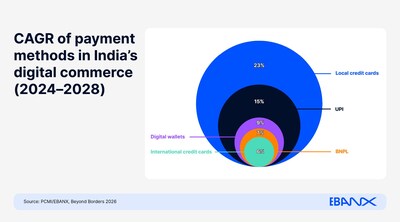
CURITIBA, Brazil, Feb. 12, 2026 /PRNewswire/ — In the home of UPI, the world’s most-used instant payment system and the backbone of how Indians shop online, the fastest-growing e-commerce payment method is credit cards. Led by domestic networks like RuPay, local cards are expected to expand at a CAGR of 23% through 2028, outpacing UPI itself (15%) and international cards (6%).

CAGR of payment methods in India's digital commerce (2024–2028)
CAGR of payment methods in India’s digital commerce (2024–2028)

The projections are featured in the new edition of Beyond Borders, EBANX’s annual comprehensive study on digital market and payment trends in emerging economies, published today, and are based on Payments and Commerce Market Intelligence (PCMI) data. The business intelligence report offers an in-depth analysis of payment trends in India, Southeast Asia, Latin America, and Africa, with data and expert perspectives on Alternative Payment Methods (APMs), cards, shopping behaviors, B2B e-commerce, and the rise of stablecoins and AI agents as personal buyers.

Click here to access the full Beyond Borders 2026 report for free.

“Our report shows that the global payments industry is undergoing a structural shift, led by emerging markets,” said Eduardo de Abreu, Chief Product Officer (CPO) at EBANX. “To meet the demands of the world’s fastest-growing digital customers, these regions have turned complex local challenges into a blueprint for the future, creating faster and more inclusive ways to pay and shifting the competitive dynamics worldwide.”

The growth of credit cards in India directly reflects this trend. In a country where APMs like UPI account for 75% of e-commerce volume, local providers found new opportunities by embedding themselves into the same rails that consumers already use daily. Under this hybrid model, domestic card schemes are linked to the UPI system, allowing real-time transactions to draw directly on credit limits. As a result, RuPay holds 33% of the Indian card market, ahead of Mastercard (20%) and American Express (4%), trailing only Visa at 43%.

“This is less about displacement and more about convergence,” Abreu emphasized. “As APMs raise the bar by reducing checkout friction and streamlining payment flows, local card schemes are responding by combining card-based credit with instant payments, wallets, and domestic infrastructure—leveraging their deeper understanding of local consumer behavior to scale faster than global rails.”

Cards’ winning moves in LatAm and Africa: installments and debit

Beyond India, this shift is turning cards into more specialised tools within broader, multi-rail payment ecosystems focused on higher-value purchases. In Latin America, they have sustained growth by leveraging the region’s longstanding installment payment culture. EBANX data shows this approach boosts average order values up to 2.7x, allowing cards to remain the backbone of e-commerce in countries like Mexico, Chile, and Peru, accounting for more than 60% of online transactions, per PCMI.

In Nigeria and Egypt, card expansion is being driven by debit, with ownership rising over 10 percentage points from 2021 to 2024, according to Global Findex. As in India, this growth is fueled by the rise of local schemes that leverage their deep understanding of domestic markets to offer tailored solutions, such as reliable processing of very low-value transactions and support for multiple refund paths. Nigeria’s leading scheme, Verve, has issued 100 million cards in a country of 232 million people.

“What determines success for payment methods in emerging markets is how well each system understands local reality,” said Abreu. “Local schemes succeed because they are built around domestic spending habits, regulatory frameworks, and technical constraints. Whether it is an instant payment system, a digital wallet, or a card, scale comes from local intelligence, not global standardisation.”

Pix overtakes cards in Brazil

Unlike UPI in India, Pix remains the fastest-growing payment method among digital consumers in Brazil. The system became the most-used option for online shopping in 2025, ending cards’ long-standing dominance. Last year, 42% of the total value of purchases in the country were paid with Pix, edging out cards at 41%. The new leader will continue to accelerate at a CAGR of 18% through 2028, when it will account for 50% of transactions compared to 36% for cards—a 14 percentage-point gap.

This sustained growth stems not only from volume but from Pix’s rapid evolution beyond one-off payments to support more complex commerce models. Last year, the system introduced recurring transactions with Pix Automático. In operation since June 2025, the feature has been growing at a rate of 41% per month, according to EBANX internal data, driven by the roughly 60 million Brazilians without credit cards who can now access services such as video and audio streaming.

“This growth reinforces that high adoption does not mean saturation. Pix is used by 95% of Brazil’s adult population, yet new demand is unlocked with each additional functionality introduced,” Abreu explained. “That momentum is now extending to businesses, particularly small and medium-sized enterprises, which are increasingly adopting Pix and reducing their reliance on corporate credit cards for their B2B purchases.”

EBANX data shows that eight out of ten companies in Brazil using Pix through EBANX are micro-businesses, with 84% of them relying on it to purchase software, opening a previously inaccessible market for global providers.

A similar dynamic is unfolding across other emerging economies. In India, a major global software-as-a-service (SaaS) company that enabled UPI Autopay via EBANX attracted more than 4,000 new customers daily during the first three months. APMs like GCash (Philippines), Mercado Pago (Latin America), Nequi (Colombia), Yape (Peru), OPay (Nigeria), and Capitec Pay (South Africa) are also expanding their ecosystems and seeing growing adoption.

Stablecoins and AI agentic buyers as the next evolution of digital payments

Beyond Borders also highlights how emerging markets are exploring crypto’s value for real-world commerce through stablecoins. They’re used to preserve value, move money efficiently, and enable cross-border transactions in economies facing inflation, currency controls, or high banking costs.

Data from Triple A analysed in EBANX’s study shows that more than 15% of the population in Brazil, Argentina, Thailand, and Vietnam already owns digital currencies, rising to 20% in Turkey. In Argentina, nearly 90% of crypto purchases are made up of dollar-pegged stablecoins.

Another trend explored in Beyond Borders is agentic commerce, where artificial intelligence evolves from a discovery tool to an autonomous buyer. In this model, AI compares prices, selects merchants, and executes transactions end-to-end—often without users visiting websites—making prompt quality and consumer context more decisive than sophisticated storefronts or visual design. Competition shifts towards pricing, availability, reliability, and trust.

McKinsey reports that 20% of consumers would be comfortable having agents complete purchases on their behalf, while Deloitte projects that up to 30% of global e-commerce value could be influenced by this technology by 2030.

“Stablecoins and agentic commerce may seem like separate trends, but they point in the same direction: payments are becoming more programmable, more automated, and less dependent on legacy assumptions. Like APMs before them, these technologies are solving problems traditional rails can’t address—and once again, emerging markets are positioned to lead adoption and shape how they evolve,” Eduardo de Abreu stated.

ABOUT EBANX

EBANX is the leading payments platform connecting global businesses to the world’s fastest-growing digital markets. Founded in 2012 in Brazil, EBANX was built with a mission to expand access to international digital commerce. Leveraging proprietary technology, deep market expertise, and robust infrastructure, EBANX enables global companies to offer hundreds of local payment methods across Latin America, Africa, and Asia. More than just payments, EBANX drives growth, enhances sales, and delivers seamless purchase experiences for businesses and end-users alike.

For further information, please visit:

Website: https://www.ebanx.com/en/
LinkedIn: https://www.linkedin.com/company/ebanx

Media Contact: 
Shan Huang
shan.huang@ahgstrategies.com 

ADB grants PH fintech leader GCash with $30-M credit facility to expand loan access to MSMEs, women entrepreneurs, especially in high poverty areas

MANILA, Philippines, Feb. 12, 2026 /PRNewswire/ — The Asian Development Bank (ADB) and Fuse Financing Inc., the lending arm of GCash, are set to spur the growth of the Philippine micro, small, and medium enterprise (MSME) sector with a $30-million landmark loan program, a first-of-its-kind partnership in the Asean fintech landscape.

[L-R] Acting Regional Director Jay Acar, Department of Trade and Industry; Martha Sazon, President and CEO of Mynt, the parent company of GCash; Secretary Cristina Roque, Department of Trade and Industry; Tony Isidro, President and CEO of Fuse Financing Inc.; Christine Engstrom Director General for Sectors Department 3 in Finance of the Asian Development Bank; and Subhashini Chandran, SVP, Mastercard Center for Inclusive Growth.  The private and public sectors are working together to promote financial inclusion for micro, small, and medium enterprises (MSMEs) and women entrepreneurs. On February 6, the Asian Development Bank and Fuse Financing Inc., the lending arm of GCash, launched a landmark loan partnership for MSMEs together with Mastercard and DTI and conducted a financial literacy workshop to support their growth.
[L-R] Acting Regional Director Jay Acar, Department of Trade and Industry; Martha Sazon, President and CEO of Mynt, the parent company of GCash; Secretary Cristina Roque, Department of Trade and Industry; Tony Isidro, President and CEO of Fuse Financing Inc.; Christine Engstrom Director General for Sectors Department 3 in Finance of the Asian Development Bank; and Subhashini Chandran, SVP, Mastercard Center for Inclusive Growth. The private and public sectors are working together to promote financial inclusion for micro, small, and medium enterprises (MSMEs) and women entrepreneurs. On February 6, the Asian Development Bank and Fuse Financing Inc., the lending arm of GCash, launched a landmark loan partnership for MSMEs together with Mastercard and DTI and conducted a financial literacy workshop to support their growth.

“This fintech partnership is the first-of-its kind for ADB in the Asean region and marks a significant step in advancing financial inclusion in the Philippines,” said Isabel Chatterton, Director General, Private Sector Operations Department of Asian Development Bank.

There are 1.24 million registered business establishments as of 2024, over 99 percent of which are MSMEs. Yet, access to financing remains a key barrier. According to an ADB study, access to credit and capital ranks as the second most significant challenge for MSMEs, after access to markets. With the lack of access to reliable funding, some small businesses are forced to shut down operations in less than 12 months[1].

“This investment enables us to accelerate our support for women entrepreneurs and small businesses in underserved areas, sectors with immense potential to drive the country’s long-term growth,” Fuse Financing Inc. President and CEO Tony Isidro said.

“Our partnership with ADB strengthens our company’s foundation for sustainable and inclusive growth. This underscores our commitment to supporting MSMEs’ impact and scale,” Mynt President and CEO Martha Sazon said.

The Mastercard Impact Fund, administered by the Mastercard Center for Inclusive Growth also extended funding  to support Fuse in effectively reaching and serving the priority MSME segments.

This milestone partnership was witnessed by over 250 MSMEs at an event in Taguig City. 10 MSMEs nominated by the Department of Trade & Industry (DTI) were awarded capitalization support to help advance their business operations. “More than the scale of financing, what makes this partnership meaningful is its intent: to ensure that capital reaches entrepreneurs who are ready to grow but have long been underserved by traditional systems. By aligning public-sector priorities with private-sector innovation, this collaboration helps widen the path to formal, fair, and sustainable access to finance for MSMEs.” DTI  Secretary Ma. Cristina Roque said.

For more information, please visit www.gcash.com

[1] Philippine Institute for Development Studies. Evaluation of the Sustainable Livelihood Program’s Seed Capital Fund for Microenterprise Development. https://www.pids.gov.ph/publication/research-paper-series/evaluation-of-the-sustainable-livelihood-program-s-seed-capital-fund-for-microenterprise-development 


Redefining Automotive Painting: Samurai Paint Completed Asia’s Biggest Aerosol Spraying Challenge

KUALA LUMPUR, Malaysia, Feb. 12, 2026 /PRNewswire/ — From 6–8 February 2026, Samurai Paint successfully hosted Asia’s Biggest Automotive Aerosol Spraying Event, a landmark three-day challenge that redefined conventional automotive spray painting. Over the course of the event, 30 full car bodies were resprayed using aerosol cans within a single organised challenge, earning official recognition from Asia Records and ASEAN Records for achieving the Highest Number of Full-Body Car Spray Paints Using Aerosol in a Single Event.

The achievement marks a significant milestone in an industry traditionally dominated by professional workshops reliant on compressor systems and spray guns.

Samurai Paint Chief Executive Officer Ian Ong Yoke En said the initiative was designed to challenge this long-standing norm by introducing an alternative driven by aerosol innovation. Years of research and product development, he explained, have enabled the brand to demonstrate that aerosol spray paint can deliver results comparable to traditional methods, while remaining more accessible to everyday users.

“The challenge provided clear, large-scale proof that full car body respraying no longer needs to be confined to professional workshop environments,” Ong said.

Samurai Paint Sets ASEAN, ASIA Records With Largest Automotive Aerosol Spraying Event by successfully respraying 30 cars in just 3 days.

A Challenge Designed for the DIY Community

A defining feature of the event was its participant selection. Rather than engaging professional painters, Samurai Paint invited DIY enthusiasts to take part, reflecting the brand’s commitment to empowering individuals to take control of their own automotive projects.

Careful planning ensured that selected vehicles and participants could complete the full spray process within three days while adhering to structured procedures. Participants were guided through proper surface preparation and application techniques to ensure consistent, high-quality results.

The successful completion of all 30 vehicles demonstrated that, with correct technique and systematic workflows, aerosol-based car painting can achieve professional-level outcomes beyond traditional workshop settings.

Challenging Industry Perceptions

Recognition from Asia Records and ASEAN Records represented more than a numerical milestone. It directly challenged the long-standing perception that aerosol spray paint is unsuitable for full vehicle body applications.

By integrating Samurai’s 2K aerosol spray paint, the patented Aero Gun and Tintatek colour-matching technology, the company demonstrated a new level of precision and performance in aerosol-based automotive finishing. Engineered to deliver professional results straight from the can, Samurai 2K features a built-in two-component system that allows paint and hardener to mix internally, producing durable, bodyshop-quality finishes without specialised equipment.

With proper surface preparation and adequate ventilation, automotive enthusiasts can achieve high-quality, long-lasting results independently. Executed publicly and at scale, the record attempt strengthened confidence in aerosol technology and positioned Samurai Paint as a credible alternative to conventional spray systems.

Sustainability and Long-Term Vision

In conjunction with the event, Samurai Paint reaffirmed its commitment to sustainability through a tree plantation programme at Sireh Park, Iskandar Puteri. Thirty trees were planted to symbolise the 30 vehicles resprayed, underscoring the belief that innovation and environmental responsibility must progress hand in hand.

Education remained central to the Samrai Paint’s strategy, with participants gaining hands-on insights into spray techniques and standard operating procedures. Although held exclusively in Malaysia, Ong described the challenge as the foundation of a long-term initiative, with plans to establish it as an annual event.

With official recognition from Asia Records and ASEAN Records, Samurai Paint has set a new benchmark for aerosol-based automotive painting — reshaping perceptions and expanding the possibilities of modern automotive finishing.

https://samurai2kaerosol.com/#30cars3days

Scotland Lights Up Brisbane with Iconic Tartan

BRISBANE, Australia, Feb. 12, 2026 /PRNewswire/ —

VisitScotland_Brisbane_Tartan

A bold cultural showcase sparks travel to Scotland in 2026
Scotland brings its iconic tartan and cultural heritage to the Southern Hemisphere as part of a global invitation to visit in 2026. With the Commonwealth Games taking place in Glasgow this year, alongside major new attractions, Scotland is stepping into the international spotlight.

Scotland paints Brisbane tartan
As The Royal Edinburgh Military Tattoo prepares to take centre stage in Brisbane and Auckland, VisitScotland has illuminated the historic pillars of Brisbane City Hall with the Tattoo tartan. The striking display celebrates Scotland’s deep-rooted traditions and cultural pride, creating a moment of connection with Australia.

Marking its 75th anniversary, the Tattoo brings massed pipes and drums, military precision and contemporary storytelling to audiences in Australia and New Zealand, having captivated more than 100 million people worldwide.

Why Scotland in 2026?
With global attention on Scotland in 2026, travellers are encouraged to look beyond postcard moments and discover a destination evolving in exciting new ways. New and reimagined experiences launching across the country include The Inverness Castle Experience, the reopening of Paisley Museum, a transformed Calanais Standing Stones Visitor Centre on the Isle of Lewis, and landmark exhibitions in Glasgow and Dundee.

Scotland is closely aligned with the travel preferences of Australian and New Zealand visitors, who are increasingly seeking wellbeing–focused, community–minded and immersive experiences. This growing appetite for wellness, noctourism and slow travel is reflected across the country from floating saunas on Highland lochs to new dark sky observatories in southern Scotland.

The Tattoo’s visit to Australia and New Zealand provides a platform for VisitScotland to connect with local partners and promote Scotland as a must-visit destination. Jill Walker, Director of Marketing at VisitScotland, said: “The Royal Edinburgh Military Tattoo is a globally recognised symbol of Scotland’s culture and a compelling platform to engage audiences in Australia and New Zealand. Alongside these highprofile cultural moments, we are working closely with media, travel trade and partners to showcase the breadth of Scotlands visitor offer and encourage future travel.

Australia also shares a longstanding connection with Scotland through whisky, craftsmanship and storytelling. The country was Johnnie Walker’s first major export market in the 1870s, a legacy continuing to draw Australian travellers to Scotland.

For more on holidays in Scotland, visit www.visitscotland.com

Notes to Editors   

  • Follow us on X: @visitscotnews or @VisitScotland on Linkedin 
  • VisitScotland is Scotland’s national tourism organisation. Its core purpose is to drive the visitor economy, growing its value in Scotland.  
  • As an economic growth agency, VisitScotland’s activity focuses on three key priorities – market development, place development and business and experience development.    
  • VisitScotland’s work helps deliver the ambitions of the national tourism strategy, Scotland Outlook 2030, for Scotland to be a world leader in 21st century tourism, and the national events strategy, Scotland the Perfect Stage.   
  • It leverages tourism and events as a force for good for all of Scotland’s people and places and builds Scotland’s international profile as a leading place to visit, live, work, study and do business. 
  • VisitScotland is a proud signatory of the Glasgow Declaration on Climate Action in Tourism and Tourism Declares a Climate Emergency.   
  • For VisitScotland’s press releases go to Media Centre (visitscotland.org) tourism statistics and frequently asked questions go to http://www.visitscotland.org/ 
  • For holiday information on Scotland go to www.visitscotland.com   

Are dating apps over? Gen Z is ditching ‘swipe-by’ culture for meaningful connections in the kitchen

  • Gen Z singles spend 156 hours per year on dating apps for only six connections
  • Knorr is turning up the heat on dating culture by blending food and friendship
  • #ServingSingles encourages friends to recommend single cooks

ROTTERDAM, Netherlands, Feb. 12, 2026 /PRNewswire/ — After clocking up roughly 156 hours a year on dating apps, equivalent to six and a half days, yet securing on average just six meaningful connections, Gen Z and young Millennial singles are officially breaking up with the “swipe-by” culture that leaves them feeling burnt out.

This cultural shift reflects a growing trend among young singles who are embracing more authentic dating methods, such as friend referrals and shared experiences, instead of relying on the impersonal nature of dating apps.


Knorr’s new study reveals a growing appetite for authenticity, as singles swap curated profiles for the unfiltered connection of a shared meal.


New research commissioned by the food company, Knorr, found that nearly three quarters (72%) of Gen Z singles question the authenticity of dating profiles, while two thirds (65%) admit they struggle finding someone whose priorities match their own. Swipe-fatigue is sky high, but one thing is sizzling through the noise: the irresistible charm of cooking.

According to the survey, more than four fifths (82%) find an interest in cooking highly attractive in a potential partner, with 78% charmed by kitchen confidence and 76% melting for anyone who cooks for others. In fact, for three quarters (74%) of Gen Z singles, cooking tops the list of attractive traits, beating those who own a flashy car (47%) and fitness fanatics (59%).

Check out #ServingSingles, where Knorr is empowering people to spotlight their single foodie friends. Flipping the script on “swipe-by” culture, it champions cooking as the new secret ingredient to real romance, swapping endless scrolling for trusty friend referrals. By blending food, friendship and modern love, it keeps authenticity at the heart of modern dating.

Inspired by the viral #DateMyFriend trend #ServingSingles invites people to hype up their single friends with a passion for cooking, to prove love truly starts in the kitchen.

Gen Zs can refer their single friends who love to cook on TikTok, sharing their first name, age range, and signature dish using the #ServingSingles hashtag and branded filter. Knorr will boost standout referral videos to reach even more singles turning the kitchen into the ultimate stage for romance.

The survey further revealed that cooking is seen as appealing because it brings you closer together (35%) shows genuine effort (32%) and heats up the romance (34%) – qualities that no dating profile can capture.

Additionally, friends and family play a bigger role in modern dating than ever before, with nearly two thirds (64%) of singles saying they’d trust a date recommendation from a friend while more than a third (36%) look to siblings for love life advice.  

Evidently, the need for a dating sidekick has never been higher as the research shows Gen Z singles swipe past more than 29 profiles a week, on average. Over the past 12 months, nearly half (48%) have been on less than 5 first dates, while the average relationship from a dating app lasts just six months.

Nicky Neerscholten, Global Head of Digital and Masterbrand at Knorr, said: “With #ServingSingles, Knorr is championing singles by spotlighting cooking as the ultimate dating superpower. We’re on a mission to make single cooks unmissable – because whether you’re a seasoned chef or just starting your cooking journey, sharing a homemade meal is a powerful way to show creativity, care, and individuality – traits that go far beyond a filtered profile picture.

“Our research proves that simply highlighting your love of cooking can dramatically boost your chances of landing a date. Food has always been the universal language of love, so if you’re looking for sparks join the #ServingSingles movement and let your signature dish do the talking.”

Got a single best friend who cooks?! Create a video introducing them and their tastiest signature dish, using Knorr’s #ServingSingles branded filter on TikTok (@knorr). Don’t forget to tag #ServingSingles and @Knorr, who will boost profiles of everyday single cooks, giving them a better shot at finding a romantic connection.

Survey info: The research was conducted by Censuswide, among a sample of 14,503 respondents (aged 18-35) who are open to dating and using dating apps, across the UK, US, Germany, Mexico, France, Benelux (Netherlands & Belgium), Philippines, Indonesia, Argentina, South Africa, Brazil, Nigeria and Italy. The data was collected between 24.12.2025 – 30.01.2026. Censuswide abides by and employs members of the Market Research Society and follows the MRS code of conduct and ESOMAR principles.

Amazon, Temu and Shein to Dominate Australia’s Marketplace Sector at the Expense of Local Competition

Pattern’s 2026 Marketplace Consumer Report reveals a sector under pressure, with global giants tightening their grip and the era of local marketplaces at risk

MELBOURNE, Australia, Feb. 12, 2026 /PRNewswire/ — Australia’s marketplace sector is being redefined as global ecommerce giants use their international scale and advanced infrastructure to grow their share of consumer spending at the expense of local marketplaces, according to new research from Pattern.

Photo Credit: Adobe Stock

The ‘2026 Marketplace Consumer Report highlights a sector that looks markedly different to just a few years ago. With fewer local Australian marketplaces following the closures of Catch and MyDeal, and pressure on Kogan to maintain its competitiveness as consumers increase their spend with global platforms, data suggests a long-term shift in how marketplace competition will play out in Australia.

Amazon now reaches 60% of Australian shoppers, growing its customer base by 3.45% year on year. Temu continues to expand rapidly with A$2.6 billion in sales last financial year and 47% of Australians purchasing from the platform, while Shein has lifted its reach to 30%, recording the fastest growth (15%) among major marketplaces. Australia’s last remaining dedicated local marketplace, Kogan, however, is losing ground. Just 15% of consumers now shop on the platform, reflecting a 6% year-on-year decline.

“The pressure on Australian born and bred marketplaces from global giants like Amazon and Temu is no longer theoretical. What we’re seeing is a sector shaped by international scale, logistics sophistication and global ecosystems. This isn’t a temporary cycle, it’s a structural shift and could signal the end of the local Australian marketplace era as we once knew it,” said Merline McGregor, Managing Director for Pattern Australia.

Amazon Leads as eBay loses ground

Amazon continues to lead the Australian marketplace sector with 8.8 million active shoppers and 66% of consumers planning to shop on the platform. eBay, however, is sliding in the opposite direction, declining 7% to 51% of shoppers planning to use the platform in 2026.

The research shows Amazon purchase decisions are broadening and no longer price-led, with price as a motivator falling by 42%. Shoppers now point to speed (35%), Prime benefits (31%) and overall preference for Amazon (28%) as key reasons for purchasing on the platform. The growing role of product reviews, now cited by 24% of shoppers, highlights Amazon’s advantage in trust and community validation, an edge eBay has struggled to match.

“Amazon has moved beyond competing purely on cost. While price still matters, its advantage today is also about removing friction at every stage of the shopping journey. Faster delivery, trusted reviews and habitual usage are what has made it the dominant marketplace in Australia and what keeps customers coming back,” said McGregor.

Temu and Shein rebuild trust and expand beyond price

Shopper perceptions of product quality and trust have improved sharply for Temu and Shein, marking a significant shift in how these platforms are viewed in Australia. Over the past year, Temu recorded a 50% increase in product quality and trust perception, while Shein saw a 36% increase.

Historically criticised for inconsistent quality, in 2025 Temu was trusted by just 12% of shoppers and Shein, 11%. However, sustained investment in supplier standards, range expansion beyond fast fashion and brand partnerships with established global brands is beginning to change sentiment. 

“Temu and Shein have worked hard to shed their reputations as low-cost disruptors and are now emerging as serious players in the marketplace landscape,” said McGregor. “Temu now serves 4.7 million Australians, with its customer base growing at 24% annually. With trust levels rising, these platforms are no longer competing on price alone, firmly positioning them for sustained, long-term relevance in the Australian market.”

Product discovery fragments across platforms

Product discovery behaviour is fragmenting rapidly. While Google has regained ground, with 54% of shoppers beginning their product searches on the platform since the rollout of AI-generated answers that ease discovery, social media is disrupting search.

Social media is now one of the fastest-growing starting points for product research, with 67% more consumers beginning their search on social platforms compared to 2025. Today 78% of Australians are active on social media and with near-universal mobile use, discovery is increasingly shaped by feeds, creators and short-form video.

“Social platforms are collapsing the long bridge between inspiration and transaction,” said McGregor. “With the imminent launch of TikTok Shop in Australia, this shift will accelerate. Brands that invest in creator-led content and seamless in-platform shopping will be best positioned as social becomes a central pillar of modern product discovery.”

Convenience and delivery speed emerge as key differentiators

With 93% of Australians purchasing from marketplaces in the past 12 months, convenience has become a defining factor in how consumers choose where to shop. One in three Australians now cite ease of use and delivery speed as the primary reason they turn to marketplaces. Amazon exemplifies this shift, with 36% of shoppers naming convenience as the main driver of their purchasing behaviour.

“Delivery performance has become a core brand asset for marketplaces today. Many Australians are choosing to order products through a marketplace, even if the same product is more expensive than elsewhere, simply because it could be delivered faster,” said McGregor.

What products will consumers buy from which marketplace in 2026?

Pattern’s research reveals clear category distinctions across marketplaces, with each platform establishing dominance in specific shopping categories:

  • Amazon leads in Books & eBooks (30%), Electronics & Computer (25%), and Clothing, Shoes & Accessories (22%).
  • eBay shows strength in Clothing, Shoes & Accessories (17%), Automotive Parts (15%), and Electronics & Computer (14%).
  • Temu captures consumer interest in Clothing, Shoes & Accessories (22%), with notable investment in Home & Kitchen Products (13%).
  • Shein’s primary appeal lies with Clothing, Shoes & Accessories (21%), but is beginning to spark interest beyond this in Home & Kitchen (7%) and Toys, Kids & Baby Products (7%).
  • Kogan holds some ground in Electronics & Computer (8%), Home & Kitchen Products (7%), and DIY/Home Improvement (5%).

“While the future of local marketplaces is uncertain, the opportunity for brands has never been greater. With 93% of Australians shopping on marketplaces, these platforms are where purchase decisions happen. Brands that understand category dynamics, build tailored strategies for each marketplace, and work with ecommerce specialists like Pattern will be positioned to capture a share in this consolidated but growing market,” concluded McGregor.

For more information and to download the full report please click here: ‘2026 Marketplace Consumer Report’

About Pattern Inc

Pattern accelerates brands on global ecommerce marketplaces leveraging proprietary technology and AI. Utilising more than 46 trillion data points, sophisticated machine learning and AI models, Pattern optimizes and automates all levers of ecommerce growth for global brands, including advertising, content management, logistics and fulfillment, pricing, forecasting and customer service. Hundreds of global brands depend on Pattern’s ecommerce acceleration platform every day to drive profitable revenue growth across 60+ global marketplaces—including Amazon, TikTok Shop, Walmart.com, Target.com, eBay, Tmall, JD, and Mercado Libre.  For more information, visit https://au.pattern.com/


Valentine’s Day Meets Summer-Ready Homes: Tineco’s Smart Cleaning Gifts for Modern Living

SEATTLE, Feb. 12, 2026 /PRNewswire/ — Valentine’s Day arrives in Australia at the height of summer. During this season, cleaning shifts from a routine obligation to something that quietly supports a modern way of living. From sandy floors and pet hair to post-gathering messes, summer living calls for intelligent solutions that adapt seamlessly to everyday life. This Valentine’s Day, Tineco invites couples to rethink traditional gifting with smart cleaning solutions that keep homes fresh through the warmer months, while making daily living feel lighter, calmer, and unmistakably modern.


Smart Gifts for Summer-Ready Homes

FLOOR ONE Stretch S6
Valentine’s Day Offer: AUD 429 (RRP AUD 899)
Designed to reach where everyday cleaning often misses, the FLOOR ONE Stretch S6 features a 180° lay-flat design that easily slides under beds, sofas and low furniture. Triple-sided edge cleaning tackles skirting boards, while iLoop™ Technology automatically adjusts power based on the mess detected. The FlashDry™ Self-Cleaning System rinses and dries the unit after use for low-effort upkeep.

FLOOR ONE Switch S7 Stretch
Valentine’s Day Offer: AUD 849 (RRP AUD 1,198)
The FLOOR ONE Switch S7 Stretch offers flexible, whole-home cleaning in one streamlined solution. Its 5-in-1 design switches seamlessly between floor washing and vacuuming, handling wet and dry messes across floors, furniture and tight spaces. Anti-tangle brush systems reduce hair wrap, while the upgraded FlashDry™ Self-Cleaning System delivers a more hygienic, low-maintenance clean.

FLOOR ONE S9 Artist & S7 Artist
Valentine’s Day Offer: AUD 999 (RRP AUD 1,199) & AUD 679 (RRP AUD 899)
Blending everyday performance with design-led appeal, the FLOOR ONE S9 Artist delivers smooth handling, edge-to-edge reach and a 180° lay-flat design for easy movement throughout the home. A dynamic 3D display and LED headlight provide real-time guidance, supported by up to 75 minutes of runtime.
For smaller homes, the FLOOR ONE S7 Artist offers the same refined design with up to 50 minutes of runtime.

PURE ONE Station 5
Valentine’s Day Offer: AUD 559 (RRP AUD 799)
Designed for low-maintenance vacuuming, the PURE ONE Station 5 features a 3-in-1 Smart Station that charges, stores and automatically empties the dustbin, holding up to 45 days of debris. With strong suction, a LED headlight and a ZeroTangle brush head, it handles dust and pet hair across floors and elevated surfaces with ease.

Valentine’s Day promotional pricing is available from February 16 to March 1. To explore Tineco’s full range of intelligent cleaning solutions, visit Tineco Amazon Store.

About Tineco
Tineco (“tin-co”) was founded in 1998 with its first product launch as a vacuum cleaner and, in 2019, pioneered the first-ever smart vacuum. Today, the brand has evolved into a global leader in intelligent appliances spanning floor care, kitchen, and personal care categories. With a growing user base of over 23 million households and availability in approximately 30 countries worldwide, Tineco remains committed to its brand vision of making life easier through smart technology and continuous innovation. For more information, visit au.tineco.com.