Home Blog Page 15

femtoAI Opens Developer Community to Build New AI Powered Products

Unlocks access to femtoAI’s full-stack AI silicon and compression platform that delivers 10X memory & power savings

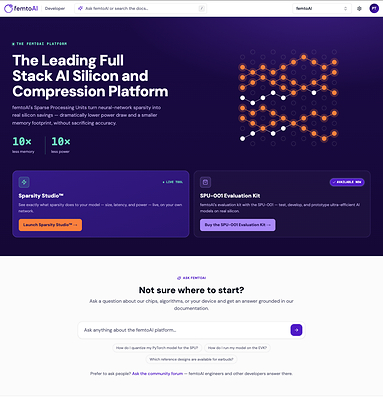
SAN BRUNO, Calif., Oct. 7, 2026 /PRNewswire/ — femtoAI, a leading full-stack AI silicon and compression platform, today announced open access to its developer community after a successful beta program. Developers now will have access to femtoAI’s full-stack compression AI platform including the femtoAI Sparse Processing Unit (SPU) chip evaluation kit, compressed models, compiler and Sparsity Studio™ that easily enable development of new AI powered products. femtoAI technology turns patented neural-network sparsity and advanced model compression into real savings, delivering a 10X lower power draw and 10X smaller memory footprint without sacrificing accuracy. Developers can now see what’s possible with femtoAI tools and systems at developer.femto.ai.

femtoAI developer community

“We’ve been working behind the scenes in our developer community with dozens of enterprises as they create new products based on femtoAI’s unique full-stack AI silicon and compression platform. The time to open this experience to more enterprises and developers is now,” said Bill Hoppin, Chief Business Officer, femtoAI. “Customers such as Legato and Marshall gained a competitive advantage by easily developing and deploying using our developer tools and systems. By now opening up the experience for everyone, we can’t wait to see how developers across all industries innovate with the power of our full-stack AI compression platform.”

Key features of the femtoAI developer community include: 

  • SPU Evaluation Kit: Order your own kit to access the SPU chip
  • Self-service development: Access to the full suite of femtoAI tools, compilers and models
  • Model flexibility: Bring your own model, use one of femtoAI’s prebuilt models, or develop from scratch with easy-to-use tools and agent-friendly documentation readily available.
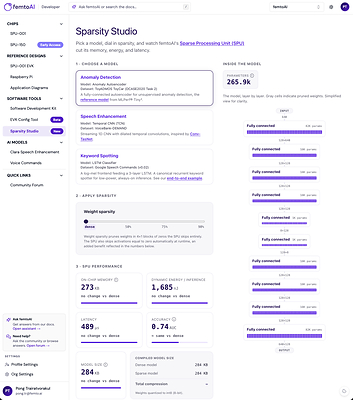
  • Sparsity Studio™: See actual power and memory savings unlocked by femtoAI sparsity with this measurement tool
  • Community Forum: Ongoing open discussion and Q&A with femtoAI experts and developers 

“At femtoAI, not only do we deliver first-class sparsity in both our hardware and software tooling and applications,” said Sangnam Choi, VP of Audio & Sensing at femtoAI, “but we also apply advanced model compression techniques that have allowed us to deliver open-source models such as OpenAI Whisper at 10X less memory, and develop custom solutions like local voice commands.  Our team continues to unearth and implement emerging techniques and methods, and in turn, we’re able to deliver with an even lower power and memory footprint. We’ll continue to push the possibilities on performance without sacrificing accuracy.”

femtoAI developer community enables faster time-to-market

The femtoAI developer platform has already been instrumental for work across femtoAI’s audio and sensing business with customers such as smart glasses disruptors Legato, and headphone and earbud icon Marshall and innovative companies like NewSound have leveraged femtoAI’s technology to build AI enhanced audio solutions with 10X less memory and 10X less power.

“Integrating advanced AI audio solutions on the femtoAI platform has been a tremendous success for us. The combination of easy-to-use tools, innovative capabilities, and amazing support helped us achieve a level of hearing performance for Legato Frames that was previously impossible in the form factor on a remarkable timeline,” Mehul Trivedi, CEO at Legato Hearing said. “We’ve loved working with the femtoAI team and are excited to continue delivering industry-leading products with them. It’s an extraordinarily valuable partnership for Legato, both now and as we grow.”

Join the Community

Meet the femtoAI team on Wednesday October 7 for an SF Tech Week developer happy hour at Barebottle Brewing Company’s beer garden located at Salesforce Park. You’ll enjoy drinks, light bites, and an exclusive walk-through of the developer community from femtoAI experts. RSVP today to join us.

To join our developer community and access the femtoAI platform, visit developer.femto.ai.

About femtoAI 

femtoAI is a leading full-stack AI silicon and compression platform that turns patented neural-network sparsity into real savings for enterprises. Headquartered in Silicon Valley, femtoAI was founded in 2018 by researchers from the Brains in Silicon Lab at Stanford University. femtoAI’s full-stack AI silicon and compression platform enables low-latency, 10X lower power draw and 10X smaller memory footprint for customers like Marshall, NewSound and Legato. From wearables and household appliances to smart glasses and robotics, femtoAI brings the power of AI to every device.

Sparsity Studio™
Sparsity Studio™

Cofounder.AI Names Former Google X Leader AJ Thomas Chief Operating Officer

Venture investor, operator and founder coach joins the AI-native startup to scale partnerships and operations, and brings Cofounder.AI to every Good Trouble Ventures portfolio founder

LOS ANGELES, Oct. 6, 2026 /PRNewswire/ — Cofounder.AI, the venture-backed, AI-native startup leveling the playing field for small business owners and entrepreneurs, today announced that AJ Thomas has joined as Chief Operating Officer. Thomas will lead Partnerships and oversee Finance, Legal and HR alongside CEO Clarence Wooten, her former colleague at Google X, Alphabet’s Moonshot Factory. At Google X, she served as Global Head of Talent & People Products. She is also cofounder of Troublemaker Ventures, home to the venture fund Good Trouble Ventures and the growth advisory firm The Troublemaker Lab.

The appointment brings Thomas’s work full circle. After years of investing in, coaching and championing founders, she will now help build technology that puts that same support in the hands of entrepreneurs everywhere.

“Most small business owners are building alone, without a cofounder, operating leverage or a board to lean on,” said Clarence Wooten, Founder and CEO of Cofounder.AI. “AJ has spent her career giving founders exactly that kind of support, at Google X, as an investor, and as an operator and leadership coach. She knows what it takes to build teams and companies that last, and she’s the right person to scale Cofounder.AI’s partnerships and operations.”

“I’ve sat on every side of the table: operator, investor and leadership coach. The pattern is the same everywhere. Talent is evenly distributed, but support is not,” said Thomas. “Cofounder.AI gives every entrepreneur the operating leverage that used to be reserved for founders with the right network. My job is to make sure humanity and technology get equal weight as we build it, so we can deliver on our mission for the entrepreneurs and small business owners who are the heartbeat of our economy.”

Capital, culture and community

Thomas brings more than 15 years of experience across venture capital, talent and company building. Her work at Troublemaker Ventures, which backs founders and their teams with both capital and hands-on support, runs on three levers:

Capital. As General Partner of Good Trouble Ventures, she invests in founders who challenge the status quo.

Culture. As Managing Partner of The Troublemaker Lab, she coaches founders and enterprise teams on growth strategy, go-to-market, operational rigor and building cultures that hold up under pressure, including adopting AI in ways that sharpen teams rather than replace them.

Community. She connects founders, investors, operators and technologists across AI, emerging tech and venture capital, widening access to the rooms and resources that shape innovation.

At Cofounder.AI, Thomas’s early priorities include expanding university and ecosystem partnerships that bring the platform to student and early-stage founders. She is also a sought-after voice on how AI is reshaping funding, teams and communities; an executive coach and advisor to multiple startups; and a bestselling children’s book author.

Alliance with Good Trouble Ventures

Alongside the appointment, Cofounder.AI and Good Trouble Ventures are forming an alliance partnership. Every current and future Good Trouble Ventures portfolio founder will receive a free one-year Cofounder.AI license, giving them an AI cofounder for fundraising readiness, diligence and day-to-day operations from day one.

“Capital alone doesn’t build a company. Operating leverage does,” said Kat Steinmetz, Cofounder and General Partner of Good Trouble Ventures. “Putting Cofounder.AI in every founder’s hands means our support doesn’t stop when the meeting ends.”

About Cofounder.AI

Cofounder.AI is a venture-backed, AI-native startup leveling the playing field for small business owners and entrepreneurs. Founded by Clarence Wooten, a two-time exited founder and former Executive Entrepreneur in Residence at Google X, Cofounder.AI gives every entrepreneur an AI cofounder to help them plan, fund and run their business.

About Troublemaker Ventures

Troublemaker Ventures is a holding company that backs founders with both capital and hands-on support. It operates through two businesses: Good Trouble Ventures, an early-stage fund investing in category-creating founders, and The Troublemaker Lab, an advisory firm that coaches founders and enterprise teams on growth strategy, financial and operational rigor, and culture.

Media Contact
press@cofounder.ai • 310.400.2434

XtalPi Debuts Kodexia™, the World’s First Closed-Loop siRNA Platform Combining Generative AI with First-Principles Modeling

  • This unified platform integrates sequence design, chemical modification, experimental validation, extrahepatic delivery design, and intellectual property strategy into an integrated computational–experimental workflow, pioneering in vivo efficacy prediction models to accelerate drug development.
  • Validating this infrastructure, XtalPi announced the advancement of six proprietary preclinical programs targeting complex diseases, with the first one reaching NHP data in just 7 months; in utilizing optimized ligand-based delivery mechanisms, XtalPi is advancing RNA interference therapies beyond the liver.
  • Internal preclinical data benchmarking demonstrates a nearly threefold increase in molecular design efficiency compared to conventional workflows, alongside a first-round in vivo hit rate exceeding 50% across multiple target programs.

BOSTON and BEIJING, Oct. 6, 2026 /PRNewswire/ — XtalPi Holdings Limited (HKEX: 2228), an AI and robotics-driven drug and materials discovery company, today debuted Kodexia™, the industry’s first closed-loop small interfering RNA (siRNA) discovery platform combining generative AI, first-principles-driven biological modeling, and automated experimentation. Validating the rapid execution capabilities of this new infrastructure, the company simultaneously announced the advancement of six proprietary therapeutic programs, marking the successful expansion of XtalPi’s technology into nucleic acid therapeutics.

By silencing disease-driving genes upstream of protein production, siRNA therapeutics offer immense potential for biological targets that conventional modalities struggle to address. However, clinical development remains heavily constrained by fragmented sequence and modification design processes, restrictive patent barriers, inconsistent translation from cellular assays to animal models, and severe limitations in extrahepatic delivery.

To address these interdependent bottlenecks, XtalPi drew on domain-specific expertise to develop siFormer, the proprietary architecture at the core of Kodexia™. By seamlessly integrating RNAi biological mechanisms with nucleic acid chemistry principles, siFormer delivers a qualitative leap in predictive accuracy that surpasses conventional design baselines. The architecture incorporates RNA thermodynamics and structural features relevant to strand loading, target accessibility, and silencing efficiency. These mechanistic constraints guide molecular generation toward biologically plausible designs rather than relying on sequence correlations alone. Through this unified approach, Kodexia™ enables researchers to systematically balance potency, in vivo translation, durability, off-target activity, safety, and patentability instead of optimizing single endpoints in isolation.

To execute this multiparameter optimization, XtalPi utilizes a closed-loop process of computational design, automated experimentation, and empirical feedback. Generative models and the proprietary siFormer architecture operate continuously with XtalPi’s automated laboratories, which conduct more than 500 in vitro and 30 in vivo experiments weekly. This seamless integration enables the parallel development of multiple target programs, yielding a nearly threefold increase in design efficiency. Notably, more than 50% of first-round designs tested across multiple programs showed stronger in vivo activity than positive controls.

Kodexia™ also globally co-optimizes dual-target siRNAs as single molecules, creating a strategy for disease biology that may not be adequately addressed through single-target intervention. For extrahepatic delivery, the platform co-designs siRNA molecules with their targeting systems and applies multi-objective optimization to antibody, peptide, and small-molecule conjugates. These capabilities are being applied to delivery research targeting the kidney, spleen, and adipose tissue.

The platform’s lead program in immunoglobulin A (IgA) nephropathy serves as an early empirical validation of this unified architecture. The program reached non-human primate efficacy data within seven months, demonstrating greater activity and durability than a clinical-stage reference molecule targeting the same target. The program is on track for preclinical candidate selection within a nine-month project timeline, significantly accelerating the industry norm of 12 to 18 months.

Kodexia™ currently drives six proprietary programs across metabolic, renal, respiratory, and central nervous system diseases, with more than half having already completed in vivo efficacy evaluations. Each internal program generates high-value experimental data that feeds directly back into the platform’s models, reinforcing a continuous cycle of discovery and commercial translation. As a global scientific utility platform, XtalPi leverages this capability alongside its established expertise in small molecules, antibodies, and peptides. By advancing these internal assets in tandem with established industry collaborations, XtalPi empowers its partners to pursue high-value targets using the modality best suited to the mechanistic and biophysical principles of RNA interference, including RNA thermodynamics and structural features, ultimately accelerating the delivery of next-generation RNA therapies for patients worldwide.

About XtalPi

XtalPi Holdings Limited (XtalPi, 2228.HK) was founded in 2015 by three physicists from the Massachusetts Institute of Technology (MIT). It is an innovative R&D platform powered by quantum physics, artificial intelligence, and robotics. By integrating first-principles calculations, AI algorithms, high-performance cloud computing, and standardized automation systems, XtalPi provides digital and intelligent R&D solutions for companies in the pharmaceutical, materials science, agricultural technology, energy, new chemicals, and cosmetics industries.

Railtown AI Launches Native Swift Agent Development Technology for the Next Generation of Agentic Applications

New Railtracks for Swift ADK and Railengine Swift SDK bring native agent development, cross-device context, and accountability to Apple platforms as Railtown advances its vision for private, secure, and observable agentic software.

Vancouver, British Columbia – Newsfile Corp. – October 6, 2026 – Railtown AI Technologies Inc. (CSE: RAIL) (OTCQB: RLAIF) (“Railtown” or the “Company“) today announced the launch of a native Railtracks Agent Development Kit (ADK) for Swift and a new Swift SDK for Railengine, bringing Railtown’s agentic application infrastructure directly into the development ecosystem used to build applications across Apple platforms.

The launch reflects a broader conviction at Railtown: Apple’s ecosystem has the potential to become one of the defining platforms for the next generation of agentic software.

Software is beginning to move beyond applications that simply wait for users to tell them what to do. The next generation of applications will increasingly understand context, reason across information, use tools, collaborate with other agents and take actions on a user’s behalf.

That transition changes what developers need from a computing platform.

Agents need intelligence, but intelligence alone is not enough. They need context. They need to move with users across their digital lives while respecting privacy and security. And as agents become capable of taking increasingly consequential actions, users and enterprises need visibility and accountability into what those agents are doing.

Railtown believes Apple’s combination of devices, silicon, native development technologies, on-device intelligence, privacy architecture and tightly integrated ecosystem creates a compelling foundation for this emerging model of computing.

Railtown is building the agentic infrastructure around that foundation.

Building Agentic Applications Natively in Swift

Swift has become central to the native development experience across Apple platforms, including iPhone, iPad, Mac, Apple Watch and Apple Vision Pro.

Railtown’s new Railtracks ADK for Swift brings its agent development technology directly into that environment, giving Swift developers native building blocks for creating agentic applications, including agents, tools, orchestration, workflows and multi-agent systems.

Rather than treating AI as an external service simply connected to an application, Railtown believes agentic capabilities should increasingly become a native part of the application architecture itself.

Railtracks for Swift is designed to allow developers to combine agentic reasoning with the frameworks, models and capabilities available across Apple platforms, opening the door to a new generation of applications that can understand, reason and act within the environments where users already work, communicate and create.

From Individual Devices to Continuous Agentic Experiences

Railtown is also bringing Railengine to Swift through a new native SDK, providing developers with a contextual intelligence layer for agentic applications.

The future of personal agents will not be confined to a single application session or a single device.

A user may capture information on an iPhone, continue working on a Mac and later interact with an agent that needs to understand the context of both experiences. For an agent to become genuinely useful, it must be capable of retrieving the right context at the right moment without requiring users to repeatedly reconstruct that context themselves.

Railengine is designed to help make that possible.

Within Railtown’s architecture, personally identifiable information remains in the data layer and is retrieved from iCloud, allowing applications to access relevant context while preserving the separation between personal identity information and the intelligence systems using that context.

This creates the foundation for continuous agentic experiences across Apple devices designed around privacy from the beginning.

The result represents a fundamentally different approach to AI applications:

Intelligence that follows the user’s context rather than requiring the user’s data to follow the AI.

Intelligence Requires Accountability

As software gains agency, Railtown believes another principle becomes increasingly important:

The more autonomy software receives, the more accountable it must become.

Traditional software is largely deterministic. Agentic software can reason, select tools, generate responses, interact with other systems, and take actions.

That means developers increasingly need to understand not only whether an application failed, but what an agent did, which tools it used, how it behaved and why a particular outcome occurred.

Railtown is extending its observability technology into the Swift development lifecycle so developers can inspect agent executions, understand tool usage, evaluate behaviour, and diagnose failures as they build.

Railtown’s Conductr platform extends that accountability model into production through centralized agent observability, error analysis, and root cause analysis.

For enterprises, Railtown is also developing an architecture designed to provide visibility and governance across agentic applications from multiple developers while maintaining appropriate boundaries between enterprise information, individual privacy, and developer intellectual property.

Together, Railtown’s technology creates a continuous agentic software lifecycle:

Build → Understand → Deploy → Observe → Improve

Apple as a Platform for the Agentic Era

Railtown believes the emergence of agents represents more than another generation of applications. It has the potential to change the relationship between users, applications and the operating platforms connecting them.

Personal agents will need access to context across applications and devices.

Enterprise agents will need to operate within organizational security and governance boundaries.

Developers will need native frameworks and infrastructure for building them.

And users will need confidence that increasingly autonomous software remains private, secure, and understandable.

Railtown believes few technology ecosystems bring those requirements together as naturally as Apple’s.

Apple has spent decades building the hardware, operating systems, silicon, development frameworks, and privacy architecture used by developers to create applications that operate across an increasingly connected family of personal devices. Railtown believes that same foundation could enable an emerging generation of third-party agentic applications capable of moving with users across their digital lives.

“AI becomes much more powerful when it understands the context around us, but that cannot require giving up control of our personal information,” said Marwan Haddad, Co-Founder and CTO of Railtown AI. “Apple has spent years building an ecosystem around privacy, security, integrated devices, and native developer experiences. We believe those principles become even more important, not less important, as software becomes agentic.”

Railtown’s strategy is to provide the infrastructure developers need to build on that foundation:

Railtracks for Swift provides the agent development layer.

Railengine for Swift provides the contextual intelligence layer.

Railtown observability and Conductr provide the accountability layer.

Together, these technologies are designed to help developers build a new generation of personal and enterprise applications that can understand context, reason and act while remaining private, visible, and accountable.

“We believe some of the most important agentic applications of the next decade can be built across the Apple ecosystem,” added Haddad. “Our goal is to give developers the infrastructure to build them and to help ensure that as these applications become more capable, they also become more accountable.”

“We believe Apple’s ecosystem could become a major platform for agentic applications, creating a significant opportunity for developers and for Railtown,” said Cory Brandolini, CEO of Railtown AI. “But while customers often hear how quickly someone can build an AI agent, the question is whether that agent is ready to be trusted with their business. SMEs need applications built to rigorous standards for reliability, privacy, security and accountability-the trust we believe Apple’s App Store model has helped establish. Our strategy is to provide the infrastructure developers need to earn that trust, from building agents and connecting them to relevant context to understanding how they behave in production. Bringing Railtracks and Railengine to Swift is an important step toward that goal.”

About Railtown AI
Railtown AI Technologies Inc. develops infrastructure for building and operating AI agents and agentic applications. Railtown’s technology spans agent development through Railtracks, contextual intelligence through Railengine, and production observability and management through Conductr.

Railtown’s mission is to help developers and organizations build agentic software that is powerful, contextual, private, and accountable.

For more information, visit www.railtown.ai.

www.railtracks.org
www.railengine.ai
www.conductr.ai

Follow us on social media

SUBSCRIBE FOR INVESTOR NEWS
Click here to receive our latest investor news alerts.

ON BEHALF OF THE BOARD
“Cory Brandolini”
Cory Brandolini, Chief Executive Officer

INVESTOR CONTACT
Investor Relations Contact
Email: investors@railtown.ai
Phone: 1-778-918-8384

This news release contains forward-looking statements relating to the future operations of the Company and other statements that are not historical facts. Forward-looking statements are often identified by terms such as “will,” “may”, “should”, “intends”, “anticipates”, “expects” and similar expressions. All statements other than statements of historical fact included in this release, including, without limitation, statements regarding the future plans and objectives of the Company, the commencement of trading of the Company’s common shares on the CSE, are forward-looking statements that involve risks and uncertainties. There can be no assurance that such statements will prove to be accurate and actual results and future events could differ materially from those anticipated in such statements. Important factors that could cause actual results to differ materially from the Company’s expectations are risks detailed from time to time in the filings made by the Company with securities regulators.

Readers are cautioned that assumptions used in the preparation of any forward-looking information may prove to be incorrect. Events or circumstances may cause actual results to differ materially from those predicted, as a result of numerous known and unknown risks, uncertainties, and other factors, many of which are beyond the control of the Company. As a result, the Company cannot guarantee that any forward-looking statement will materialize, and readers should not place undue reliance on any forward-looking information. Such information, although considered reasonable by management at the time of preparation, may prove to be incorrect and actual results may differ materially from those anticipated. Forward-looking statements contained in this news release are expressly qualified by this cautionary statement. The forward-looking statements contained in this news release are made as of the date of this news release and the Company will only update or revise publicly any of the included forward-looking statements as expressly required by Canadian securities law.

The issuer is solely responsible for the content of this announcement.

NANO Nuclear Energy Appoints Former Y-12 Leader and Nuclear Fuel Cycle Expert Jennifer Charlton, Ph.D., as Vice President of Fuel Technology to Accelerate Vertical Integration Strategy

New York, New York – Newsfile Corp. – October 6, 2026 – NANO Nuclear Energy Inc. (NASDAQ: NNE) (“NANO Nuclear” or “the Company”), a leading advanced nuclear micro modular reactor and technology company focused on developing clean energy solutions, nuclear fuel cycle capabilities and nuclear transportation solutions, today announced that it has hired Jennifer Charlton, Ph.D., as its Vice President of Fuel Technology.

Dr. Charlton brings nearly two decades of experience in nuclear materials, uranium processing, fuel-cycle technology, and advanced manufacturing to NANO Nuclear. Prior to joining NANO Nuclear, Dr. Charlton held several senior technical and leadership positions at the Y-12 National Security Complex. Notably, she served as Chief Scientist and U.S. Lead for Nuclear Material Verification, leading technical initiatives and providing comprehensive technical expertise across the nuclear fuel cycle, from uranium mining and milling through conversion, enrichment, fuel fabrication, and finished fuel and weapons component operations.

“NANO Nuclear’s strategic focus on building capabilities across key areas of the nuclear fuel cycle is an important part of supporting its long-term microreactor deployment strategy,” said Jennifer Charlton, Ph.D., Vice President of Fuel Technology of NANO Nuclear Energy. “I’m excited to join the team at this important stage of its growth and leverage my experience leading complex technical initiatives to help advance this strategy and strengthen NANO Nuclear’s capabilities across the fuel cycle.”

Figure 1 – NANO Nuclear Energy Hires Former Y-12 Leader and Nuclear Fuel Cycle Expert, Jennifer Charlton Ph.D. as its Vice President of Fuel Technology.

To view an enhanced version of this graphic, please visit:
https://images.newsfilecorp.com/files/11703/317616_08bb19ec343c59a3_002full.jpg

Dr. Charlton earned a Ph.D. in Chemistry from the University of Tennessee, a Bachelor of Science in Chemistry from the University of North Florida, and an Associate of Arts from Florida State College. Her graduate research encompassed automated radiochemical separations, nanofabrication, surface-enhanced spectroscopy, mass spectrometry, instrumentation development, nuclear forensics, trace-level materials analysis, and materials characterization.

“It is a pleasure to welcome Dr. Charlton to the NANO Nuclear team,” said Jay Yu, Founder and Chairman of NANO Nuclear Energy. “Her addition marks another step towards ensuring that we have the right personnel to oversee NANO Nuclear’s long-term strategic focus on vertical integration. Her experience within the Y-12 National Security Complex will be invaluable as we look to expand our capabilities across the nuclear fuel cycle.”

Dr. Charlton joins a growing list of former senior nuclear leaders and builds on NANO Nuclear’s recently announced addition of Marylin Diaz to support the Company’s expansion across the nuclear fuel cycle. In her role as Vice President of Fuel Technology, Dr. Charlton will be responsible for evaluating opportunities to expand NANO Nuclear’s capabilities across the nuclear fuel cycle and leading the design, engineering, and development of related technologies, with a focus on the uranium conversion, deconversion, and fuel fabrication processes. She will also provide technical expertise to inform strategic decisions regarding NANO Nuclear’s broader vertical integration strategy in support of future advanced reactor deployments and nuclear logistics activities.

“As our core, proprietary technology, the KRONOS MMR™ Energy System, continues along its development pathway, we are working to expand across the nuclear fuel cycle to help de-risk the marketplace as well as support the energy sovereignty of the United States,” said James Walker, Chief Executive Officer of NANO Nuclear Energy. “Dr. Charlton’s appointment is a key step in that effort, and I am delighted to welcome her to the Company. I believe that Dr. Charlton’s addition, as well as her experience and knowledge of the inner workings of the fuel cycle will prove to be incredibly important as we continue to put together the building blocks for our next stages of growth.”

About NANO Nuclear Energy, Inc.
NANO Nuclear Energy Inc. (NASDAQ: NNE) is a North American advanced technology-driven nuclear energy company seeking to become a commercially focused, diversified, and vertically integrated company across five business lines: (i) cutting edge portable and other microreactor technologies, (ii) nuclear fuel supply chain, (iii) nuclear fuel transportation, (iv) nuclear applications for space and (v) nuclear industry consulting services.

Led by a world-class nuclear engineering team, NANO Nuclear’s reactor products in development include the proprietary KRONOS MMR™ Energy System, a stationary high-temperature gas-cooled reactor that is in construction permit pre-application engagement U.S. Nuclear Regulatory Commission (NRC) in collaboration with University of Illinois Urbana-Champaign, the ZEUS™ system, a portable solid core battery reactor, and the space focused, portable LOKI MMR™ system, each representing advanced developments in clean energy solutions that are portable, on-demand capable, advanced nuclear microreactors.

Advanced Fuel Transportation Inc. (AFT), a NANO Nuclear subsidiary, bolstered by the May 2026 acquisition of Secured Transportation Services (STS), is led by former executives from the largest transportation company in the world and provides nuclear engineering and materials transport services in the U.S. and globally. Through NANO Nuclear, AFT is the exclusive licensee of a patented high-capacity HALEU fuel transportation basket developed by three major U.S. national nuclear laboratories and funded by the Department of Energy.

HALEU Energy Fuel Inc. (HEF), a NANO Nuclear subsidiary, is focusing on the future development of a domestic source for a High-Assay, Low-Enriched Uranium (HALEU) fuel fabrication pipeline for NANO Nuclear’s own microreactors as well as the broader advanced nuclear reactor industry.

NANO Nuclear Space Inc. (NNS), a NANO Nuclear subsidiary, is exploring the potential commercial applications of NANO Nuclear’s developing micronuclear reactor technology in space. NNS is focusing on applications such as the LOKI MMR™ system and other power systems for extraterrestrial projects and human sustaining environments, and potentially propulsion technology for long haul space missions. NNS’ initial focus will be on cis-lunar applications, referring to uses in the space region extending from Earth to the area surrounding the Moon’s surface.

For more corporate information please visit: https://NanoNuclearEnergy.com/

For further NANO Nuclear information, please contact:
Email: IR@NANONuclearEnergy.com
Business Tel: (212) 634-9206

PLEASE FOLLOW OUR SOCIAL MEDIA PAGES HERE:
NANO Nuclear Energy LINKEDIN
NANO Nuclear Energy YOUTUBE
NANO Nuclear Energy X PLATFORM

Cautionary Note Regarding Forward Looking Statements
This news release and statements of NANO Nuclear’s management and collaborators in connection with this news release contain or may contain “forward-looking statements” within the meaning of Section 21E of the Securities Exchange Act of 1934, as amended, and the Private Securities Litigation Reform Act of 1995. In this context, forward-looking statements mean statements related to future events, which may impact our expected future business and financial performance, and often contain words such as “expects”, “anticipates”, “intends”, “explore,” “plans”, “aim,” “goal,” “believes”, “potential”, “future,” “will”, “should”, “could”, “would” or “may” or derivations of these words and other words of similar meaning about the future, although forward-looking statements could be denoted by other terms as well. In this press release, forward-looking statements relate to the anticipated benefits of Dr. Charlton joining the Company, as well as the Company’s vertical integration and other operational plans and goals. These and other forward-looking statements are based on information available to us as of the date of this news release and represent management’s current views and assumptions. Forward-looking statements are not guarantees of future performance, events or results and involve significant known and unknown risks, uncertainties and other factors, which may be beyond our control. For NANO Nuclear, particular risks and uncertainties that could cause our actual future results to differ materially from those expressed in our forward-looking statements include but are not limited to, risks associated with conditions to closing the asset purchase agreement, which may not be satisfied, including for reasons beyond NANO Nuclear’s control, as well as the following: (i) risks related to our U.S. Department of Energy (“DOE”), U.S. Nuclear Regulatory Commission (“NRC”), Canadian Nuclear Safety Commission (“CNSC”) or related state or other U.S. or non-U.S nuclear licensing submissions, (ii) risks related the development of new or advanced technology and the acquisition of complementary technology or businesses, including difficulties with design and testing, cost overruns, regulatory delays, integration issues and the development of competitive technology, (iii) risks related to our ability to obtain key vendor, technology and customer contracts and the significant funding necessary to execute on our business plan, (iv) risks related to uncertainty regarding our ability to technologically develop and commercially deploy a competitive advanced nuclear reactor or other technology in the timelines we anticipate, if ever, (v) risks related to the impact of U.S. and non-U.S. government regulation, policies and licensing requirements, including by the U.S. Department of Energy, and the NRC, including those associated with the recently enacted ADVANCE Act and the May 23, 2025 Executive Orders seeking to streamline nuclear regulation, and (vi) similar risks and uncertainties associated with the operating a developing business a highly regulated, competitive and rapidly evolving industry, including that our plans may change and we may use our cash on hand faster or in different ways than anticipated as our business requires. Readers are cautioned not to place undue reliance on these forward-looking statements, which apply only as of the date of this news release. These factors may not constitute all factors that could cause actual results to differ from those discussed in any forward-looking statement, and NANO Nuclear therefore encourages investors to review other factors that may affect future results in its filings with the SEC, which are available for review at www.sec.gov and at https://ir.nanonuclearenergy.com/financial-information/sec-filings. Accordingly, forward-looking statements should not be relied upon as a predictor of actual results. We do not undertake to update our forward-looking statements to reflect events or circumstances that may arise after the date of this news release, except as required by law.

The issuer is solely responsible for the content of this announcement.

Silicon Quantum Computing Named to Fast Company’s 2026 Next Big Things in Tech List

SQC’s quantum-enhanced AI chip Watermelon™ recognized for its ability to make classical models faster, more efficient and less resource-intensive

SYDNEY, Oct. 6, 2026 /PRNewswire/ — Silicon Quantum Computing (SQC), a pioneer in quantum computing and atomic-precision manufacturing, today announced that its quantum-enhanced AI system, Watermelon™, has been named to Fast Company’s 2026 Next Big Things in Tech list. The annual list recognizes breakthrough technologies with the potential to transform industries and shape the future.

A digital render of SQC’s Watermelon system.

Fast Company recognized Watermelon in the Computing, Chips, and Foundational Technology category for its breakthrough approach to quantum-classical computing. Launched in October 2025, Watermelon is the world’s first commercial quantum reservoir computer, leveraging SQC’s atomic manufacturing capabilities. The system generates quantum-enhanced features from classical data to uncover complex relationships in sparse and time-series datasets, and can also be used as an offload resource to train AI models more efficiently.

Watermelon is built for global enterprises where AI training costs, energy consumption and time-to-insight directly affect operational outcomes. In commercial trials Telstra, Australia’s largest telecommunications provider, Watermelon reduced the training time of a predictive network model from weeks to days. More recently, results with Schneider Electric, a global energy technology leader, showed Watermelon improved the accuracy of home energy forecasting models by up to 41% against the classical benchmark.

“We’re honored to receive this recognition, which reflects more than two decades of excellence in atomic-precision hardware engineering,” said Michelle Simmons, Founder & CEO of Silicon Quantum Computing. “Today’s performance edge will become a structural shift in how organizations approach AI: moving workloads away from energy-intensive GPUs toward quantum-classical systems that can deliver better results with fewer resources.”

Fast Company’s Next Big Things in Tech recognizes innovative technologies developed by established companies, startups and research teams that are making meaningful progress toward transforming the lives of consumers, businesses and society. This year’s honorees span industries, with each innovation demonstrating the potential to create significant impact in the years ahead.

“The most exciting technology innovations are the ones that move beyond promise to demonstrate real potential for impact,” said Brendan Vaughan, editor-in-chief of Fast Company. “The companies and teams recognized on this year’s list are tackling ambitious problems with new ideas, products, and approaches that have the potential to fundamentally shape the years ahead.”

For more information or to view the complete Fast Company 2026 Next Big Things in Tech list, visit here.

About Silicon Quantum Computing

Silicon Quantum Computing (SQC) is at the forefront of global efforts to deliver a commercial-scale quantum system. Backed by 25 years of technological leadership, SQC holds a singular advantage: exclusive capability to manufacture silicon chips with atomic precision, enabling quantum computing systems with world-leading algorithmic fidelity. With in-house QPU manufacturing, SQC iterates new chips weekly while delivering quantum-enhanced AI and materials simulation systems to customers today. The company was founded in 2017 and is headquartered in Sydney, Australia.

For more information, visit www.sqc.com or follow SQC on LinkedIn.

About Fast Company 

Fast Company is the only media brand fully dedicated to the vital intersection of business, innovation, and design, engaging the most influential leaders, companies, and thinkers on the future of business. Headquartered in New York City, Fast Company is published by Mansueto Ventures LLC, along with fellow business publication Inc. For more information, please visit fastcompany.com. 

Vermiculus Launches AI-Powered, Configurable Corporate Action System

VeriAct, Vermiculus corporate action system, enables market infrastructures to manage any corporate action event type through a fully configurable, cloud-native system with complete transparency, automation, and scalability.

STOCKHOLM, Oct. 6, 2026 /PRNewswire/ — Vermiculus, a global independent provider of market infrastructure technology, today announced the launch of VeriAct corporate action system, a cloud-native solution designed to handle the full lifecycle of corporate action processing.

The corporate action system features fully configurable event types, formulas, and tax rules, allowing organizations to respond quickly to new market demands. Explicit and auditable outcome logic provides complete transparency and traceability throughout the processing chain, while comprehensive notification capabilities keep market participants informed throughout the event lifecycle.

The system is designed to handle both official processing and simulations with equal precision, making it suitable for any system that depends on corporate action results. It efficiently processes complex scenarios by parameterizing any event type invented in the market, while ensuring accurate outcomes and consistent delivery to downstream systems.

“Corporate actions require market infrastructures to manage a constantly evolving range of event types. With our new AI-powered corporate action system, we’ve made that process dramatically simpler and more flexible,” said Gustav Nystedt, Senior Product Expert at Vermiculus. “With this launch, we are providing market infrastructures with a flexible product built for change that can manage any event types, regulatory requirements, and local market practices without lengthy hard-code projects.”

The VeriAct corporate action system is used by clients such as B3, one of the world’s largest market infrastructure operators. Built on a microservices architecture, the system offers flexible deployment options and seamless interoperability through message-based integration. Individual components can operate independently, enabling high-performance processing while isolating workloads and simplifying integration with existing market infrastructure environments.

The VeriAct corporate action system is available as a stand-alone solution or as part of Vermiculus’ broader portfolio of cloud-native systems supporting trading, clearing, and CSD operations.

About Vermiculus

Vermiculus Financial Technology AB provides best-in-class trading, clearing, and CSD solutions to market participants around the world. Vermiculus’ solutions are the first to bring state-of-the-art advances in dynamic microservice architecture together with vast experience in clearing house, exchange, and CSD business requirements.

The company started its operation in 2020 and is founded by industry experts with the incentive to revolutionize the technology of exchanges, clearing houses, and CSDs. With its headquarters in Stockholm, Sweden, Vermiculus consists of hand-picked teams, trained to deliver mission-critical solutions. Learn more at vermiculus.se

For further information, please contact:

Amelie Hedenstierna – PR & Communications 
Vermiculus Financial Technology
Tel +46-(0)73 622 24 54
amelie.hedenstierna@vermiculus.se

This information was brought to you by Cision http://news.cision.com

https://news.cision.com/vermiculusft/r/vermiculus-launches-ai-powered–configurable-corporate-action-system,c4405104

The following files are available for download:


Currie & Brown research: uncertainty adds almost $2 trillion to global construction costs

Annual Construction Certainty Index reveals how higher-maturity organisations are building resilience through disruption

LONDON, Oct. 6, 2026 /PRNewswire/ — Uncertainty has added an average 12.4% to construction project pipeline costs globally over the past year. Applied to forecast global construction spending, that equates to almost US$2 trillion in 2026.

The findings come from Currie & Brown’s annual Construction Certainty Index, based on a survey of more than 1,300 construction and infrastructure decision-makers across the Americas, Europe and Asia-Pacific.

Confidence has fallen in meeting every project target. Fewer than half of organisations (46%) are now confident they can meet deadlines. Only 40% are confident about staying within budget – falls of 12 and 14 percentage points respectively from last year.

Material cost inflation has a high impact on project delivery for 70% of respondents, followed by energy price volatility (64%) and supply chain disruption (59%). Organisations expect most risks to intensify further.

The consequences are already visible. On average, respondents report that 30% of projects have been delayed over the past year and 27% descoped. A further 31% of potential projects have not started or progressed beyond planning because of uncertainty.

Dr Alan Manuel, Group Chief Executive Officer at Currie & Brown, said: “Organisations can’t afford to lurch from one crisis to the next or simply wait for calmer conditions. Those that are resilient to uncertainty share common characteristics. They’re investing in the people, technology and data that enable them to gain an earlier, clearer view of where they are exposed – and the judgement and skills they need to take action.”

The research identifies a distinct group of ‘higher-maturity’ organisations that follow this approach. Representing 32% of respondents, they invest strategically in AI, digital technology, data analytics, sustainability, skills and training.

These organisations are considerably more confident of meeting their targets. Almost six in ten (58%) are confident they will meet project deadlines, compared with 41% of the rest of the sample. They also experience fewer severe impacts from uncertainty.

Delivering through disruption: Currie & Brown Construction Certainty Index explores the drivers and impact of uncertainty and how organisations can build resilience.

About Currie & Brown

Currie & Brown is a world-leading project management, cost management and advisory services firm. We help clients deliver with certainty across every sector and stage of the project lifecycle.