2–4 October 2026 | Preview
5–7 October 2026 | Auctions
Six Pacific Place, Hong Kong
HONG KONG, Oct. 3, 2026 /PRNewswire/ — Poly Auction Hong Kong is pleased to present its Autumn Auctions 2026 Hong Kong Preview and Auctions, a highlight of the autumn auction season, with the preview now open at Six Pacific Place, Hong Kong from 2 to 4 October, and the auctions to follow from 5 to 7 October.
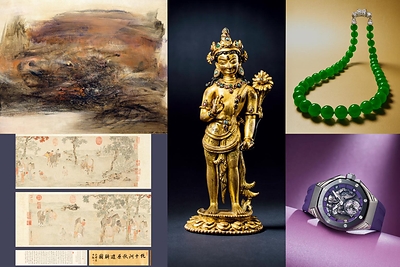
This season spans four collecting categories: Modern and Contemporary Art; Chinese Ceramics and Works of Art; Chinese Paintings and Calligraphy; and Jewels & Watches. The selection brings together important works of art-historical significance and strong collector interest. Highlights range from the expansive abstraction of ZAO WOU-KI’s 01.06.65 to QIU YING’s Autumn Ride on the Plains, a treasure formerly in the Qing imperial collection; from A GILT-COPPER STANDING FIGURE OF MANJUSHRI KHASA MALLA KINGDOM, NEPAL, 13TH CENTURY, BURMESE ‘PIGEON’S BLOOD’ RUBY AND DIAMOND NECKLACE, and A fine and rare limited edition Royal Oak Concept Black Panther Flying Tourbillon manual winding titanium watch, Circa 2021. Together, these works offer a compelling encounter between Eastern and Western aesthetics.
Modern and Contemporary Art
This season, the Modern and Contemporary Art Department brings together outstanding works by leading Chinese modern and contemporary masters and internationally acclaimed artists, tracing an artistic spectrum that spans modernity and the contemporary era, East and West. The sale also features diverse practices by women artists, charting developments from traditional media to digital creation, alongside works by a new generation of artists. Together, they offer collectors a selection distinguished by its art-historical depth and market rarity.
Among the highlights is Wu Guanzhong’s Old Riverside Trees, painted in 1977 at a pivotal moment in his transition from figuration to semi-abstraction. From Qianling Mountain through the White-bark Pine series to this work, Wu progressively distils the tree from its natural setting, until its structure becomes the structure of the painting itself. The old tree remains recognisable, yet its trunk becomes a bold diagonal entering from the right, crossing the center and extending towards the upper left, before branching into curves and finer lines. The world behind it is radically simplified: distant mountains become planes, fields become blocks of color, houses become dots, and the stream becomes a reserve of white. Reflections are suggested with economical brushwork, setting presence against absence and challenging conventional perspective. The languages of oil painting and ink painting permeate one another. Calligraphic branches convey the spontaneity of cursive script, while a palette of black, white and grey, enlivened by bright accents, creates an atmosphere of quiet refinement. Mountains become planes, houses become dots, and trees become lines: Wu had already clearly established the structure of “dots, lines and planes” by 1977.”Form may take flight into abstraction, but its connection to life must never be severed.” Old Riverside Trees gives the tree a second life in abstraction, embodying the essential boundary Wu established between the figurative and the abstract.
Another leading highlight is Zao Wou-Ki’s 01.06.65, painted in 1965 at the height of his artistic powers. It embodies the pure and free personal language he developed through his immersion in Eastern and Western cultures. A warm band of ochre-orange light traverses the upper register, while black, brown, grey-purple and ochre-red interweave at the center. Flying-white, scumbled and impasto passages interlace, evoking a primordial state in which heaven and earth take shape and vital breath moves. The Chinese understanding of qi is reinterpreted through the material qualities of modern oil painting. An inscription on the reverse dedicates the work to the distinguished French art historian André Chastel and his wife, Paule-Marie. It bears witness both a close friendship and Zao’s place at the heart of Parisian intellectual circles. Calligraphic brushwork and abstract structure permeate one another, as color and space bring each other into being. Making invisible light, time and breath visible, the painting moves beyond a synthesis of East and West to the essence of painting itself.
A leading exponent of Cynical Realism in the 1990s, Liu Wei brought together political memory, bodily desire and a sense of decay in series such as Revolutionary Family and You Like Pork? The present sale features a markedly different work, Landscape, which marks an important transition from the politically charged imagery of his 1990s Cynical Realism towards an inwardly felt expression of nature. A vast expanse of green grass fills the canvas, creating a poetic tension between flourishing life and decay. The human figure has withdrawn, its fleshiness transformed into vegetation, signaling the maturation of Liu’s pictorial language. The work combines Richter’s deconstruction through blur with the spirit of Chinese landscape painting and Liu’s distinctive experience of the body. Featured in the landmark 2008 solo exhibition My Landscape – Liu Wei and inspired by everyday scenes in Songzhuang, it is a rare monumental work from the artist’s landscape series.
The sale also presents Big Ear, painted in 1992 by Yue Minjun, another leading exponent of Cynical Realism. The work marks the emergence of his personal visual language and bears witness to Chinese contemporary art’s turn towards individual expression. After moving to the Yuanmingyuan artists’ village in Beijing, Yue stepped outside his previous framework of practice and began depicting the companions around him. Although based on real friends, the figures already show the closed eyes and tooth-baring smiles that would become his signature, occupying a transitional space between realistic portraiture and symbolic imagery. The enormous ear on the right, occupying almost a third of the composition, is particularly striking. Its deliberately distorted proportions create an absurd tension between laughter and listening, anticipating his continued exaggeration of bodily features. The smiles are not yet fully standardised and retain a raw directness, while already suggesting an ambiguous mixture of joy, embarrassment and estrangement. This echoes Cynical Realism’s departure from grand narratives. The work captures an era of loosening collective values and emerging consumer culture, while opening a new aesthetic path for contemporary Chinese oil painting.
Also featured is The Arrival of Spring in Woldgate, East Yorkshire in 2011 (twenty eleven) – 30 April 2011, an iPad drawing printed on paper by David Hockney, who passed away earlier this year. Executed in 2011, the present work is number 3 from a limited edition of 25. It is the first in the series to appear at auction in Asia, marking an important moment in digital art’s entry into the highest levels of the international market. The work records the decisive arrival of spring on 30 April: blossoms crowd the branches, lush greens fill the landscape, and the sky is a clear blue. With delicate digital brushwork, Hockney captures the shifting textures of flowers and grass, conveying the quiet poetry of everyday life in the English countryside. He inherits the Impressionists’ fascination with fleeting light and seasonal change, while using the iPad’s zoom function to add minute marks, combining the immediacy of working from life with carefully considered composition. Of the series’ 94 digital landscapes, 51 were selected to print. Other impressions of this work have been exhibited at the Royal Academy of Arts in London and the Guggenheim Museum Bilbao, establishing its place in a significant dialogue between digital creation and traditional aesthetics.
The sale also embraces diverse practices by women artists. Yuan Jai’s Age of Bloom was executed in 1998, during her mature period. At first glance, it remains a Chinese landscape: blue-and-green mountains, golden slopes and scattered trees preserve a familiar visual order. Yet, as we enter the painting, seemingly weighty rock formations soften, resembling textiles, folds of fabric, folded paper and disassembled geometric planes of color. From a distance, they are mountains; up close, they dissolve into color, edges and shapes. Yuan does not abandon Chinese landscape painting but opens it anew from within. Literati and court painting, objects, crafts and folk decoration all become a repertoire of forms for her to dismantle, recolor and reassemble. The visual experience of her mature work extends well beyond the traditional system of literati painting.
If Yuan Jai engages with a repertoire of forms shaped by a millennium of culture, Kei Imazu confronts the ever-expanding image database of the digital age. Mermaids draws on 18th-century accounts of the “Amboina Mermaid” associated with the Dutch East India Company. After moving to Indonesia in 2018, the artist began drawing on historical archives, museum objects, online imagery and local folklore, dismantling and layering them to create a distinctive pictorial world. Rather than simply illustrating an old legend, the painting resembles a dream generated by a database, with history, mythology, the colonial gaze and contemporary digital imagery floating together on the canvas. Her question is not whether mermaids exist, but how much of an image’s original identity remains after it has been repeatedly described, classified and reproduced.
Chinese Ceramics and Works of Art
Chinese Ceramics and Works of Art Department presents a selection of rare, exceptional objects with distinguished provenance. Continuing the department’s tradition of offering a broad range of categories and a wide historical span, this season features carefully selected lots and a series of more focused auctions. Among the highlights include Stellar Effulgence: The Wang Xing Lou Collection of Imperial Qing Dynasty Porcelain Part Two and The Tsui Museum of Art Collection. Breaking with the established structure of the department’s previous three dedicated sales, the season also introduces the new standalone section “Echoes of Eternity: Chinese Art through the Ages“, together with Ethereal Attainment: Floral, Tea and Religious Artistic Treasures. Together, the four dedicated sales encompass the finest craftsmanship from different periods and represent the highest standards across a wide range of categories. The selection provides a comprehensive view of the diversity, quality and market significance of Chinese antiquities and works of art.
Among the highlights from the Wang Xing Lou Collection is A GOLD-FOILED AND GILT RED-GLAZED ‘THREE FRIENDS OF WINTER’ BOTTLE VASE, YONGZHENG PERIOD. The body is decorated using the low-temperature overglaze technique of gold painting, with a finely rendered design of the “Three Friends of Winter”: pine, bamboo and plum. The Vigorous pine branches twist across the surface, while upright bamboo leaves convey graceful vitality. Plum blossoms appear in full bloom, and the three plants intertwine across the body from the lower section to the neck. The brilliant gold decoration is both striking and refined. Beneath the gold, subtle purple-blue tones emerge, creating a luxurious visual effect of depth and relief against the rich, dark-red sacrificial glaze. The mouth rim is decorated with kui-dragon and ruyi-pattern borders. The recessed base is inscribed in underglaze blue with a six-character double-line mark within double circles reading “Made during the Yongzheng Period.” The carefully structured inscription and upright calligraphy reflect the strict standards of imperial porcelain production. The contrast between the vivid gold decoration and the intense sacrificial-red glaze combines the elegant refinement characteristic of Yongzheng imperial porcelain with the magnificence and dignity of the imperial court. The work possesses considerable artistic value.
Another important highlight from the Wang Xing Lou Collection is A RARE FAMILLE-ROSE ‘FOUR SAGES OF MOUNT SHANG’ VASE, MEIPING, YONGZHENG PERIOD. The vessel is formed in the shaped like a meiping, with a small mouth and folded rim, a slightly elongated neck, broad shoulders, a body that gradually narrows toward the foot, and a subtly flared base. Its slender, upright form, along with its graceful curves, creates an elegant sense of movement. A pure white glaze covers the entire vessel, smooth and lustrous like polished jade, providing an ideal background for the painted decoration. The main body is finely decorated in famille rose with a narrative scene depicting the Four Sages of Shangshan. Four elderly figures gather among rocks, flowers and plants. Each figure has distinct expression and lively character. Some sit on the ground or lean against rocks while conversing and admiring the surrounding landscape. Another elderly figure, holding a staff, joins the gathering with a respectful expression. The colors are delicate and refined. Red, green, blue, yellow, and purple enamels are applied with great precision, creating rich gradations and subtle tonal effects. The shaded and illuminated surfaces of the rocks, together with the folds of the figures’ garments, are rendered in meticulous detail. The composition conveys the graceful and flowing qualities of traditional Chinese ink figure painting. The recessed base is inscribed in underglaze blue with a six-character, three-line regular-script mark reading “Made during the Yongzheng Period.” The orderly structure and fluid brushwork of the inscription reflect the rigorous standards and courtly character of Yongzheng imperial kilns.
Another noteworthy lot from the former Tsui Museum of Art Collection, is AN EXCEPTIONALLY RARE COPPER-RED AND UNDERGLAZE-BLUE AMPHORA, YONGZHENG PERIOD. The vessel has a small, outward-flaring mouth, a slender, elongated neck, and three raised horizontal bands at the junction between the shoulder and neck. Its broad shoulders gradually taper towards the lower body, ending in an inwardly recessed foot. The base bears a six-character double-line regular-script mark in underglaze blue reading “Made during the Yongzheng Period.” The vessel’s elegant, upright lines create a graceful silhouette. Its form resembles a radish, giving rise to the name Amphora. The term amphora is the classical name for a radish and also serves as a pun on “bringing good fortune.” The foot is carefully finished and highly regular. The entire body is covered with a thick, lustrous white glaze with a subtle bluish tone, resembling jade or polished fat jade. The decorative arrangement is particularly sophisticated, combining two underglaze techniques: underglaze blue and copper-red. The central section of the body is decorated in vivid underglaze blue with a Taiji yin-yang diagram and Eight Trigrams. The trigrams encircle the body, their horizontal strokes rendered with strength and clarity. The cobalt pigment appears in a deep and verdant blue, while the brushwork remains controlled and refined. The Taiji diagram depicts the yin and yang forms embracing one another, suggesting movement within stillness and balance within opposing forces. The lower body and area near the foot are fully decorated in copper-red with turbulent waves. The red is brilliant and vivid, with scattered spots resembling the colors of dawn. The waves are rendered with densely articulated lines and clearly defined layers. The intense warmth of the copper-red contrasts with the calm depth of the underglaze blue. The two colors complement one another, combining strength and softness, movement and stillness. The work demonstrates both exceptional artistic expressiveness and highly refined ceramic craftsmanship.
The dedicated sale Ethereal attainment floral, Tea and religious artistic treasures is led by A GILT-COPPER STANDING FIGURE OF MANJUSHRI KHASA MALLA KINGDOM, NEPAL, 13TH CENTURY. This 13th-century gilt-bronze standing figure of Manjushri represents a mature and orthodox expression of Nepalese classical sculpture. It fully embodies the established formal principles and aesthetic system of medieval Nepalese image-making. The bodhisattva raises his right arm in the gesture of teaching. His posture is dignified and composed, recalling the Tribhanga, or three-bend posture, commonly associated with Padmapani images. However, a long lotus stem emerges from Manjushri’s left shoulder, with a sacred scripture concealed within the lotus flower. This is one of Manjushri’s most distinctive attributes and clearly differentiates the figure from representations of Padmapani. Examples of this type are extremely rare, further enhancing the importance of the present work. The face is exceptionally beautiful. Tightly modelled and three-dimensional features frame the broad forehead and short face. The long arched eyebrows flow naturally into the straight bridge of the nose, while the slightly raised outer ends of the brows give the expression a subtle liveliness. The eyes are gentle and compassionate, and a faint smile is concealed at the corners of the mouth. The overall expression is serene, soft and benevolent, inspiring a sense of peace, joy and reverence. Three clearly defined horizontal lines encircle the neck, continuing the classical conventions of Indian sculpture established since the Gupta period. These features lend the image a profound sense of antiquity. When discussing the golden age of Himalayan sculpture, the Khasa Malla period represents an essential high point. Even more significantly, written historical records relating to the Khasa Malla dynasty are extremely scarce. Standard works of this type therefore serve as crucial material evidence for reconstructing the region’s artistic and cultural history. They are especially important for dating later Buddhist sculptures, tracing stylistic origins, and studying artistic transmission.
The season also presents a selection of outstanding early works, among which AN EXQUISITE AND RARE CARVED YAOZHOU CELADON KUNDIKA, NORTHERN SONG DYNASTY, is particularly noteworthy. The vessel has a distinctive form and was used as a Buddhist ritual object. It has a slender neck, a narrow upward-opening mouth and a sharp, flattened wheel-shaped platform at the center of the neck. From the body to the foot, its contours are fluid and streamlined, conveying a dignified and elegant appearance. The body is decorated with carved peony flowers and foliage. Because of its complex form, the vessel may have required throwing and shaping the body in separate sections before assembly. This process would have been highly time-consuming and demanding. Chinese kilns never produced such vessels on a large scale, and only one comparable example is known to have survived. Few vessels in the history of Chinese ceramics can rival the present work. Technically, the bottle’s upright structure made both its production and decoration particularly laborious. It also took up considerable space in the kiln and posed significant challenges during firing. Yaozhou kilns therefore produced very few objects of this type, making the present bottle an exceptionally rare example.
Chinese Paintings and Calligraphy
This season, the Fine Chinese Paintings and Calligraphy Department presents a distinguished selection spanning Ming and Qing literati painting and innovations in modern ink art. Landscapes that renew the traditions of earlier masters appear alongside works of freely expressive brushwork, bringing together literati integrity, imperial provenance and modern experimentation.
Leading the sale is Qiu Ying’s Autumn Ride on the Plains. The handscroll depicts a leisurely autumn outing on horseback, with figures, saddled horses, trees and rocks rendered in fine lines. A soft and restrained palette enlivens its spacious, carefully balanced composition. The figures appear calm and content, their drapery articulated in fluid lines with measured changes of pace. The horses, varied in pose, draw on Tang precedents and combine an archaic dignity with a vivid sense of life. Formerly in the Qing imperial collection and recorded in Shiqu Baoji Sanbian (The Third Compilation of the Stone Moat Treasury), the scroll was removed from the palace by the last emperor, Puyi, under the guise of a gift. Yang Renkai’s Guobao Chenfulu (Records of the Floating and Sinking of National Treasures) also records it.
Xu Wei’s Frog on Lotus Leaf, Radish is a representative work of his boldly expressive xieyi painting in handscroll form. Dating from his late career, it comprises two sections depicting a radish and a frog with lotus and was formerly in the collection of the renowned Japanese journalist Tokutomi Sohō (1863–1957). The radish section carries the artist’s five-character poem “Cha Luobo” (Forked Radish): “At the garden’s right, a shallow cut of the hoe; / Beneath the brush tip, two deep forks. / Kudzu from Guangzhou has only just been cut; / Ginseng from Shangdang has yet to be steamed.” The poem appears in volume 10 of the Ming edition of Xu Wenchang Wenji (Collected Writings of Xu Wenchang) and in Zhonghua Book Company’s Xu Wei Ji (Collected Works of Xu Wei). The lotus and frog section is inscribed: “The leaf can bear little weight; / To turn over may be beyond your power. / Lotus fibres are brittle as jade; / Take care not to break them as you move ahead.” Executed in Xu’s characteristic freehand manner, the work combines luxuriant ink with economical brushwork and an untamed vitality. Uniting poetry, calligraphy and painting, it is a distinctive work that travelled to Japan at an early date and has a documented history of ownership.
Among the Ming and Qing literati paintings, Bada Shanren’s Lotus conveys a distinctive spiritual sensibility. The most striking visual quality of his work is its economy: few objects occupy the composition, and brush and ink are highly distilled. His lotus leaves are reduced to their simplest forms, with scarcely any veins or complex spatial layering. Each is rendered in direct strokes that move freely between the center and side of the brush, allowing wet and dry, dense and pale ink to unfold naturally. The petals are drawn in double outlines with measured tension, each stroke made with the center of the brush. The outlines remain open in places, leaving spaces for the image to breathe and giving the lotus an air of refined detachment. As a descendant of the Ming imperial family, Bada Shanren was profoundly affected by the fall of the dynasty and the loss of his family. His lotus imagery carries two intertwined meanings: the flower that “rises from the mud unstained” evokes the integrity of a Ming loyalist who would not serve the new dynasty, while the emptiness and stillness of the lotus pond suggest the Chan Buddhist insight that all phenomena are empty.
Another work by Bada Shanren, Secluded Rock, also appears in the sale. His rocks do not pursue the qualities conventionally prized in Taihu stones: slenderness, wrinkled surfaces, perforation and openness. Instead, they are often rough, ungainly, even somewhat “dirty”. This aesthetic choice is itself a position: a refusal of elegance, ingratiation and forms domesticated by prevailing taste. As Bada wrote: “Shatter Mount Sumeru at its waist; / Break off Lanka’s tail. / No trace of axe or chisel remains; / This is no attempt to startle ghosts and spirits.” Secluded Rock offers a scene of radical purity. Apart from a single rock, there is nothing: no flower, bird or grass, and no other recognisable image through which the viewer might enter the scene. The rock offers neither an explanation of itself nor an easy route to interpretation. Such purity allows a deeper meaning to emerge: some suffering cannot be narrated, and some solitude cannot be shared. The rock can only remain silent, and the force of that silence is deafening.
Modern ink painting is represented by Fu Baoshi’s Landscape Inspired by Gong Xian’s Poem. Its inspiration lies in three five-character regulated poems entitled “Travelling with Fei Mi”, written by the early Qing loyalist poet Gong Xian. Fu encountered them while compiling and translating Mingmo Minzu Yiren Zhuan (Biographies of Patriotic Artists of the Late Ming) in 1937, and was deeply moved by their anguish at a fallen country and a landscape seemingly weeping blood. After the outbreak of the War of Resistance against Japan, the loss of territory and his family’s displacement resonated strongly with the grief surrounding the Ming–Qing transition three centuries earlier, prompting him to give the poems pictorial form. Taking its cue from “a lone boat in midstream”, the expansive composition merges sky and water. It combines a lofty view over the walls of Jinling with a level vista along the eastward-flowing river. The Yangtze surges onward while a solitary boat drifts at its center, contrasting the vastness of the world with the vulnerability of an individual life. Fu’s distinctive Baoshi texture strokes convey Gong’s proud solitude and desolation. Rapid texturing and rubbing with broken ink and a splayed brush envelop mountains and trees in mist and cloud. At the lower left, city walls are suggested only by ink tones and lines, evoking the devastation of a fallen country. On a high terrace overlooking the river, two figures appear solemn and forlorn, lingering over a final view of their homeland. The line “Camels, what creatures are you, / Driven into the Han encampment?” voices their condemnation of the invaders and their unyielding national integrity. The inscription at the upper left, more than 130 characters in length, is written in the regular-script manner, its strokes upright and angular with a distinctive bronze-and-stone epigraphic interest. Fu’s painting does more than depict a historical episode: through the integrity of earlier figures, it seeks to awaken the resolve to resist the Japanese invasion, moving beyond personal reflection to call for national solidarity.
While Fu Baoshi turns to ancient poetry to express grief and indignation, Wu Hufan finds a refined harmony through his synthesis of earlier masters’ brushwork. One is sorrowful and expansive, the other joyful and restrained: together they embody contrasting poles of modern ink painting.
Wu Hufan painted Surging Spring in Ancient Gorge in 1954, when he was in his sixties and at the height of his ability to renew earlier masters’ traditions. Lush yet elegant, the work combines a rigorous composition with an ethereal atmosphere. Wu first wetted the surface with a broad brush, then, once it had partially dried, used pale ink to establish the structure of the rocks. Repeated washes of very light colour built up an atmosphere of drifting cloud, mist and water-washed rocks. Further outlining, texturing and accents in ink and colour created a surface in which the two remained distinct yet mutually enriching. The water is drawn with rounded, fluid, centred brushstrokes that combine softness with strength. A waterfall emerges from the upper valley and winds through the ravine in successive turns, vividly recalling the inscription’s image of a rain-swollen torrent carrying a dragon in flight. Gnarled old trees stand in the middle distance amid luxuriant grasses, with a few plants bearing dark leaves and white blossoms. The scene distils the finest qualities of the four seasons. In the green foreground, a scholar in a red robe and white trousers sits on the ground by the water, leisurely playing the qin; its music, now seeming present and now fading, lingers among the pines and trailing vines. According to the inscription, Wu painted this work on New Year’s Day after completing his collation of He Xiaoshan Ci (Matching Lyrics to the Xiaoshan Ci). With mind and hand in accord, the landscape arose from within.
Jewel and Watches
For this Autumn Auction, the Jewels, Watches and Handbags Department presents a magnificent selection of rare gemstones and fine timepieces. Blending Eastern elegance with legendary Western colored gemstones, every lot stands as a sublime masterpiece forged by millions of years of geological artistry and supreme craftsmanship. Collectors are cordially invited to attend the preview and appreciate these timeless treasures.
Among the highlights is a Burmese Jadeite Bead and Diamond Necklace, comprising 39 natural jadeite beads of immaculate and consistent colour, including a prominent 13.93 mm centre bead, elegantly accented by luminous diamonds. Each rounded, full-bodied stone graduates harmoniously in smooth, elegant lines. Fine matched jadeite bead suites are exceedingly scarce. Requiring premium rough material that is large and crack-free with uniform texture and color, they undergo intricate craftsmanship involving immense stone wastage and minimal yield. Far more challenging to craft than ordinary jadeite jewelry, this piece fully embodies the poised, timeless refinement and extraordinary rarity of collectible Oriental jade. Jadeite reigns as the crown jewel of Oriental gemstones, bred by millennia of geological artistry. This exceptional piece is an exceedingly rare treasure uniting pure color and glassy translucency. The beads display an even, vivid, and rich green hue with a fine, dense texture and lush, translucent body. With its soft, understated grandeur and serene composure, it bears an irreplicable Eastern grace.
An 11.88 Carat Kashmir Sapphire and Diamond Ring, No Heat: Natural Kashmir sapphires command an unparalleled prestige among fine colored gemstones. Discovered in the 1880s, the Kashmir mining region bore exceedingly limited fine rough material. Virtually depleted since the 1920s, superior-grade Kashmir sapphires have rendered extraordinarily rare in the modern market. Weighing 11.88 carats, this large, fine-saturation unheated Kashmir sapphire stands as a quintessential collector’s treasure of immense scarcity in the global market. The gem exhibits a uniform, richly saturated pure royal blue, gracefully nuanced with delicate violet undertones. Accented by Kashmir’s signature plush velvety luster, it epitomizes the origin’s legendary quality, presenting a timeless jewel fit for generational inheritance.
A Total of 50.37 Carat Burmese ‘Pigeon’s Blood’ Ruby and Diamond Necklace, No Heat: Gracefully set with approximately 50.37 carats of exquisite Burmese rubies and accented by sparkling diamonds, this necklace emanates the mesmerizing, fiery crimson radiance iconic to supreme Burmese rubies. Kashmir’s unique geological environment has produced sapphires of exceptional quality, with fine examples now extraordinarily rare in the modern market. As light grazes the gems, they radiate a warm, glowing crimson that is luxurious yet refined—a character that rubies from other origins cannot replicate. With Burmese ruby mining resources long depleted, fine unheated rough stones are exceptionally rare, and natural unheated rubies reaching ‘Pigeon’s Blood’ grade are virtually impossible to find. The Swiss Gemmological Institute Gübelin imposes the most exacting standards for ‘Pigeon’s Blood’ classification, covering hue, saturation, color uniformity, and fluorescence—far beyond a mere commercial label. Merely a handful of individual Burmese rubies qualify for this distinction. A necklace of this scale, featuring Gübelin-certified Pigeon’s Blood rubies, represents an extraordinary rarity in the global gem collecting market.
A 3.71 Carat Fancy Intense Pink Diamond, Colored Diamond and Diamond Ring: Natural pink diamonds are exceptionally scarce, with only a tiny fraction displaying rich and vivid color. This sale features a pink diamond ring centered on a 3.71-carat natural stone graded Fancy Intense Pink by GIA. It radiates a full-bodied, pure pink hue, unmarred by gray or brown modifiers. As light grazes its facets, shifting pink nuances unfold—softly blended in lighter tones and rich and concentrated in deeper areas—creating a multi-layered, three-dimensional depth. Its captivating color stems from natural lattice distortion deep underground without any artificial treatment, preserving the pristine beauty of the original mineral. A natural Fancy Intense Pink diamond of substantial weight is a world-class rarity. Merging tender pink allure with distinguished collectible merit, it offers striking visual grace and enduring value for long-term preservation, standing as a precious treasure among high-grade colored diamonds.
An Icy Jadeite Bangle: Crafted from a single solid block of natural icy jadeite in one integrated piece, this bangle features flawless material quality. It displays a refined cool gray-white tone with a clean, even, and flawless base. With exceptional texture and outstanding water clarity, the stone shows a glass-like icy translucency. Finely high-polished, the sleek surface radiates a soft, vivid icy sheen that demonstrates top-tier jadeite quality. Understated and elegant when worn on the wrist, it perfectly embodies the restrained gentleness and classic grace of Oriental aesthetics.
In the timepiece section, Audemars Piguet leads the offering with the “Black Panther” watch: Marking its first-ever collaboration with Marvel, Audemars Piguet selected the futuristic Royal Oak Concept collection to partner with the superhero Black Panther. Inspired by Black Panther’s iconic design cues, the watch is powered by the manufacture manual-winding Calibre 2965 flying tourbillon movement. Positioned at 6 o’clock, the flying tourbillon is fully revealed, allowing the sophisticated movement architecture to be appreciated. Highly recognizable, the timepiece features a striking purple inner bezel and matching rubber strap, centered by a 3D hand-carved and hand-painted 18K white gold Black Panther figure that has captured the hearts of top collectors. This Royal Oak Concept “Black Panther” Flying Tourbillon watch is not only a triumph of mechanical movement craftsmanship, but also a monumental collector’s item celebrating Marvel pop culture that should not be missed.