Home Blog Page 252

Six Leading Enterprises Jointly Awarded Tender for Hung Shui Kiu/Ha Tsuen Pilot Development Area


Cross-industry Collaboration to Support Northern Metropolis Growth
Total Investment Approximately HK$16.8 Billion

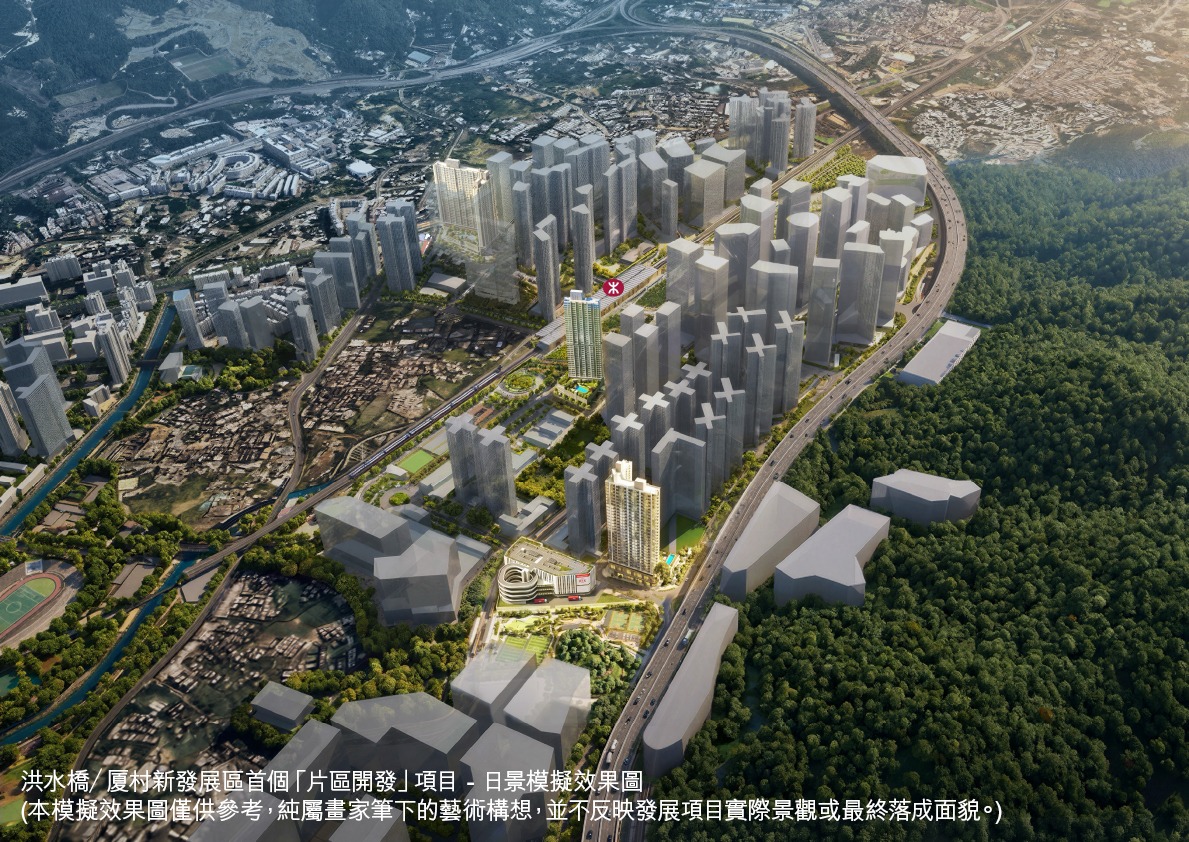
HONG KONG SAR– Media OutReach Newswire – 24 August 2026 – HSK New Development Limited, a joint venture formed by China Overseas Land & Investment Limited (Stock Code: 0688), China Merchants Land Limited (Stock Code: 0978), China Resources Land (Overseas) Limited, CTG Investment Management Corporation Limited, JD.com Inc., and Sino Land Company Limited (Stock Code: 0083), has been awarded the development project for the first pilot area within the Hung Shui Kiu/Ha Tsuen New Development Area (the ‘HSK Pilot Area’) in the Northern Metropolis. In full support of the National 15th Five-Year Plan and under the coordination of the HKSAR Government, the joint venture will leverage the strengths of cross-boundary collaboration across diverse industries to invest in, develop and operate a large-scale smart logistics project. The project will also incorporate residential and community commercial facilities, with innovative technologies driving industrial upgrading, contributing to the high-quality development of the Northern Metropolis and reinforcing the commitment to supporting Hong Kong’s long-term development.

Mr Daryl Ng, Chairman of Sino Land Company Limited

Mr Daryl Ng, Chairman of Sino Land Company Limited, said, ‘The National 15th Five-Year Plan states the accelerated development of the Northern Metropolis as a key priority of Hong Kong’s future growth engine. We are truly honoured to have been awarded the HSK Pilot Area project alongside our distinguished corporate partners. We have full confidence in Hong Kong and believe that the cross-sector collaboration can help bring together diverse expertise to contribute to the region’s innovation and technology development. In the HKSAR Government’s first Five-Year Plan, the Chief Executive also highlighted the pivotal role of the Northern Metropolis in enriching the housing ladder and creating more opportunities and space for home ownership. We are committed to bringing high-value industries and a quality living community to the Northern Metropolis, providing more housing and employment opportunities while enhancing connectivity between Hong Kong and cities across the Greater Bay Area.’

The HSK Pilot Area development project.

Hashtag: #SinoLand #NorthernMetropolis #HungShuiKiu

The issuer is solely responsible for the content of this announcement.

Pacific Empire Announces Commencement of 2026 Diamond Drill Program at Trident and Pinnacle

Vancouver, British Columbia – Newsfile Corp. – August 24, 2026 – Pacific Empire Minerals Corp. (TSXV: PEMC) (“Pacific Empire”, “PEMC” or the “Company”) is pleased to announce that diamond drilling is now underway at its flagship Trident copper-gold porphyry project, with drilling also planned at the Company’s Pinnacle project, located immediately to the west of Trident, in north-central British Columbia. The 2026 exploration program is being managed by Equity Exploration Consultants Ltd. (“Equity”), which was formally engaged by the Company earlier this year to provide technical leadership and project management for the season.

2026 Diamond Drilling Underway at Trident
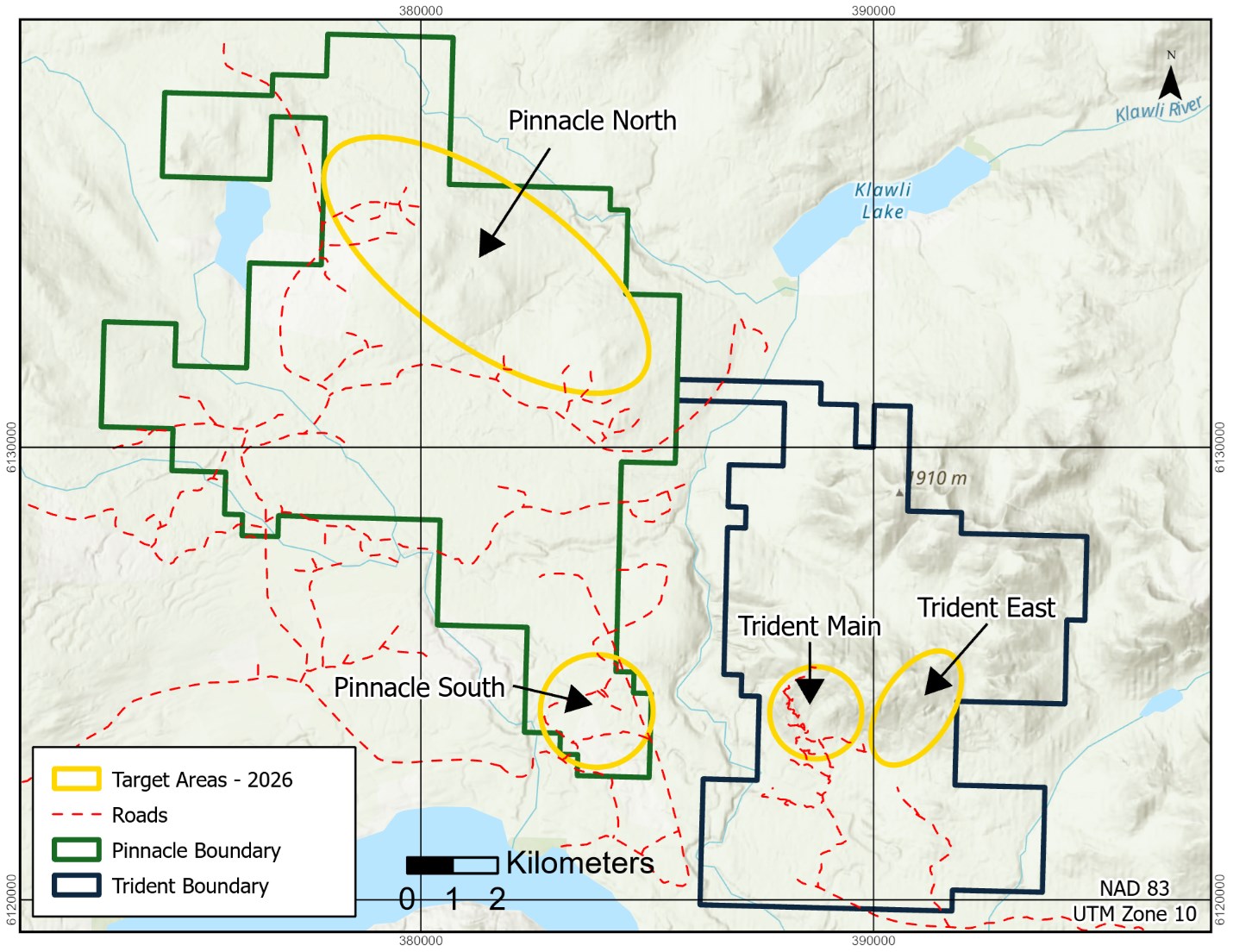
Diamond drilling is now underway at the Trident property, with initial holes testing the Trident Main Zone to follow up on the Company’s 2025 drill results, which included holes DD25-TRI-001, DD25-TRI-005 and DD25-TRI-006.

Following completion of drilling at Trident Main Zone, the drill rig is planned to move to the eastern portion of the Trident property, where the Company just completed two ground-based induced polarization (“IP”) lines designed to follow up on an anomalous chargeability response originally identified in a 2014 survey. Interpretation of the expanded IP dataset has identified a significantly larger area of anomalous chargeability, which has been prioritized as the next drill target at Trident.

2026 Diamond Drilling Planned at Pinnacle
Following completion of drilling at the Trident Main Zone and Trident East IP target, diamond drilling is planned to move to the Company’s Pinnacle property, where it will test targets identified from the June 2026 airborne magnetic survey, as well as the Pinnacle South target.

2026 Work Completed to Date
Prior to the commencement of drilling, the following work has been completed at Trident and Pinnacle as part of the 2026 field season:

  • Two ground-based IP lines at Trident, expanding on a 2014 chargeability anomaly and identifying a significantly larger area of anomalous chargeability in the eastern portion of the property.
  • An airborne magnetic survey across the northern Pinnacle property block.
  • Review of historical drill core from Trident and Pinnacle.
  • Review of historical exploration data from Trident and Pinnacle.

Pacific Empire’s President and CEO, Brad Peters, commented: “With diamond drilling now underway at Trident, we are excited to begin testing both the follow-up targets from our 2025 program and the substantially larger IP chargeability anomaly identified through this year’s geophysical work. The expanded target area in the eastern portion of the property is particularly compelling, and the opportunity it gives us to step out and think big about the scale of this system is exciting. At the same time, results from the airborne magnetic survey at north Pinnacle, when considered alongside historical drilling, are equally encouraging. We believe 2026 will be a pivotal year for both projects and look forward to updating shareholders as results become available.”

Figure 1: Location of the four target areas planned for 2026 drilling on Pacific Empire’s Trident and Pinnacle properties. Coordinates shown in NAD83, UTM Zone 10N.

To view an enhanced version of this graphic, please visit:
https://images.newsfilecorp.com/files/5412/311026_1d04783a54446945_001full.jpg

Figure 2: 2026 airborne magnetic survey coverage over the Trident and Pinnacle properties, with the Pinnacle North target area outlined in yellow. Coordinates in NAD83, UTM Zone 10N.

To view an enhanced version of this graphic, please visit:
https://images.newsfilecorp.com/files/5412/311026_1d04783a54446945_002full.jpg

Qualified Person’s Statement
Ron Voordouw, P.Geo., Ph.D., is a Qualified Person as defined by National Instrument 43-101. Dr. Voordouw is independent of Pacific Empire Minerals Corp. as defined in NI 43-101 and has reviewed and approved the scientific and technical information contained in this news release.

About Pacific Empire
Pacific Empire is a copper exploration company based in Vancouver, British Columbia and trades on the TSX Venture Exchange under the symbol PEMC. The Company has a district scale land position in north-central British Columbia.

British Columbia is a “Green” copper jurisdiction with abundant hydroelectric power, access and infrastructure in close proximity to the end market.

ON BEHALF OF THE BOARD,
“Brad Peters”
President, Chief Executive Officer and Director
Pacific Empire Minerals Corp.
Tel: +1-604-356-6246
brad@pemcorp.ca
www.pemcorp.ca
Neither the TSX Venture Exchange nor its Regulation Services Provider (as that term is defined in the policies of the TSX Venture Exchange) accepts responsibility for the adequacy or accuracy of this release.

Forward-Looking Statements
Information set forth in this news release may involve forward-looking statements under applicable securities laws. Forward-looking statements are statements that relate to future, not past, events. In this context, forward-looking statements often address expected future business and financial performance, and often contain words such as “anticipate”, “believe”, “plan”, “estimate”, “expect”, and “intend”, statements that an action or event “may”, “might”, “could”, “should”, or “will” be taken or occur, or other similar expressions. All statements, other than statements of historical fact, are forward-looking statements, including statements regarding the timing, scope and results of the 2026 diamond drilling program at Trident and Pinnacle. By their nature, forward-looking statements involve known and unknown risks, uncertainties and other factors which may cause our actual results, performance or achievements, or other future events, to be materially different from any future results, performance or achievements expressed or implied by such forward-looking statements. Such factors include, among others, the following risks: the need for additional financing; operational risks associated with mineral exploration; fluctuations in commodity prices; title matters; environmental liability claims and insurance; reliance on key personnel; the potential for conflicts of interest among certain officers, directors or promoters with certain other projects; the absence of dividends; competition; dilution; the volatility of our common share price and volume and the additional risks identified in the management discussion and analysis section of our interim and most recent annual financial statement or other reports and filings with the TSX Venture Exchange and applicable Canadian securities regulations. Forward-looking statements are made based on management’s beliefs, estimates and opinions on the date that statements are made, and the Company undertakes no obligation to update forward-looking statements if these beliefs, estimates and opinions or other circumstances should change, except as required by applicable securities laws. Investors are cautioned against attributing undue certainty to forward-looking statements.

The issuer is solely responsible for the content of this announcement.

Uzbekistan Pushes for a More Connected and Competitive Central Asia

Central Bank of the Republic of Uzbekistan and Singapore-headquartered GFTN convene more than 6,000 participants from 74 countries in Tashkent to accelerate investment, financial innovation and regional connectivity

TASHKENT, UZBEKISTAN – Media OutReach Newswire – 24 August 2026 – Uzbekistan today put its financial reform agenda before a global audience, bringing together policymakers, regulators, investors and founders to advance its ambition to become a gateway for capital, technology and financial connectivity across Central Asia.

The Silk Road Finance & Technology Forum 2026, convened by the Central Bank of the Republic of Uzbekistan and Singapore-headquartered Global Finance & Technology Network (GFTN), and co-hosted by Ant International, brings together more than 6,000 participants from 74 countries, almost 200 speakers and more than 25 investors representing US$4 billion in assets under management.

Held at CAEx on 24–25 August, the Forum moves to the Islamic Civilisation Centre on 26 August for The Azimuth, a dedicated programme on Islamic finance and entrepreneurship.

Uzbekistan’s Reform Push Opens the Door to Global Investment
Opening the Forum, H.E. Jamshid Kuchkarov, Deputy Prime Minister and Minister of Economy and Finance of the Republic of Uzbekistan, set out the next phase of the country’s economic transformation: converting a decade of reform into deeper markets, greater private-sector participation and long-term investment.

“Over the past 10 years, as a result of structural reforms, our economy has demonstrated strong and steady growth. During this period, the size of our economy has tripled. Going forward, we will work to achieve investment-grade credit ratings, complete accession to the World Trade Organization, further reduce the state’s presence in the economy, and continue market-oriented reform. This effort will strengthen the role of the private sector, deepen Uzbekistan’s integration into the global economy and create greater opportunities for domestic and international investors,” said H.E. Jamshid Kuchkarov.

Uzbekistan enters the Forum with strong economic and regulatory momentum. GDP grew 8.5% in the first half of 2026, foreign investment reached US$8.3 billion in the first quarter, and Moody’s upgraded the sovereign rating to Ba2 in June. Presidential Decree PQ-359 and the National FinTech Strategy are advancing open banking, digital payments and financial innovation, with a target of US$1 billion in fintech investment by 2030. Digital-payment adoption rose from 39% in 2021 to 71% in 2025.

In his opening address, The Silk Road Initiative: Turning a Socio-Economic Heritage into Central Asia’s Financial Innovation Corridor, H.E. Timur Ishmetov, Governor, Central Bank of the Republic of Uzbekistan, framed the country’s fintech strategy through five building blocks drawn from the region’s intellectual and commercial heritage: Al-Jabr, restoring what is missing; Al-Muqabala, balancing the elements of a sustainable financial ecosystem; Zarkaynar, creating a marketplace where innovation meets opportunity; Saroy, building shared financial infrastructure; and Madrassa, developing talent.

With 57% of payments now cashless, SMEs accounting for more than half the economy and a target of 5,000 young people trained in financial technology by 2030, the Central Bank is translating these principles into its regulatory sandbox, open-banking APIs, payments infrastructure and innovation framework.

“Scale alone is not sufficient. The objective must be to translate technological adoption and transaction growth into sustainable economic value, competition and broader financial development, while maintaining financial stability, resilience and public trust,” Governor Ishmetov said.

Sopnendu Mohanty, Group CEO, Global Finance & Technology Network added:.

“Uzbekistan has the ingredients to become Central Asia’s digital finance gateway: strong political commitment, bold regulatory reform, growing digital adoption and a clear ambition to attract international investment. The next step is to turn those foundations into investment, partnerships and financial corridors that connect Central Asia to the world. That is what the Silk Road Finance & Technology Forum is designed to accelerate.”

That opportunity comes as fintech moves firmly into the global financial mainstream. In 2025, global fintech revenues reached US$504 billion, growing 22% and more than four times faster than incumbent financial institutions, while 74% of the largest public fintechs were profitable, according to the 2026 Global Fintech Report by BCG and FT Partners.

For Central Asia, the opportunity is to capture more of that growth by combining financial innovation, inclusion and regional connectivity with the regulatory and institutional foundations required to attract long-term capital.

From Domestic Reform to a Financial Silk Road

The Forum is examining how Uzbekistan’s domestic transformation can support a more connected Central Asian financial system, with priorities spanning investable markets, interoperable payments, digital identity, open APIs, tokenisation, digital money, cross-border settlement and long-term institutional capital.

Central Asia’s relatively young financial infrastructure creates an opportunity to build interoperable systems without inheriting all the constraints of legacy architecture. The next step is moving from domestic digitalisation to cross-border connectivity, with faster settlement, lower remittance costs and infrastructure capable of connecting national financial systems.

The wider ambition is to recast the historic Silk Road for the digital economy, extending its role from the movement of goods to the movement of money, capital and data between Central Asia and markets across the Middle East, China, South Asia and Southeast Asia.

Greater connectivity, however, will require more than technology. Predictable regulation, deeper markets, institutional capital, cybersecurity and trusted governance will determine whether new payment rails, AI, tokenisation and digital assets can scale safely across borders.

New Islamic Banking Law Opens Uzbekistan to US$6 Trillion Market

Uzbekistan’s new Islamic banking law, effective from June 2026, creates the country’s first legal framework for Shariah-compliant banking and opens a potential channel to a global Islamic finance market approaching US$6 trillion in assets.

The Forum culminates on 26 August with The Azimuth at the Islamic Civilisation Centre, focused on the standards, Shariah governance, liquidity, digital infrastructure and cross-border capital required to scale the sector. The opportunity extends beyond domestic Islamic banking to positioning Uzbekistan as a bridge between Central Asia and Islamic finance markets across the Gulf, Türkiye, South Asia and Southeast Asia.

Governor Ishmetov issued a direct invitation to international investors and innovators: “Uzbekistan is open to investment, technology, expertise and long-term partnership. Build here. Test new solutions here. Invest here. Develop talent here. With the right partnerships, Central Asia can become a more connected, competitive and internationally integrated financial region.”

Hashtag: #GFTN

The issuer is solely responsible for the content of this announcement.

About the Silk Road Finance & Technology Forum

The inaugural Silk Road Finance and Technology Forum takes place in Tashkent from 24 to 26 August 2026, co-hosted by the Central Bank of the Republic of Uzbekistan and the Global Finance and Technology Network (GFTN). The Forum connects policymakers, regulators, investors and founders to shape Central Asia’s next financial corridor across five strategic themes: digital payments and infrastructure, Islamic finance and new corridors, AI and emerging technology, tokenisation and digital assets, and cross-border finance and regulation.
LinkedIn:
Website:

About the Global Finance & Technology Network (GFTN)

The Global Finance & Technology Network (GFTN) is a Singapore-headquartered not-for-profit organisation established in 2024. With offices in Tokyo, Berlin, and India, GFTN’s mission is to bridge policy, capital, and technology to build financial systems that are resilient, efficient, and inclusive. GFTN Services hosts global forums across five continents, bringing together innovators, entrepreneurs, investors, and policymakers from over 130 countries. It offers policy advice to governments to promote financial technology innovation, inclusion, and capacity building. GFTN Capital will be a venture capital firm investing in growth-stage FinTechs globally. For more information, please visit .

Omdia H1 2026: Hisense Ranks No. 1 Globally in 100-Inch-and-Above TV Shipments

QINGDAO, China, Aug. 24, 2026 /PRNewswire/ — Hisense, a leading brand in global consumer electronics and home appliances, ranked No. 1 globally in shipments of TVs 100 inches and above in H1 2026, according to Omdia, accounting for a 55.1% market share. The result reflects demand for larger, more immersive screens and Hisense’s ability to bring premium big-screen experiences into more homes.


Building on this leadership, Hisense is putting the viewing experience first — turning display technology into more immersive, lifelike experiences. The UR9 Series advances RGB MiniLED technology by independently controlling red, green and blue light at the backlight source, delivering richer colors, deeper contrast and greater detail — so movies feel more cinematic, sports more vivid and every scene truer to life.

Hisense is also bringing premium MiniLED performance to consumers through the U7 and U6 Pro Series, powered by Hi-QLED MiniLED technology. By combining precise local dimming with Quantum Dot color, these TVs create brighter highlights, deeper blacks and more vibrant colors, helping viewers catch every detail in movies, sports and everyday content.

Hisense’s large-screen expertise also extends to Laser TV, where the brand achieved more than 70% of global shipments in 2025. Put simply, more than two out of every three Laser TVs shipped globally were Hisense — demonstrating its longstanding commitment to redefining entertainment at home.

At IFA 2026, Hisense will take this vision further under the theme “Innovating a Brighter Life,” showcasing how technology can create more intelligent, immersive and enjoyable experiences. The Hisense IFA Press Conference will take place from 15:00–16:00 on September 3 at the Innovation Stage, Messe Berlin, followed by the Hisense exhibition from September 4–8, 09:00–17:00 daily, in Hall 23a.

From market leadership to next-generation display innovation, Hisense continues to turn technology into experiences that help people see more, enjoy more and live brighter.

About Hisense

Hisense, founded in 1969, is a globally recognized leader in home appliances and consumer electronics with operations in over 180 countries, specializing in delivering high-quality multimedia products, home appliances, and intelligent IT solutions. According to Omdia, Hisense ranks No. 1 globally in the 100-inch and over TV segment (2023-2026H1). As The Origin of RGB MiniLED, Hisense continues to lead the next-generation RGB MiniLED innovation. As the official sponsor of the FIFA World Cup 2026™, Hisense is committed to global sports partnerships as a way to connect with audiences worldwide.

LG ELECTRONICS’ PRISM AI WINS BEST AI TOOL/PRODUCT AT THE 2026 IN2 SABRE AWARDS ASIA-PACIFIC

Delivering Real-Time Insights to Support Strategic Decision-Making,
AI-Powered Communications Platform Redefines PR Measurement Worldwide

News Summary

  • LG Electronics’ (LG) PRISM AI has won the Best AI Tool or Product category at the 2026 IN2 SABRE Awards Asia-Pacific, recognizing its technological and PR excellence.
  • PRISM AI, an AI-powered communications intelligence platform using large language models (LLMs), delivers actionable insights by assessing media coverage, competitive positioning and emerging narratives across 200 markets and 30 brands worldwide.
  • This achievement highlights PRISM AI as a model case of LG Group’s broader AI Transformation (AX) efforts, demonstrating how AI can reshape global organization operations and setting a new benchmark for the communications industry.

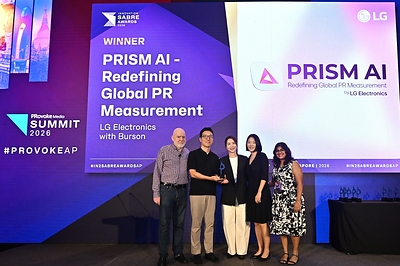
SEOUL, South Korea, Aug. 24, 2026 /PRNewswire/ — LG Electronics’ (LG) proprietary AI-powered communications intelligence platform, PRISM AI, has been awarded one of the industry’s most prestigious honors, the Best AI Tool or Product category at the 2026 IN2 (Insight & Innovation) SABRE Awards Asia-Pacific. PRISM AI has also advanced as a finalist for the Consumer Electronics & Telecommunications category at the 2026 SABRE Awards Asia-Pacific.

LG Electronics’ PRISM AI Wins Best AI Tool/Product at the 2026 IN2 SABRE Awards Asia-Pacific

The SABRE Awards Asia-Pacific, presented by PRovoke Media, are among the most respected programs in the global public relations industry, recognizing excellence in branding, reputation and engagement. The IN2 SABRE Awards Asia-Pacific, part of the broader SABRE Awards program, recognizes innovation in the evolving PR landscape, highlighting achievements in areas such as AI, data and analytics, digital engagement and emerging communications technologies.

AI-powered global PR analytics platform, PRISM AI leverages large language models (LLMs) and deep learning to analyze data related to 200 markets and 30 brands worldwide, measure PR performance and deliver strategic insights. By conducting in-depth analysis of millions of news articles, the platform generates key metrics, including PR Score and CI Index, while using context-based keyword analysis and AI Agents to transform complex data into actionable insights and reports. This enables executives and communications professionals to make faster, more objective communications decisions. Its evaluation methodology and measurement metrics have been validated by Burson, a leading global PR consultancy, further strengthening the objectivity and credibility of the platform.

The honor represents comprehensive global recognition of the PRISM AI’s innovation, validating both its advanced technological capabilities and tangible value for business. This milestone stands as a premier example of successfully deploying AI technology within real-world communications. By extending its impact beyond a single function to redefine how a global organization operates, PRISM AI sets a new benchmark for AI Transformation (AX) in the industry – solidifying LG’s position as a pioneering leader driving the future of data-driven communications.

As LG’s group-wide AI transformation efforts gained recognition as a leading example of enterprise-wide innovation, LG sought to bring the same data-driven discipline to its communications activities. With a deep understanding of the growing importance of global communications and the diverse needs of overseas markets, the Overseas Sales and Marketing Company identified the need for a data-driven framework to measure and optimize PR performance worldwide.

“PRISM AI enables us to objectively measure communications impact across markets and derive strategic insights from our activities – supporting LG’s business portfolio transformation and differentiated market strategies around the globe,” said Thomas Yoon, executive vice president of the Overseas Sales and Marketing Company at LG Electronics. “It is an indispensable tool for making more informed decisions with greater speed and precision.”

“Combining LG’s global PR expertise with advanced AX capabilities, PRISM AI represents something few companies can replicate,” added Cho Jung-bum, head of the AX Center of CSO at LG Electronics. “PRISM AI exemplifies how AX is taking root not only within LG Electronics but across LG Group as a whole — moving beyond individual tools to reshape how LG operates.”

About LG Electronics, Inc.
LG Electronics is a global innovator in technology and consumer electronics with a presence in almost every country and an international workforce of more than 75,000. LG’s four Companies – Home Appliance Solution, Media Entertainment Solution, Vehicle Solution and Eco Solution – combined for global revenue of over KRW 89 trillion in 2025. LG is a leading manufacturer of consumer and commercial products ranging from TVs, home appliances, air solutions, monitors, automotive components and solutions, and its premium LG SIGNATURE and intelligent LG ThinQ brands are familiar names world over. Visit www.LG.com/global/newsroom/ for the latest news.

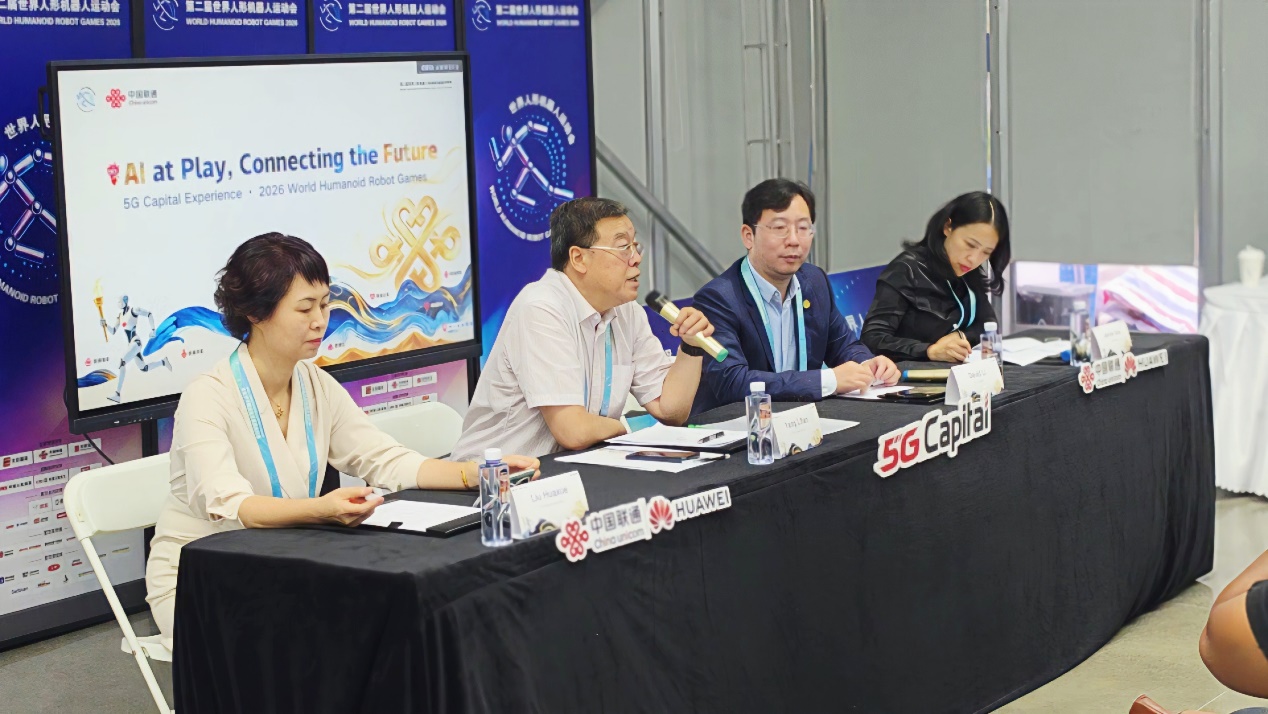
5G Capital Sets a New Benchmark:China Unicom Beijing and Huawei Power the 2nd World Humanoid Robot Games with 5G-A GigaUplink


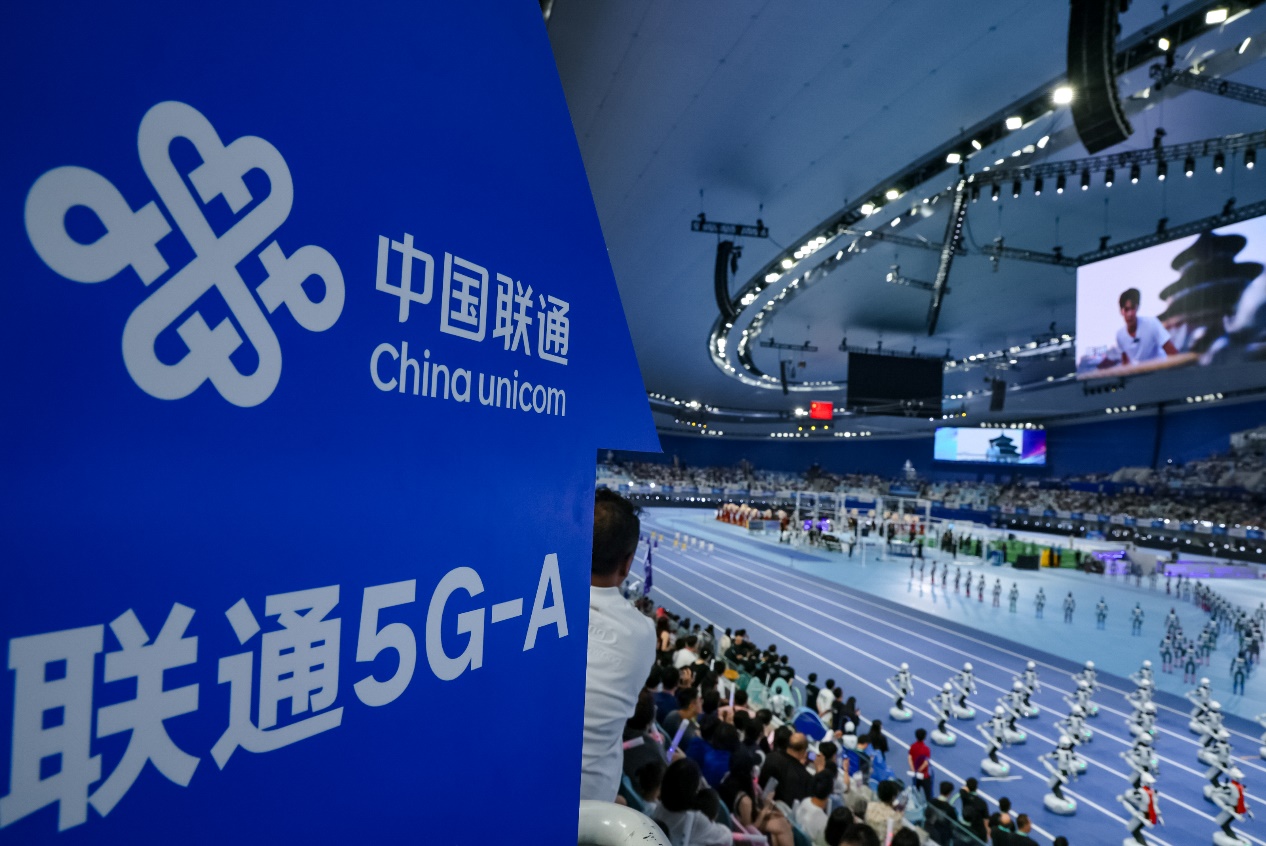
BEIJING, CHINA– Media OutReach Newswire – 24 August 2026 – The 2nd World Humanoid Robot Games opened yesterday at Beijing’s National Speed Skating Oval, also known as the “Ice Ribbon.” As another real-world validation of 5G Capital in robotics and embodied AI, China Unicom Beijing and Huawei have built an integrated digital foundation powered by a 5G-A GigaUplink network, supporting intelligent event operations, robot competition, and spectator experiences. The deployment also lays a connectivity foundation for humanoid robots to move beyond the arena and into everyday life. Across Beijing, 5G Capital’s region-wide GigaUplink network is providing ubiquitous, secure, and reliable connectivity for a growing range of cultural tourism, embodied AI, and Mobile AI applications and events.

China Unicom Beijing and Huawei Power the 2nd World Humanoid Robot Games with 5G-A GigaUplink

This year’s Games feature major upgrades in both scale and competition design. A total of 1,301 competitions across 51 events will see 2,056 humanoid robots from 666 teams worldwide take part. The number of events has nearly doubled from 26 in the inaugural Games to 51 this year, with new high-intensity head-to-head events such as table tennis and kickboxing. Scenario-based competitions have also expanded into real-world settings including industrial production, hotels, homes, and logistics, while dance events place greater emphasis on synchronized movement across multiple robots. More autonomous competition formats and significantly higher task complexity are placing stringent demands on networks for high-capacity uplink, millisecond-level responsiveness, and high reliability, supporting real-time robot telemetry, precise control signaling, and multi-robot coordination.

To meet these requirements, China Unicom Beijing and Huawei deployed a dedicated 100 MHz network, complemented by a 300 MHz LampSite ultra-wideband indoor network, to support real-time robot telemetry and precise signaling exchange. A dedicated 5QI 7 slice combined with carrier isolation keeps end-to-end latency for humanoid robots within 30 milliseconds, supporting millisecond-level decision-making and response while helping ensure the precision of multi-robot coordination, obstacle avoidance, and fine-motion control.

By further integrating the dedicated network with BeiDou RTK (Real-Time Kinematic) positioning, the solution delivers decimeter- to sub-decimeter-level positioning accuracy, supporting autonomous navigation, agile obstacle avoidance, and precision racing in complex environments. On-site tests recorded a peak uplink speed of 1 Gbps, with average latency below 30 milliseconds.

While safeguarding mission-critical connectivity for the robots, China Unicom has also made the network experience of on-site spectators a priority. To address the high-density, heavy-traffic demands of large crowds, network resources and service assurance policies are dynamically adjusted according to different phases and areas of the event, including admission, waiting, competition, and departure. Core services such as instant messaging, ticket inquiries, QR-code admission, and mobile payments are prioritized for stable access, while the network also accommodates data-intensive services such as photo uploads, short-video sharing, and live streaming. This allows spectators to stay connected, interact seamlessly, and share highlights in real time even during peak traffic periods.

On the operations side, China Unicom has also developed China’s first embodied AI robot management platform designed for event scenarios. Through a unique network ID assigned to each robot, event staff can monitor its location within the venue, competition status, and operational metrics in real time, creating a closed-loop operations and management system.

China Unicom and Huawei Together Advancing the 5G Capital initiative

Yang Lifan, Deputy General Manager of China Unicom Beijing, said: “This network deployment is not only a real-world test of China Unicom’s network capabilities; it will also help us accumulate valuable network assurance experience for the large-scale deployment of embodied AI. China Unicom will continue to build on the experience gained through the 5G Capital initiative and turn technological innovation into tangible and replicable network capabilities for the Mobile AI era. In doing so, we aim to support industrial innovation and help bring Chinese solutions to the world with China Unicom’s expertise.”

David Li, President of Huawei’s Wireless TDD Product Line, said: “The 2nd World Humanoid Robot Games have provided a compelling real-world validation of the 5G-A 100 MHz GigaUplink network based on 3.5 GHz 2CC + 2.1 GHz SUL for embodied AI scenarios. Looking ahead, Huawei will continue to work with China Unicom Beijing to strengthen uplink capabilities and advance spectrum coordination, building multidimensional network capabilities with tiered and differentiated service assurance for multimodal device-to-cloud transmission. This will enable real-time interaction and precise control across a wide range of embodied AI scenarios.

“Networks are about more than speed. Low latency, high reliability, and ubiquitous coverage are equally important. Building on these capabilities, we will further advance the 5G Capital initiative, continue to expand the boundaries of network performance, and lay a solid foundation for the Mobile AI era, working with industry partners to enable an intelligent future.”

Hashtag: #Huawei #WorldHumanoidRobotGames

The issuer is solely responsible for the content of this announcement.

New global IKEA study: Nearly 4 in 10 are staging a “silent protest” over household mess

MALMÖ, Sweden, Aug. 24, 2026 /PRNewswire/ — In 38% of homes, someone is quietly leaving things out and hoping someone else will deal with it. (They won’t.) Welcome to the silent protest. It’s one of many findings from the IKEA Store & Organise Report 2026: Finding Meaning in the Mess.

IKEA Report - Top 10 Store and Organize Trends
IKEA Report – Top 10 Store and Organize Trends

Life at home is getting busier and space tighter — so this year, IKEA is focusing on helping people find calm, not just storage.

The report surveyed 31,488 people across 31 markets — and found that clutter creates real tension at home. Nowhere more so than the kitchen countertop, the hardest space to keep clutter-free (24%) and the most likely to cause an argument (37%).

One in ten of us even use the oven for storage, rising to 21% in South Korea. Somewhere, someone’s about to get a very unpleasant surprise.

Living spaces are getting smaller. But there’s a clear shift towards “meaningful mess”: owning with intention, keeping what holds value. With 59% preferring a lived-in home over a minimalist one, perhaps the goal was never a perfect home.

“People aren’t chasing a perfect home anymore. They want a home that feels like them — one that holds their stories, their memories, the things that matter. What we keep says a lot about who we are. It was never just stuff. At IKEA, we believe everyone deserves a home that works for them. That’s what smart, affordable solutions are for,” says Licca Li, Home Furnishing & Retail Design Manager, Ingka Group (IKEA).

82% keep things purely for sentimental reasons, even if rarely used or out of sight. Then there’s the 26% hiding mementos from past relationships — men more so than women.

68% of households have a drawer of doom, and inside? Cables, mostly. 54% of Boomer men still keep them for gadgets they no longer own.

When guests are coming, one in 10 admit to cancelling plans with friends because the house is too messy, and 34% shuffle clutter before they arrive.

Even so, 15% globally see mess as a form of creativity — rising to 31% in China but just 4% in Japan. Maybe the goal was never a perfect home; just a happy one.

For more information visit IKEA Store & Organise Report 2026 and Ingka newsroom.

IBM Unveils Next Generation Dual-Architecture Processor for IBM Z and LinuxONE

Revolutionary design will bring Arm-native applications to IBM’s flagship mainframes and servers, broadening software choice for enterprise computing

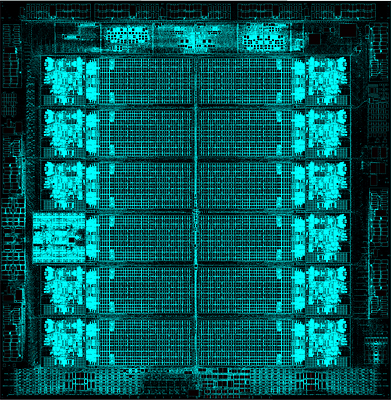
ARMONK, N.Y., Aug. 24, 2026 /PRNewswire/ — At the annual Hot Chips conference, IBM (NYSE: IBM) today is announcing the first dual-architecture mainframe processor, which is being designed to enable enterprises to run operating systems and applications on both the IBM and Arm® compute platforms in future IBM Z and LinuxONE systems. This marks the first processor milestone to emerge from the IBM and Arm collaboration established in April 2026, and represents a significant advance in enterprise computing. The new processor is being developed to allow organizations to run Arm-native Linux environments simultaneously with z/OS and Linux on IBM Z, while benefiting from IBM’s established security, reliability, and scale.

A CAD layout of IBM's dual-architecture processor chip, designed with Arm.
A CAD layout of IBM’s dual-architecture processor chip, designed with Arm.

With more than 22 million developers worldwide, the Arm software ecosystem supports a broad and growing range of applications from cloud to edge, including the cloud-native and AI software increasingly shaping modern infrastructure. This new processor will bring that ecosystem to the IBM platforms known globally for transaction processing and data-intensive operations. Arm workloads will benefit from IBM’s enterprise-grade capabilities, including enhanced reliability, hardware-level fault detection and recovery, advanced encryption, secure key management, and AI acceleration.

Built on a 2 nanometer technology node, the processor’s design will contain 11 high-performance cores operating at more than 5.7 GHz, AI inference accelerators for in-transaction fraud detection, a dedicated on-chip data processing unit for I/O acceleration, and a large cache architecture for demanding enterprise workloads. The chip is architected to not contain separate Arm and IBM cores: each processor core can natively execute Arm and IBM Z, or Arm and LinuxONE, instructions concurrently while prioritizing the platform’s established performance, security, encryption, and availability characteristics. IBM Z and LinuxONE platforms are capable of scaling to hundreds of cores and tens of terabytes of memory.

“As organizations modernize their application portfolios and integrate AI into core business operations, they need infrastructure that expands their options,” said Christian Jacobi, Chief Technology Officer and IBM Fellow, IBM Systems Development. “This processor represents a significant architectural advancement for IBM Z and LinuxONE. By bringing Arm natively to our platform, we’re combining access to one of the industry’s fastest-growing software ecosystems with the qualities that have made IBM systems the foundation for how businesses run today.”

“As AI scales, more of the computing landscape is converging on Arm,” said Mohamed Awad, Executive Vice President, Cloud AI, Arm. “IBM Z and LinuxONE power some of the world’s most demanding workloads in highly regulated industries. Bringing Arm compute and its software ecosystem to these platforms will extend that momentum into mission-critical enterprise infrastructure to give organizations greater choice in how they deploy AI.”

This milestone represents a major step forward in IBM and Arm’s shared vision of expanding application choice and access to the latest in software innovation for enterprise computing without compromising the capabilities these environments demand.

Statements regarding IBM’s future direction and intent are subject to change or withdrawal without notice, and represent goals and objectives only.

Additional Sources

About IBM 
IBM is a leading provider of global hybrid cloud and AI, and consulting expertise. We help clients in more than 175 countries capitalize on insights from their data, streamline business processes, reduce costs and gain the competitive edge in their industries. Thousands of governments and corporate entities in critical infrastructure areas such as financial services, telecommunications and healthcare rely on IBM’s hybrid cloud platform and Red Hat OpenShift to affect their digital transformations quickly, efficiently and securely. IBM’s breakthrough innovations in AI, quantum computing, industry-specific cloud solutions and consulting deliver open and flexible options to our clients. All of this is backed by IBM’s long-standing commitment to trust, transparency, responsibility, inclusivity and service. Visit www.ibm.com for more information.

Media Contact
Bethany Hill McCarthy
bethany@ibm.com
IBM