Home Blog Page 459

Asendia and Singapore Post Form Strategic Partnership to Strengthen APAC Cross-Border E-commerce Gateway


PARIS, FRANCE – Media OutReach Newswire – 7 May 2026 – Asendia, the international e-commerce and mail specialist, today announced a strategic partnership with Singapore Post (SingPost), a leading postal and e-commerce logistics provider. The partnership will strengthen cross-border e-commerce logistics capabilities, enhancing delivery performance, scalability and market access for businesses shipping into and out of Singapore and the wider Asia-Pacific region.

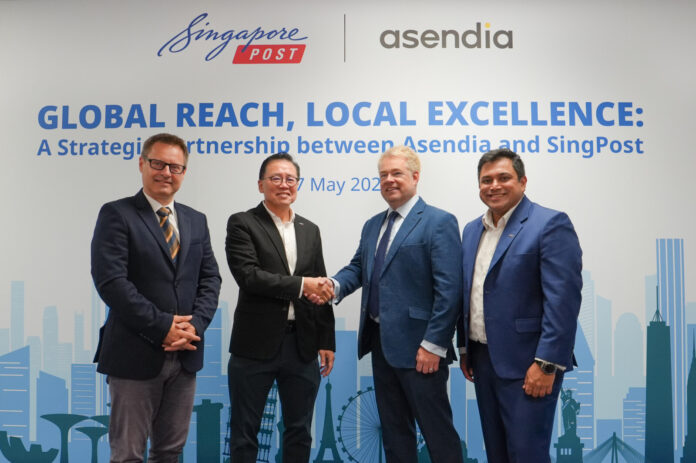
A Strategic Partnership Between Asendia and SingPost (Left to right): Lionel Berthe, Head of Asia Pacific, Asendia; Mark Chong, CEO, SingPost; Simon Batt, CEO, Asendia, and Gavin Pathross, Chief Information Technology Officer, SingPost.

The partnership reinforces Singapore as a strategic gateway for cross-border e-commerce. With almost 75%[1] of online shoppers in Singapore having purchased from overseas sellers, the country is a key destination for international sellers. It also serves as an important logistics gateway to millions of online shoppers in the APAC region.

Strategic Navigation of the 2026 EU Customs Reform

The partnership is timely as global regulators move to close taxation gaps that previously defined the sector. From 1 July 2026, the European Union will officially abolish the €150 de minimis customs duty exemption[2], introducing a flat €3 customs duty on all low-value imports. These changes, aimed at leveling the playing field for traditional retail, have taken effect in a few countries since March, where authorities have imposed national handling fees. SingPost and Asendia are working to offer Delivered Duty Paid (DDP) solutions to the EU, providing a “frictionless corridor” to help merchants – navigate this transition.

“This partnership comes at a critical juncture for global trade. Following the US suspension of de minimis exemptions in August 2025, the upcoming July 2026 EU reform introduces new regulations for exporting businesses to navigate.” said Mark Chong, CEO, SingPost. “By extending our cross-border partnerships, we are providing businesses with the support to manage these complexities, ensuring that our customers can maintain access to these markets, minimising the risk of delivery friction or doorstep rejection.”

The collaboration builds on Asendia’s long-established presence in the region, including its recent establishment of the Singapore Hub operation. International brands and global marketplace sellers on platforms such as Amazon, eBay and Etsy will benefit from more streamlined parcel shipping into Singapore and the wider APAC region.

Through Asendia’s international network, SingPost’s Singapore-based e-commerce customers gain access to a more diverse, reliable set of options to sell and scale across new markets with delivery capabilities into Europe, North America, South America, the Middle East and Oceania, supported by a broad ecosystem of last-mile partners. In turn, Asendia’s customers benefit from improved access into Singapore, Southeast Asia and the wider APAC corridor via SingPost’s infrastructure.

Merchants working with both organisations will gain access to a comprehensive suite of delivery solutions. The core service offerings include Asendia’s e-PAQ Home Delivery, e-PAQ Out-of-Home Delivery and e-PAQ Returns.

Lionel Berthe, Head of APAC, Asendia, said: “Asendia’s Beyond Borders survey shows that 32% of retailers in APAC cite border delays, customs clearance, and cross‑border returns as key friction points. This partnership directly addresses those challenges, with Singapore as a core focus market, while enabling scalable and cost‑effective cross‑border growth across the wider region.”

Notes to Editors:
Beyond Borders Study:
Over 1,000 global e-commerce professionals were surveyed in early 2026. Respondents included senior decision-makers from retail businesses engaged in cross-border e-commerce across four regions: UK (259), USA (250), Europe (251) and APAC (253). The survey was conducted by Censuswide under MRS guidelines.

Hashtag: #Asendia #SingaporePost

The issuer is solely responsible for the content of this announcement.

About Asendia

Asendia is one of the world’s leaders in international e-commerce and mail, delivering packages, parcels and documents to more than 200 destinations across the globe. With a rich heritage from founding companies La Poste and Swiss Post, Asendia combines extensive international and local know-how. Asendia’s expertise is broad-reaching, encompassing different aspects of e-commerce, from webshop software and marketplace management to international logistics.

At Asendia, we don’t just deliver parcels – we connect brands and shoppers through intelligent, flexible logistics solutions built on experience, technology, and care. Our philosophy, smart-design by asendia®, brings together our people, technology and network to create solutions that work across borders and evolve with every customer’s needs.

Asendia’s vision is to empower its customers worldwide with seamless access to global markets through our innovative and sustainable cross-border eCommerce logistics solutions. Asendia Group employs over 2,000 people in Europe, UK, Asia Pacific and the USA – a global network blended with a local presence.

Global expertise. Local understanding. Designed for you.

Please visit

About Singapore Post Limited (SingPost)

Singapore Post (SingPost) is a leading postal and eCommerce logistics provider in Asia Pacific. The portfolio of businesses spans from national and international postal services to warehousing and fulfilment, international freight forwarding and last mile delivery, serving customers in more than 220 global destinations. Headquartered in Singapore, SingPost has approximately 3,000 employees. Since its inception in 1858, the Group has evolved and innovated to bring about best-in-class integrated logistics solutions and services, making every delivery count for people and planet.

DP World Secures Laem Chabang Concession Extension Amid Rising Intra-Asia Trade

The five-year extension ensures operational continuity at one of Thailand’s leading container terminals, supporting the country’s expanding role in intra-Asian trade


BANGKOK, THAILAND – Media OutReach Newswire – 7 May 2026 – DP World, through its joint venture Laem Chabang International Terminal Co., Ltd. (LCIT), has secured a five-year concession extension to continue operating the B5 container berth at Laem Chabang Port. The extension comes at a time of increasing intra-Asian trade and evolving supply chain dynamics, reinforcing the port’s role as a critical gateway for Thailand’s economy.

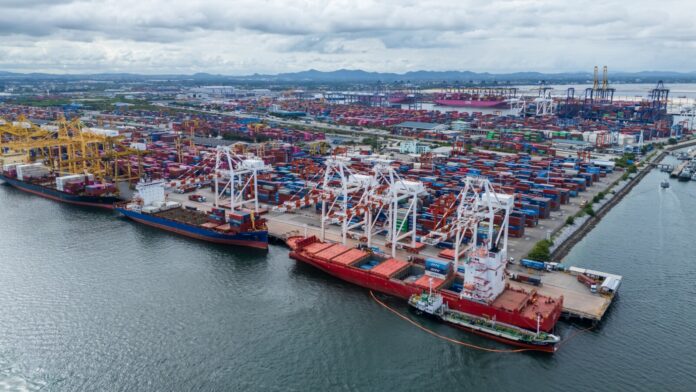
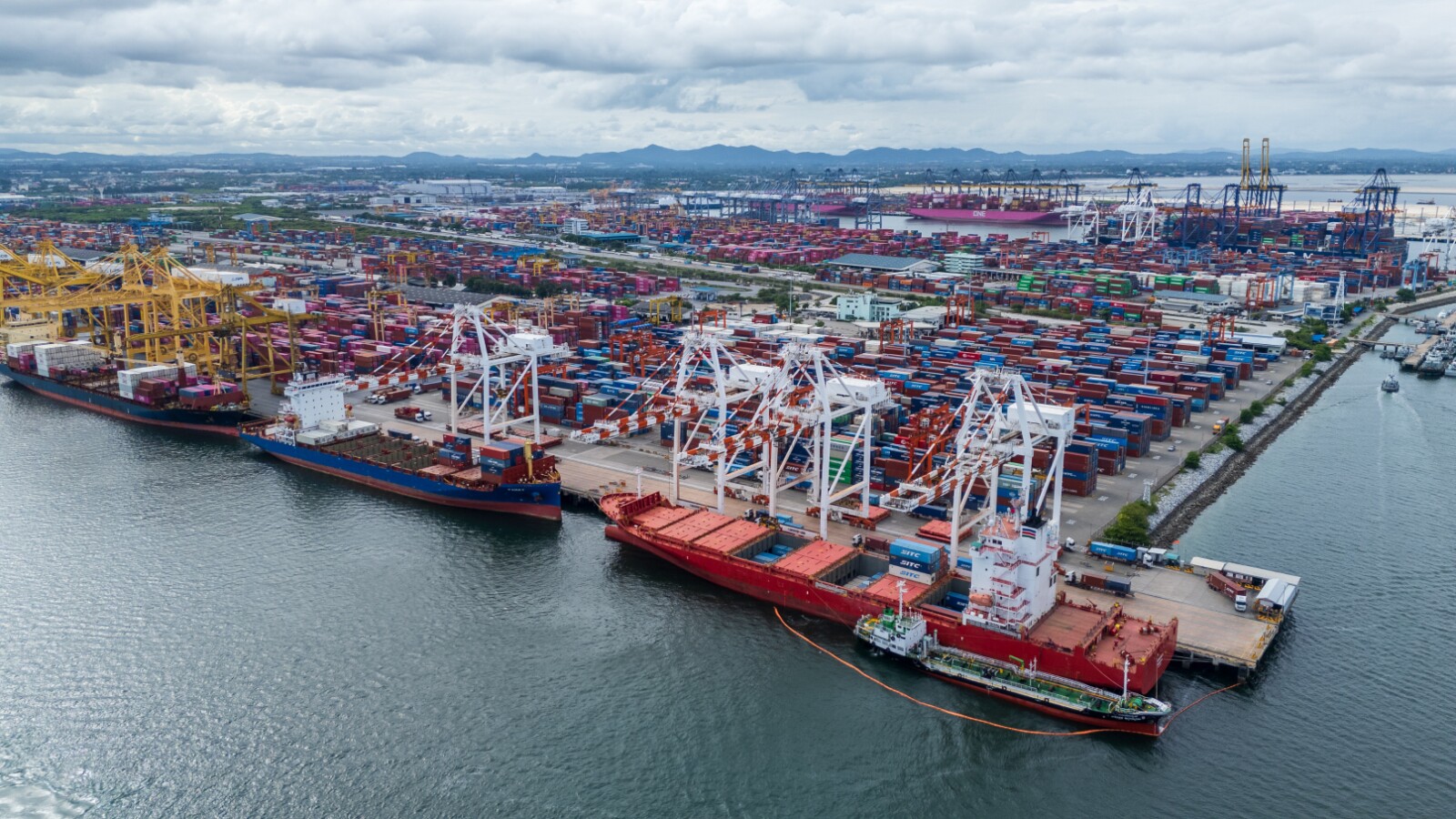
Terminal and yard at Laem Chabang Port

The contract, granted by the Port Authority of Thailand (PAT), will run from May 2026 to April 2031, reinforcing DP World’s central role in bolstering regional trade flows.

LCIT operates both B5 and C3 berths at Laem Chabang, Thailand’s principal deep-sea gateway and the country’s largest container hub supporting international trade. The terminals can accommodate up to four vessels simultaneously along 900 meters of berth length and are supported by 4,420 sqm of on-dock container freight station (CFS) facilities. In 2025, LCIT handled a record 1.936 million twenty-foot equivalent units (TEUs), its highest annual throughput to date, reflecting sustained growth in container volumes.

Glen Hilton, CEO & Managing Director, Asia Pacific, DP World, said: “This concession extension at Laem Chabang Port ensures continuity and service stability for our customers at a time when supply chains face increasing pressure and complexity. As Thailand strengthen its position as a regional trade hub, this extension allows us to continue investing in capacity, efficiency and sustainable operations. Together with our partners at LCIT, we are well positioned to support growing intra-Asia trade and deliver long-term value for customers across the Asia Pacific region.”

This concession will enable continued investment by DP World in operational efficiency and sustainability at Laem Chabang. In 2025, five electric internal transfer vehicles (eITVs) were deployed at LCIT, reducing emissions by approximately 60% compared to diesel alternatives while supporting faster vessel handling. Further upgrades are planned in 2026, including the installation of additional eITVs, electric reach stackers, and an electric empty container handler.

Complementing its operations at Laem Chabang Port, DP World has an integrated logistics network throughout Thailand, including cross-border trucking, landside logistics and freight forwarding. The company also recently launched a rail-connected inland container yard in Khon Kaen with a dedicated thrice-weekly rail shuttle to Laem Chabang, enhancing connectivity for exporters in Thailand’s Northeastern region.

​ These services and solutions aim to strengthen Thailand’s domestic and export trade by enabling the seamless movement of goods and materials from port to domestic hinterlands, and to markets across the wider Asia Pacific region.
Hashtag: #DPWorld


The issuer is solely responsible for the content of this announcement.

About DP World

DP World is reshaping the future of global trade to improve lives everywhere. Operating across six continents with a team of over 125,000 employees, we combine global infrastructure and local expertise to deliver seamless supply chain solutions. From Ports and Terminals to Marine Services, Logistics and Technology, we leverage innovation to create better ways to trade, minimising disruptions from the factory floor to the customer’s door.

In Asia Pacific, DP World employs over 15,000 people across 22 geographies. We operate 17 ports and terminals, complemented by a comprehensive suite of end-to-end supply chain solutions – to connect the region to the rest of the world.

WE MAKE TRADE FLOW

Australia Expands Support for Lao Media

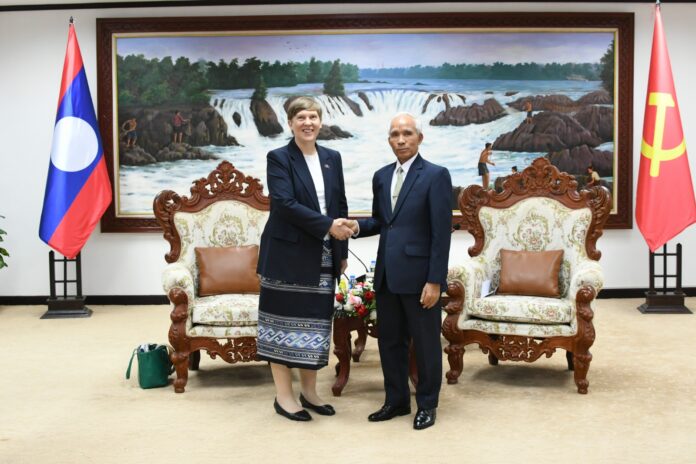
Australia Expands Support for Lao Media With Training, Study Tours, and ABC Partnership. (Photo: Australian Embassy in Vientiane)

Australia and Laos have agreed to deepen media cooperation through expanded training, exchanges, and professional development programs for Lao media officials and journalists.

Australian Ambassador Megan Jones discussed the partnership during a courtesy call with Khamphan Pheuyavong, Head of the Commission for Information and Education, in Vientiane on 7 May.

The meeting highlighted growing cooperation between the two countries as they mark 74 years of diplomatic relations this year.

Ambassador Jones said Australia continues supporting Laos’ priorities to strengthen capacity within Party and government agencies, including the media sector, through English language training and programs focused on analytical, research, and leadership skills.

Khamphan welcomed Australia’s support for training and study tours aimed at helping Lao media professionals respond to misinformation and adapt to changes in the media landscape.

The ambassador also thanked Lao media organizations for supporting bilateral cooperation across development, trade, investment, and government engagement.

Australia previously supported the Australian Broadcasting Corporation’s Digital Dialogue program in Laos, the first such initiative held in Southeast Asia, to strengthen digital journalism skills among Lao media professionals.

Earlier this year, two Lao state media joined a media executive leadership program organized by the ABC with support from the Australian government.

The ABC and Australian Associated Press are also expanding cooperation with Lao media through content sharing and capacity-building activities. The ABC television channel now forms part of the LAOSAT programming package.

During the meeting, both sides also discussed upcoming geostrategic and geoeconomic workshops scheduled for 16–18 June in Vientiane, which Australia and Laos will co-host with participation from officials and experts from both countries.

Global Governance Report Highlights Future Shock Risks as Democratic Accountability Slips and State Capacity Plateaus


LOS ANGELES, US – Newsaktuell – 7 May 2026 – The newly released 2026 Berggruen Governance Index (BGI) paints a mixed picture of global governance heading into a future of mounting shocks, finding widespread gains in public-goods provision from 2000 to 2023 even as democratic accountability edged down and state capacity showed little overall improvement.

Presentation of the 2026 Berggruen Governance Index: On 6 May in Los Angeles, the following individuals discussed the findings of the study (from left): Vinay Lai (Professor of History, UCLA), Michael Storper (Distinguished Professor of Urban Planning, UCLA), Stella Ghervas (Professor of History, UCLA) and the two authors of the study, Joseph Saraceno and Prof. Helmut Anheier (both from UCLA's Luskin School of Public Affairs). Democracy News Alliance / Jordan Strauss/AP for DNA
Presentation of the 2026 Berggruen Governance Index: On 6 May in Los Angeles, the following individuals discussed the findings of the study (from left): Vinay Lai (Professor of History, UCLA), Michael Storper (Distinguished Professor of Urban Planning, UCLA), Stella Ghervas (Professor of History, UCLA) and the two authors of the study, Joseph Saraceno and Prof. Helmut Anheier (both from UCLA’s Luskin School of Public Affairs). Democracy News Alliance / Jordan Strauss/AP for DNA

The BGI, presented Wednesday by an international group of governance scholars, analyses measurable benchmarks of democratic accountability across 145 countries.

On a 100-point scale, the global score for democratic accountability slipped slightly from 65 in 2000 to 64 in 2023, the most recent data used in the project. The wave of democratisation observed in the closing decades of the last century has stalled in the last 15 years. Democratic accountability fell in 54 countries while it improved in 48 countries.

Yet the BGI — a collaborative project of the Luskin School of Public Affairs at the University of California, Los Angeles (UCLA), Berlin’s Hertie School and the Berggruen Institute, a think tank headquartered in Los Angeles — captures remarkably widespread growth in provision of public goods.

Encompassing healthcare, education, infrastructure, environmental sustainability and conditions to foster employment and rising prosperity, public goods improved in 135 of the countries studied, while declining slightly in just four. The global average jumped from 58 to 69 points from 2000 to 2023.

The third component of what the BGI authors refer to as the “governance triangle” is state capacity, defined as the ability to tax, borrow and spend, control territory, operate scrupulous, competent bureaucracies and administer predictable rule of law. The index finds the global average ticking up from 48 to 49 points; 56 countries had increased state capacity while 57 declined.

“What does it tell us about the world ahead?” Prof. Helmut K. Anheier, a Luskin School sociologist and BGI principal investigator, asked during the public release of the 2026 BGI on the UCLA campus.

“Countries are not really improving in their governance performance in significant ways. … We’re not really having forward-looking investment in governance capacity. There is considerable inertia.”

The largest improvements across all three BGI components occurred in Gambia, which the report groups with “low-capacity developing states.” These states score low across the board, particularly in the provision of public goods. This cluster constitutes the poorest countries with the least developed economies, which face the most serious challenges.

“They have the greatest exposure to likely future crises, whether it’s global warming, whether it’s a new pandemic, whether it’s another financial crisis, whether it’s the impact of AI,” Anheier said. “And they have the least capacity to respond to it.”

Bhutan, Georgia, Iraq and Tunisia — which make up the remaining top five countries with the largest improvements in the BGI — are classified as “capacity-constrained states.” They tend to be middle-income with struggling democracies. These countries score higher across the board than the low-capacity developing states, but their state capacity tends to lag compared to public goods and democratic accountability.

The capacity-constrained states risk falling into “a cycle that erodes the institutions they have built,” Anheier said.

“Consolidated democratic states”, a cluster of most of the world’s richest countries, which score highly in all three BGI components, have to confront domestic complacency. Further, in the United States and some others, “political dysfunction” is leaving mounting problems unaddressed and risking erosion of state capacity, Anheier said.

At the other end of the spectrum, the country with the farthest fall on the BGI since 2000 is Nicaragua. Second from last is Venezuela, followed by Hong Kong, Hungary and Turkey. The rest of the bottom 10 are Russia, Iran, Poland, El Salvador and Belarus.

Since 2023, which is the last year of data available for the study, Poland and Hungary have both seen government changes via election, despite serious democratic backsliding. Both had fallen out of the group of “consolidated democratic states” by 2023 and moved into the capacity constrained cluster.

The other eight countries at the bottom of the list are all places that once had some semblance of competitive elections, but by now have little or no remaining pretense of democracy. They are grouped by the authors among the “authoritarian and hybrid states”, which have by far the lowest democratic accountability but outperform even some struggling democracies in delivering public goods.

These regimes have tended toward faster economic growth in the period observed. But that seeming prosperity, typically fueled by extractive industries or overreliance on exports, masks “serious institutional weaknesses in these countries, including divided elites,” Anheier said.

Relatively few countries — 21 of the 145 — changed enough for better or worse to be classified in a new group by the end of the 23-year study period.

“Movement between them is rare, but this is largely what we should expect,” said Stella Ghervas, a UCLA historian on a panel of experts who discussed the BGI findings Wednesday. “Government systems are not created in a moment. They evolve over long periods of time.”

Local conditions shaping governance in each country can rarely be quickly reset through political will or even external shocks, Joseph C. Saraceno, a Luskin School data scientist and BGI co-author, said Wednesday.

“Despite all the talk of major transformations happening in global affairs, the underlying configuration of governance simply doesn’t appear to change very much,” Saraceno said. “We use the term inertia to describe this reoccurring pattern. In other words, the structures of global governance are resistant to movement as the conditions beneath them are quite sticky: political economies, demographics, resource endowments. These are deeply layered, and they push each country toward the world that it already inhabits.”

But the challenges lurking around the world may not wait for the slow and difficult processes of political change and development to catch up.

“With the few exceptions of those countries in the consolidated democratic world,” Anheier said, “the great majority of the countries in the world is ill-prepared for the future.”

The full report, ‘ 2026 Berggruen Governance Index – The Four Worlds of Governance‘, can be viewed and downloaded from the website of the UCLA’s Luskin School.

Frank Fuhrig, DNA

—————————————————-

This text and the accompanying material (photos and graphics) are an offer from the Democracy News Alliance, a close co-operation between Agence France-Presse (AFP, France), Agenzia Nazionale Stampa Associata (ANSA, Italy), The Canadian Press (CP, Canada), Deutsche Presse-Agentur (dpa, Germany) and PA Media (PA, UK). All recipients can use this material without the need for a separate subscription agreement with one or more of the participating agencies. This includes the recipient’s right to publish the material in own products.

The DNA content is an independent journalistic service that operates separately from the other services of the participating agencies. It is produced by editorial units that are not involved in the production of the agencies’ main news services. Nevertheless, the editorial standards of the agencies and their assurance of completely independent, impartial and unbiased reporting also apply here.

The issuer is solely responsible for the content of this announcement.

Grobrix Launches “Silver Harvest Initiative”, Turning Schools into Micro-Farms Powered by Students and Retirees


SINGAPORE – Media OutReach Newswire – 7 May 2026 – More than 200 students and retirees have come together at Bukit View Primary School to grow fresh produce within school corridors, as part of Grobrix’s newly launched Silver Harvest Initiative. With local vegetable production at just 8% against a national target of 20%, the pilot demonstrates how everyday spaces can be transformed into productive micro-farms, offering a scalable approach to local food production in land-scarce Singapore.

The pilot transforms existing spaces such as corridors and rooftops into small-scale growing sites using compact, soil-less farming systems. By using existing infrastructure instead of new farmland or large facilities, the model enables food production across multiple community locations, making it easier to implement in schools and shared environments.

Students take part in planting, transplanting and harvesting as part of their daily school environment, while crops such as leafy greens can be harvested in cycles of approximately three weeks. This demonstrates how consistent production can be achieved even within limited spaces.

Retirees, known as “Silver Farmers”, manage the farms and oversee daily operations. Students support planting, harvesting and basic monitoring, creating a working environment where food production becomes part of everyday school life. The setup also gives students direct exposure to how food is grown and managed, turning the school into a hands-on learning environment aligned with sustainability and applied learning goals.

“Singapore does not have the luxury of large farming spaces. But we have schools, and we have retirees who want to contribute. This pilot shows that food production can be practical and repeatable by using spaces we already have,” said Mathew Howe, Founder of Grobrix.

The initiative comes amid growing adoption of micro-farming across Singapore, with schools, companies and community spaces increasingly integrating small-scale food production into existing environments. Demand for such systems has risen in recent months, reflecting broader interest in community-based approaches to food resilience.

The Bukit View Primary School pilot will run over 12 months, focusing on improving yields and integrating produce into school consumption. Grobrix will track how much of the school’s leafy green needs can be met through these growing spaces, with the aim of developing a model that can be adopted across other schools.

Grobrix has installed more than 100 edible growing systems across Singapore and is expanding its footprint regionally and internationally. The company plans to scale the Silver Harvest Initiative to more schools while training additional retiree participants, building a network of community-based growing sites over time.

As Singapore continues to strengthen its food security strategy, including updated targets to increase local production of vegetables and protein by 2035, the initiative offers a practical example of how food production can be integrated into everyday environments beyond traditional farming spaces. It also aims to build greater awareness of food sources and encourage more active participation in local food systems.
Hashtag: #Grobrix #growingtogether #sustainability #urbanfarming


The issuer is solely responsible for the content of this announcement.

About Grobrix

is a Singapore based agritech company that integrates farming into the built environment through its patented “Farming as a Service” model. By combining modular vertical farming technology with a cloud based management system, the company enables corporate and residential spaces to produce high quality local crops. Beyond hardware, Grobrix fosters community engagement and food resilience through its unique intergenerational and corporate wellness programs. Currently operating across Singapore, Malaysia, and the United States, the brand is redefining how urban populations interact with their food sources. Its mission is to transform urban infrastructure into a productive, sentient, and sustainable ecosystem for all.

Route Surveys Advance for Laos’ Planned Longest Expressway in Xaysomboun

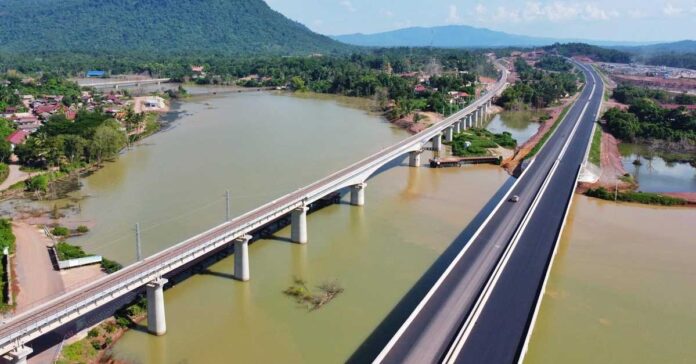
Vientiane-Vang Vieng Expressway section. Image used for representational purposes only. (Photo: Love Laos)

Laos is moving ahead with route surveys in Xaysomboun Province for a planned expressway that would become the country’s longest highway, linking Vientiane Capital with the Vietnam border through northeastern Laos.

Phongsavanh Group presented three proposed alignments during a meeting with the Xaysomboun Provincial Department of Public Works and Transport on 6 May.

The company signed an agreement with the Lao government in May 2025 to conduct feasibility studies, route surveys, design planning, and project preparation under a Build-Operate-Transfer model.

All three proposed routes begin through Long Xan district and Anouvong district before branching toward different parts of Xieng Khouang and Houaphanh provinces.

Route 1 runs north through Long Cheng and Phonesavanh before connecting with Route 7 West, covering roughly 207 kilometers. Route 2 cuts through the Nam Ngiep hydropower area before reaching Lat Houang at around 196 kilometers.

Route 3, which authorities currently favor, passes through Khoun district before ending at the Namsoi border checkpoint in Houaphanh Province. At approximately 186 kilometers, it offers the shortest and most direct connection to Vietnam.

Thongprasert Xayalath, Vice Chairman of the Xaysomboun Provincial Administrative Committee, instructed provincial departments to immediately submit transport, mining, agriculture, and industrial data to consulting teams as authorities accelerate the route selection process.

The expressway would begin at the KM 21 intersection on National Road 13 South in Xaythany district, Vientiane Capital, where it would connect with the existing Vientiane–Vang Vieng Expressway completed in 2020.

Authorities expect the highway to strengthen transport links between central and northeastern Laos while improving trade, tourism, and cargo movement with Vietnam.

The project also supports Laos’ broader strategy to expand regional connectivity and develop the country into a land-linked transport hub connecting China, Thailand, Vietnam, and the wider Mekong region.

Lao Electricity Exports to Vietnam Surge as Regional Energy Trade Expands

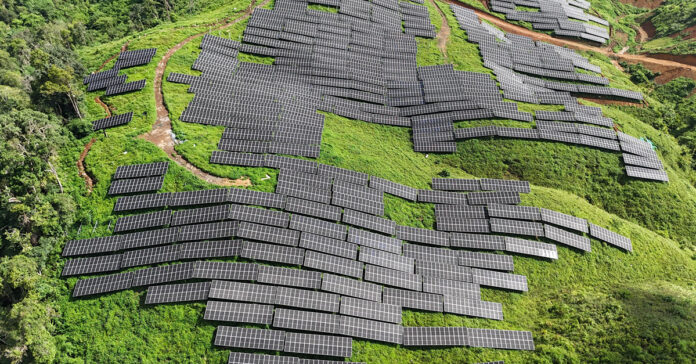
A 1,000 MW solar power facility in Oudomxay Province, one of the country’s largest renewable energy projects. (Photo credit: CGN Energy Laos)

Electricity exports from Laos to Vietnam rose sharply in early 2026 as Vietnam increased purchases to support growing energy demand and strengthen supply stability.

Vietnam imported around 2.92 billion kWh of electricity from Laos during the first quarter of 2026, nearly 120 percent higher than the same period last year, according to Vietnamese energy data.

Before the latest surge, Vietnam had already been steadily increasing electricity imports from Laos as power demand continued rising, especially in its northern industrial areas.

By the end of 2025, Vietnamese authorities had approved electricity imports from 47 Lao energy projects with a combined capacity of more than 8,260MW. Projects with installed capacity totaling 2,379MW were already supplying electricity to Vietnam last year, up from around 1,700MW in 2024.

Regional Exporter

The growth comes as Laos continues positioning itself as a regional energy exporter under its long-running “Battery of Southeast Asia” strategy.

Hydropower remains the backbone of Laos’ energy sector. According to recent international energy assessments, Laos had around 12.4GW of installed hydropower capacity in 2025, accounting for most of the country’s electricity generation.

In recent years, Laos has also expanded investment in wind and solar energy, especially projects aimed at export markets. One of the largest developments is the Monsoon Wind Power Project in southern Laos, which exports electricity directly to Vietnam through a dedicated transmission line.

Cross-border electricity trade has become increasingly important for the Lao economy.

Earlier this month, Laos and Thailand also discussed expanding energy cooperation, with electricity exports to Thailand alone reaching more than USD 2.3 billion in 2025, according to Lao authorities.

At the same time, Laos continues developing major transmission infrastructure projects with neighboring countries, including new high-voltage connections with China and Vietnam aimed at strengthening regional power integration.

Despite growing export volumes, Laos still faces domestic energy challenges during the dry season, when lower water levels can reduce hydropower generation and place pressure on the national grid.

Vietnamese authorities are also planning additional transmission upgrades to support larger electricity imports in the coming years while expanding domestic renewable energy and energy-saving measures to reduce pressure on supply systems.

Bison Bank, wholly owned by Hong Kong’s Bison Capital, launches its MiCA-compliant stablecoin for institutional cross-border payments

The Bison Bank stablecoin is fully compliant with European MiCA regulation and will be available in Euro (EUB) and US Dollar (USB).

HONG KONG, May 7, 2026 /PRNewswire/ — Bison Bank, a wholly-owned subsidiary of Bison Capital Holding Company Limited, today announced the launch of the ‘Bison Bank Electronic Token’. Designed for fast, secure, and transparent international payments and transfers, the digital asset will be issued as two distinct crypto-assets: one referenced to the Euro, named ‘EUB‘, and another referenced to the US Dollar, named ‘USB‘.

This initiative is in full compliance with the MiCA (Markets in Crypto-Assets) Regulation, the European Union’s legal framework designed to harmonize crypto-asset regulation and ensure operational security and stability. This move highlights Bison Bank’s deep investment in the digital asset space.

A Bridge Between Traditional Money and the Digital Future

In 2022, Bison Bank launched Bison Digital Assets (BDA). Through this subsidiary, Bison Bank enabled clients to access crypto-asset exchange and custody services directly from their bank accounts.

Today, the Bison Bank Electronic Token establishes a new global benchmark for digital money. It fosters innovation while guaranteeing client protection and market stability.

Meeting Basel Standards for Bank Balance Sheets

As a MiCA-compliant Electronic Money Token issued by a regulated EU credit institution under ECB supervision, the Bison Bank Electronic Token qualifies for preferential treatment under the Basel Committee’s prudential treatment of cryptoasset exposures (SCO60), effective 1 January 2026. This enables financial institutions in jurisdictions aligned with the Basel Framework to integrate the EMT into their treasury management and balance-sheet treatment with capital requirements aligned to the underlying fiat reference asset.

“Bison Bank’s goal is to reshape the global financial landscape,” states António Henriques, CEO of Bison Bank. “Our Electronic Money token serves as a secure bridge between traditional money and the digital future — a compliant, fast channel for cross-border payments among institutional partners, merging the reliability of a regulated banking group with the innovation of digital assets.”

What are Electronic Money Tokens

An e-money token is the digital equivalent of cash, built on blockchain technology. Each token represents an equivalent value in a traditional currency and is issued by a regulated entity – in this case, Bison Bank – which guarantees that every token is backed 1:1 by real currency reserves. Unlike other crypto-assets, these tokens maintain a stable value, making them a secure and suitable medium for payments.

About Bison Capital: Bison Capital Holding Company Limited is a Hong Kong-based company focused on strategic investments in the financial sector. Its main asset is a 100% stake in Bison Bank, S.A., a fully licensed European Universal Bank with operations in the crypto assets area. Bison Capital’s strategic rationale consists of establishing a structured network of resources across the different geographies where it has a business-driven presence, with the aim of generating sustained growth and strategic alliances.

About Bison Bank: Bison Bank, S.A. is a bank focused on providing a comprehensive and specialized range of Private Banking, Depositary Bank, Corporate Advisory and Digital Assets services to individual and institutional clients. It is leveraged by a strategic link between European and other global markets. It develops its business globally, supported by its strong presence in Europe and its network of international partners.

Further information on Bison Bank Electronic Money Token is available at https://bisonbank.com/eub/ and https://bisonbank.com/usb/. Please refer to the corresponding White Paper for full details.