


Home Blog Page 479

GWM Unveils World-Class Safety & Testing Facilities: Safety Built on Data, Not Hype


BAODING, CHINA – Media OutReach Newswire – 3 May 2026 – During the 2026 Beijing Auto Show, GWM hosted a Tech Day event, opening its global safety and testing complex to hundreds of international journalists and overseas dealers, who engaged in in-depth exchanges with engineers. No staged demos, no polished pitches—only real engineering: black electromagnetic absorbers, a 120ton rotating crash barrier, and an ORA 5 undergoing a 60 km/h side impact in full view of witnesses.

Frontier Tech in Focus: Global Media Eagerly Inquire About Rollout Timelines

During the Tech Day event, technical experts from GWM delivered in-depth technical analyses on all-scenario intelligent driving, next-generation smart cockpits, and the Hi4 powertrain family. The smart cockpit, powered by the Coffee OS 3 system, stood out with its five defining qualities – ” Good-looking, Easy to Use, Fun to Use, Pleasant to Hear, and Highly Intelligent.” GWM’s driver assistance system also earned strong acclaim for its forward-looking design and broad adaptability, particularly its thorough consideration of global regulations, local driving habits, scenario adaptability, and data localization strategies–a clear reflection of GWM’s global R&D vision. Meanwhile, the Hi4 powertrain family impressed attendees with its all-scenario capability and exceptional performance. Throughout the event, media representatives from various countries and regions eagerly inquired about the local rollout plans and timelines for these cutting-edge technologies.

A Foundation of Self-Reliance: Power and Validation Built In-House

Technical confidence starts with self‑developed power. Based on its Forest Ecosystem architecture, GWM has independently created 4.0T V8 and 3.0T V6 engines plus advanced diesel hybrid systems. To prove safety rather than just claim it, GWM built China’s first independent comprehensive proving ground, high‑altitude simulation lab, and climatic wind tunnel, forming a full‑life‑cycle validation system for global markets.

Launched in 2025, the GWM Safety Lab represents a 510‑million‑yuan investment across 57,000 square meters, serving as the core of a nearly 10‑billion‑yuan testing ecosystem. Global media experienced the facility with no guided script, seeing authentic validation rather than curated showcases.

Core Labs: Engineering Excellence Behind Every Detail

Inside the EMC Chamber, full shielding and wave‑absorbing materials enable 360‑degree testing with all electronic systems active. GWM’s internal standard limits electromagnetic radiation to less than one‑fifth of the national legal requirement. The 30‑million‑yuan NVH anechoic chamber uses a double‑layer room‑in‑room structure to reach 20 dB.

The 300‑million‑yuan climatic wind tunnel covers 2,800 square meters, simulating ‑40°C to 60°C, 5%–95% humidity, and winds up to 250 km/h. “To use the same calibration in the Middle East and Northern Europe without validation is gambling, not engineering,” a senior engineer noted,”Every GWM vehicle passes extreme cold, heat, and humidity tests before market launch. ”

Crash Test Center: Where Every Millisecond Defines Safety

GWM’s crash lab supports Euro NCAP, C‑NCAP, and FMVSS standards. In the Multi‑Angle Crash Zone, the high-speed camera captures 4,000 frames per second, allowing it to clearly record the trajectory of a bullet’s movement. In this way, engineers can split the 0.1-second crash into hundreds of parts and observe and analyze them frame by frame. Below the track, a glass‑covered camera pit captures underbody deformation in real time.

The 120‑ton moving deformable barrier withstands a 3.5‑ton vehicle crashing at 80 km/h. In the laboratory. It is possible to simulate vehicle collisions with guardrails on both sides of the highway, as well as full-scenario drop and rollover conditions for both left-hand drive and right-hand drive vehicles. “Rollover risk is deadly, so we test more rigorously than any other brand,” an engineer explained.

The AEB pre‑collision track simulates real‑world “brake then crash” conditions to ensure restraints and airbags work in sync. The New Energy Safety Zone manages thermal runaway with automated submergence in 30 seconds and AI firefighting for severe cases. GWM’s 34 high‑precision crash dummies include $1.7‑million THOR units and $1.1‑million WorldSID side‑impact units. “Dummies are not props—they define life‑saving boundaries,” engineers stressed.

ORA 5 Euro NCAP Test: Five-Star Safety Ready for Europe

In the on-site side impact test referencing Euro NCAP, the ORA 5 destined for Europe was struck at 60 km/h with one adult and two child dummies. The vehicle moved 5 meters, activated hazard lights, showed zero fuel leakage, and kept doors closed for occupant protection.

With 75% high‑strength steel, 2,000‑MPa submarine‑grade A‑pillars, 1,500‑MPa door beams, full‑coverage airbags, and adaptive seatbelts, the ORA 5 is on track for a Euro NCAP five‑star safety rating.

Strategic Vision: Trust, Safety and Tech Sovereignty

By opening its labs transparently, GWM builds global trust with tangible engineering rather than marketing. Safety validation clears regional barriers for Europe, the Middle East, Southeast Asia, and North America, enabling synchronized global launches.

Full‑stack self‑developed systems, industry‑first rotating barriers, and exclusive rollover testing mark GWM’s shift from adopting global tools to defining global standards.

As one senior dealer commented: “This is exactly what we needed to see.”

GWM’s global safety promise is clear: safety built on data, proven in labs, trusted worldwide.

Hashtag: #GWM

The issuer is solely responsible for the content of this announcement.

GWM Unveils World-Class Safety & Testing Facilities: Safety Built on Data, Not Hype


BAODING, CHINA – Media OutReach Newswire – 3 May 2026 – During the 2026 Beijing Auto Show, GWM hosted a Tech Day event, opening its global safety and testing complex to hundreds of international journalists and overseas dealers, who engaged in in-depth exchanges with engineers. No staged demos, no polished pitches—only real engineering: black electromagnetic absorbers, a 120ton rotating crash barrier, and an ORA 5 undergoing a 60 km/h side impact in full view of witnesses.

Frontier Tech in Focus: Global Media Eagerly Inquire About Rollout Timelines

During the Tech Day event, technical experts from GWM delivered in-depth technical analyses on all-scenario intelligent driving, next-generation smart cockpits, and the Hi4 powertrain family. The smart cockpit, powered by the Coffee OS 3 system, stood out with its five defining qualities – ” Good-looking, Easy to Use, Fun to Use, Pleasant to Hear, and Highly Intelligent.” GWM’s driver assistance system also earned strong acclaim for its forward-looking design and broad adaptability, particularly its thorough consideration of global regulations, local driving habits, scenario adaptability, and data localization strategies–a clear reflection of GWM’s global R&D vision. Meanwhile, the Hi4 powertrain family impressed attendees with its all-scenario capability and exceptional performance. Throughout the event, media representatives from various countries and regions eagerly inquired about the local rollout plans and timelines for these cutting-edge technologies.

A Foundation of Self-Reliance: Power and Validation Built In-House

Technical confidence starts with self‑developed power. Based on its Forest Ecosystem architecture, GWM has independently created 4.0T V8 and 3.0T V6 engines plus advanced diesel hybrid systems. To prove safety rather than just claim it, GWM built China’s first independent comprehensive proving ground, high‑altitude simulation lab, and climatic wind tunnel, forming a full‑life‑cycle validation system for global markets.

Launched in 2025, the GWM Safety Lab represents a 510‑million‑yuan investment across 57,000 square meters, serving as the core of a nearly 10‑billion‑yuan testing ecosystem. Global media experienced the facility with no guided script, seeing authentic validation rather than curated showcases.

Core Labs: Engineering Excellence Behind Every Detail

Inside the EMC Chamber, full shielding and wave‑absorbing materials enable 360‑degree testing with all electronic systems active. GWM’s internal standard limits electromagnetic radiation to less than one‑fifth of the national legal requirement. The 30‑million‑yuan NVH anechoic chamber uses a double‑layer room‑in‑room structure to reach 20 dB.

The 300‑million‑yuan climatic wind tunnel covers 2,800 square meters, simulating ‑40°C to 60°C, 5%–95% humidity, and winds up to 250 km/h. “To use the same calibration in the Middle East and Northern Europe without validation is gambling, not engineering,” a senior engineer noted,”Every GWM vehicle passes extreme cold, heat, and humidity tests before market launch. ”

Crash Test Center: Where Every Millisecond Defines Safety

GWM’s crash lab supports Euro NCAP, C‑NCAP, and FMVSS standards. In the Multi‑Angle Crash Zone, the high-speed camera captures 4,000 frames per second, allowing it to clearly record the trajectory of a bullet’s movement. In this way, engineers can split the 0.1-second crash into hundreds of parts and observe and analyze them frame by frame. Below the track, a glass‑covered camera pit captures underbody deformation in real time.

The 120‑ton moving deformable barrier withstands a 3.5‑ton vehicle crashing at 80 km/h. In the laboratory. It is possible to simulate vehicle collisions with guardrails on both sides of the highway, as well as full-scenario drop and rollover conditions for both left-hand drive and right-hand drive vehicles. “Rollover risk is deadly, so we test more rigorously than any other brand,” an engineer explained.

The AEB pre‑collision track simulates real‑world “brake then crash” conditions to ensure restraints and airbags work in sync. The New Energy Safety Zone manages thermal runaway with automated submergence in 30 seconds and AI firefighting for severe cases. GWM’s 34 high‑precision crash dummies include $1.7‑million THOR units and $1.1‑million WorldSID side‑impact units. “Dummies are not props—they define life‑saving boundaries,” engineers stressed.

ORA 5 Euro NCAP Test: Five-Star Safety Ready for Europe

In the on-site side impact test referencing Euro NCAP, the ORA 5 destined for Europe was struck at 60 km/h with one adult and two child dummies. The vehicle moved 5 meters, activated hazard lights, showed zero fuel leakage, and kept doors closed for occupant protection.

With 75% high‑strength steel, 2,000‑MPa submarine‑grade A‑pillars, 1,500‑MPa door beams, full‑coverage airbags, and adaptive seatbelts, the ORA 5 is on track for a Euro NCAP five‑star safety rating.

Strategic Vision: Trust, Safety and Tech Sovereignty

By opening its labs transparently, GWM builds global trust with tangible engineering rather than marketing. Safety validation clears regional barriers for Europe, the Middle East, Southeast Asia, and North America, enabling synchronized global launches.

Full‑stack self‑developed systems, industry‑first rotating barriers, and exclusive rollover testing mark GWM’s shift from adopting global tools to defining global standards.

As one senior dealer commented: “This is exactly what we needed to see.”

GWM’s global safety promise is clear: safety built on data, proven in labs, trusted worldwide.

Hashtag: #GWM

The issuer is solely responsible for the content of this announcement.
/C O R R E C T I O N — Applied Intuition, Inc./

In the news release, Applied Intuition Collaborates with Heidelberg Materials to Advance Innovation in Quarry Operations with Autonomous Haulage Fleets, issued 30-Apr-2026 by Applied Intuition, Inc. over PR Newswire, we are advised by the company that changes have been made. The complete, corrected release follows, with additional details at the end:

Applied Intuition Collaborates with Heidelberg Materials to Advance Innovation in Quarry Operations with Autonomous Haulage Fleets

Deployment brings intelligent, vehicle-based autonomy to Australia, establishing a new operating model for construction and mining environments.

SUNNYVALE, Calif., April 30, 2026 /PRNewswire/ — Applied Intuition, Inc., a leader in physical AI, today announced its collaboration with Heidelberg Materials, one of the world’s largest integrated manufacturers of building materials and solutions, to deploy autonomous haulage systems for Heidelberg Materials’ quarry operations, starting at a site in Australia.

Applied Intuition will provide its Self-Driving System (SDS) for Construction to support autonomous haulage operations within Heidelberg Materials’ fleet of construction and mining vehicles in Australia. The deployment marks the next real-world application of Applied Intuition’s autonomy platform in industrial environments. Upon successful completion, it will support the expansion of autonomous operations within Heidelberg Materials’ broader Australian network.

The collaboration also challenges the standard industry model. While autonomy solutions traditionally target the largest quarry sites, this system is designed for smaller operations, including those running just two 40-ton trucks, making it deployable across quarry sites of varying size worldwide.

“No two quarry or construction sites operate the same way, with different layouts, constraints and economics,” said Qasar Younis, co-founder and CEO of Applied Intuition. “We’ve built our platform to adapt to that reality. This partnership shows we can take the same core system used in large mining operations and apply it to smaller, infrastructure-constrained quarry sites, scaling it across hundreds of unique locations.”

For Heidelberg Materials, the partnership is aimed at enhancing safety and operational performance. It also reflects the need for an autonomy solution that can operate at large sites and smaller ones too, whereas traditional autonomous haulage systems are often too infrastructure-heavy or costly to scale. For Applied Intuition, it serves as a proof point that its autonomy platform is designed not just for one-off deployments, but for global scale across construction, quarry and mining environments of any size.

Applied Intuition’s system runs directly on the vehicle, with integrated perception, decision-making and safety systems onboard, enabling reliable operation without constant connectivity or heavy site infrastructure.

The collaboration builds on Applied Intuition’s growing presence in construction and mining autonomy and reinforces its broader physical AI strategy. The same core platform has already been deployed in other industries, including trucking and defense, with learnings from each domain contributing to continuous system improvements. Applied Intuition’s SDS platform strategy also enables the company to bring technologies proven in other domains into construction and mining, helping accelerate development and deployment.

Through this project, Applied Intuition demonstrates the range of its autonomy platform, from some of the largest mining trucks in the world to smaller quarry vehicles operating in constrained, lower-infrastructure environments. Together, these deployments highlight the company’s approach to building scalable autonomy for construction and mining from the ground up.

To learn more about how Applied Intuition is building the future of construction autonomy, visit applied.co.

About Applied Intuition
Applied Intuition, Inc. is powering the future of physical AI. Founded in 2017 and now valued at $15 billion, the Silicon Valley company is creating the digital infrastructure needed to bring intelligence to every moving machine on the planet. Applied Intuition services the automotive, defense, trucking, construction, mining and agriculture industries in three core areas: tools and infrastructure, operating systems and autonomy. Eighteen of the top 20 global automakers, as well as the United States military and its allies, trust the company’s solutions to deliver physical intelligence. Applied Intuition is headquartered in Sunnyvale, California, with offices in Washington, D.C.; San Diego; Ft. Walton Beach, Florida; Ann Arbor, Michigan; London; Stuttgart; Munich; Stockholm; Gothenburg, Sweden; Bangalore; Seoul; and Tokyo. Learn more at applied.co.

Correction: An earlier version of this release incorrectly stated the location of the site noted in the first paragraph.

/C O R R E C T I O N — Applied Intuition, Inc./

In the news release, Applied Intuition Collaborates with Heidelberg Materials to Advance Innovation in Quarry Operations with Autonomous Haulage Fleets, issued 30-Apr-2026 by Applied Intuition, Inc. over PR Newswire, we are advised by the company that changes have been made. The complete, corrected release follows, with additional details at the end:

Applied Intuition Collaborates with Heidelberg Materials to Advance Innovation in Quarry Operations with Autonomous Haulage Fleets

Deployment brings intelligent, vehicle-based autonomy to Australia, establishing a new operating model for construction and mining environments.

SUNNYVALE, Calif., April 30, 2026 /PRNewswire/ — Applied Intuition, Inc., a leader in physical AI, today announced its collaboration with Heidelberg Materials, one of the world’s largest integrated manufacturers of building materials and solutions, to deploy autonomous haulage systems for Heidelberg Materials’ quarry operations, starting at a site in Australia.

Applied Intuition will provide its Self-Driving System (SDS) for Construction to support autonomous haulage operations within Heidelberg Materials’ fleet of construction and mining vehicles in Australia. The deployment marks the next real-world application of Applied Intuition’s autonomy platform in industrial environments. Upon successful completion, it will support the expansion of autonomous operations within Heidelberg Materials’ broader Australian network.

The collaboration also challenges the standard industry model. While autonomy solutions traditionally target the largest quarry sites, this system is designed for smaller operations, including those running just two 40-ton trucks, making it deployable across quarry sites of varying size worldwide.

“No two quarry or construction sites operate the same way, with different layouts, constraints and economics,” said Qasar Younis, co-founder and CEO of Applied Intuition. “We’ve built our platform to adapt to that reality. This partnership shows we can take the same core system used in large mining operations and apply it to smaller, infrastructure-constrained quarry sites, scaling it across hundreds of unique locations.”

For Heidelberg Materials, the partnership is aimed at enhancing safety and operational performance. It also reflects the need for an autonomy solution that can operate at large sites and smaller ones too, whereas traditional autonomous haulage systems are often too infrastructure-heavy or costly to scale. For Applied Intuition, it serves as a proof point that its autonomy platform is designed not just for one-off deployments, but for global scale across construction, quarry and mining environments of any size.

Applied Intuition’s system runs directly on the vehicle, with integrated perception, decision-making and safety systems onboard, enabling reliable operation without constant connectivity or heavy site infrastructure.

The collaboration builds on Applied Intuition’s growing presence in construction and mining autonomy and reinforces its broader physical AI strategy. The same core platform has already been deployed in other industries, including trucking and defense, with learnings from each domain contributing to continuous system improvements. Applied Intuition’s SDS platform strategy also enables the company to bring technologies proven in other domains into construction and mining, helping accelerate development and deployment.

Through this project, Applied Intuition demonstrates the range of its autonomy platform, from some of the largest mining trucks in the world to smaller quarry vehicles operating in constrained, lower-infrastructure environments. Together, these deployments highlight the company’s approach to building scalable autonomy for construction and mining from the ground up.

To learn more about how Applied Intuition is building the future of construction autonomy, visit applied.co.

About Applied Intuition
Applied Intuition, Inc. is powering the future of physical AI. Founded in 2017 and now valued at $15 billion, the Silicon Valley company is creating the digital infrastructure needed to bring intelligence to every moving machine on the planet. Applied Intuition services the automotive, defense, trucking, construction, mining and agriculture industries in three core areas: tools and infrastructure, operating systems and autonomy. Eighteen of the top 20 global automakers, as well as the United States military and its allies, trust the company’s solutions to deliver physical intelligence. Applied Intuition is headquartered in Sunnyvale, California, with offices in Washington, D.C.; San Diego; Ft. Walton Beach, Florida; Ann Arbor, Michigan; London; Stuttgart; Munich; Stockholm; Gothenburg, Sweden; Bangalore; Seoul; and Tokyo. Learn more at applied.co.

Correction: An earlier version of this release incorrectly stated the location of the site noted in the first paragraph.

/C O R R E C T I O N — Applied Intuition, Inc./

In the news release, Applied Intuition Collaborates with Heidelberg Materials to Advance Innovation in Quarry Operations with Autonomous Haulage Fleets, issued 30-Apr-2026 by Applied Intuition, Inc. over PR Newswire, we are advised by the company that changes have been made. The complete, corrected release follows, with additional details at the end:

Applied Intuition Collaborates with Heidelberg Materials to Advance Innovation in Quarry Operations with Autonomous Haulage Fleets

Deployment brings intelligent, vehicle-based autonomy to Australia, establishing a new operating model for construction and mining environments.

SUNNYVALE, Calif., April 30, 2026 /PRNewswire/ — Applied Intuition, Inc., a leader in physical AI, today announced its collaboration with Heidelberg Materials, one of the world’s largest integrated manufacturers of building materials and solutions, to deploy autonomous haulage systems for Heidelberg Materials’ quarry operations, starting at a site in Australia.

Applied Intuition will provide its Self-Driving System (SDS) for Construction to support autonomous haulage operations within Heidelberg Materials’ fleet of construction and mining vehicles in Australia. The deployment marks the next real-world application of Applied Intuition’s autonomy platform in industrial environments. Upon successful completion, it will support the expansion of autonomous operations within Heidelberg Materials’ broader Australian network.

The collaboration also challenges the standard industry model. While autonomy solutions traditionally target the largest quarry sites, this system is designed for smaller operations, including those running just two 40-ton trucks, making it deployable across quarry sites of varying size worldwide.

“No two quarry or construction sites operate the same way, with different layouts, constraints and economics,” said Qasar Younis, co-founder and CEO of Applied Intuition. “We’ve built our platform to adapt to that reality. This partnership shows we can take the same core system used in large mining operations and apply it to smaller, infrastructure-constrained quarry sites, scaling it across hundreds of unique locations.”

For Heidelberg Materials, the partnership is aimed at enhancing safety and operational performance. It also reflects the need for an autonomy solution that can operate at large sites and smaller ones too, whereas traditional autonomous haulage systems are often too infrastructure-heavy or costly to scale. For Applied Intuition, it serves as a proof point that its autonomy platform is designed not just for one-off deployments, but for global scale across construction, quarry and mining environments of any size.

Applied Intuition’s system runs directly on the vehicle, with integrated perception, decision-making and safety systems onboard, enabling reliable operation without constant connectivity or heavy site infrastructure.

The collaboration builds on Applied Intuition’s growing presence in construction and mining autonomy and reinforces its broader physical AI strategy. The same core platform has already been deployed in other industries, including trucking and defense, with learnings from each domain contributing to continuous system improvements. Applied Intuition’s SDS platform strategy also enables the company to bring technologies proven in other domains into construction and mining, helping accelerate development and deployment.

Through this project, Applied Intuition demonstrates the range of its autonomy platform, from some of the largest mining trucks in the world to smaller quarry vehicles operating in constrained, lower-infrastructure environments. Together, these deployments highlight the company’s approach to building scalable autonomy for construction and mining from the ground up.

To learn more about how Applied Intuition is building the future of construction autonomy, visit applied.co.

About Applied Intuition
Applied Intuition, Inc. is powering the future of physical AI. Founded in 2017 and now valued at $15 billion, the Silicon Valley company is creating the digital infrastructure needed to bring intelligence to every moving machine on the planet. Applied Intuition services the automotive, defense, trucking, construction, mining and agriculture industries in three core areas: tools and infrastructure, operating systems and autonomy. Eighteen of the top 20 global automakers, as well as the United States military and its allies, trust the company’s solutions to deliver physical intelligence. Applied Intuition is headquartered in Sunnyvale, California, with offices in Washington, D.C.; San Diego; Ft. Walton Beach, Florida; Ann Arbor, Michigan; London; Stuttgart; Munich; Stockholm; Gothenburg, Sweden; Bangalore; Seoul; and Tokyo. Learn more at applied.co.

Correction: An earlier version of this release incorrectly stated the location of the site noted in the first paragraph.

/C O R R E C T I O N — Applied Intuition, Inc./

In the news release, Applied Intuition Collaborates with Heidelberg Materials to Advance Innovation in Quarry Operations with Autonomous Haulage Fleets, issued 30-Apr-2026 by Applied Intuition, Inc. over PR Newswire, we are advised by the company that changes have been made. The complete, corrected release follows, with additional details at the end:

Applied Intuition Collaborates with Heidelberg Materials to Advance Innovation in Quarry Operations with Autonomous Haulage Fleets

Deployment brings intelligent, vehicle-based autonomy to Australia, establishing a new operating model for construction and mining environments.

SUNNYVALE, Calif., April 30, 2026 /PRNewswire/ — Applied Intuition, Inc., a leader in physical AI, today announced its collaboration with Heidelberg Materials, one of the world’s largest integrated manufacturers of building materials and solutions, to deploy autonomous haulage systems for Heidelberg Materials’ quarry operations, starting at a site in Australia.

Applied Intuition will provide its Self-Driving System (SDS) for Construction to support autonomous haulage operations within Heidelberg Materials’ fleet of construction and mining vehicles in Australia. The deployment marks the next real-world application of Applied Intuition’s autonomy platform in industrial environments. Upon successful completion, it will support the expansion of autonomous operations within Heidelberg Materials’ broader Australian network.

The collaboration also challenges the standard industry model. While autonomy solutions traditionally target the largest quarry sites, this system is designed for smaller operations, including those running just two 40-ton trucks, making it deployable across quarry sites of varying size worldwide.

“No two quarry or construction sites operate the same way, with different layouts, constraints and economics,” said Qasar Younis, co-founder and CEO of Applied Intuition. “We’ve built our platform to adapt to that reality. This partnership shows we can take the same core system used in large mining operations and apply it to smaller, infrastructure-constrained quarry sites, scaling it across hundreds of unique locations.”

For Heidelberg Materials, the partnership is aimed at enhancing safety and operational performance. It also reflects the need for an autonomy solution that can operate at large sites and smaller ones too, whereas traditional autonomous haulage systems are often too infrastructure-heavy or costly to scale. For Applied Intuition, it serves as a proof point that its autonomy platform is designed not just for one-off deployments, but for global scale across construction, quarry and mining environments of any size.

Applied Intuition’s system runs directly on the vehicle, with integrated perception, decision-making and safety systems onboard, enabling reliable operation without constant connectivity or heavy site infrastructure.

The collaboration builds on Applied Intuition’s growing presence in construction and mining autonomy and reinforces its broader physical AI strategy. The same core platform has already been deployed in other industries, including trucking and defense, with learnings from each domain contributing to continuous system improvements. Applied Intuition’s SDS platform strategy also enables the company to bring technologies proven in other domains into construction and mining, helping accelerate development and deployment.

Through this project, Applied Intuition demonstrates the range of its autonomy platform, from some of the largest mining trucks in the world to smaller quarry vehicles operating in constrained, lower-infrastructure environments. Together, these deployments highlight the company’s approach to building scalable autonomy for construction and mining from the ground up.

To learn more about how Applied Intuition is building the future of construction autonomy, visit applied.co.

About Applied Intuition
Applied Intuition, Inc. is powering the future of physical AI. Founded in 2017 and now valued at $15 billion, the Silicon Valley company is creating the digital infrastructure needed to bring intelligence to every moving machine on the planet. Applied Intuition services the automotive, defense, trucking, construction, mining and agriculture industries in three core areas: tools and infrastructure, operating systems and autonomy. Eighteen of the top 20 global automakers, as well as the United States military and its allies, trust the company’s solutions to deliver physical intelligence. Applied Intuition is headquartered in Sunnyvale, California, with offices in Washington, D.C.; San Diego; Ft. Walton Beach, Florida; Ann Arbor, Michigan; London; Stuttgart; Munich; Stockholm; Gothenburg, Sweden; Bangalore; Seoul; and Tokyo. Learn more at applied.co.

Correction: An earlier version of this release incorrectly stated the location of the site noted in the first paragraph.

/C O R R E C T I O N — Applied Intuition, Inc./

In the news release, Applied Intuition Collaborates with Heidelberg Materials to Advance Innovation in Quarry Operations with Autonomous Haulage Fleets, issued 30-Apr-2026 by Applied Intuition, Inc. over PR Newswire, we are advised by the company that changes have been made. The complete, corrected release follows, with additional details at the end:

Applied Intuition Collaborates with Heidelberg Materials to Advance Innovation in Quarry Operations with Autonomous Haulage Fleets

Deployment brings intelligent, vehicle-based autonomy to Australia, establishing a new operating model for construction and mining environments.

SUNNYVALE, Calif., April 30, 2026 /PRNewswire/ — Applied Intuition, Inc., a leader in physical AI, today announced its collaboration with Heidelberg Materials, one of the world’s largest integrated manufacturers of building materials and solutions, to deploy autonomous haulage systems for Heidelberg Materials’ quarry operations, starting at a site in Australia.

Applied Intuition will provide its Self-Driving System (SDS) for Construction to support autonomous haulage operations within Heidelberg Materials’ fleet of construction and mining vehicles in Australia. The deployment marks the next real-world application of Applied Intuition’s autonomy platform in industrial environments. Upon successful completion, it will support the expansion of autonomous operations within Heidelberg Materials’ broader Australian network.

The collaboration also challenges the standard industry model. While autonomy solutions traditionally target the largest quarry sites, this system is designed for smaller operations, including those running just two 40-ton trucks, making it deployable across quarry sites of varying size worldwide.

“No two quarry or construction sites operate the same way, with different layouts, constraints and economics,” said Qasar Younis, co-founder and CEO of Applied Intuition. “We’ve built our platform to adapt to that reality. This partnership shows we can take the same core system used in large mining operations and apply it to smaller, infrastructure-constrained quarry sites, scaling it across hundreds of unique locations.”

For Heidelberg Materials, the partnership is aimed at enhancing safety and operational performance. It also reflects the need for an autonomy solution that can operate at large sites and smaller ones too, whereas traditional autonomous haulage systems are often too infrastructure-heavy or costly to scale. For Applied Intuition, it serves as a proof point that its autonomy platform is designed not just for one-off deployments, but for global scale across construction, quarry and mining environments of any size.

Applied Intuition’s system runs directly on the vehicle, with integrated perception, decision-making and safety systems onboard, enabling reliable operation without constant connectivity or heavy site infrastructure.

The collaboration builds on Applied Intuition’s growing presence in construction and mining autonomy and reinforces its broader physical AI strategy. The same core platform has already been deployed in other industries, including trucking and defense, with learnings from each domain contributing to continuous system improvements. Applied Intuition’s SDS platform strategy also enables the company to bring technologies proven in other domains into construction and mining, helping accelerate development and deployment.

Through this project, Applied Intuition demonstrates the range of its autonomy platform, from some of the largest mining trucks in the world to smaller quarry vehicles operating in constrained, lower-infrastructure environments. Together, these deployments highlight the company’s approach to building scalable autonomy for construction and mining from the ground up.

To learn more about how Applied Intuition is building the future of construction autonomy, visit applied.co.

About Applied Intuition
Applied Intuition, Inc. is powering the future of physical AI. Founded in 2017 and now valued at $15 billion, the Silicon Valley company is creating the digital infrastructure needed to bring intelligence to every moving machine on the planet. Applied Intuition services the automotive, defense, trucking, construction, mining and agriculture industries in three core areas: tools and infrastructure, operating systems and autonomy. Eighteen of the top 20 global automakers, as well as the United States military and its allies, trust the company’s solutions to deliver physical intelligence. Applied Intuition is headquartered in Sunnyvale, California, with offices in Washington, D.C.; San Diego; Ft. Walton Beach, Florida; Ann Arbor, Michigan; London; Stuttgart; Munich; Stockholm; Gothenburg, Sweden; Bangalore; Seoul; and Tokyo. Learn more at applied.co.

Correction: An earlier version of this release incorrectly stated the location of the site noted in the first paragraph.

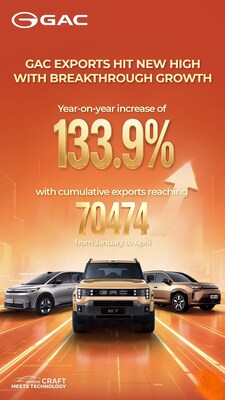
GAC’s overseas export volume breaks through to new highs, surging 133.9% year-on-year from January to April, as its global expansion journey enters the fast lane

GUANGZHOU, China, May 2, 2026 /PRNewswire/ — Building on strong overseas sales with 86% YoY growth in Q1, GAC has further accelerated its global expansion. From January to April, the company exported 70,474 vehicles, a 133.9% YoY increase. Guided by the “One GAC 2.0” strategy, GAC is advancing toward its annual target of 250,000 export units, with a stretch goal of 300,000.

As GAC’s global strategic flagship, the AION UT continues to excel. In the pure electric hatchback segment, it ranks first in Hong Kong SAR, Colombia, Uruguay, and Singapore; second in Indonesia; and third in Thailand and Mexico. In Australia, the AION UT secured over 600 orders within its first pre-sales month.

Robust Regional Growth and Breakthroughs in Benchmark Markets

In Asia-Pacific, GAC secured 6,287 orders at the Bangkok International Motor Show. Monthly sales in Hong Kong SAR, Malaysia, and Indonesia surged by 503%, 900%, and 338%, respectively, while the AION UT officially launched in Australia. In Europe, the model debuted in Milan and commenced localized production with Magna in Austria, marking a critical step for GAC’s “In Europe, for Europe” commitment. In Israel, AION entered the top 10 for EV sales just six months post-launch. Across the Americas, sales in Uruguay and Colombia skyrocketed by 775% and 1,007%. Concurrently, GAC continues expanding its sports marketing footprint by sponsoring top football clubs like Brazil’s Flamengo and Bolivia’s Oriente Petrolero.

Global Strategy Upgrade and Accelerated Eco-Expansion

At the 139th Canton Fair, GAC secured letters of intent for over 900 vehicles (approx. $10 million export value), demonstrating the strength of its “Technology + Ecosystem” model. The 2026 GAC International Partner Conference gathered 700 dealers from 87 countries, reinforcing the international sales network. At Auto China, GAC unveiled its 2030 Strategic Plan, aiming to enter 120 countries and establish over 2,000 overseas touchpoints. Leveraging a full-powertrain product matrix across its GAC, AION, and HYPTEC brands, the company targets one million annual overseas sales.

Transitioning from product exportation to deep-rooted global ecological integration, GAC is rapidly accelerating its journey toward the one-million-unit international milestone.

About GAC:

For further information about GAC, please visit: https://www.gacgroup.com/en or follow us on social.
