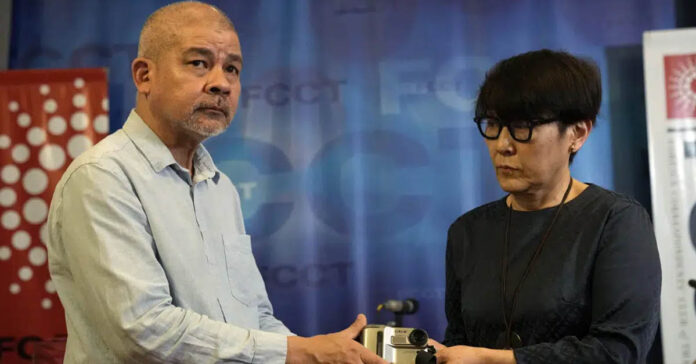
Aye Chan Naing, left, of Democratic Voice of Burma, hands over the video camera of slain Japanese journalist Kenji Nagai to his sister Noriko Ogawa, at the Foreign Correspondents Club in Bangkok, Thailand Wednesday, April 26, 2023. Nagai's video camera, which he had been carrying when he was shot dead covering a during a street protest in Myanmar September 2007, was missing until it was recently recovered by the Democratic Voice of Burma news service, which handed it over to his sister at the club. (AP Photo/Sakchai Lalit)
BANGKOK (AP) — A video camera that had been missing for more than 15 years after it was dropped by a Japanese journalist who was fatally shot during a street protest in Myanmar was handed over Wednesday to his sister at a ceremony in Bangkok.
Lao police have issued a search warrant with a reward of LAK 50 million to arrest a Lao businesswoman who is believed to have been involved in fraud and money laundering.
Public See Parental and Caregivers’ Corporal Punishment as Private Family Matter, Reluctant to Intervene Over 80% support legislating Mandatory Reporting Requirement
HONG KONG SAR – Media OutReach – 27 April 2023 – It is the responsibility of the society to protect children from harm and violence, regardless of the setting. This includes taking action to prevent abuse and mistreatment in the home, as well as outside of the home and in institutional settings. Save the Children Hong Kong commissioned Centre for Communication and Public Opinion Survey, the Chinese University of Hong Kong to conduct public opinion polling on physical and humiliating punishment and Mandatory Reporting Requirement for suspected child abuse cases, gathering responses from 1,008 adults in Hong Kong.
Ms. Winnie Ng, Spokesperson of Save the Children Hong Kong (Middle) and Mr. Ian Li, Advocacy Manager of Save the Children Hong Kong (Left) released the “Public view on Corporal Punishment” Survey Report.
Majority Reluctant to Intervene in Corporal Punishment on Children
In the polling, only 23% of respondents acted upon witnessing other adults beating, slapping or verbally humiliating their children on the street. There are several reasons why individuals may choose not to act, including a reluctance to intervene in other families’ personal matters (54.5%), a belief that the incident is not severe enough to warrant intervention (30.7%), and uncertainty about whether the situation constitutes child abuse (30.4%). This potentially delays the identification of child abuse cases, which could lead to serious violence and harm to child victims.
Misconception of Corporal Punishment as a Private Family Matter
One-third of respondents (31.1%) agreed that disciplining children is an internal matter of the family, and outsiders should not interfere. Among those who did not intervene when witnessing parents or caregivers exercising corporal punishment, more than half of them (54.5%) saw it as a private family matter. Save the Children Hong Kong believes this reflects a traditional and cultural norm contributing to corporal punishment.
Ms. Winnie Ng, Spokesperson of Save the Children Hong Kong, expresses that, “Corporal punishment is not a private family matter, as it violates children’s rights and can have long-lasting negative effects on their well-being. It is the society’s responsibility to ensure that all children are protected from harm. Positive parenting needs to be reinforced through public education to fulfil this responsibility. We also encourage bystanders to step up and protect children from violence they witness.” She emphasises the need to strengthen support for positive parenting and prioritise the best interests of the child.
Ms. Sylvia Chung, Chairperson of Division of Counselling Psychology of Hong Kong Psychology Society, also concerns about the report’s finding, ” Corporal punishment causes a collective trauma that can have a devastating impact on children and parents. Corporal punishment can cause trauma to children physically and psychologically, which distorts the nature of children’s need to be nurtured and loved. Preventing children from addressing their unmet emotional needs may cause them to question the potential for building relationships in a non-violent manner. This, in turn, can have negative effects on their interactions with others and their self-image, and even impact the way they treat their own children in the future.”
Polling Shows Strong Public Support for Legislating Mandatory Reporting Requirement
83.2% of respondents support the government legislating a mandatory reporting mechanism to ensure professionals who have regular contact with children report suspected child abuse and neglect cases. This level of public support creates a favourable environment for the government to move forward with the legislative process. Legislators should consider stakeholders’ opinions, including children’s suggestions, and initiate the legislative process as soon as possible.
Ms. Winnie Ng, highlights that the poll findings support an urgency to legislate Mandatory Reporting. The mandatory reporting requirement is a significant step to strengthen child protection. Save the Children Hong Kong also recommends the government to mandate Child Safeguarding policies for organisations that frequently interact with children. This would support mandated reporters and streamline cooperation with local authorities during investigations.
Building the Path Towards a Ban on Corporal Punishment of Children in All Settings
The study also shows 64.2% of respondents support legislation to prohibit any form of corporal punishment towards children in all settings, including at home. However, the current legislation in Hong Kong only prohibits corporal punishment in certain public settings, such as schools and organisations.
Across the world, 65 countries have already legally prohibited physical punishment of children in all settings, including Sweden, Germany, Spain, Japan, and South Korea. To create a culture that prioritises the best interests of the child, the government, child-facing institutions, and parents must continue the conversation on developing a supportive environment, and build a path towards a ban on corporal punishment of children in all settings.
The issuer is solely responsible for the content of this announcement.
Save the Children Hong Kong
Save the Children believes every child deserves a future. In Hong Kong and around the world, we do whatever it takes – every day and in times of crisis – so children can fulfil their rights to a healthy start in life, the opportunity to learn and protection from harm. Established in 2009, Save the Children Hong Kong is part of the Save the Children global movement which is made up of 30 member organisations and operates in almost 120 countries. With over 100 years of expertise, we are the world’s first independent children’s organisation – transforming lives and the future we share. Visit our website, or follow us on Facebook , Instagram, LinkedIn and YouTube.
36-year-old Sararat Rangsiwuthaporn was arrested after the accuse of 9 deaths from cyanide poisoning. ( Photo: Nation).
Police in Thailand have arrested a woman who is suspected of poisoning at least 13 people with cyanide, with only two individuals managing to survive the ordeal.
Hong Kongers Clean Their Homes Less Frequently After the COVID-19 Pandemic and Very Few of Them Realise the Importance of Effective Filtration
HONG KONG SAR – Media OutReach – 27 April 2023 – Today, Dyson announces the results of its annual global dust study, investigating cleaning habits and behaviours, our understanding of household dust and its potential impact on our well-being.
Dyson’s team of in-house microbiologists have been studying real dust from around the world for almost 20 years, analysing particles measuring 70 microns in size – the width of human hair – right down to 0.1 microns, the size of a virus. Dyson’s labs are also home to a farm of dust mites, enabling scientists to collect their faeces and learn more about dust mite allergens. Only through this extensive research can Dyson engineers continue to engineer new vacuum cleaner technologies, to better deal with the conditions they face in the real world.
The global dust study[1], undertaken by over 30,000 people from 39 countries, reveals that post-pandemic, cleaning habits globally are slipping. 60% of people now admit to only cleaning when they see visible dust or dirt – this number has risen by 20% since last year. Over the past year, Hong Konger’s attitude towards cleaning their homes have drastically changed. They have become less proactive and more reactive in cleaning noticeable dust. This is evidenced by seeing 56% of them only motivated to clean their home when they see dust. This figure rose by 50% from last year’s global dust study. Hong Kong respondents claim that they understand the importance of having their home properly sanitised more than their peers in the Greater China region. But only 1 in 4 Hong Kong people clean their homes regularly – a major decline from last year (43%).
“The COVID-19 pandemic highlighted the presence of viruses in indoor environments and emphasised the need for regular cleaning to maintain a healthy home”, said Monika Stuczen, Research Scientist in Microbiology at Dyson. “This significant increase in the number of people only cleaning when they spot visible dust is a cause for concern, as many dust particles – including viruses and bacteria – are microscopic in size and not visible to the naked eye.”
Are people neglecting hidden spots for a proper cleaning?
Dyson’s study reveals that awareness of what’s in our household dust – and therefore what we’re trying to remove – is low. Hong Kong people’s overall awareness of the presence of viruses in dust stands at 1 in 3 people across the region, lower than the global average. Only 17% of Hong Kongers know that sofas can harbour viruses. What is more striking is that only 2 out of 5 Hong Kongers clean behind their sofas, which is the lowest in the Greater China region. Bed linen is another place that is being overlooked by Hong Kongers when they are cleaning their homes. Only 1 out 2 Hong Kongers clean it on a regular basis. On average, this is less often than in other parts of the world.
“COVID-19 highlighted transmission via respiratory events such as coughing or sneezing but there is growing evidence that small aerosol droplets can be carried around indoor environments on air currents, like cigarette smoke, and settle on surfaces” says Monika. “If people are more aware of what’s in their dust and how it can be spread around the home, they can better focus their time and attention when cleaning to support their wellbeing.
Are people underestimating the importance of filtration in vacuum cleaning?
Ensuring a healthy environment is the top reason globally for people wanting to rid their home of dust. While many people assume that if dust and dirt is picked up then the problem is solved, vacuum cleaning is pointless without thorough filtration.
Dyson’s dust study reveals that awareness of filters overall is low, and despite it becoming a buzzword during the pandemic, just 1 in 4 Hong Kongers understand the importance of effective filtration when it comes to removing dust. About half of them believe that HEPA (High Efficiency Particulate Air) does not need to be replaced.
HEPA filter vs. HEPA product
A common misconception is that any machine equipped with a HEPA filter makes it a HEPA product. According to ASTM, a world-leading standards institute, it is not enough for just the final, post-motor filter to be HEPA-grade; every single filter and seal throughout the machine must be HEPA-grade for it to be considered a HEPA product.
“The best filter cannot provide clean air if there is an opportunity for dirty air to leak out of the machine – so our engineers worked hard to ensure that all our Dyson vacuums have whole-machine filtration. In our Gen5detect vacuum, we went a step further with HEPA filtration to ensure that even virus particles as small as 0.1 microns remain trapped in the machine.” Charlie Park, Vice President of Floorcare at Dyson
The importance of keeping pets clean in Hong Kong
Only 1 in 3 households in Hong Kong that have a pet keep their animal clean on a regular basis. Most of them seek to trim their pet’s hair when grooming but only one-third of them remove viruses that could possibly be on their pet’s fur. Only 16% of Hong Kong pet owners use a pet-focused vacuum tool to remove possible viral particles from their four-legged friend. Despite 41% of pet owners in Hong Kong are aware that their furry friends can carry viruses, almost one-third of them allow their pets to sleep with them.
“We hope our latest global dust study will continue to encourage people to think about what can reside in household dust, and how that might impact the well-being of those in their household.The best way to remove dust is by using a vacuum cleaner with effective filtration and sealing technology, to ensure that whatever you vacuum remains trapped and is not expelled back into the home.” Monika Stuczen, Research Scientist in Microbiology at Dyson.
[1] 33,997 online interviews across a representative sample of 39 countries. Fieldwork was conducted between 11th January and 6th February 2023. Data has been weighted at a ‘Global’ level to be representative of different population sizes.
Hashtag: #Dyson
The issuer is solely responsible for the content of this announcement.
About The Dyson Global Dust Study 2023
The Dyson Global Dust Study 2022 is a 15-minute online survey undertaken by 33,997 people across 39 countries. Fieldwork was conducted between the 11th January to 6th February 2023 and data has been weighted at a ‘global’ level to be representative of different population sizes.
DYSON TECHNOLOGY
Dyson Zone™ noise cancelling headphones with air purification: Advanced noise cancelling removes unwanted environmental and motor noise, and high-fidelity precision audio replicates sound as the artist or creator intended. Powered by the smallest compressors in any Dyson machine, the Dyson Zone™ draws air through the electrostatic filters in each earcup to capture 99% of particles as small as 0.1 microns, and potassium-enriched carbon filters remove city fumes, to deliver cleaner air to the wearer’s nose and mouth via a contact-free visor.
Dyson Gen5 Detect vacuum cleaner™: Our most powerful cordless vacuum featuring a new fifth generation HyperdymiumTM motor. The machine also features a fully sealed, whole-machine HEPA filtration system, engineered to capture 99.99% of particles down to 0.1 microns2, as small as viruses3. A new Fluffy Optic™ cleaner head reveals twice the microscopic dust with increased brightness and range – so you can see exactly where to clean.
Dyson V15 Detect™cordless vacuum: A new generation of cordless vacuum cleaners, launched in March 2021, feature an illuminated cleaner head that reveals hidden dust, while an acoustic piezo sensor measures and records the dust and debris that has been sucked up.
Dyson Omni-glide cordless vacuum™: Dyson’s most manoeuvrable vacuum with the first omnidirectional Fluffy™ cleaner head. Proprietary Dyson floorcare technology is concentrated and rearranged in-line, allowing it to lie flat and clean into tight spaces.
Dyson Purifier Hot+Cool Formaldehyde™: Now with precision solid-state formaldehyde sensing and catalytic formaldehyde destruction, Dyson’s newest generation of intelligent air purifiers is the most advanced yet in tackling airborne particle and gas pollutants, whilst heating and cooling your space.
About Dyson
Despite significant challenges and lost production from the Covid-19 pandemic and a global chip shortage, Dyson announced strong 2021 revenue growth of 5% to £6.0bn (2020: £5.7bn) and profits (EBITDA) up 16% to £1.5bn (2020: £1.3bn).
Since introducing the revolutionary cordless vacuum format, Dyson has now sold more than 70m cord-free machines around the world.
In 2022 Dyson attended the International Conference on Robotics and Automation and gave its biggest clue to the future of household robotics, releasing images and a video for the first time of early-stage household robotics research across its Hullavington and Singapore campuses.
Dyson undertook one of the broadest studies of Air Quality during lockdown, using our air quality backpacks in 14 cities as well as data from our connected purifiers in homes around the world. Results indicated a rise in PM2.5 levels indoors during lockdown as people were spending more time within their homes.
The James Dyson Foundation funds a £1.5m dementia research Fellowship in partnership with Race Against Dementia, a charity founded by former F1 driver Sir Jackie Stewart. The Fellow, Dr Claire Durrant, seeks to establish new human models of Alzheimer’s disease, investigating the role of tau – a protein implicated in dementia.
This Autumn, the Dyson Cancer Centre at Royal United Hospitals will open, following a £4m donation from the James Dyson Foundation. The centre will be the cancer services hub for 500,000 people in the Southwest of England.
The James Dyson Award launches in Portugal for the first time in 2023. Since 2005, the Award has supported 390 inventions from young people around the world.
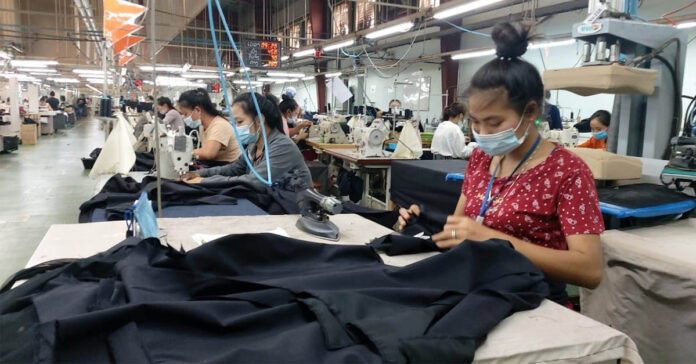
Sewing staff working in a factory (photo: Pathedlao)
Ahead of International Labor Day, the government has increased the country’s minimum wage from LAK 1,200,000 to LAK 1,300,000, during the monthly cabinet meeting that took place this week.
Firm is making ESG a watermark running through the organisation
Launched the internal carbon price (ICP) to contribute to the national ‘dual carbon’ goals
Supported freshwater and wetland projects to promote a greener Greater Bay Area
Collaborated with local non-profit organisations to support rural revitalisation
HONG KONG SAR – Media OutReach – 27 April 2023 –On 26 April, KPMG China held offline and online launch events in Shanghai, Beijing, Guangzhou, Shenzhen and Hong Kong to mark the release of its third environmental, social and governance (ESG) report, Our Impact Plan FY2022 (“the OIP Report”). The OIP Report highlights the firm’s ESG commitments and progress across four key pillars – Governance, People, Planet and Prosperity – as well as the firm’s determination to continue to commit to ESG principles and practices.
At KPMG China, we are committed to promoting high-quality and sustainable economic and social development by supporting the United Nations Sustainable Development Goals (UN SDGs) and aligning ourselves with key national strategies such as the ‘dual carbon’ goals, rural revitalisation and Chinese modernisation. In 2022, KPMG China implemented an internal carbon price (ICP) to charge for greenhouse gas emissions related to its business travel. We also funded freshwater and wetland conservation programmes to protect the natural and ecological environment and promote a greener Greater Bay Area. In addition, we collaborated with local non-profit organisations (NPOs) to enhance their capability and ultimately promote rural revitalisation.
Honson To, Chairman of KPMG China and Asia Pacific, said:
“In the face of significant challenges, such as extreme weather, energy crises, geopolitical instability and more, we remain steadfast in our belief that putting ESG into practice is a core responsibility of the business community. In doing so, we have incorporated ESG principles across our company strategy, business operations and services, creating positive impacts for our people, our clients, the environment and society. A journey of a thousand miles begins with a single step. KPMG China will strive to lead by example and take the necessary steps to put our commitments into action. In the future, ESG will continue to be the watermark running through our organisation. Together with our stakeholders, we aspire to be proactive in initiating change as we build a sustainable and promising future.”
Tracy Yang, Head of Corporate Affairs, and Senior Partner of the Eastern and Western Region, KPMG China, said:
“KPMG China has grown and flourished amid China’s rapid economic development. As we continue to grow our business in China, where we are deeply rooted, we remain grateful for the support of our communities. The 20th National Congress of the Communist Party of China has called for a new era of achievement to drive high-quality development and promote green and low-carbon development across society. As it embarks on this new journey, KPMG China will continue to fully support the country’s national policies through Our Impact Plan and different key strategies, in an effort to contribute to a bright future for China.”
Commenting on the release of the OIP Report, Wilson Pang, Head of Our Impact Plan, Senior Partner of Advisory in the Southern Region, and Board Member of the KPMG Foundation, KPMG China, said:
“Driven by Our Impact Plan, KPMG China is actively integrating ESG into its daily operations and striving to create a corporate culture that centres sustainable development. While assisting clients in achieving their own sustainable development visions, the firm is leading by example by committing itself to acting as a responsible corporate citizen, protecting the environment, helping communities in need, and supporting national strategies such as ‘rural revitalisation’ and the ‘dual carbon’ goals. Going forward, we hope to see more like-minded individuals join us on this journey so we can all play a role in building a more sustainable future.”
Governance: Values-led corporate culture
As a professional services firm, our purpose – to inspire confidence and empower change – guides how we do business. To safeguard the firm’s corporate governance, all partners and staff are required to complete anti-corruption training, and all of the firm’s board and Executive Committee members have completed anti-corruption training as well. We take a rigorous approach with the Enterprise Risk Management (ERM) process to identify and manage potential top risks. We have also established an independent and dedicated investigation unit to receive and systematically handle cases of misconduct. We act with integrity and maintain independence, transparency and open communication with our stakeholders, and hold ourselves accountable for our actions. All of these efforts contribute to the development of a positive brand image for the firm.
KPMG China is also committed to driving purposeful business to help our clients achieve their sustainability goals through our multidisciplinary services, including our ESG services. As part of its on-going efforts to promote green and low-carbon development in the market together with our business partners, in 2022, KPMG China signed a strategic cooperation agreement with the China Carbon Emissions Registration and Clearing Co., Ltd. (CCERC), as well as officially joined the China Carbon Neutral Action Alliance (CCNAA), led by the Shanghai Environment and Energy Exchange, as a council member, for the transformation to the green economy
Wei Lin, Head of Environmental, Social and Governance at KPMG China, said:
“More and more companies realise the necessity of integrating strong ESG practices into their operations, and they are moving quickly to determine how they can best turn these practices into a competitive advantage. Similarly, regulatory frameworks are evolving and expanding so that ESG is top of mind for many of our clients. This is translating into greater demand for our services, both existing and new. At KPMG, we are fully committed to delivering for our clients and achieving our own internal ESG goals and targets.”
People: Respecting individuals and embracing diversity
At the core of the People pillar is our goal of creating a caring, inclusive and values-led culture for our people. Incorporating ESG principles into our corporate culture and people strategy is a key priority. We strive to promote a gender inclusive and equitable workplace by upholding the values of Inclusion, Diversity and Equity (IDE). By 2025, globally, KPMG aims to have at least 33 percent of its leadership, including partners and directors, comprised of female professionals. At KPMG China, we take pride in achieving and going beyond this target. Specifically, 66% of our total workforce are women and 42% have taken on leadership roles (partners and directors)[1]. We continue to take actions to level the playing field for female employees so that they can meet their full potential and thrive in their careers.
One of the ways in which KPMG engages with its young people, and encourages them to express their views and make their mark, is through our Next Generation Council (NGC) programme, which aims to develop the firm’s next cohort of future leaders. The members of the NGC act as the firm’s young “think tank” and provided our leadership with fresh views and ideas about Our Impact Plan during FY2022.
We also foster a culture of lifelong learning by encouraging our people to continue to learn and improve their professional skills. To this end, we offer professional ESG training to all our people to empower them to become a formidable force in our ESG transformation.
Planet: Supporting a low-carbon and greener future
KPMG China is committed to reducing its impact on the environment and building a sustainable and resilient future. Starting from 1 October 2022 (FY23), KPMG China implemented an internal carbon price (ICP) to support the firm in reaching KPMG’s global net-zero climate goal and contribute to China’s ‘dual carbon’ goal. The ICP, which applies the ‘polluter pays’ principle, is a fee charged to responsible departments based on business travel emissions from air travel, rail travel and hotel accommodation. In FY22, KPMG China purchased 100% renewable electricity by buying renewable energy certificates (RECs), continuing a commitment that we have fulfilled since FY21. In terms of building selection and leases, we prioritise buildings with green certifications. Currently, 68% of our office floor area is located in buildings with green and/or wellness-related certifications.
Improving nature and biodiversity is one of our key commitments. To this end, we have collaborated with many local and global NPOs to support conservation projects that bring positive impacts to the environment. For example, we participated in a mangrove wetland restoration programme that aims to improve the ecological habitat of migratory birds and protect local wetland resources and promote a greener Greater Bay Area. We also supported a freshwater project that is protecting water resources in the Dongjiang Basin in Guangdong province. This project reduced the environmental impact caused by sewage discharge, resulting in an improvement of the rural living environment and therefore contributing to rural revitalisation.
Prosperity: Collaborating closely to promote sustainable development
The OIP report shows that, in line with our three-year strategy, we continued to pursue our regional penetration strategy during FY22 by setting up five new offices, as well as a KPMG Digital Ignition Centre (KDi) in Dalian. As at 30 September 2022, we had a presence in 30 cities[2] across China with a headcount of over 15,000 people, representing a 15.3% increase from the end of the firm’s previous financial year. Our regional penetration strategy provides a major channel for us to attract and recruit new professional service talent, while also creating more job opportunities, empowering local talent pools and fostering economic growth in China.
At KPMG, we believe in lifelong learning, and for this reason, we have launched the global ’10by30′ strategy, which aims to economically empower over 10 million disadvantaged young people by 2030 through education, employment and entrepreneurship. Under this programme, we are equipping disadvantaged youths with future-ready skills and a work-based learning experience so that they can adapt and be competitive in their future careers. Meanwhile, KPMG China runs the STEM is HER Future programme, which aims to encourage promising female students to pursue STEM careers. In 2022, the programme was recognised by UN Women at the National Women’s Empowerment Principles awards as the winner of the Community Engagement and Partnerships category, acknowledging KPMG China’s contribution to promoting gender equality in the community. Since 2022, KPMG China has collaborated with the China Foundation for Rural Development (CFRD) to support human capital development. We are utilising our strengths to provide professional volunteering services to empower social organisations in less developed areas through CFRD. This collaboration will help improve the financial management of social organisations, promoting standardised management and professional development, thus contributing to rural revitalisation.
[2] As at 31 March 2023, KPMG China expanded its presence to 31 cities in China.
Hashtag: #KPMGChina
The issuer is solely responsible for the content of this announcement.
About KPMG China
KPMG China has offices in 31 cities, with more than 15000 partners and employees in Beijing, Changchun, Changsha, Chengdu, Chongqing, Dalian, Dongguan, Foshan, Fuzhou, Guangzhou, Haikou, Hangzhou, Hefei, Jinan, Nanjing, Nantong, Ningbo, Qingdao, Shanghai, Shenyang, Shenzhen, Suzhou, Taiyuan, Tianjin, Wuhan, Wuxi, Xiamen, Xi’an, Zhengzhou Hong Kong Special Administrative Region and Macao Special Administrative Region. Under the close cooperation of these agencies, KPMG China is able to efficiently and quickly mobilize various resources to provide high-quality services to customers.
KPMG is a global organization composed of independent professional members, providing professional services such as auditing, taxation, and consulting. KPMG International Limited (“KPMG International”) is a member of KPMG that conducts business operations for the brand and provides professional services. KPMG can refer to an independent member firm within a KPMG global organization, as well as one or more KPMG member firms.
KPMG members are located in 143 countries and regions worldwide, with over 265000 professionals. Each member is an independent legal entity, and their description of themselves is also the same. Each KPMG member independently assumes their own obligations and responsibilities.
KPMG International Limited is a UK private guarantee limited liability company. KPMG International and its affiliated entities do not provide any customer service.
In 1992, KPMG became the first international accounting firm approved for Sino foreign cooperation in mainland China. On August 1, 2012, KPMG became the first of the four major accounting firms to switch from a Sino foreign cooperative system to a special general partnership. KPMG Hong Kong was established even earlier in 1945. The pioneering opportunity to enter the market and our relentless pursuit of quality have accumulated rich industry experience. Many well-known Chinese companies have long hired KPMG to provide professional services in a wide range of fields, including auditing, taxation, and consulting, which also reflects KPMG’s leadership position.
HONG KONG SAR – Media OutReach – 27 April 2023 –TAL Apparel today has joined the ranks of a niche but growing range of socially and environmentally conscientious companies in Hong Kong by sweeping up the “Caring Company Logo” 2022-2023 for its resolute effort and dedication to its people, the community and the environment. Organized by the Hong Kong Council of Social Service (HKCSS), the Caring Company Program aims to foster strategic partnerships between the business and social welfare sectors to promote corporate social responsibility while building an inclusive society.
“Winning the ‘Caring Company’ award is a testament to TAL Apparel’s unwavering commitment to our employees, the environment, and the communities we serve. We have always aimed to lead change in how the world sustainably clothes itself and believe that the positive and lasting changes a company creates can measure its true success. This recognition fuels our determination to continue fostering this culture of care and compassion.” said Roger Lee, CEO of TAL Group.
To qualify for the award, companies are required to have made specific contributions to the community, environment, and their employees. In the past year, TAL:
Donated over 100,000 pieces of personal protective equipment and over 1,000 Enro masks, which were a dire requirement of the communities locally.
Partnered with selected NGOs and charities to address specific needs, including charity donations through TAL’s ‘Hearty Bags’ programme with the Christian Action.
Organized the Green Hero Challenge to clean up Hong Kong’s hiking trails in collaboration with The Green Earth.
Organized ‘Move for Good’, where 38 participants walked over 13 million steps a month with the winning teams to nominate charities that received HK$2,000 each from TAL.
Encouraged 31 employees to complete 36-hour professional training and obtained the Certificate of Competence in First Aid.
The issuer is solely responsible for the content of this announcement.
About TAL Apparel
First established in 1947 in Hong Kong, TAL Apparel is one of the largest garment operations in the world, driven by a simple formula of combining quality garments, on-time delivery and product innovation. Today, TAL Apparel is best known as the supplier of one of every six men’s dress shirts sold in the U.S. market, producing technologically advanced garments that combine superior styles, comfort, and functionality.





 https://www.linkedin.com/company/save-the-children-hong-kong/
 https://www.facebook.com/savethechildrenhk
 https://www.instagram.com/savethechildrenhk/
 https://www.youtube.com/user/savehk
 website, or follow us on


 Dyson Zone™ noise cancelling headphones with air purification: Advanced noise cancelling removes unwanted environmental and motor noise, and high-fidelity precision audio replicates sound as the artist or creator intended. Powered by the smallest compressors in any Dyson machine, the Dyson Zone™ draws air through the electrostatic filters in each earcup to capture 99% of particles as small as 0.1 microns, and potassium-enriched carbon filters remove city fumes, to deliver cleaner air to the wearer’s nose and mouth via a contact-free visor.
  images and a video for the first time of early-stage household robotics research across its Hullavington and Singapore campuses.