Home Blog Page 522

Thailand, Vietnam Target USD 25 Billion Trade Goal as Ties Enter ‘New Phase’

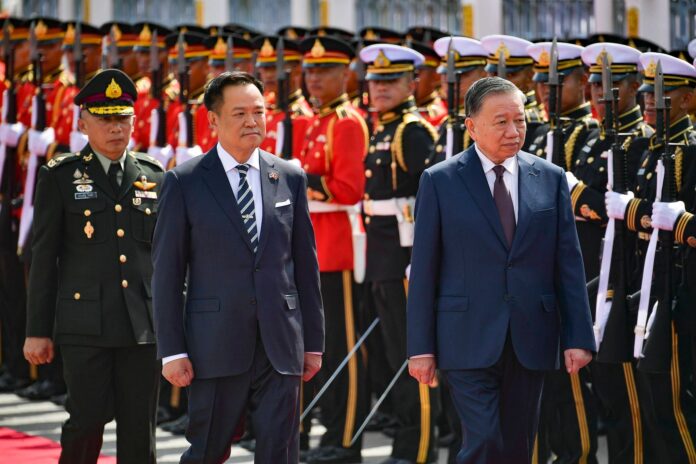
Thailand and Vietnam pledged deeper security and economic ties, targeting US$25 billion annual trade as relations enter a “new phase”. (Photo: Khaosod English)

Thailand and Vietnam pledged deeper economic and security cooperation on 28 May as the two countries marked 50 years of diplomatic relations and set a target of reaching USD 25 billion in annual trade “as soon as possible”.

At Government House in Bangkok, Thai Prime Minister Anutin Charnvirakul and Vietnamese President To Lam witnessed the signing of four cooperation agreements covering trade, technology, aviation and education, while both sides described bilateral ties as entering a “new phase”.

Currently, the bilateral annual trade is at approximately USD 24 billion per year, Anutin said.

The agreements signed on 28 May included a 2026–2031 action plan for the Thailand-Vietnam comprehensive partnership, a science and technology cooperation agreement, a memorandum on developing an aircraft maintenance, repair and overhaul (MRO) centre at U-Tapao International Airport, and an academic cooperation agreement between Khon Kaen University and the Vietnam Academy of Public Administration and Governance.

The aviation agreement between Thailand’s Eastern Economic Corridor Office and Vietjet Group was among the most commercially significant announcements during the visit and reflects growing cooperation in logistics and infrastructure between the two Southeast Asian economies.

First Visit

The visit by To Lam, who serves as President and Secretary-General of the Communist Party of Vietnam, was his first official trip to Thailand under the current government.

The two sides also discussed what officials called the “3 Connect” strategy, aimed at linking supply chains and production chains, strengthening local economic connectivity, and expanding cooperation in green energy and energy security.

Thailand and Vietnam also agreed to increase military and defence cooperation and intensify efforts against transnational crime, particularly online scam networks, human trafficking, illegal fishing and drug trafficking.

The leaders agreed to implement extradition agreements under the ASEAN framework.

Anutin said Thailand was also ready to expand cooperation in science, technology and innovation, including biotechnology, satellites and space technology.

The Vietnamese leader also highlighted the importance of infrastructure connectivity across the Mekong sub-region and the East-West Economic Corridor to support trade and transportation links.

Thailand and Vietnam are among the largest economies in mainland Southeast Asia and have increasingly positioned themselves as regional manufacturing and logistics hubs as global companies diversify supply chains away from China.

Skills Become the New Currency: Salary Polarisation Deepens as AI and Semiconductor Talent Command Up to 30% Pay Increases in Taiwan

Robert Walters Taiwan’s 15th anniversary report Reveals Structural Shift in the Local Talent Market

  • Taiwan’s talent market has officially shifted from an employer-driven to a candidate-driven market, with critical skills increasingly replacing tenure and job titles as the core measure of talent value.
  • AI adoption and global supply chain restructuring are accelerating salary polarisation. Professionals in semiconductors and high-tech industries are seeing salary increases of 15–20% when changing jobs, while those with AI, HPC and cross-border supply chain expertise can command increases of up to 30%.
  • Career priorities are evolving beyond compensation. 54% of professionals cite learning and development opportunities as a key reason for staying with their current employer.
  • By 2030, Gen Z is expected to account for 30–33% of Taiwan’s workforce, making flexibility, work-life balance and transparent workplace culture critical factors in talent attraction and retention.

TAIPEI, TAIWAN – Media OutReach Newswire – 29 May 2026 – Taiwan’s talent market has gradually shifted from an employer-driven to a candidate-driven market through globalisation, digital transformation and pandemic-driven disruption. Meanwhile, the rapid advancement of technology and AI is not only accelerating demand for critical skills, but also reshaping industry structures and redefining the rules of talent competition.

Robert Walters, the world’s most trusted talent solutions business, said in its latest 15th anniversary report, Taiwan’s Talent Market: The New Rules of Competition, that “critical skills” are increasingly replacing tenure and job titles as the primary indicators of talent value and compensation. Particularly as Taiwan’s semiconductor industry strengthens its strategic position within the global technology supply chain, professionals with in-demand capabilities are seeing salary growth significantly outpace the broader market, making salary polarisation an increasingly structural feature of Taiwan’s labour market.

As competition for high-skilled talent intensifies, candidates are placing greater emphasis not only on compensation, but also on Career Value Proposition (CVP), including career development, workplace flexibility and management culture. The report also highlights the rise of a candidate-driven market, where professionals are becoming increasingly selective about what they expect from employers.

In today’s market, growing uncertainty and increasing business complexity are shifting competition away from workforce scale towards the ability to secure critical capabilities and high-value talent. John Winter, Country Manager of Robert Walters Taiwan, noted: “Since entering the Taiwan market in 2011, we have seen talent strategy evolve into a core business strategy. Organisations that can identify critical capabilities early, integrate talent effectively and continuously strengthen organisational resilience will be best positioned for long-term success.”

Global Supply Chain Restructuring Accelerates the Shift Towards a Skills-Based Talent Market and Salary Polarisation

Amid geopolitical uncertainty and ongoing global supply chain restructuring, organisations are increasingly reshaping their structures and global workforce strategies to strengthen resilience and competitiveness. As a result, hiring priorities are shifting away from narrow technical expertise towards cross-functional integration, strategic thinking and problem-solving capabilities. At the same time, talent assessment is moving beyond tenure and job titles, with greater emphasis placed on practical capability, skill scarcity and immediate business impact.

Rapid AI adoption is further accelerating demand for critical skills, driving increasingly concentrated salary growth across the market.

In semiconductor and high-tech industries, professionals changing jobs may see salary increases of 15–20%, while talent with expertise in AI, High-Performance Computing (HPC), Edge Computing and cross-border supply chain management may achieve salary growth of up to 30% reinforcing the growing shift towards a labour market increasingly defined by “skills value”. In contrast, salary growth among execution-focused roles has remained relatively moderate. According to Taiwan’s Directorate-General of Budget, Accounting and Statistics (DGBAS), nearly 70% of employees in 2025 earned below the average salary level — the highest proportion on record — highlighting widening salary polarisation across the labour market.

Candidate-Driven Market Takes Shape:

Career Value Proposition Emerges Alongside Salary as a Key Driver of Employer Attractiveness

The rise of in-demand skills is accelerating Taiwan’s shift towards a candidate-driven labour market, with professionals becoming increasingly selective about what they expect from employers. According to Robert Walters Taiwan’s 15th Anniversary Report, candidates are moving beyond a compensation-led mindset and placing greater emphasis on Career Value Proposition (CVP), including career growth, workplace flexibility and management culture.

As AI adoption and industry transformation continue to reshape the workforce, professionals are placing greater importance on long-term career development and employability. Robert Walters Taiwan’s research found that 54% of professionals view continuous learning and development opportunities as a key reason for staying with their current employer.

Expectations around workplace culture and working models are also evolving. The report shows that beyond salary and benefits (75%), professionals increasingly prioritise flexible working arrangements (36%) and an open, effective management culture (32%) when evaluating employers. Meanwhile, Taiwan’s National Development Council projects that Gen Z will account for approximately 30–33% of the labour force by 2030. As the influence of this generation continues to grow, priorities such as work-life balance, workplace flexibility and transparent organisational culture are becoming defining factors in employer attractiveness.

Reflecting on the findings, John Winter noted: “The rise of a candidate-driven market reflects a broader shift in how professionals evaluate employers. Beyond compensation, talent is increasingly prioritising long-term growth, flexibility and organisational culture. Companies that can provide meaningful career development and adaptability will be better positioned to attract and retain top talent.”

Five Strategies Reshaping Talent Competition:

Building Organisational Resilience Through Critical Capabilities and Skills Value

As geopolitical uncertainty, global supply chain restructuring and rapid AI adoption continue to reshape business environments, organisations are increasingly competing on critical capabilities and organisational resilience rather than scale alone. In this context, talent strategy is no longer a back-office HR function, but a core driver of transformation, competitiveness and long-term business sustainability.

Robert Walters Taiwan’s report identifies five key strategies organisations should focus on to remain competitive in a rapidly evolving market:

1. Shift from workforce expansion to critical capability planning
Hiring success will increasingly depend on the ability to identify and secure high-value talent with in-demand, business-critical skills.

2. Build compensation strategies around skills value

As skills replace tenure as the key measure of talent value, organisations must redesign salary structures and talent evaluation frameworks to remain competitive.

3. Strengthen long-term learning and capability development

AI-driven transformation will require organisations to proactively build reskilling and upskilling cultures to reduce future capability gaps.

4. Redesign workplaces around flexibility and employee experience

Beyond compensation, organisations must strengthen career development, flexibility and workplace culture to attract and retain high-performing talent.

5. Elevate talent strategy to a core business priority

Future talent competition will increasingly shape organisational agility, transformation capability and long-term competitiveness.

Reflecting on the evolving talent landscape, John Winter said: “In the past, talent strategies were largely designed to address immediate hiring needs. Today, the nature of talent strategy has fundamentally changed. Organisations must shift from asking ‘Who do we need now?’ to ‘What capabilities will we need in the future?’ The businesses that can continuously build adaptable talent and resilient organisations will be the ones best positioned for long-term success.”

-END-

About Taiwan’s Talent Market: The New Rules of Competition

Published as Robert Walters Taiwan’s 15th anniversary report, Taiwan’s Talent Market: The New Rules of Competition explores how globalisation, digital transformation, the pandemic, AI adoption and geopolitical uncertainty have structurally reshaped Taiwan’s labour market over the past 15 years.

The report combines Robert Walters Taiwan’s long-term market observations, talent insights and findings from the Salary Survey 2026, covering key sectors including semiconductors, high technology, manufacturing, digital transformation and cross-border operations. It also examines the major workforce trends redefining talent competition, salary structures and employer attractiveness in Taiwan’s evolving labour market.

To access the full report, please visit: https://reurl.cc/9W97bn

Hashtag: #RobertWalters

The issuer is solely responsible for the content of this announcement.

About Robert Walters

Robert Walters is the world’s most trusted talent solutions business. Across the globe, we deliver recruitment, recruitment process outsourcing and advisory services for businesses of all shapes and sizes, opening doors for people with diverse skills, ambitions, and backgrounds. We help organisations find the skills and solutions to reach their goals and assist talented professionals to power their unique potential.

The Taipei office specialises in placing candidates in the following specialities: accounting & finance, electronics & industrial, healthcare, human resources, IT & digital transformation, marketing, manufacturing, sales, semiconductors, software, supply chain, logistics & procurement.

Avalara Names Hugo Sarrazin Chief Executive Officer

Planned leadership transition positions Avalara to accelerate and scale its AI-driven innovation

DURHAM, N.C., May 29, 2026 /PRNewswire/ — Avalara, Inc., the agentic AI leader in global tax and compliance, announced that Hugo Sarrazin has been appointed Chief Executive Officer. Scott McFarlane, Avalara’s co-founder and original CEO, will become an advisor to ensure Avalara’s ongoing success, effective today.

Hugo Sarrazin
Hugo Sarrazin

Sarrazin will lead Avalara’s global operations and strategy, focused on scaling the business, strengthening execution, and advancing innovation for customers and partners worldwide. This transition preserves continuity while sharpening Avalara’s focus on execution and innovation in its next phase of growth. Sarrazin will also join Avalara’s Board of Directors.

“I’m excited to join the leader for tax and compliance that leverages proprietary data and deep domain expertise to deliver intelligent, dynamic solutions for customers worldwide,” said Sarrazin. “Avalara is helping define how AI agents can automate and simplify compliance at global scale and already has a leading AI-powered platform and market presence that few companies can replicate. The opportunity now is to accelerate innovation even further, turning that advantage into more seamless outcomes for customers and partners globally.”

Sarrazin has more than 30 years of experience building and scaling global software and technology businesses, with a strong track record of execution, innovation, and customer focus. He most recently served as President and CEO of Udemy, where he scaled the business through product-led and inorganic growth, advanced AI-driven innovation, and led the company through its sale to Coursera.

Prior to Udemy, Sarrazin was President and Chief Product and Technology Officer at UKG, where he led cloud transformation initiatives, expanded AI-driven solutions, and drove strategic acquisitions. He spent 26 years at McKinsey & Company, advising global organizations on digital transformation and M&A, and co-founded McKinsey Digital Labs.

McFarlane co-founded Avalara in 2004 and has led the company for more than two decades, growing it from a startup on Bainbridge Island, Washington, into the global leader in tax and compliance, supporting more than 1 million businesses worldwide. Under his leadership, Avalara pioneered cloud-based compliance, completed its 2018 initial public offering, and scaled into a global platform with more than $1.3 billion in annual revenue, an ecosystem of more than 1,400 integrations, and deep partnerships across ERP, ecommerce, and financial systems, while helping guide Avalara’s evolution into an AI-first platform for tax and compliance.

“Avalara is stronger today than at any point in our history,” said McFarlane. “We’ve built a category leader with real scale and a platform that’s becoming more critical as tax and compliance grow more complex. The next chapter is about moving faster and delivering more for our customers and partners. Hugo brings the operational and technology leadership needed to accelerate what comes next.”

Advancing AI in Tax and Compliance
Avalara continues to lead the evolution of tax and compliance through AI-driven innovation. Building on more than two decades of investment in tax content, regulatory coverage, and integrations, Avalara’s platform processes tens of billions of transactions annually, helping businesses operate with greater accuracy and efficiency in an increasingly complex global environment. Through innovations such as Agentic Tax and Compliance™ and the Avalara LLM framework for agentic applications, Avalara is embedding AI directly into the compliance lifecycle—automating processes and enabling more consistent, real-time outcomes for customers.

About Avalara
Avalara is the agentic AI platform for global tax and compliance. For more than two decades, Avalara has built one of the most expansive libraries of tax content and integrations in the industry, processing more than 54 billion transactions annually and supporting millions of businesses worldwide. The company’s purpose-built AI agents automate end-to-end compliance with greater precision, from tax calculations and return filings to exemption certificate management and beyond. For more information, visit Avalara.com.

Scott McFarlane
Scott McFarlane

SEMIFIVE Showcases Advanced 3D-IC and Big Die Solutions for AI Semiconductor Innovation at SAFE™ Forum 2026

SAN JOSE, Calif., May 29, 2026 /PRNewswire/ — SEMIFIVE, a leading global provider of custom AI semiconductor (ASIC) solutions, today announced its participation in the Samsung Advanced Foundry Ecosystem (SAFE™) Forum 2026 in San Jose.

At this forum, Brandon Cho, CEO and co-founder of SEMIFIVE, will deliver a presentation titled “Leading 3D-IC/Big Die Solution for AI Innovation.” He will share SEMIFIVE’s advanced design expertise in AI and High-performance Computing (HPC), alongside its latest breakthroughs driving innovation in the global market.

[3D-IC] Overcoming Next-Gen AI Chip Challenges with Logic-on-Memory 3D-IC Design Platforms

As the advancement of large-scale AI models leads to an explosion of processed data, the “Memory Wall,” the bottleneck between computing devices and memory, has emerged as a major challenge in the AI industry. SEMIFIVE presents its 3-dimensional integrated circuit (3D-IC) ASIC design solution as a core strategy to resolve this issue.

Moving beyond the conventional approach of connecting stacked memory to logic chips horizontally, SEMIFIVE’s 3D-IC solution vertically integrates logic and memory into a single system architecture, significantly shortening data transmission distances.

Compared to conventional High Bandwidth Memory (HBM) configurations, this architecture achieves higher memory bandwidth, lower latency, higher power efficiency, and lower cost. Specifically, the reduced chip footprint enables compact packaging and greater design flexibility for a wide range of AI chip development, spanning from edge devices with space and power constraints to high-performance data centers.

SEMIFIVE is currently accelerating the commercialization of AI chips that vertically stack a 4-layer memory on top of a large logic chip, in collaboration with global customers. Furthermore, leveraging its proprietary design platform and robust global supply chain, the company is proactively responding to the surging demand for next-generation AI chips while expanding its market influence.

[Big Die] Differentiated AI ASIC Capabilities Proven through Big Die Design Exceeding 500mm²

As AI models scale up, the demand for larger and more complex AI chips is growing rapidly. SEMIFIVE delivers its optimized Big Die Solution for reliable large-scale AI semiconductor design and will showcase its latest achievements in Big Die design at this forum.

Notably, the company highlights its collaboration with AI semiconductor startup HyperAccel on “Bertha,” the LLM Processing Unit (LPU)-based AI inference accelerator. SEMIFIVE successfully executed the comprehensive design and verification process for the Big Die exceeding 500mm² based on Samsung Foundry’s 4nm (SF4X) process technology.

“The rapid advancement of AI technology demands innovation in existing system semiconductor architectures, and 3D-IC and Big Die design technologies are pivotal to this transformation,” said Brandon Cho, CEO and co-founder of SEMIFIVE. “Built on our robust partnership with Samsung Foundry, SEMIFIVE will continue to push technological boundaries within the SAFE ecosystem while further strengthening our position as a leading ASIC partner.”

At the event, SEMIFIVE will host a dedicated exhibition booth to solidify business collaboration and strengthen networking with global customers and partners.

Euhomy Helps Keep This Summer Chilled With Launch of Rock Plus and Rock Pro Smart Ice Makers

New tabletop ice makers deliver crystal-clear square and sphere ice for elevated cocktails and premium home entertaining

NEW YORK, May 29, 2026 /PRNewswire/ — Euhomy, a leading innovator in modern home ice solutions, today announced the launch of two new premium smart ice makers: the Euhomy Rock Plus Square Ice Maker and the Euhomy Rock Pro Sphere Ice Maker. Designed for cocktail enthusiasts, whiskey lovers, and modern entertainers, the new countertop appliances combine crystal-clear ice technology, smart controls, and sleek portable designs to deliver a sophisticated at-home bar experience.

The new products were unveiled during an exclusive media preview event in New York City on May 28 and expand Euhomy’s growing portfolio of premium ice solutions engineered for every lifestyle and occasion.

“Consumers are increasingly looking for elevated beverage experiences at home, and ice quality plays a critical role in flavor, presentation, and enjoyment,” said Paul Shen, founder and CEO of Euhomy. “With Rock Plus and Rock Pro, we designed products that combine premium craftsmanship, intelligent technology, and exceptional ice clarity to help users enjoy bar-quality drinks anytime, anywhere.”

Euhomy Rock Plus: Built for Every Pour

Launching May 25, 2026, the Euhomy Rock Plus Square Ice Maker produces large 2-inch crystal-clear square ice cubes designed to chill drinks efficiently while minimizing dilution. Ideal for whiskey, cocktails, iced coffee, and premium beverages, the compact countertop machine features dual ice-making modes that allow users to prioritize either speed or enhanced clarity depending on the occasion.

Additional features include:

  • Smart app scheduling and remote operation
  • Real-time color display with live system updates
  • One-touch self-cleaning functionality
  • Compact, portable design for home or outdoor entertaining

The Euhomy Rock Plus will retail for $399.99.

Euhomy Rock Pro: Form Meets Flavor

Available May 26, 2026, the Euhomy Rock Pro Sphere Ice Maker  elevates luxury home entertaining with perfectly round 2.5-inch crystal-clear ice spheres crafted for premium spirits and craft cocktails. Designed to reduce surface area and slow melting, the spheres rapidly chill beverages while preserving nuanced flavors.

The Rock Pro combines advanced cooling performance with refined materials, including stainless steel, aluminum, and leather accents, creating a statement piece for modern home bars.

Key features include:

  • Crystal-clear 2.5-inch sphere ice
  • Continuous cooling technology to keep ice ready to serve
  • Smart app scheduling and remote management
  • Intuitive real-time color display
  • 15-minute deep self-cleaning cycle
  • Compact portable footprint

The Euhomy Rock Pro will retail for $499.99.

Both products reflect Euhomy’s continued focus on combining thoughtful design, smart functionality, and premium ice performance for today’s home entertaining needs.

For product spec sheets and hi-res images, please find the media kit HERE. For more information about Euhomy’s products, visit www.euhomy.com.

About Euhomy

Euhomy is dedicated to creating innovative, high-quality home appliances designed to enhance everyday living. From portable ice makers to advanced smart ice solutions, Euhomy combines modern design, intelligent technology, and user-focused functionality to deliver exceptional convenience for homes, kitchens, and entertaining spaces worldwide.


DSC Holdings, AI Implementation Infrastructure for China’s Used-Car Industry, Files for Nasdaq Listing

NEW YORK, May 29, 2026 /PRNewswire/ — The following report is from Deep Blue Finance: 

DaSouChe Holdings Ltd. (“DSC”) publicly filed its registration statement with the U.S. Securities and Exchange Commission on May 26, 2026, in connection with a proposed listing on Nasdaq, underwritten by Deutsche Bank (DB), China International Capital Corporation Limited (CICC), China Renaissance Holdings Limited (CR), and Industrial and Commercial Bank of China Limited (ICBC).


Anchored by an operating system with over 90% market share among China’s used-car dealers, and comprehensive transaction services embedded in dealer workflows, DSC positions itself as the AI application infrastructure for China’s used-car industry — built not only to inform decisions but to execute them — with the aim of moving the industry from a traditional, experience-driven model into a new era of digitalization, networked collaboration, and AI.


From 2023 to 2025, DSC reported revenue of RMB 909 million, RMB 948 million and RMB 677 million, respectively; the disclosed reason for the 2025 revenue decline is the divestiture of the B2B financial product referral business. Net loss over the same period was RMB 187 million, RMB 157 million and RMB 94.6 million, respectively, narrowing year over year.

Hainan: A Microcosm of China’s Opening Up

HAIKOU, China, May 29, 2026 /PRNewswire/ — A report from Hainan International Media Center:

On December 18, 2025, Hainan, an island province just off the southern tip of the Chinese mainland, launched special customs operations. It is a landmark initiative in the country’s efforts to further high-standard opening up with the island—designated in its entirety as the Hainan Free Trade Port—at the epicenter.

Telling the story of the monumental developments that have taken place since then are Hinews.cn and Hainan International Media Center, which are shining a light on the policies and the people from around the world benefiting from them through the online international communications event, An Open Future—Hainan’s Answers to Global Questions. 

Posters for the three series of Decoding the Hainan FTP


Click to view highlights of young foreign entrepreneurs hustling in Hainan

Decoding the Hainan FTP: Special Customs Operations takes viewers on a journey through the key policies that make Hainan’s model unique: how much money can companies save in taxes? How fast can international trade goods make it through customs? How easy is it to move money across borders through the QDLP program and the EF account system? From the bustling dockside at Yangpu Container Terminal to the multilingual 12345 government service hotline, learn more about what keeps special customs operations ticking. (Watch here: https://www.youtube.com/playlist?list=PLk3RJ_5TEtr3bXEQU9sYyLb8H241dNS02) 

In Decoding the Hainan FTP: Chasing Dreams, follow the story of 10 young international entrepreneurs who, thanks to Hainan’s policies, are successfully pursuing careers on the island. There’s Albina, who works as a vlogger and international tourism promotion ambassador for Hainan, Imani and Gloria, who connect Hainan’s goods with global markets through livestreaming, and Musa, who has secured two international patents and project funding from China’s National Natural Science Foundation. (Watch here: https://www.youtube.com/playlist?list=PLk3RJ_5TEtr3VZLxFl0He8AETSHcha47D) 

In Decoding the Hainan FTP: Building Businesses, watch how preferential tax policies are transformed into tangible benefits. Jia Green Chocolate Works, with its roots in Canada, saves around 10% in costs thanks to a value-added processing policy that eliminates import duties. Meanwhile, Malaysian shoe brand Fipper set up its first shop in Hainan after exhibiting at the China International Consumer Products Expo, saving 10-15% on import costs compared to other free-trade zones. (Watch here: https://www.youtube.com/playlist?list=PLk3RJ_5TEtr0lozF6igEdM4Fz7sM2yjkt) 

That global talent and businesses are flocking to Hainan speaks for itself: China’s bold moves on this small island are reaping dividends for both the country and stakeholders.

WiMi Achieves Breakthrough in Deep Convolutional Neural Network Technology Based on Quantum Parameterized Circuits

BEIJING, May 29, 2026 /PRNewswire/ — WiMi Hologram Cloud Inc. (NASDAQ: WiMi) (“WiMi” or the “Company”) is a leading global Hologram Augmented Reality (“AR”) Technology provider. A quantum deep convolutional neural network technology oriented toward image recognition tasks has achieved phased progress. This technology provides a new technical path to address the challenges faced by traditional deep learning in terms of computational complexity, memory consumption, and training efficiency by constructing a quantum deep convolutional neural network model and combining it with a quantum-classical hybrid training mechanism. The proposal of this technology marks a further deepening of the application of quantum machine learning in typical artificial intelligence tasks such as image recognition, and also provides a new research direction for the realization of future large-scale quantum intelligent computing systems.

WiMi has proposed a quantum deep convolutional neural network model for image recognition tasks. The model takes quantum parameterized circuits as its core computing structure, performs feature extraction on image data through quantum convolutional layers, and utilizes a quantum classification layer to complete the final recognition task. The overall architecture draws on the hierarchical structure of classical deep convolutional neural networks in terms of design philosophy, while fully leveraging the parallel computing capability of quantum circuits, enabling the model to achieve higher computational efficiency when processing high-dimensional data.

At the technical architecture level, the quantum deep convolutional neural network consists of a data encoding module, a quantum convolutional layer module, a quantum feature fusion module, and a quantum classification module. The system first maps classical image data to the quantum state space through the data encoding module. Since quantum computers process quantum state information, it is necessary to convert pixel information into probability amplitudes of qubits through specific encoding strategies. This process is usually achieved through amplitude encoding, angle encoding, or hybrid encoding methods, enabling image data to be effectively processed by quantum circuits.

After completing data encoding, the quantum convolutional layer begins to perform feature extraction on the quantum states. Similar to the convolution kernels in classical convolutional neural networks, the quantum convolutional layer operates on local qubits through a set of parameterized quantum gates. These quantum gates can form functions similar to convolution filters, performing feature mapping on the input quantum states. Since quantum gate operations can act on multiple superposition states simultaneously, they enable highly parallel feature extraction processes when handling complex image structures.

The core of the quantum convolutional layer lies in the design of parameterized quantum circuits. WiMi’s circuit consists of basic quantum logic gates such as rotation gates, control gates, and entanglement gates, controlling the evolution process of quantum states through trainable parameters. Rotation gates are used to adjust the state angles of qubits, control gates are used to construct correlation relationships between qubits, and entanglement gates enable the establishment of complex quantum entanglement structures among multiple qubits. Through these operations, the quantum circuit can form feature extraction capabilities similar to those of classical convolutional layers while possessing higher expressive power.

As the quantum convolutional layers are stacked layer by layer, the network is able to gradually extract higher-level image features. Shallow quantum convolutional layers are primarily responsible for capturing low-level features such as edges and textures in the image, while deeper quantum convolutional layers can identify more complex shapes and structural information. Since quantum states remain in superposition during the computation process, the entire feature extraction process can be performed in parallel within an exponentially large state space, thereby significantly improving computational efficiency.

Following the quantum convolutional layers, the system introduces a quantum feature fusion module. This module integrates feature information from different qubits through additional quantum gate operations. Through quantum entanglement mechanisms, image features from different regions can be effectively fused, thereby forming higher-dimensional feature representations with greater discriminative power. Compared to the feature fusion methods in traditional neural networks that rely on matrix multiplication, quantum feature fusion completes information integration through the quantum state evolution process, which can reduce some computational overhead.

After completing feature extraction and fusion, the network enters the quantum classification stage. The quantum classification layer outputs classification results by measuring the probability distribution of the quantum states. Specifically, the quantum circuit measures several key qubits in the final stage and determines the category of the input image through statistical analysis of the measurement probabilities. This process is similar to the fully connected classification layer in classical neural networks, but its computation occurs in the quantum state space, thus enabling the use of quantum parallelism to improve computational efficiency.

To train this quantum deep convolutional neural network, WiMi proposed a quantum-classical hybrid training scheme. Since current quantum hardware is still in the development stage, relying entirely on quantum devices for large-scale training presents certain difficulties. Therefore, the hybrid training strategy has become an effective solution. In this scheme, the quantum circuit is responsible for executing the forward computation process, while parameter updates are completed by classical computers.

During the training process, the system first encodes the image data into quantum states and completes feature extraction and classification calculations through the quantum circuit. Subsequently, by statistically analyzing the quantum measurement results, the error between the network output and the true label is obtained. Classical optimization algorithms calculate gradient information based on this error and update the trainable parameters in the quantum circuit. These parameters are then reloaded into the quantum circuit for the next round of computation, thereby forming a training process in which quantum and classical computing work collaboratively.

WiMi’s hybrid training mechanism draws on the design philosophy of variational quantum algorithms. Variational quantum algorithms combine parameterized quantum circuits with classical optimizers, enabling quantum computing to solve complex problems under limited quantum resources. In this quantum deep convolutional neural network, the idea of variational quantum algorithms is applied to network parameter updates, thereby realizing the feasibility of model training.

From the perspective of computational complexity, the model is theoretically capable of providing significant computational advantages. Traditional deep convolutional neural networks typically exhibit polynomial growth in computational complexity with increasing network scale when processing high-dimensional image data. In contrast, the quantum deep convolutional neural network leverages quantum superposition and parallel computing capabilities to simultaneously process a large number of data states in an exponentially large state space, thereby achieving exponential computational acceleration in certain tasks.

In terms of experimental validation, WiMi conducted quantitative experimental testing of the model on a quantum simulation platform. The experimental results show that the quantum deep convolutional neural network can effectively learn image features in image classification tasks and achieve stable recognition performance. Although the current experimental scale is still limited by the number of qubits, the results have already demonstrated the feasibility of the model in image recognition tasks.

In terms of system implementation, the R&D team has built a complete software and algorithm framework. This framework supports functions such as quantum circuit construction, data encoding, training optimization, and model evaluation, enabling the quantum deep convolutional neural network to run on existing quantum simulation environments and early quantum hardware.

From the perspective of technological development trends, with the continuous advancement of quantum hardware, quantum machine learning models are expected to gradually move toward practical applications. As one of the important directions in quantum machine learning, quantum deep convolutional neural networks have broad application prospects in fields such as image recognition and video analysis. By leveraging the parallel capabilities of quantum computing, such models may demonstrate significant advantages when processing ultra-large-scale data.

WiMi stated that it will continue to optimize the structural design of this quantum deep convolutional neural network in the future, including improving the quantum convolutional layer structure, optimizing quantum data encoding methods, and enhancing the training efficiency of quantum circuits. At the same time, it also plans to explore more complex quantum neural network architectures, such as quantum residual networks, quantum attention mechanisms, and quantum generative models, to further improve the performance of quantum machine learning systems.

In addition, with the integration of quantum computing and high-performance computing platforms, hybrid quantum-classical computing architectures are expected to become an important component of next-generation intelligent computing systems. The research on quantum deep convolutional neural network technology not only provides a new technical route for image recognition but also lays an important foundation for the future development of quantum artificial intelligence.

WiMi’s technology demonstrates the potential value of quantum computing in the field of artificial intelligence. By combining the physical properties of quantum computing with the model structures of deep learning, new intelligent systems with higher expressive power and stronger computational efficiency can be constructed. As quantum hardware gradually matures, such technologies are expected to achieve larger-scale applications in the future. Overall, this quantum deep convolutional neural network technology for image recognition provides new ideas for the development of quantum machine learning. In the future, as quantum computing technology continues to advance, such innovative technologies that integrate quantum computing and artificial intelligence are expected to play an even more important role in the field of intelligent computing.

About WiMi Hologram Cloud

WiMi Hologram Cloud Inc. (NASDAQ: WiMi) focuses on holographic cloud services, primarily concentrating on professional fields such as in-vehicle AR holographic HUD, 3D holographic pulse LiDAR, head-mounted light field holographic devices, holographic semiconductors, holographic cloud software, holographic car navigation, metaverse holographic AR/VR devices, and metaverse holographic cloud software. It covers multiple aspects of holographic AR technologies, including in-vehicle holographic AR technology, 3D holographic pulse LiDAR technology, holographic vision semiconductor technology, holographic software development, holographic AR virtual advertising technology, holographic AR virtual entertainment technology, holographic ARSDK payment, interactive holographic virtual communication, metaverse holographic AR technology, and metaverse virtual cloud services. WiMi is a comprehensive holographic cloud technology solution provider. For more information, please visit http://ir.wimiar.com.

Translation Disclaimer

The original version of this announcement is the officially authorized and only legally binding version. If there are any inconsistencies or differences in meaning between the Chinese translation and the original version, the original version shall prevail. WiMi Hologram Cloud Inc. and related institutions and individuals make no guarantees regarding the translated version and assume no responsibility for any direct or indirect losses caused by translation inaccuracies.