

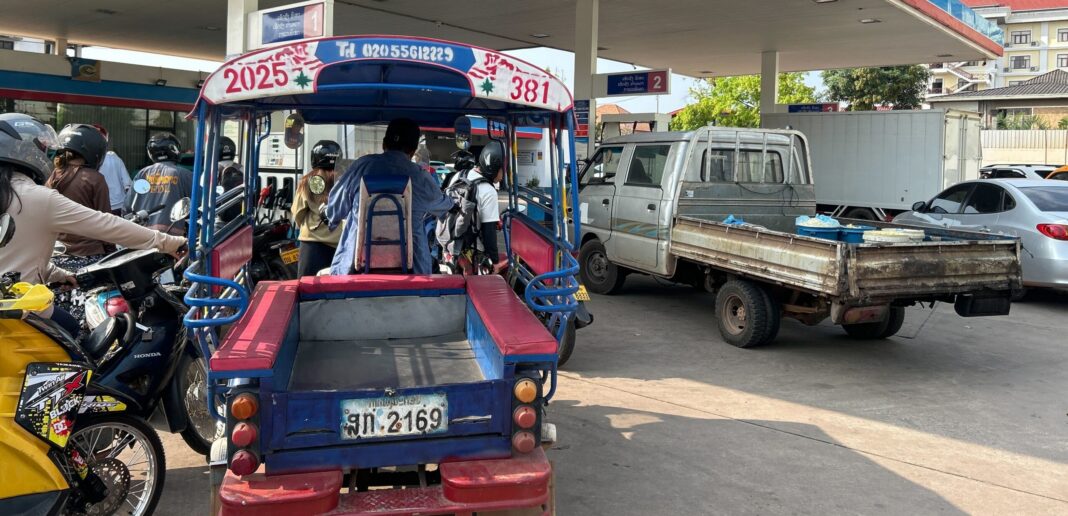
Fuel supply conditions in Vientiane are beginning to stabilize following recent imports from Thailand, although some smaller stations remain out of stock.
On 1 March, Thailand initially announced a suspension of fuel exports due to escalating tensions in the Middle East, sparking concerns over potential shortages in Laos.
The decision came after Iran’s closure of the Strait of Hormuz disrupted global oil supply routes, prompting Thailand’s Minister of Energy, Auttapol Rerkpiboon, to halt exports as a precautionary measure to protect domestic reserves.
However, less than 24 hours later, the Thai government made an exception for Laos, allowing the continued flow of fuel despite the ongoing crisis.
On 2 March, drivers in Vientiane rushed to gas stations, causing long queues as residents scrambled to fill up amid rising uncertainty.
Today, a gas station worker told Laotian Times that his station had been without petrol since that date.
“Normally, fuel comes once per week, but this time, it was not enough,” he said. “Mostly, small gas stations do not have priority, while larger operators, especially the Thai company ones, often receive deliveries sooner or have priority for ordering.”
Earlier this week, Laos imported 12 million litres of fuel from Thailand. The supply appears to have reduced immediate pressure in the capital.
“At first, I was worried Thailand might stop exports, but after confirmation that exports would continue, the situation felt more stable. So for now, the situation seems a little bit better, and there are fewer cars queuing up for gas,” the man said.
On 2 March, the Ministry of Industry and Commerce issued a directive requiring all fuel import-export companies and domestic distributors to report their import and supply plans daily by 4:00 PM to the Department of Internal Trade.
The Ministry also prohibited operators from hoarding fuel or manipulating the market, and ordered that stations not close without valid reasons.
Operators are now required to notify local authorities three days in advance if they plan to temporarily or permanently close.
Several gas station workers across the city said officials did not visit their locations, mentioning that authorities would only run inspections on stations that had closed up.
The shortage is also unfolding against a backdrop of broader price pressures.
Laos’ inflation rate rose to 6.2 percent in February 2026, up from 5.1 percent the previous month. International energy prices increased by 12 percent over the period, while domestic diesel prices climbed by 7.2 percent.
For now, queues have shortened and supply appears to be improving. However, delivery schedules and continued imports from Thailand will determine how quickly all stations return to normal operations.
