

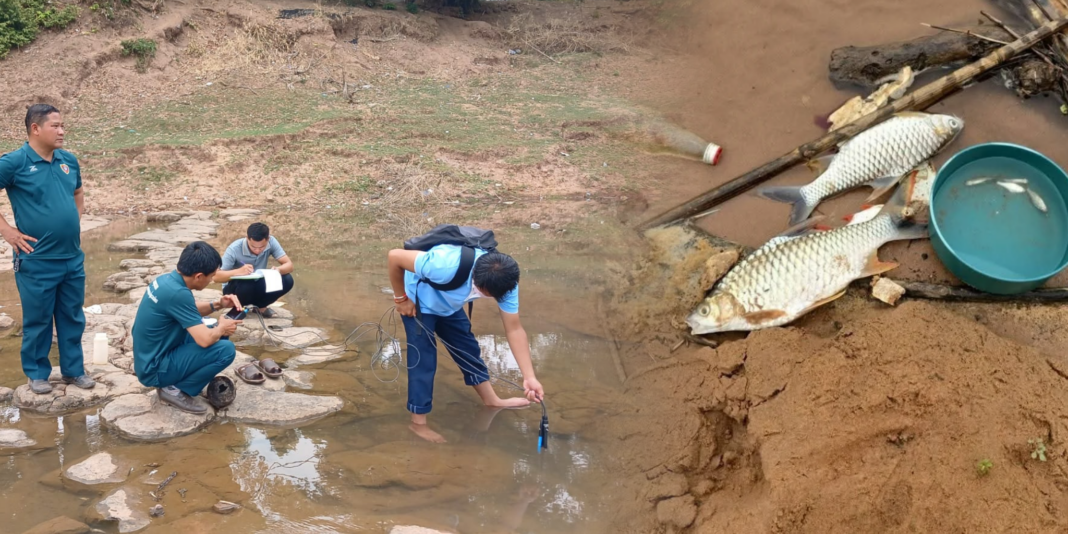
Authorities in Salavanh province have attributed the mass death of fish along the Xe Don River to extreme heat, but the explanation has drawn public skepticism and raised concerns about possible pollution.
Residents first reported dead fish floating along the riverbank in Khongxedon district on 23 April, accompanied by a strong odor and fears over water safety.
On 28 April, officials from the Livestock and Fisheries Sector conducted on-site inspections across multiple villages in Khongxedon and Salavanh districts. Head of the sector Phetnykone Sinthasack announced that water quality tests found no signs of pollution or toxic wastewater.
According to the Salavanh authorities, test results showed pH levels between 7.8 and 8.06 and dissolved oxygen levels between 6.8 and 7.12, both within safe ranges for aquatic life. However, water temperatures reached 32.1 degree Celsius, above seasonal norms and potentially harmful to heat-sensitive fish species.
Authorities emphasized that the heat is linked to El Niño, a natural climate pattern caused by warmer Pacific Ocean temperatures that can bring hotter and drier weather to parts of Southeast Asia, according to the World Health Organization.
Therefore, environmental officials believed the combination of hotter water and reduced water-flow likely placed stress on fish, especially species less tolerant of heat.
Officials also noted that illegal fishing methods, including electric shock devices, may have contributed to fish deaths in some locations.
Public Questions Official Explanation as Concerns Grow
The official conclusion has triggered skepticism online, with many residents calling for a deeper and more transparent investigation.
One commenter wrote, “If fish died because of hot weather, then fish across the whole country should be dying,” reflecting doubts that temperature alone could explain the incident.
Another said, “The water looks polluted just by seeing the surface,” suggesting that contamination could be a cause rather than the heat.
Beyond that, some also pointed to nearby plantations and factories as possible sources of the incident. The comments show wider public concern over water safety and environmental monitoring.
