

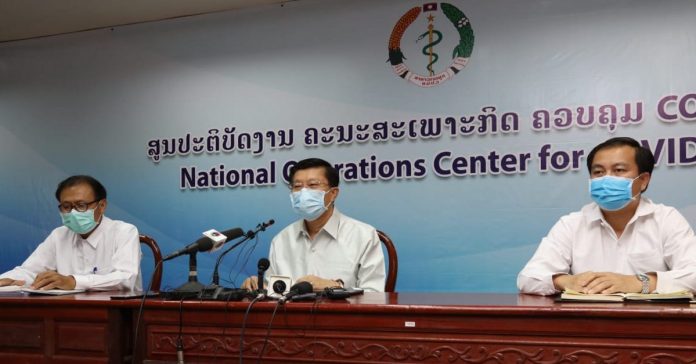
The Lao Government has opened a donation channel for all those looking to contribute financially to the fight against the outbreak of COVID-19.
Home Blog
IRIS Optronics Receives 2026 Japan Digital Signage Award for Full-Color ChLCD e-Paper Innovation
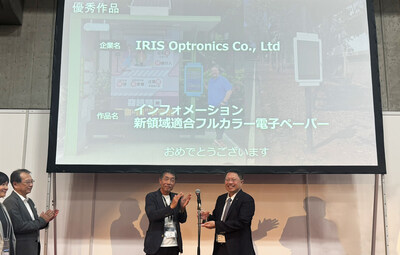
TOKYO, June 10, 2026 /PRNewswire/ — IRIS Optronics, a pioneer in full-color Cholesteric Liquid Crystal Display (ChLCD) technology, today announced that it has been honored with the 2026 Digital Signage Award, presented by the Digital Signage Consortium (DSC) of Japan.
IRIS Optronics received the 2026 Japan DSA. (Left_Yasuji Eguchi, DSC Managing Director; Right_ Chairman & CEO Dr. Albert Liao)
The award recognizes IRIS Optronics for redefining the role of digital signage through technological innovation, helping shift the industry from conventional attention-grabbing, advertising-focused displays toward information-centric signage designed for effective communication and enhanced user engagement. The recognition also underscores the growing market acceptance and commercial potential of full-color ChLCD e-Paper technology in Japan’s digital signage sector.
“IRIS Optronics has been cultivating the Japanese market for many years. Following the opening of our Tokyo office and the launch of our latest B3-size product at the end of May, receiving the DSJ Award in early June is a strong endorsement of both our technology and our long-term commitment to the Japanese market,” said Dr. Albert Liao, Chairman and CEO of IRIS Optronics. “The Digital Signage Award is one of the industry’s most prestigious annual recognitions in Japan. Beyond technological excellence, the evaluation criteria emphasize user experience and social value creation, reflecting a broader industry transition from focusing solely on hardware specifications to delivering meaningful real-world applications. With its full 16-million-color display capability, ultra-low power consumption, and energy-efficient design, IRIS Optronics’ full-color ChLCD e-Paper aligns closely with the evolving needs of Japan’s commercial display market. This recognition is particularly meaningful to us.”
Organized annually by the Digital Signage Consortium, the Digital Signage Award honors outstanding digital signage projects selected from publicly submitted entries, with the objective of promoting innovation and accelerating the development of the digital signage industry. This year, approximately one hundred submissions from DSC members were evaluated, resulting in the selection of one Grand Prize winner and ten Excellence Award recipients.
IRIS Optronics’ proprietary ChLCD technology employs a display mechanism fundamentally different from conventional Electrophoretic Display (EPD) technology. It delivers exceptional durability, vibrant color reproduction, and excellent readability across diverse lighting environments while maintaining ultra-low power consumption. The technology can also be integrated with solar power systems to enable self-powered operation, further enhancing its suitability for sustainable information display applications. These capabilities were highly regarded by the award judging panel and contributed significantly to the company’s recognition.
Robo.ai Subsidiary Neurovia AI Newly Appointed Chief Operating Officer, Rashed Aleghfeli, to Participate at the 2026 UAE Data Center Infrastructure & Cloud Summit
|
ABU DHABI, UAE, June 10, 2026 /PRNewswire/ — Robo.ai Inc. (NASDAQ: AIIO) today announced the appointment of Emirati executive Mr. Rashed Aleghfeli as Chief Operating Officer (COO) of its wholly-owned data processing and compression subsidiary, Neurovia AI. Mr. Aleghfeli will oversee the daily operational management and core strategic execution of the company. Concurrently, Neurovia AI confirmed its participation as the OFFICIAL AI INFRASTRUCTURE PARTNER at the upcoming UAE Data Center Infrastructure & Cloud Summit 2026, scheduled for June 11 in Abu Dhabi. In his new capacity as COO, Mr. Aleghfeli will represent the company and deliver an address titled “Unload Data Burden, Unlock AI Power: Building a Resilient AI Infrastructure in UAE”.
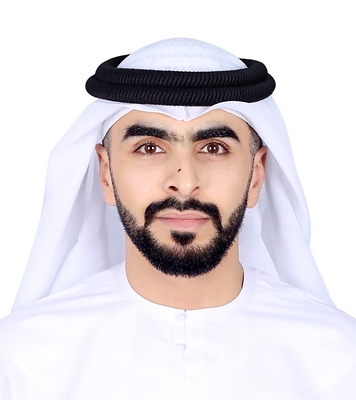
Rashed Aleghfeli, Chief Operating Officer of Neurovia AI
Prior to joining Neurovia AI, Mr. Aleghfeli accumulated over a decade of professional experiences in government and public relations, international collaboration and operational management. He previously served an extended tenure as a senior staff member at the Government of Ajman, where he coordinated, planned, and executed complex operational and government and public relations initiatives. Through extensive practice in large-scale cross-departmental coordination, high-level event management, and systemic process optimization, Mr. Aleghfeli has demonstrated leadership capabilities in managing high-level government-enterprise partnerships and complex system engineering. Mr. Aleghfeli holds a Bachelor’s degree in Business Studies from the University of Wales in the UK, and has completed international management training programs in the USA. His established regional government-enterprise network and global perspective will provide operational support and compliance assurance for the large-scale commercialization of Neurovia AI’s infrastructure in the Middle East and global core markets.
At the upcoming 2026 UAE Data Center Infrastructure & Cloud Summit, Mr. Aleghfeli will detail Neurovia AI’s core strategy regarding the development of foundational data platforms for Physical AI. The Summit, hosted by the UAE Cyber Security Council and supported by the Ministry of Energy & Infrastructure, is a core high-level forum convening senior government stakeholders to discuss national digital infrastructure investments and cloud strategy evolution in the Middle East. Operating as the Summit’s OFFICIAL AI INFRASTRUCTURE PARTNER, Neurovia AI will participate in dialogues surrounding regional digital foundations, aiming to integrate the highly efficient data processing and compression capabilities of the NeuroStream™ platform into government-led digital transformation frameworks to advance the large-scale deployment of smart infrastructure across the region. Commenting on his appointment, Mr. Aleghfeli said: “The UAE is building the most ambitious digital infrastructure in the world, and the data layer beneath it must be trusted, efficient, and sovereign. That is precisely what Neurovia AI delivers. I am proud to join this team and committed to driving the operational foundations that will bring NeuroStream™ to governments and enterprises across the region and beyond”.
This executive appointment and Summit participation further establish Robo.ai and Neurovia AI’s strategic positioning within the regional core digital infrastructure network. The company is advancing the standardized delivery of its underlying data processing and compression technology in high-concurrency government and enterprise environments, establishing a solid operational foundation for the long-term growth of Robo.ai’s global machine economy platform.
About the UAE Data Center Infrastructure & Cloud Summit 2026
The UAE Data Center Infrastructure & Cloud Summit 2026 serves as a core high-level forum in the Middle East focused on national digital infrastructure development and cloud platform evolution. As the UAE accelerates its transition to a comprehensive digital economy, the Summit gathers regional government officials, regulatory representatives, and technology executives to examine the strategic role of modern data centers, cloud architectures, and artificial intelligence infrastructure in enhancing operational efficiency, supporting digital governance, and ensuring national digital sovereignty, providing clear direction for the modernization and sustainable development of digital infrastructure in the region.
About Neurovia AI Limited
Neurovia AI (www.neuroviaai.ae) is an AI infrastructure and visual data processing technology company operating as a wholly-owned subsidiary of Robo.ai Inc. (NASDAQ: AIIO). Guided by its core philosophy to “Unload the data burden, unlock AI power,” the company leverages its NeuroStream™ platform to drive the transition of visual data architectures from human viewing to machine understanding. By applying AI-native compression and edge computing, Neurovia AI addresses critical bottlenecks in data storage, transmission, and computation for Physical AI. Its technology serves core sectors including safety and security, autonomous driving, smart cities, and intelligent manufacturing, providing foundational data support for global machine perception and collaboration.
About Robo.ai Inc.
Robo.ai Inc. (NASDAQ: AIIO) is a technology company focused on building an artificial intelligence machine economy platform. Through the systematic integration of AI software, intelligent hardware, and smart assets, the company builds a unified AI operating system and an empowered ecosystem, delivering efficient, compliant, and hardware-software integrated infrastructure solutions for global government and enterprise clients.
Forward-Looking Statements
This press release contains forward-looking statements as defined by the Private Securities Litigation Reform Act of 1995. Actual results may differ from expectations; for further details, please refer to the relevant disclosure documents filed by Robo.ai Inc. with the U.S. Securities and Exchange Commission.
Media Contacts
Neurovia AI Corporate Communications
Email: info@neuroviaai.ae
Website: www.neuroviaai.ae
Robo.ai Inc. Corporate Communications
Email: pr@roboai.io
Website: www.roboai.io
Four in Five Business Leaders Expect Permanent Disruption as AI, Tariffs and Critical Minerals Competition Reshape Global Commerce, Finds DMCC Future of Trade Report
|
- DMCC Future of Trade 2026 report finds global trade will be shaped by AI, tariff shock, critical minerals and clean tech competition
- More than 80% of global trade leaders expect slow trade growth with ongoing disruption, while only 4% expect best-case scenario
- AI-related goods made up 43% of global merchandise trade growth in first half of 2025, growing five times faster than non-AI goods
- Nearly one fifth of goods imports impacted by tariffs or similar measures
- South-South trade accounts for around 35% of global trade, outpacing North-North flows
- Future of Trade 2026 launches in London before follow up events in Dubai and Singapore
- Full report can be accessed and downloaded here: www.futureoftrade.com
DUBAI, UAE, June 10, 2026 /PRNewswire/ — DMCC, the leading international business district that drives the flow of global trade through Dubai, today launched its Future of Trade 2026 report that finds that global trade will remain resilient over the next two years but fundamentally reshaped by artificial intelligence, structural tariff volatility, supply chains designed for resilience, and a contest for industrial advantage in critical minerals and infrastructure powering global clean energy and technologies.
To view the Multimedia News Release, please click:
https://www.multivu.com/dmcc/9402751-en-ai-tariffs-critical-minerals-competition-reshape-global-commerce-dmcc-trade-report
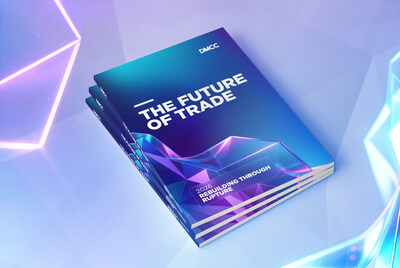
The report, Future of Trade 2026: Rebuilding Through Rupture, comes as businesses confront a sharp deterioration in the predictability of the global trade landscape. Nearly 20% of global merchandise imports are now subject to tariffs or similar restrictions, up from 12.6% a year earlier, while more than four in five business leaders surveyed by DMCC expect slow growth, continued supply chain disruption and prolonged geopolitical volatility in the coming years. Almost 12% expect a worst-case scenario driven by escalating conflict, tariffs, sanctions and financial fragmentation. Only 4% expect a best-case outcome.
At the same time, AI is rapidly emerging as the dominant driver of trade growth. Trade in AI-related goods, including semiconductors, servers and data-centre hardware, expanded by more than 20% in the first half of 2025, compared with less than 4% growth for non-AI goods. Although AI-related goods account for only 15% of global trade by volume, they generated 43% of total trade growth during the period, according to the report.
The report forecasts merchandise exports to slow to 1.9% in 2026, down from 4.6% in 2025, before marginally recovering to 2.6% in 2027. Services exports are forecast to continue outpacing goods.
Ahmed Bin Sulayem, Executive Chairman and Chief Executive Officer, DMCC, said: “AI-related goods accounted for 43% of global trade growth in the first half of 2025, despite representing just 15% of global trade by volume. This underscores where global trade is heading. We are entering a new phase in which competitiveness will be defined not only by cost or geography, but by technology, connectivity, energy access, and the ability to adapt quickly to disruption. In a more complex and fragmented environment, the role of globally connected hubs becomes even more important.
“Dubai has positioned itself at the centre of these shifts by remaining open, agile, and deeply connected to global markets. With almost 27,000 companies in our district, DMCC sees these changes unfolding in real time across commodities, technology, finance, and trade. The businesses and economies that will lead over the next decade are those building resilience, investing in technology, and creating stronger connections across global markets.”
Feryal Ahmadi, Deputy CEO and Chief Operating Officer, DMCC, said: “The trade environment is becoming more complex, but also more connected. AI is already improving efficiency across customs, logistics, compliance and trade finance, and we are now moving towards practical, operational deployment. Stablecoins, tokenisation and wholesale central bank digital currencies are beginning to support faster and more flexible settlement in certain corridors. Data regulation, cybersecurity and digital governance are becoming increasingly important considerations for businesses operating internationally.
“In this environment, trade hubs like DMCC have an important role to play in anticipating the needs of global businesses and ensuring they can continue to operate, grow and adapt through periods of disruption and change. The companies that will perform best are those investing in technology, building operational resilience and remaining agile as global trade continues to evolve.”
The Future of Trade 2026 is the sixth and tenth-anniversary edition of DMCC’s biennial flagship report on the changing nature of global trade. It draws on 12 roundtables with over 200 senior leaders, policymakers and trade experts across key global trade centres, alongside a survey of more than 130 leading businesses and trade practitioners.
Four Forces Shaping the Future of Trade
The report identifies four structural forces reshaping global commerce: AI moving from experimentation to operational deployment; the breakdown of a stable tariff framework; the shift from efficiency-led to resilience-led supply chains; and the energy transition becoming a contest for industrial and geopolitical advantage.
The Growing AI Divide
One of the report’s most consequential findings is the widening gap between businesses treating AI as a strategic priority and those still running pilots. Fewer than 15% of firms surveyed describe their AI deployment as fully integrated; more than a quarter report no meaningful adoption at all. With agentic AI systems beginning to take on complex logistics, compliance and trade finance decisions, the report warns that this gap will harden into a structural competitive divide. Meanwhile, AI-related goods such as semiconductors, servers and data centre hardware, expanded 20% in the first half of 2025, five times the rate of non-AI merchandise. The WTO estimates that sustained AI-related trade growth could add 0.5 percentage points to global export volumes.
The end of the tariff rulebook
The dismantling of rules-based trade has accelerated faster than most forecasters anticipated. The Trump administration’s tariff regime, though legally contested and partially struck down by the Supreme Court in February 2026, has been rapidly replaced by Section 122 and Section 301 instruments covering 90-95% of US imports. More than half of respondents now expect trade to become more regional and bloc-based. Only 17% anticipate a more multilateral outcome.
Supply chains built for resilience
The “China + 1” diversification model has been overtaken in many sectors by broader “China + many” strategies. U.S. imports from Vietnam rose 345% between 2014 and 2024; imports from India rose 94% and from Mexico 72% over the same period, while imports from China contracted 5%. The 2026 conflict with Iran which precipitated the closure of the Strait of Hormuz, through which 25% of global seaborne oil and 19% of LNG transits, has added urgency and sent Brent crude above $120 per barrel, reducing tanker transits by approximately 90% from pre-conflict levels. The report notes that 45% of businesses have already engaged in onshoring, nearshoring or friendshoring. Among DMCC’s own survey respondents, those describing their supply chains as more regionalised and resilience-driven nearly double those describing them as more globalised and efficiency-driven.
The energy transition as new industrial contest
Clean energy investment reached a record $2.3 trillion in 2025, outpacing fossil fuel investment by $102 billion. But the transition has become as much a competition for industrial advantage as an environmental imperative. China controls 94% of global sintered permanent magnet production, an input critical to EVs, wind turbines, AI data centres and defence systems, and leads refining for 19 of 20 strategic minerals tracked by the IEA. With average lead times of 16 years from mineral discovery to production, the report argues that supply diversification is a long-term solution to a near-term problem.
The next generation of finance
The global trade finance gap has held at $2.5 trillion, with SMEs and developing-economy exporters bearing a disproportionate share. The report identifies next-generation financial infrastructure as a potential partial remedy, with global stablecoin supply exceeding $300 billion in early 2026, B2B stablecoin payments growing 733% year-on-year in 2025, and the first cross-border CBDC transaction on the mBridge platform successfully processed in November 2025.
Rise of South-South trade
One of the report’s quieter but structurally significant findings is the continued rise of South-South trade and growing influence of middle powers. Flows between developing economies now account for approximately 35% of global trade, outpacing North-North flows, and accelerating. The IMF forecasts that by 2030, emerging and developing economies will account for around two-thirds of global growth. The report points to the UAE, India and Singapore as global “connectors” and examples of middle power economies capturing redirected trade and investment flows through infrastructure and diversified trade relationships.
DMCC’s Future of Trade 2026 report puts forward a series of key recommendations to businesses and governments to support trade resilience and growth:
Policy Recommendations for Businesses:
- Build resilience as a continuous operating discipline. Map single-country, single-route and single-supplier dependencies; stress-test tariff, sanctions, shipping disruption and energy price scenarios; and maintain strategic inventories where continuity is critical.
- Scale AI in high-friction trade processes. Prioritise demand forecasting, customs, compliance, documentation, logistics routing, trade finance and risk assessment where measurable savings and productivity gains can be tracked.
- Treat data as a trade asset. Invest in clean, interoperable data systems and map exposure to data localisation and cross-border data rules before entering or expanding in key markets.
- Build optionality in payments and finance. Maintain traditional banking relationships while testing fintech, tokenised and digital settlement rails in corridors where speed, cost and liquidity advantages are clear.
- Secure critical inputs. Assess exposure to semiconductors, compute, energy, water and critical minerals, and build supplier diversification and long-term sourcing arrangements where supply concentration poses material risk.
Policy Recommendations for Governments:
- Use trade agreements to set practical digital standards. Prioritise AI, data, e-commerce, paperless trade and digital identity provisions, rather than relying on tariff schedules alone.
- Accelerate paperless trade. Set clear timelines for electronic bills of lading, digital customs, e-invoicing and interoperable documentation, while funding SME adoption to avoid widening the digital divide.
- Expand trade finance access. Work with banks, development finance institutions and fintechs to lower due diligence costs, improve risk assessment and channel finance to SMEs and developing economy exporters.
- Build resilient trade corridors. Invest in ports, logistics, energy grids, data centres and customs systems that can absorb route disruption and support AI-enabled trade.
- Develop critical minerals and clean technology partnerships. Use long-term offtake agreements, recycling capacity, standards alignment and transparent supply chains to reduce chokepoints without fragmenting markets further.
Use long-term offtake agreements, recycling capacity, standards alignment and transparent supply chains to reduce chokepoints without fragmenting markets further.
Report launch
Ahmed Bin Sulayem, DMCC’s Executive Chairman and CEO, unveiled the report to a packed crowd at One Marylebone in London, UK. Following the London launch, DMCC will present the report to key business stakeholders in Dubai and Singapore.
The Future of Trade is DMCC’s biennial flagship research on the changing nature of global trade. The report examines the impact of global economic trends, geopolitics, technology, sustainability, trade finance and infrastructure on the future of the trade landscape, with recommendations for businesses and governments navigating a more fragmented and fast-moving global economy.
To read the full report by DMCC, please visit: www.futureoftrade.com
About DMCC
DMCC is a leading international business district that drives the flow of global trade through Dubai. We make it easier for our members to do business, helping them access the world’s fastest growing markets from a dynamic district that offers everything they need to thrive. This approach is why we are the preferred location for over 26,000 top multinationals and high-impact startups, contributing significantly to Dubai’s position as a global hub for trade and innovation. DMCC is where the world does business.
For more information, visit dmcc.ae.
Four in Five Business Leaders Expect Permanent Disruption as AI, Tariffs and Critical Minerals Competition Reshape Global Commerce, Finds DMCC Future of Trade
KINGSTEEL and D3O Launch Strategic Development Partnership to Advance Next-Generation SCF and High-Performance Protection Applications
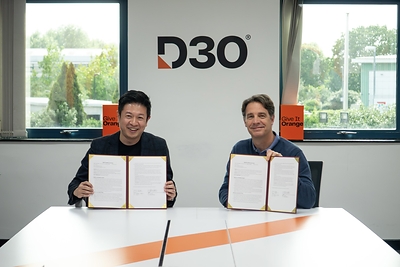
TAIPEI and LONDON, June 10, 2026 /PRNewswire/ — KINGSTEEL recently visited D3O, a global leader in advanced protection materials, where the two companies officially initiated a strategic development partnership focused on next-generation SCF applications and advanced manufacturing solutions. The collaboration brings together complementary expertise in material science and manufacturing technology to explore future opportunities in high-performance protection applications.
Jim Chen, General Manager of KINGSTEEL (left), and Matthieu Bazil, CEO of D3O (right), sign exclusive joint development agreement to accelerate the future of advanced foam innovation.
D3O is internationally recognized for its advanced protective materials and impact protection technologies, with applications spanning sports, industrial, and other high-performance sectors. The company works closely with leading global brands in markets where protection, comfort, and performance are critical.
KINGSTEEL has continued to invest in physical foaming injection molding technologies, process innovation, equipment development, and scalable manufacturing integration. Through years of technical development and real-world production experience, KINGSTEEL has established strong capabilities in process control, equipment engineering, and manufacturing solutions for advanced material applications.
Both companies believe that the future of high-performance products will increasingly depend on deeper integration between advanced materials and advanced manufacturing technologies. This partnership combines D3O’s expertise in material science and product performance with KINGSTEEL’s strengths in process technology and scalable production capability to jointly accelerate next-generation SCF development.
The collaboration will focus on future applications involving impact protection, vibration management, shock absorption, and other high-performance product solutions, while continuing to explore new opportunities across emerging application areas.
According to KINGSTEEL, this partnership represents not only an important milestone between the two companies, but also reflects a broader industry trend toward closer collaboration between advanced materials and next-generation manufacturing technologies to deliver higher-value products and future-oriented manufacturing solutions.
51Talk Online Education Group to Report First Quarter 2026 Financial Results on Friday, June 12, 2026
Earnings Call Scheduled at 8:00 a.m. ET on June 12, 2026
SINGAPORE, June 10, 2026 /PRNewswire/ — 51Talk Online Education Group (“51Talk”, or the “Company”) (NYSE American: COE), a global online education platform with core expertise in English education, today announced that it will report its unaudited financial results for the first quarter ended March 31, 2026 on Friday, June 12, 2026, before the open of U.S. markets.
The Company’s management will host an earnings conference call at 8:00 a.m. U.S. Eastern Time on June 12, 2026 (8:00 p.m. Singapore/Beijing/Hong Kong time on June 12, 2026).
Dial-in details for the earnings conference call are as follows:
|
United States Toll: |
1-888-346-8982 |
|
International: |
1-412-902-4272 |
|
Mainland China (toll free): |
4001-201203 |
|
Hong Kong (toll free): |
800-905945 |
|
Web phone: |
Participants should dial-in at least 5 minutes before the scheduled start time and ask to be connected to the call for “51Talk Online Education Group.”
Additionally, a live and archived webcast of the conference call will be available on the Company’s investor relations website at http://ir.51talk.com.
A replay of the conference call will be accessible approximately one hour after the conclusion of the live call until June 19, 2026, by dialing the following telephone numbers:
|
United States Toll: |
1-855-669-9658 |
|
International Toll: |
1-412-317-0088 |
|
Replay Access Code: |
4750622 |
About 51Talk Online Education Group
51Talk Online Education Group (NYSE American: COE) is a global online education platform with core expertise in English education. The Company’s mission is to make quality education accessible and affordable. The Company’s online and mobile education platforms enable students to take live interactive English lessons on demand. The Company connects its students with highly qualified teachers using a shared economy approach, and employs student and teacher feedback and data analytics to deliver a personalized learning experience to its students.
For more information, please visit http://ir.51talk.com.
Korean Liquor (K-SUUL), Raises Its First Flag for Globalization on Asia’s Largest Stage
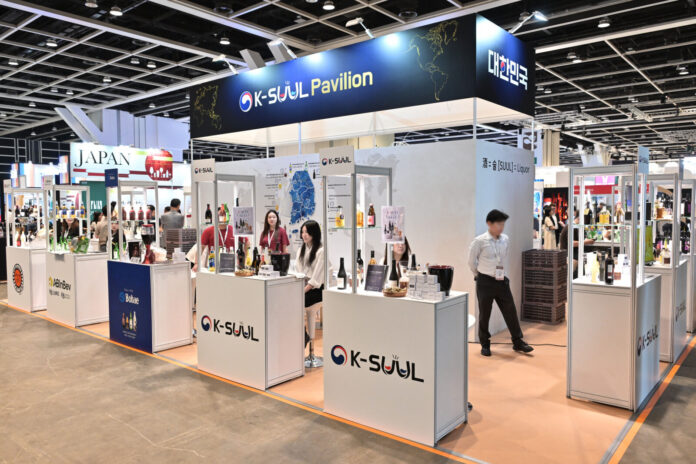
“K-SUUL Pavilion” to Open for the First Time at the HKCEC on May 26-28
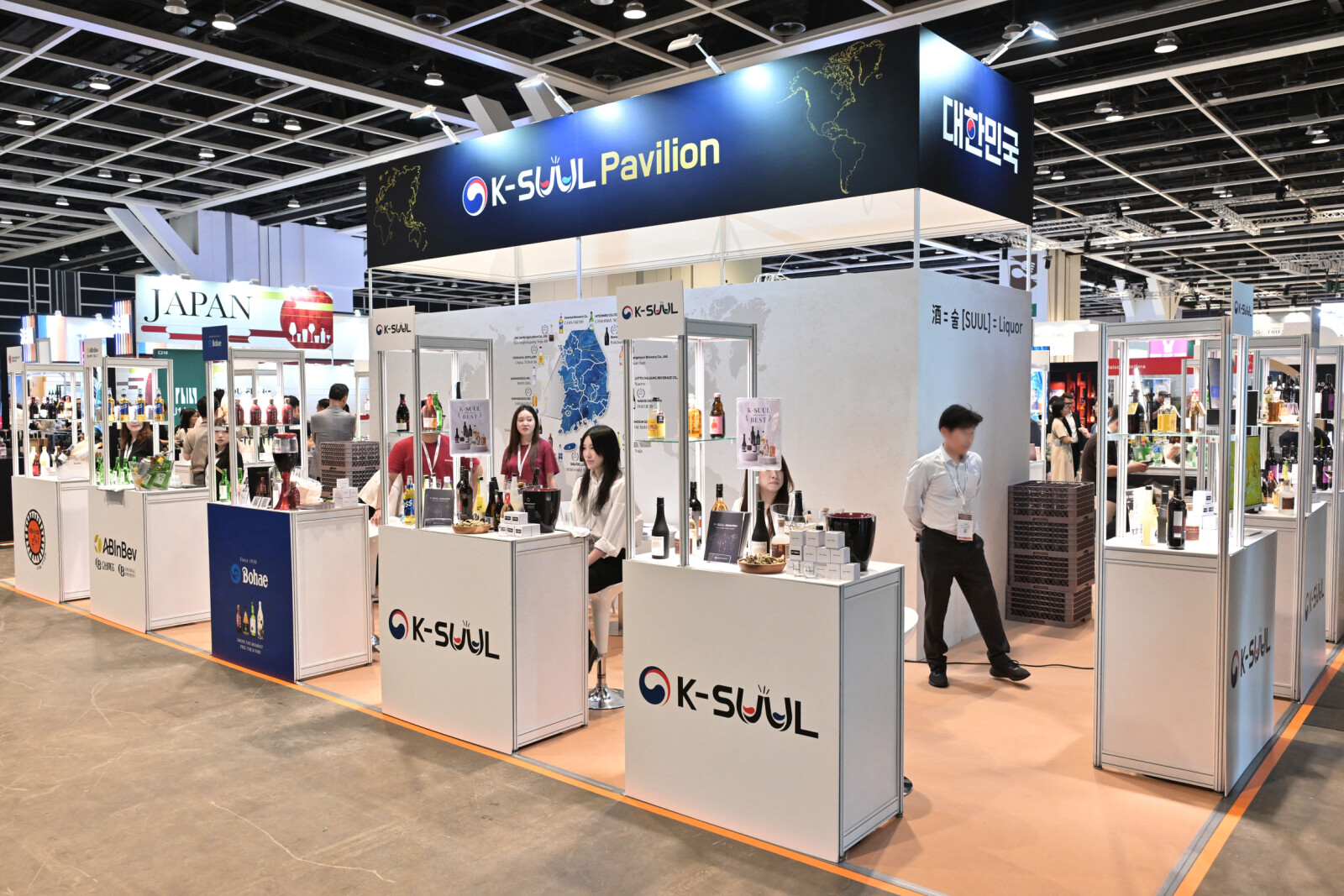
HONG KONG SAR – Media OutReach Newswire – 10 June 2026 – The National Tax Service of Korea (Commissioner: Lim Kwang-hyun), for the first time, opened the “K-SUUL Pavilion” at Vinexpo Asia[1], which was held for three days from May 26 to 28 at the Hong Kong Convention and Exhibition Centre (HKCEC).
[Photo] Korean Liquor (K-SUUL) Raises Its First Flag for Globalization on Asias Largest Stage
The opening of the “K-SUUL Pavilion” was served as a key milestone in raising the global profile of Korean alcoholic beverages and expanding overseas exports.
At the inaugural “K-SUUL AWARDS” held by National Tax Service of Korea last December, 175 small and medium-sized liquor producers from across Korea submitted a total of 366 products. Following document screening and blind testing, 12 products were selected.
The award-winning liquors, selected through a fair judging process with the participation of Korean citizens, was introduced to the global market through this exhibition, marking their first step toward overseas expansion.
The “K-SUUL Pavilion” was operated through cooperation between the National Tax Service of Korea and the liquor industry and association (the Korea Alcohol and Liquor Industry Association). It was designed as an integrated promotional platform to strengthen the export competitiveness of Korean alcoholic beverages and develop overseas sales channels.
The “K-SUUL Pavilion” was operated with a total of 16 booths (display and tasting booths), and 12 companies — including winners of the K-SUUL AWARDS — participated to hold consultations with overseas buyers.
Participating companies ranged from traditional liquor breweries to regional soju producers and major liquor companies, showcasing the diverse spectrum of Korea’s alcoholic beverage industry on a single stage.
In addition to the booths operated by the 12 participating companies, a dedicated booth was set up exclusively to showcase the award-winning liquors, further highlighting the significance of the K-SUUL AWARDS.
At the venue, promotional videos of the award-winning liquors were screened, while English-language brochures and souvenirs were distributed to attract local buyers and visitors to raise awareness of Korean alcoholic beverages.
In addition, meetings with the organizers of Vinexpo Asia, overseas buyers, and distribution industry officials were also held to identify rapidly changing global liquor market trends and assess the overseas expansion potential of Korean alcoholic beverages.
Han Yeong-seok Fermentation Research Institute expressed gratitude for being given the opportunity to participate in the exhibition, saying, “It was meaningful to showcase our award-winning liquor, ‘Dohan Cheongmyeongju,’ on the same stage as liquors from around the world through this exhibition. We did our best to promote Korea’s unique fermentation culture and the value of Korean liquor to the world.”
Going forward, the National Tax Service of Korea will continue to enhance the substance of the K-SUUL AWARDS, continuously discover outstanding liquors from promising small and medium-sized enterprises, and will actively support the globalization of Korean liquor (K-SUUL) by promoting it both domestically and internationally and helping these businesses expand their sales channels.
[1] Vinexpo Asia is Asia’s largest B2B wine and spirits exhibition, attracting approximately 9,000 industry professionals from 60 countries last year.
Hashtag: #K-SUUL
The issuer is solely responsible for the content of this announcement.

LAK 210 Million Tequila Bill Puts Laos Night Out in Viral Spotlight
A single receipt forwarded in a group chat has turned into one of Laos’ most entertaining social media moments in recent weeks, all because a few friends ordered tequila.
On 6 June, Facebook user Tonkham Phonchanheuang shared a post of a receipt her friends sent to their group chat after a night out, revealing a total bill of LAK 210 million (approximately USD 10,507).
The post spread rapidly, drawing nearly 2,000 engagements and over 800 shares.
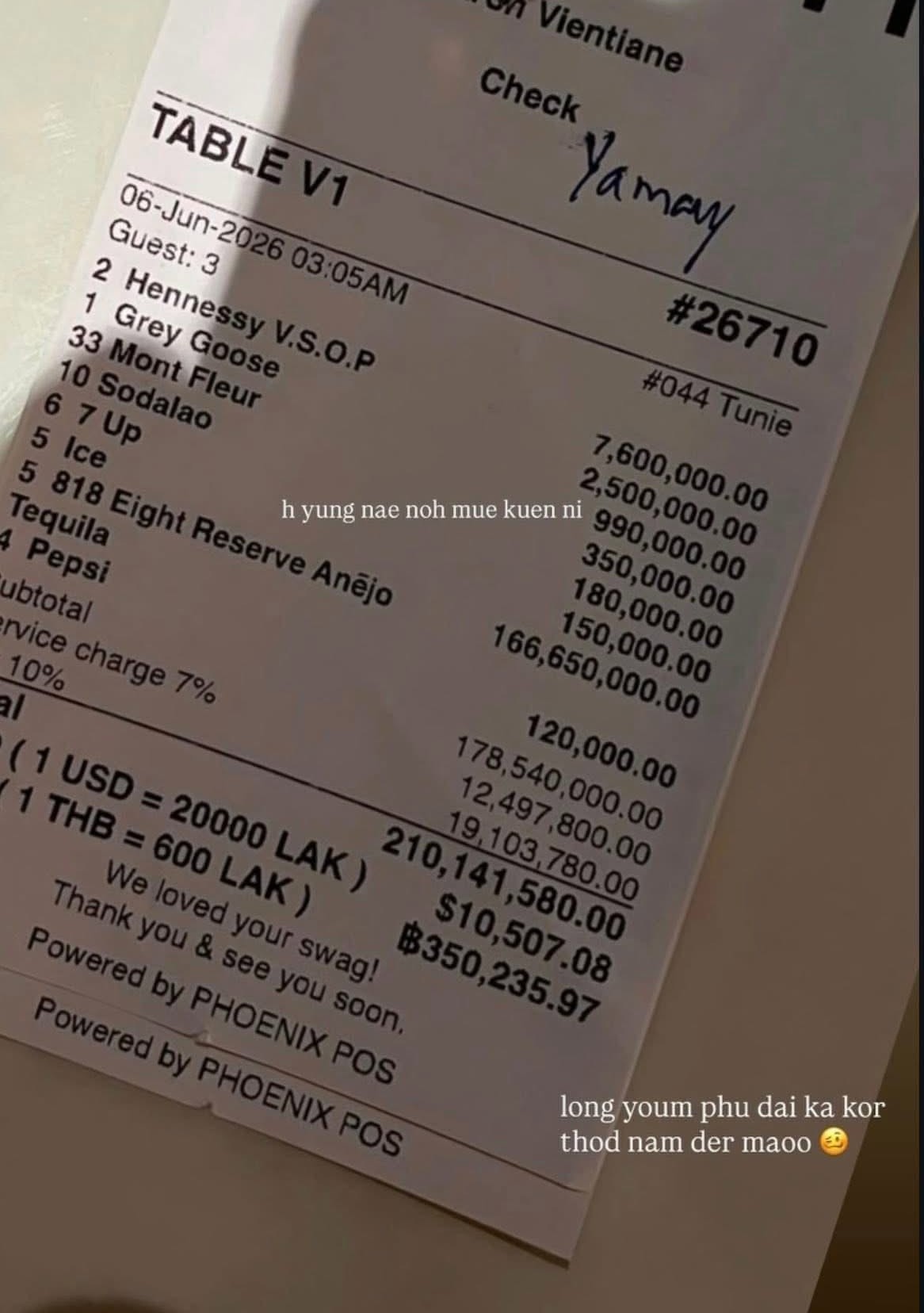
Tonkham had missed the outing; she was home caring for her child. After seeing the bill, she wrote in her caption that she had absolutely no regrets.
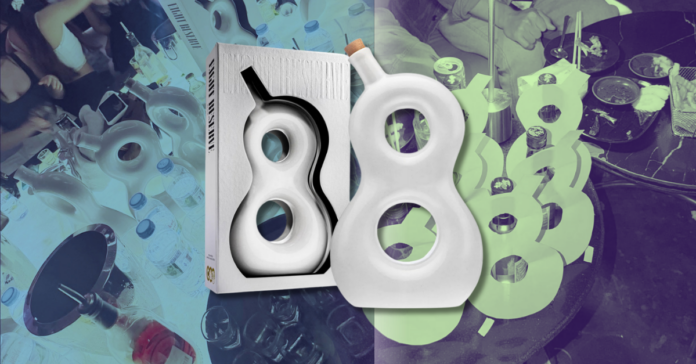
At the heart of the eye-watering total was 818 Eight Reserve Añejo, the ultra-premium flagship expression from 818 Tequila, a brand founded by American celebrity Kendall Jenner. The receipt listed five 750ml bottles at a combined LAK 166.6 million (approximately USD 7,560), or around LAK 33.3 million (approximately USD 1,500) per bottle.
The spirit typically retails internationally for between USD 100 and USD 200.

A Comment Section That Delivered
The public response was swift, sharp, and largely hilarious.
One commenter questioned the pricing directly: “What kind of drinks reserve service within two to three hours could possibly be worth LAK 12 million? That is ten times the local monthly minimum wage.”
Another quipped, “Are you just a customer, or are you taking over the place?”
Another put it in relatable terms: “My friends and I once argued over a LAK 500,000 (USD 22) bill. If it were this much, we would have to flee to the other side of the Earth.”
Tonkham herself appeared to enjoy every bit of it.
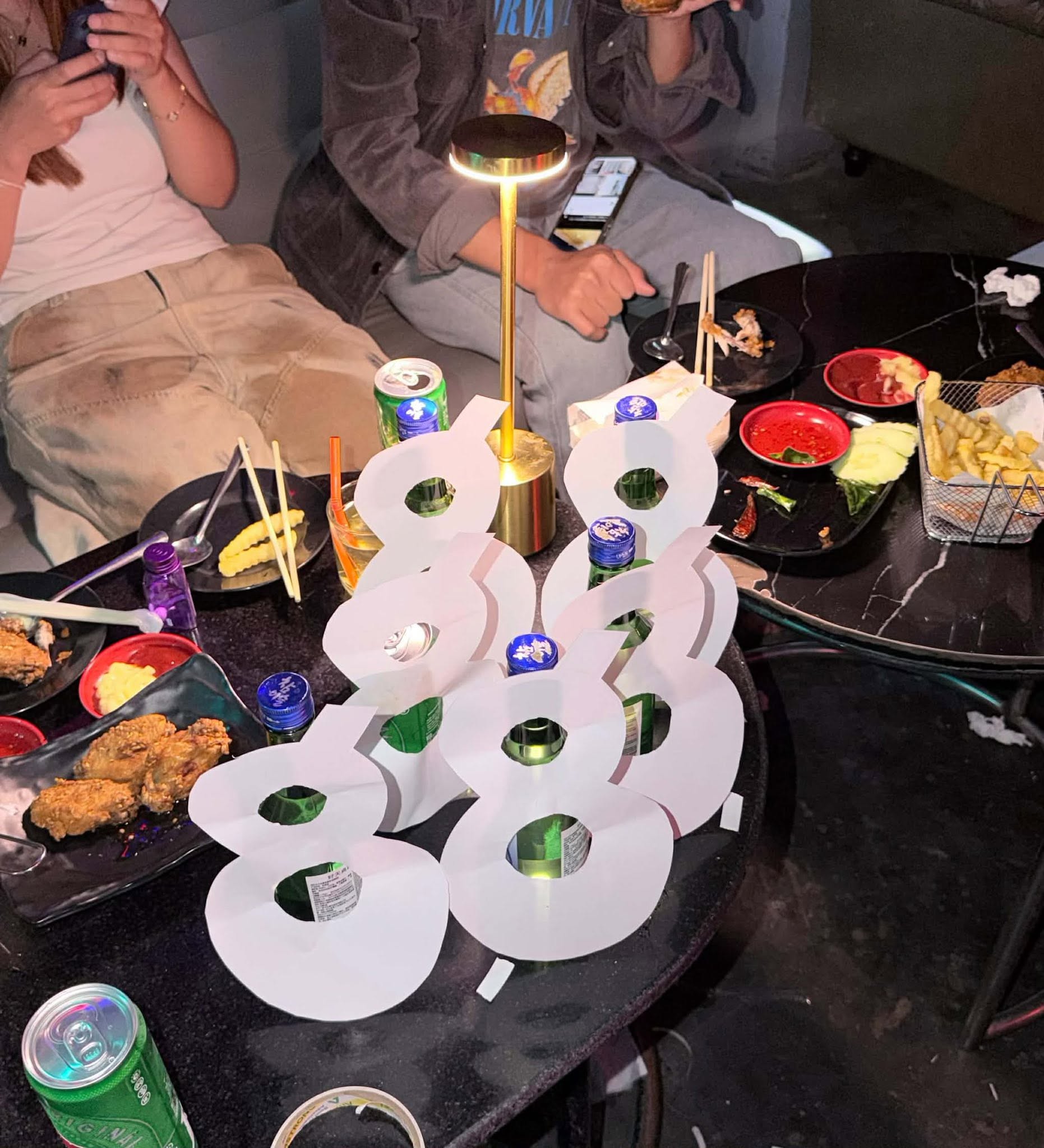
The conversation soon moved well beyond the receipt. Lao people on social media noticed that the 818 Eight Reserve Añejo bottle has a distinctive shape resembling the numeral 8, and a playful trend took off from there.
Users began sharing images and creative re-imaginings of everyday objects styled to echo that iconic silhouette, a cinema reshaping a popcorn box to look like the bottle, a beverage shop unveiling a new cup design inspired by the form, and a company jokingly proposing a new building in an 8-style design.

Many users generated AI images placing themselves or their products into the same visual, not ridiculing the drink, but riding its sudden fame for a laugh.
On Lao social media, a moment catches fire not through outrage but through collective humor and creativity.
For now, 818 Eight Reserve Añejo has gone from a little-known luxury import to a household punchline, and possibly the most-talked-about bottle in the country, without anyone actually buying it.
‘Hidden Hands’ Cave Opens as New Tourism Site in Khammouane

On 8 June, authorities in Khammouane Province have officially opened Hidden Hands Cave (Tham Pha Mue) to visitors, marking the launch of a new heritage tourism destination expected to strengthen cultural tourism and raise the province’s international profile.
The opening follows several years of archaeological research conducted by Lao and international experts. At a scientific symposium held at the French Institute in Vientiane on 5 June, Professor Olivia Rivero Vila, Director of the Prehistoric Technology Laboratory (LabTC), presented findings from studies carried out between 2024 and 2026.
Researchers documented more than 280 prehistoric rock-art images at the cave, including hand stencils, human figures, animals, and geometric symbols, making it one of the most significant rock-art sites identified in Laos.
The findings have helped establish the cave’s heritage value and contributed to efforts to develop the site as a protected cultural destination with tourism potential.
Researchers and officials emphasized that conservation will remain a priority as visitor access expands. While much of the artwork has remained relatively well preserved due to limited human disturbance, experts have called for continued protection measures to safeguard the fragile rock surfaces for future generations.
Provincial officials said Hidden Hands Cave will contributed into Khammouane’s tourism network alongside attractions such as Kong Lor-Natan Cave and “The Loop.”
They said the project supports sustainable tourism and geopark development efforts while creating new opportunities for local communities and helping diversify the province’s tourism sector beyond traditional nature-based attractions.
