

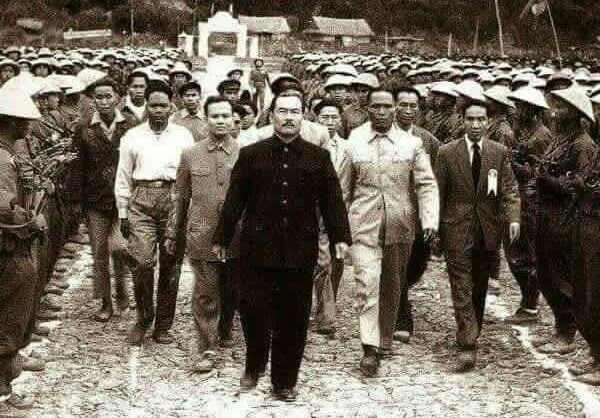
Born into one of Laos’ most powerful royal families, former President Souphanouvong could have lived a life of comfort under French colonial rule. Instead, he became the key figure of the country’s communist revolution from the late 50s and, eventually, its first president in 1975.
Laos marked the 117th anniversary of his birth on 13 July, with President Thongloun Sisoulith laying flowers at his statue in Luang Prabang and officials paying tribute nationwide. Yet, the ceremony is the latest reminder of how a French-trained engineer became the “Red Prince” who helped end one of Southeast Asia’s last monarchies.
Born a Prince, Raised Apart
Souphanouvong was born 13 July 1909, at the Sisouvanna Palace in Xieng Dong, Luang Prabang, one of the sons of Prince Bounkhong, the last viceroy of Luang Prabang. But his position within the royal family was always unusual. Unlike his half-brothers Souvanna Phouma and Phetsarath Ratanavongsa, whose mothers held royal status, Souphanouvong’s mother, Mom Kham Ouane, was a commoner.
This marked the beginning of one of the biggest political rivalries in modern Lao history. Souphanouvong became one of the “Three Princes,” alongside Souvanna Phouma and Prince Boun Oum of Champasak.
Each represented a different political path, reflecting the old divisions that remained after the Lan Xang Kingdom broke apart into the kingdoms of Luang Prabang, Vientiane, and Champasak in the early 1700s. Boun Oum stood with the royalists, Souvanna Phouma tried to keep Laos neutral, while Souphanouvong became the leader of the armed revolutionary movement.
An Engineer Radicalized by Empire
Nothing in Souphanouvong’s early life suggested he would become a revolutionary leader. He first studied at the Lycée Albert Sarraut in Hanoi before going to Paris to study civil engineering at the École nationale des ponts et chaussées. After graduating in 1937, he returned to French Indochina and spent nearly ten years building roads and bridges in central Vietnam and Laos, including the Xe Bang Hiang Bridge in Savannakhet Province.
According to Lao historical accounts, it was this work that changed his outlook. As he traveled across then-French Indochina and worked within the colonial administration, he saw firsthand how local people were treated under the colonial rule.
Those experiences are widely believed to have influenced his decision to leave engineering behind and join the struggle against the colonizers. By 1945, as Japan’s occupation came to an end and France sought to regain control of Indochina, Souphanouvong had joined the Pathetlao movement, the communist-aligned resistance group that he helped establish and lead.
Thirty Years Underground and in Exile
What followed was three decades of clandestine run.
Souphanouvong spent much of the next thirty years fighting a war fought on multiple fronts at once: against French colonial forces, then against the U.S.-backed Royal Lao Government, often in coordination with North Vietnamese forces during the wider Indochina wars.
His own half-brother, Souvanna Phouma, would serve repeatedly as prime minister of the government Souphanouvong’s movement was trying to overthrow.
The Pathetlao’s fortunes shifted permanently in 1975, as communist forces swept through Vietnam and Cambodia. Laos followed the same trajectory. The monarchy fell, and on 2 December 1975, the Lao People’s Democratic Republic (Lao PDR) was proclaimed. Souphanouvong became the new republic’s first president.
He held the office in an active capacity from December 1975 until October 1986, when declining health forced him to step back.
Rather than formally resign, Souphanouvong retained the presidential title for another five years while Phoumi Vongvichit governed as acting president in his place. That arrangement that lasted until August 1991, when Kaysone Phomvihane, the country’s first prime minister, was installed as the officially elected second president under a new constitution.
Souphanouvong died in Vientiane on 9 January 1995, of heart disease, at age 85. The government declared five days of national mourning.
Today the country celebrate his birth anniversary with ceremonies, floral tributes, and official commemorations honoring his role in the revolutionary struggle and the founding of the Lao PDR.
