MALMÖ, Sweden, Aug. 24, 2026 /PRNewswire/ — In 38% of homes, someone is quietly leaving things out and hoping someone else will deal with it. (They won’t.) Welcome to the silent protest. It’s one of many findings from the IKEA Store & Organise Report 2026: Finding Meaning in the Mess.
IKEA Report – Top 10 Store and Organize Trends
Life at home is getting busier and space tighter — so this year, IKEA is focusing on helping people find calm, not just storage.
The report surveyed 31,488 people across 31 markets — and found that clutter creates real tension at home. Nowhere more so than the kitchen countertop, the hardest space to keep clutter-free (24%) and the most likely to cause an argument (37%).
One in ten of us even use the oven for storage, rising to 21% in South Korea. Somewhere, someone’s about to get a very unpleasant surprise.
Living spaces are getting smaller. But there’s a clear shift towards “meaningful mess”: owning with intention, keeping what holds value. With 59% preferring a lived-in home over a minimalist one, perhaps the goal was never a perfect home.
“People aren’t chasing a perfect home anymore. They want a home that feels like them — one that holds their stories, their memories, the things that matter. What we keep says a lot about who we are. It was never just stuff. At IKEA, we believe everyone deserves a home that works for them. That’s what smart, affordable solutions are for,” says Licca Li, Home Furnishing & Retail Design Manager, Ingka Group (IKEA).
82% keep things purely for sentimental reasons, even if rarely used or out of sight. Then there’s the 26% hiding mementos from past relationships — men more so than women.
68% of households have a drawer of doom, and inside? Cables, mostly. 54% of Boomer men still keep them for gadgets they no longer own.
When guests are coming, one in 10 admit to cancelling plans with friends because the house is too messy, and 34% shuffle clutter before they arrive.
Even so, 15% globally see mess as a form of creativity — rising to 31% in China but just 4% in Japan. Maybe the goal was never a perfect home; just a happy one.
Revolutionary design will bring Arm-native applications to IBM’s flagship mainframes and servers, broadening software choice for enterprise computing
ARMONK, N.Y., Aug. 24, 2026 /PRNewswire/ — At the annual Hot Chips conference, IBM (NYSE: IBM) today is announcing the first dual-architecture mainframe processor, which is being designed to enable enterprises to run operating systems and applications on both the IBM and Arm® compute platforms in future IBM Z and LinuxONE systems. This marks the first processor milestone to emerge from the IBM and Arm collaboration established in April 2026, and represents a significant advance in enterprise computing. The new processor is being developed to allow organizations to run Arm-native Linux environments simultaneously with z/OS and Linux on IBM Z, while benefiting from IBM’s established security, reliability, and scale.
A CAD layout of IBM’s dual-architecture processor chip, designed with Arm.
With more than 22 million developers worldwide, the Arm software ecosystem supports a broad and growing range of applications from cloud to edge, including the cloud-native and AI software increasingly shaping modern infrastructure. This new processor will bring that ecosystem to the IBM platforms known globally for transaction processing and data-intensive operations. Arm workloads will benefit from IBM’s enterprise-grade capabilities, including enhanced reliability, hardware-level fault detection and recovery, advanced encryption, secure key management, and AI acceleration.
Built on a 2 nanometer technology node, the processor’s design will contain 11 high-performance cores operating at more than 5.7 GHz, AI inference accelerators for in-transaction fraud detection, a dedicated on-chip data processing unit for I/O acceleration, and a large cache architecture for demanding enterprise workloads. The chip is architected to not contain separate Arm and IBM cores: each processor core can natively execute Arm and IBM Z, or Arm and LinuxONE, instructions concurrently while prioritizing the platform’s established performance, security, encryption, and availability characteristics. IBM Z and LinuxONE platforms are capable of scaling to hundreds of cores and tens of terabytes of memory.
“As organizations modernize their application portfolios and integrate AI into core business operations, they need infrastructure that expands their options,” said Christian Jacobi, Chief Technology Officer and IBM Fellow, IBM Systems Development. “This processor represents a significant architectural advancement for IBM Z and LinuxONE. By bringing Arm natively to our platform, we’re combining access to one of the industry’s fastest-growing software ecosystems with the qualities that have made IBM systems the foundation for how businesses run today.”
“As AI scales, more of the computing landscape is converging on Arm,” said Mohamed Awad, Executive Vice President, Cloud AI, Arm. “IBM Z and LinuxONE power some of the world’s most demanding workloads in highly regulated industries. Bringing Arm compute and its software ecosystem to these platforms will extend that momentum into mission-critical enterprise infrastructure to give organizations greater choice in how they deploy AI.”
This milestone represents a major step forward in IBM and Arm’s shared vision of expanding application choice and access to the latest in software innovation for enterprise computing without compromising the capabilities these environments demand.
Statements regarding IBM’s future direction and intent are subject to change or withdrawal without notice, and represent goals and objectives only.
About IBM IBM is a leading provider of global hybrid cloud and AI, and consulting expertise. We help clients in more than 175 countries capitalize on insights from their data, streamline business processes, reduce costs and gain the competitive edge in their industries. Thousands of governments and corporate entities in critical infrastructure areas such as financial services, telecommunications and healthcare rely on IBM’s hybrid cloud platform and Red Hat OpenShift to affect their digital transformations quickly, efficiently and securely. IBM’s breakthrough innovations in AI, quantum computing, industry-specific cloud solutions and consulting deliver open and flexible options to our clients. All of this is backed by IBM’s long-standing commitment to trust, transparency, responsibility, inclusivity and service. Visit www.ibm.com for more information.
DOVER, Del., Aug. 24, 2026 /PRNewswire/ — xLean Robotics will showcase xLean TR1, the world’s first dual-form transformable floor-washing robot, at IFA 2026 from Sept. 4–8, following a preview at ShowStoppers @ IFA, on Sept. 3 at Messe Berlin.
xLean Brings AI Agent-Powered Floor-Washing Robot to IFA 2026
xLean TR1 returns to Berlin with four honors: Best of IFA Next and Best in Design Honoree at IFA 2025, followed by the Red Dot Award: Product Design 2026 and an International Design Excellence Award (IDEA).
More than 2,000 early backers pledged over $2 million to xLean TR1 on Kickstarter, validating xLean’s belief that home robots should address the messes people actually face.
Households face a familiar compromise: autonomous robots manage daily cleaning, but sudden spills, dried stains, and muddy paw prints still require another appliance. TR1 closes that gap by operating as an autonomous whole-home floor washer, then transforming in one second into a handheld cleaner for targeted messes, combining robotic convenience with immediate human control.
That raised a broader question: can a robot understand what someone needs rather than wait for a predefined command?
Central to xLean’s presentation will be live demonstrations of EvoMate™ OS, an AI Agent experience designed to make robot cleaning as natural as asking someone for help. Visitors will see TR1 interpret one-sentence requests, identify what needs cleaning, execute the appropriate task, and report completion. Demonstrations will also show simple visual assistance, including locating everyday items and checking whether pet essentials need attention.
Unlike voice systems limited to preset commands, EvoMate™ OS interprets intent and manages cleaning from request through completion, without complex maps, menus, mode selections, or manual settings. To support this intelligent experience, xLean TR1 is powered by the D-Robotics Sunrise™ X5 AI chips with 10 TOPS of computing power.
The same user-driven philosophy extends to product design. Following strong community support, xLean introduced two supporter rewards: a newly unlocked Space Silver TR1 and personalized top-cover laser engraving for names, messages, or graphics. Both will be shown at IFA as examples of community-driven personalization and the beginning of deeper European localization.
xLean invites European distributors, retailers, and service partners to discuss market launches, localized experiences, channel partnerships, and long-term service support and experience TR1 in action at IFA.
Visit xLean at ShowStoppers @ IFA on Sept. 3 and Booth 11.1-129 during IFA 2026, Sept. 4–8.
BEIJING, CHINA – Media OutReach Newswire – 24 August 2026 – HiDream.ai today launched HiDream-O1-World, a native omni-modal interactive world model that lets users generate complete, explorable 3D worlds from a single text prompt, image, or interactive control.
The model combines three core capabilities — roaming, editing, and interaction — and is built on HiDream.ai’s self-developed UiT (Unified Transformer) architecture. The upgraded UiT delivers a key breakthrough on two persistent challenges in the field: spatiotemporal consistency and physical consistency. As cameras pan, zoom, or track, scene geometry remains stable — objects don’t vanish or deform, and collisions, occlusions, and gravitational responses follow real-world causal logic rather than appearing as randomly stitched frames.
“The value of an interactive world model isn’t in generating a photorealistic 3D scene — it’s in AI beginning to genuinely understand the depth of space, the texture of objects, the inertia of motion, and the logic of light and shadow,” said Yao Ting, CTO of HiDream.ai. “This is a systematic reconstruction of how the physical world works. HiDream-O1-World is the first bridge in that reconstruction — every interaction leads to a world never reached before.”
Topping the Leaderboard on Debut
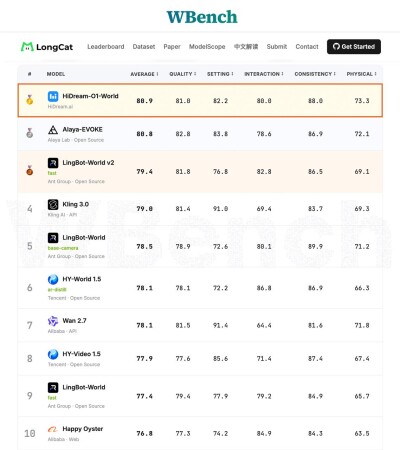
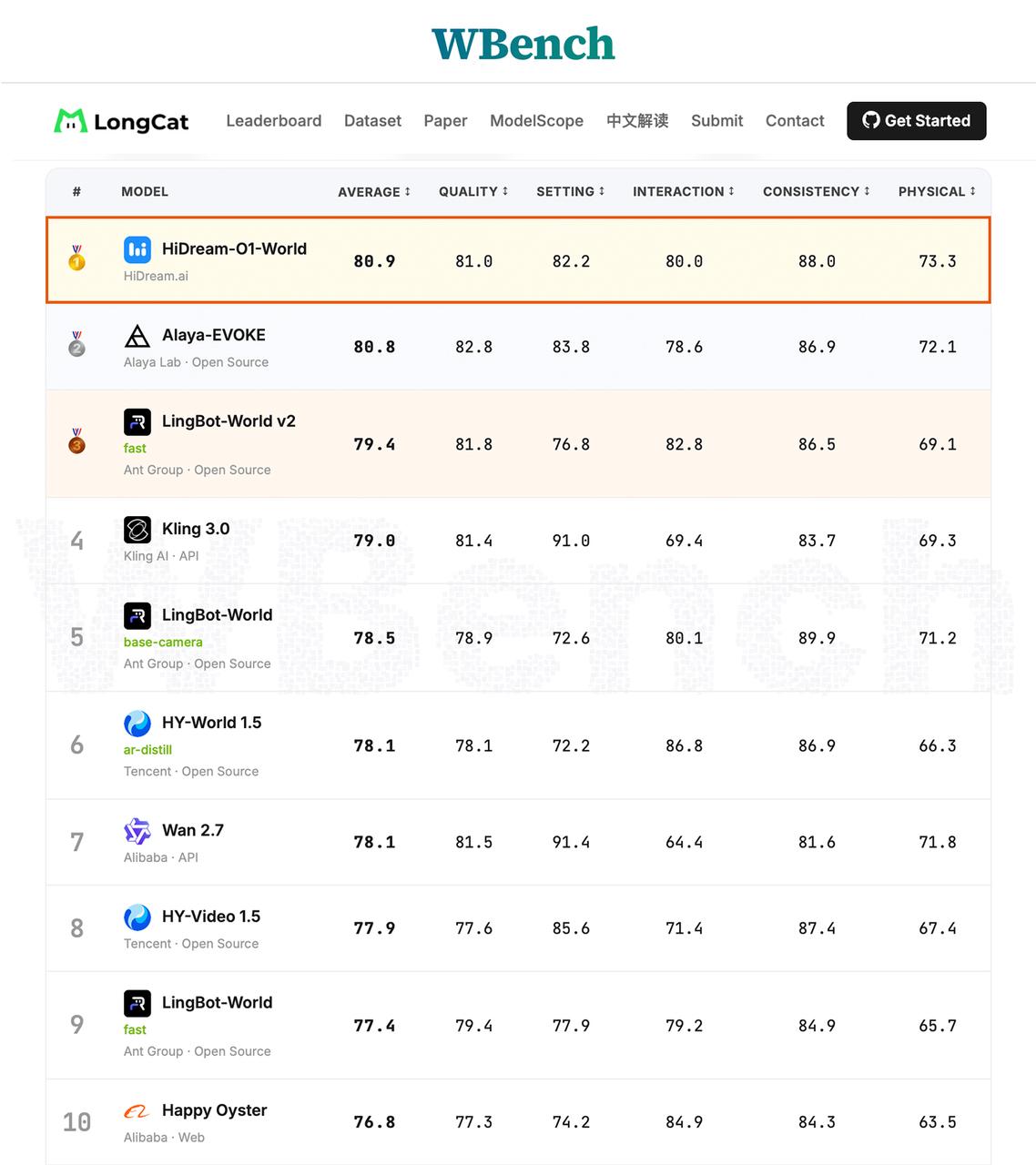
HiDream-O1-World’s first third-party benchmark results came from WBench, an interactive world model evaluation benchmark jointly developed by Meituan’s LongCat team and Fudan University. The model topped the core Navi sub-leaderboard with an average score of 80.9, ranked first in the Physical dimension at 73.3, and scored 88.0 on Consistency — the best overall performance on the board.
WBench covers 289 multi-turn interaction cases and 1,058 interaction turns across five dimensions and 22 metrics. Its Navi board, focused on spatial navigation and viewpoint control, is widely regarded as the core measure of a world model’s spatial understanding. Topping Navi on its first entry, HiDream-O1-World sets a new performance ceiling for interactive world models — outperforming established players including Tencent Hunyuan 1.5.
One-Click World Generation for Immersive Interaction
The model lets users generate structurally complete, stylistically diverse interactive worlds from a short description, a single image, or simple controls. Upload a photo of a room, for example, and the model rapidly constructs a high-precision digital twin, completing the full panorama with accurate proportions and fine-grained detail.
Users can explore worlds in first-person or third-person mode, freely driving a character and adjusting viewpoints. In a diving scene, light patterns on the water surface and refracted glimmers on the seabed shift in sync with the camera; coral textures remain crisp and drift-free throughout.
Beyond roaming, HiDream-O1-World enables real-time editing — directing characters to grab, run, crouch, or jump, or triggering environmental events like rainfall. Changes maintain globally unified coherence across geometry, lighting, materials, and physical logic, ensuring every interaction remains self-consistent.
The model generalizes across humans, animals, and fictional characters, adapting to each one’s form and motion. In a snow-climbing scene, footprints press realistic indentations into the snow, snowflakes drift at varied speeds, and distant ridgelines blend naturally with rock textures as the viewpoint shifts. It supports a wide scene and stylistic range — from real city streets and natural terrain to anime-style cartoons and AAA-game-grade rendering.
Two Core Breakthroughs: Spatiotemporal and Physical Consistency
Interactive world models have long been constrained by three problems: space, physics, and memory. Camera switches cause blurring and scene drift; physics violations undermine credibility; and without long-term memory, objects disappear when the view turns. HiDream-O1-World addresses these through two coordinated capabilities:
Long-horizon spatiotemporal consistency. The model pairs 3D priors injected into Memory context with Test-Time Training (TTT) online maintenance. The Memory mechanism encodes scene geometry and object relationships as 3D priors, letting the model “remember” explored structures across viewpoint switches — fundamentally eliminating drift and scene resets. TTT performs lightweight online adaptation during inference, dynamically optimizing adapters so internal representations stay aligned with the scene’s 3D constraints. Where conventional models act like a painter redrawing every frame — with errors compounding into drift and vanishing objects — HiDream-O1-World behaves like a director with spatial memory: it records scene structure rather than re-guessing the environment at each step, recalling the corresponding view when the camera moves.
Globally stable physical consistency. On the training side, a generative world simulator produces synthetic data covering rigid-body collisions, fluid motion, soft-body deformation, and gravity-driven projectiles — systematically reinforcing the model’s inductive bias through physics-simulated data. On the inference side, the same TTT mechanism enhances physical consistency online, adjusting representations when new object types or materials appear so subsequent frames better follow that scene’s physics. This dual-engine design delivers gains of 13.6% over the industry average on visual-plausibility evaluation and 12.7% on causal-fidelity evaluation across fluid, collision, and deformation dimensions.
The research has been accepted to ECCV 2026 (European Conference on Computer Vision), one of the three premier academic conferences in computer vision and AI.
Beyond technical breakthroughs, HiDream-O1-World opens new possibilities for industrial transformation:
AI interactive film and games. Users no longer follow a linear plot passively but become active participants, with worlds evolving along branching storylines — delivering cinematic visual quality, unprecedented immersion, and the enjoyment of multiple endings.
Embodied-AI simulation. The model builds physically grounded, high-fidelity simulation spaces — cities, factories, interiors — providing virtual testbeds for robotics training, autonomous driving, and smart manufacturing, replacing high-cost, high-risk real-world testing.
3D scene production. Creators can generate 3D figurines, home scenes, and art spaces with complete structure and rich detail, supporting structural fine-tuning and instant style switching. It even extends to the microscopic world — simulating cellular behavior and protein interactions for drug discovery and disease-mechanism research.
When the physical world can be generated at a click and explored freely, many industries deserve to be reimagined. These fields are only the tip of the iceberg — as more developers and creators join, the application boundaries of interactive world models will extend far beyond what can be described today.
Hashtag: #HiDreamAI
The issuer is solely responsible for the content of this announcement.
A pciture of education in Laos, used for illustration purpose only. (Photo by European Commission)
Attapeu is expanding its employment services as the province seeks to respond to labor shortages and help people who have left school find work, according to provincial media.
At a meeting on 20 August, Director of the provincial Department of Labour and Social Welfare Phonmany Khiengxayavong said the province will focus on linking jobseekers with employers and helping businesses recruit workers with suitable skills.
The push comes after provincial authorities recorded 5,237 students leaving secondary school, grade 6 to 12 between 2022 and 2026.
Attapeu’s labor market currently includes 47,420 workers, of whom 46,282 are employed. The province’s unemployment rate is 2.4 percent, equivalent to about 1,138 people.
Most workers remain in agriculture, which employs 26,315 people, or 56.8 percent of the workforce. Industry accounts for 15,242 workers, while 4,725 people work in services.
Looking ahead, Attapeu will expand employment services in the second half of 2026 by collecting information from jobseekers and employers, identifying workforce needs and improving coordination between government agencies and businesses to connect available workers with suitable jobs.
The province has 2,368 registered business units, providing a potential base for expanding job opportunities and matching workers with employers.
Enrollment Trend in Laos
The issue is part of a bigger challenge in the education field in Laos..
In late July, Vientiane announced plans to support disadvantaged students and reduce school dropouts by waiving school fees, providing free textbooks, redistributing teachers, and strengthening science, technology, engineering and mathematics (STEM) and information and communications technology (ICT) education.
During the 2024-25 school year, 2.38 percent of primary students dropped out, well above the city’s target of less than 0.4 percent. The lower-secondary dropout rate stood at 5 percent, also above the target of less than 4 percent. Officials linked the dropouts mainly to poverty, families moving, and students leaving school to work or help support their families.
The decline in school enrollment has continued for several years.
Laos has recorded three consecutive years of declining school enrollment. From 2022-23 to 2024-25 school year, primary enrollment fell from 741,976 students to 739,554, while lower secondary enrollment dropped from 388,019 to 378,457.
The sharpest decline was recorded at the upper secondary level, where enrollment fell from 169,523 to 144,050 over the same period.
Education authorities cite poverty, migration to work in the city or abroad and infrastructure challenges.
To Address This
The education challenges facing Attapeu are part of a wider national effort to reduce school dropouts and improve teaching quality.
During a meeting ahead of the 2026–27 school year, Education Minister Thongsalith Mangnomek identified enrollment, dropouts and teacher quality as key challenges. Reforms will strengthen teacher training and placement, while authorities prepare to introduce the 6+3+3 education system nationwide in 2028–29.
In early August, the ministry also announced plans to recruit 2,200 new teacher trainees for the 2026–27 academic year. The intake is based on the number of secondary schools nationwide, with provinces expected to select students with strong academic performance and an interest in teaching.
A 1,000 MW solar power facility in Oudomxay Province, one of the country’s largest renewable energy projects. (Photo credit: CGN Energy Laos)
Laos is moving to update its electricity sector as the government prepares to adopt a revised Electricity Law aimed at supporting a greener, more modern and sustainable energy system.
The current Electricity Law, adopted in 2017, no longer fully reflects changes in how electricity is generated, traded and managed, according to officials.
A seven-day meeting to review the revised law ran from 17 to 23 August.
Minister of Industry and Commerce Malaithong Kommasith said the government has long considered energy a strategic sector of the national economy, with electricity serving as the “backbone” of economic stability and competitiveness.
He said Laos needs to revise the 2017 law because the electricity sector has developed rapidly, with new investment models, market mechanisms and technologies emerging that the existing legislation does not fully cover.
Laos is working to change how it produces and uses electricity. The government wants to make it easier for households and businesses to generate their own power or buy electricity directly from producers. It also plans to prepare for power projects whose concessions will expire and return control to the state.
Resource Diversity
Another big plan is to diversify the country’s energy resources. This will help Laos not depend so much on hydropower.
Deputy Justice Minister Khamphan Bounphakhom also emphasized that the Electricity Law needs to be updated to reflect the changing times, both in terms of the economy and society, as well as keeping pace with developments in Laos and globally.
The meeting discussed several proposed changes, including new business models such as Build-Lease-Transfer (BLT) and Lease-Operate-Transfer (LOT), the establishment of an energy management agency, and measures to promote new technologies, clean energy and greener industries.
The revised draft contains 14 parts, nine chapters and 176 articles. Of these, 86 articles have been amended, 65 are new provisions and 25 remain unchanged.
The draft also introduces several new policies and mechanisms. These include an Electricity Regulatory Authority, rules for self-supply and direct electricity sales, and new measures for managing power projects when their concessions expire.
It would also establish a Lao Grid Code and Renewable Energy Certificates, while introducing registration requirements for electrical engineers and technicians.
Following the meeting, the revision committee will continue working on areas where officials disagreed to ensure the final law can be implemented effectively.
Broater Energy Transition
The proposed law comes as Laos begins to diversify its electricity system beyond its long-standing reliance on hydropower.
In April, Electricité du Laos (EDL) introduced a nationwide program to buy electricity from household rooftop solar systems at LAK 992 (USD 0.04) per kilowatt-hour, with contracts lasting up to 10 years. The program allows households with single-phase connections to install systems of up to 5 kilowatt-peak, while those with three-phase connections can install up to 10 kWp. EDL set an initial nationwide limit of 50 MWp for the program.
The government is also encouraging people to switch to electric vehicles.
In May, it suspended imports of most fossil-fuel-powered vehicles until the end of 2026 while introducing price controls for electric vehicles to keep them affordable. The measures aim to reduce fuel imports, make transportation cleaner and strengthen the country’s long-term energy security.
They form part of a broader push to build a cleaner and more sustainable transport system.
These policies match with the broader energy transition plan outlined in the revised Electricity Law. The draft would establish rules for self-supply, direct electricity sales and renewable energy certificates, while also creating a Lao Grid Code and a framework for managing power projects as existing concessions expire.
Following the recent seven-day review, the revision committee will continue working on areas where officials disagree before finalizing the draft for implementation.
From surging sports interest to last-minute purchase, Hong Kong users are eager for greater access to live entertainment experiences
HONG KONG SAR – Media OutReach Newswire – 24 August 2026 – With the excitement of football events and chart-topping concerts still reverberating across the city, Hong Kong is carrying the momentum into a vibrant summer of live entertainment. Capturing the pulse of the moment, MoreTickets, Asia’s No.1* live event ticket resale platform, releases Hong Kong’s top international and local live events[1] scheduled for the summer period (July and August), alongside consumer insights into platform users’ ticket-buying behavior.
Concerts Top Summer Searches as Sports Interest Surges
MoreTickets offers a wide range of live entertainment events worldwide, including popular concerts, sporting events, theatre performances and many more. Concerts continue to drive the summer entertainment landscape, capturing the majority of user interests. According to MoreTickets data1, the “Concert” category accounts for nearly two-thirds of all searches for live events or shows scheduled in July and August, reinforcing the city’s demand for major headline acts. Interest in “Sports” category is also rising, with searches up about 150% year on year, reflecting heightened appetite for major matches and global tournament moments this summer.
Top 10 Most–Searched Live Events Scheduled for July and August[1]:
Rank
Event Name
Category
Location
Show Date
1
AXA Presents: You & Mi Sammi Cheng Live at Hong Kong Kai Tak Stadium 2026
Concert
Hong Kong
July 10-12, 2026
2
MC Cheung E=MC² Concert 2026
Concert
Hong Kong
July 7-11, 2026
3
Hong Kong Football Festival (HKFF) 2026
Sports
Hong Kong
July 31-August 5, 2026
4
FIFA World Cup 2026
Sports
Overseas
June 11-July 19, 2026
5
CTF Life Title-sponsors: 2026 TMElive International Music Awards
Award Ceremony
Hong Kong
August 22-23, 2026
6
NMIXX 1ST WORLD TOUR IN HONG KONG
Concert
Hong Kong
July 25-26, 2026
7
The Music of Chan Fai Young: King of Pop
Concert
Macau
July 24-26, 2026
8
Hins Cheung UNPLUGGED 2 Second Movement Concert
Concert
Macau
July 24-26, 2026
9
LiSA – LiVE is Smile Always~15~ in Hong Kong
Concert
Hong Kong
July 18, 2026
10
ILLIT LIVE ‘PRESS START’ in HONG KONG
Concert
Hong Kong
August 22-23, 2026
Local Hong Kong artists and city-based performances remain highly searched, representing more than 70% of total searches, led by Sammi Cheng and MC Cheung, two renowned local singers who appeal spans generations. Fueled by global FIFA World Cup fever, the Hong Kong Football Festival emerged as a breakout hit, ranking the third among the top searches.
Hong Kong Live Event Goers Made Last-Minute Purchase, and Rise in Single-Ticket Purchases
In Hong Kong, MoreTickets users are deciding closer to the event date. MoreTickets purchase data[2] shows that nearly two out of five ticket transactions were made within seven days of the show (37%), signaling a more spontaneous approach to live entertainment planning. This last-minute pattern is strongest in event categories such as pop music concerts (55%) and fan meetings (40%). Among those last-minute buyers, 60% of the purchases opted for single-seat tickets, underscoring strong eagerness to attend live shows, supported by the platform’s real-time availability andtransparent pricing. MoreTickets helps users compare across the spectrum and secure the best fit with confidence.
Top 10 Events Purchased Within 7-Days of Event Date in May 2:
Rank
Event Name
Category
Location
Show Date
1
FAMA (Nongfu): The Funniest Concert in All Hong Kong
Concert
Hong Kong
May 8-10, 2026
2
Sun Life Presents: SANDY LAM RESONANCE
Concert
Hong Kong
May 16-17, 2026
3
Laufey: A Matter of Time Tour in Hong Kong
Concert
Hong Kong
May 12, 2026
4
Hang Seng Insurance Presents: 25+ EEG Family Concert
Concert
Hong Kong
May 3-4, 2026
5
b.balance Presents Live Band Concert|<3 symbol of love | MC Cheung x CONSTANCE x Gareth.T
Concert
Hong Kong
May 16, 2026
6
K-SPARK in MACAU
Music Festival
Macau
May 2, 2026
7
EXO PLANET #6 – EXhOrizon in MACAU
Concert
Macau
May 22-23, 2026
8
IVE WORLD TOUR IN MACAO
Concert
Macau
May 23-24, 2026
9
2025-26 TREASURE TOUR [PULSE ON] in Hong Kong
Concert
Hong Kong
May 9, 2026
10
UFC Fight Night Macau and Road to UFC
Sports
Macau
May 28-30, 2026
A Safer Way to Find Tickets with MoreTickets
As live entertainment demand becomes more immediate and fragmented, many consumers still struggle when trying to secure tickets through various channels. MoreTickets offers an alternative as a safer platform with real-time availability, transparent-priced listing, and a secure refund guarantee, making it a reliable choice for live-event goers. It operates with two core safeguards – vetted sellers supported by a verified ticket-sourcing network, and escrow-based payment held until successful event entry.
Trusted by millions of users, MoreTickets helps users secure ticket access safely, ensuring they can enjoy the live entertainment moments that matter.
[1] The analysis is based on H1 2026 search activity on MoreTickets platform, filtered to events scheduled in July and August 2026.
[2] The analysis is based on purchase activity during 1 to 31 May 2026 on MoreTickets platform.
Hashtag: #MoreTickets
The issuer is solely responsible for the content of this announcement.
About MoreTickets
MoreTickets is Asia’s No.1* live event ticket resale platform, dedicated to providing convenient, secure, and hassle-free ticketing services. The platform covers a wide range of live entertainment, including popular concerts, sporting events, theatre performances, and more. To date, MoreTickets is trusted by millions of users in Hong Kong and Macau, with its ticket sourcing network spanning major global live events across Hong Kong, Macau, Taiwan, as well as Japan, South Korea, Southeast Asia, Australia, Europe and the Americas.
By integrating comprehensive event information and ticket sources, MoreTickets helps users quickly search and compare options while offering end-to-end services, including secure payment, order protection, and post-sale support. The platform is committed to delivering a seamless, intuitive, and reliable ticketing experience, ensuring users never miss out on their most anticipated shows.
*Measured by GMV of live event ticket resale platform in Asia in 2025 (According to Frost & Sullivan’s research on the live event resale platform industry in Asia, as of May 2026
YOGYAKARTA, Indonesia, Aug. 24, 2026 /PRNewswire/ — Malaysia Healthcare Travel Council (MHTC) once again strengthened Malaysia’s presence in Indonesia through MHX Yogyakarta 2026, held from 20 to 23 August 2026 at the Grand Atrium, Pakuwon Mall Jogja. The four-day event came on the back of a record year for the Indonesian market, which generated RM2.2 billion in healthcare travel revenue in 2025, marking a 24% year-on-year increase. The four-day healthcare consumer event underscores Malaysia Healthcare’s commitment to bringing trusted, high-quality healthcare services closer to Indonesian communities while expanding its footprint in one of Indonesia’s fastest-growing regional centres. Held under the Malaysia Year of Medical Tourism (MYMT) 2026 campaign themed Healing Meets Hospitality, MHX Yogyakarta 2026 reinforces Malaysia’s position as the preferred destination for medical tourism by combining world-class medical expertise with compassionate patient care and seamless healthcare experiences.
Malaysia Healthcare returns to Yogyakarta building on a record RM2.2 billion in healthcare travel revenue from Indonesia in 2025.
Yogyakarta has emerged as a strategic market for Malaysia Healthcare, supported by a well-educated population, increasing demand for advanced specialty care, and convenient direct connectivity to Kuala Lumpur. These factors present strong opportunities to further strengthen healthcare collaboration between Malaysia and Indonesia and to provide greater access to specialised treatment options for Indonesian patients.
Speaking on the occasion, Rahmatullah Baragau, MHTC’s Head of Indonesia Market said: “Indonesia has always been Malaysia Healthcare’s closest and most valued market, and Yogyakarta represents an exciting opportunity as healthcare awareness and demand for specialised treatments continue to grow. Through MHX Yogyakarta 2026, we aim to strengthen public confidence in Malaysia Healthcare while bringing our trusted healthcare ecosystem closer to local communities.”
More than 15 member hospitals participated, showcasing Malaysia’s strengths across various medical disciplines including cardiology, oncology, orthopaedics, fertility, health screening, gastroenterology, and other specialised services.
Participating list of hospitals:
Island Hospital Penang
Institut Jantung Negara
Mahkota Medical Centre
Subang Jaya Medical Centre
Alpha IVF & Women’s Specialists
Ampang Puteri Specialist Hospital
GenPrime Everlink Fertility Centre
Hospital Picaso
Damansara Specialist Hospital 2
KPJ Klang Specialist Hospital
MSU Medical Centre
Optimax Eye Specialist Centre
Pantai Hospital Kuala Lumpur
Pantai Hospital Penang
Penang Adventist Hospital
Sunway Medical Centre Damansara
Sunway Medical Centre Penang
Sunway Medical Centre Sunway City Kuala Lumpur
Thomson Hospital Kota Damansara
Indonesia continues to be Malaysia Healthcare’s largest source market. Healthcare traveller arrivals from Indonesia reached 968,000 in 2025, a 16% increase from the previous year, reflecting sustained confidence among Indonesian patients in Malaysia’s healthcare offerings. MHX Yogyakarta 2026 forms part of MHTC’s broader strategy to strengthen long-term partnerships with communities, healthcare stakeholders, and local organisations across Indonesia, while supporting MYMT 2026’s goals to position Malaysia as the world’s preferred medical tourism destination.
For media inquiries and further information, please contact:
Malaysia Healthcare Travel Council (MHTC), established in 2009 under the purview of the Ministry of Health (MOH) Malaysia, is entrusted with developing and nurturing the “Malaysia Healthcare” brand. MHTC enhances, coordinates, and promotes Malaysia’s healthcare travel industry by fostering industry collaborations and building valuable public-private partnerships both domestically and internationally. With 91 member hospitals nationwide, MHTC continues to elevate the healthcare travel ecosystem through strong branding, seamless patient experiences, and strategic market initiatives. In line with these efforts, MHTC is spearheading the Malaysia Year of Medical Tourism (MYMT) 2026, the nation’s first dedicated year to celebrate and advance healthcare travel. MYMT 2026 serves as a milestone initiative to showcase Malaysia’s world-class healthcare offerings, strengthen its position as the premier global healthcare destination, and highlight the industry’s significant contribution to the national economy.












 https://www.moretickets.com/