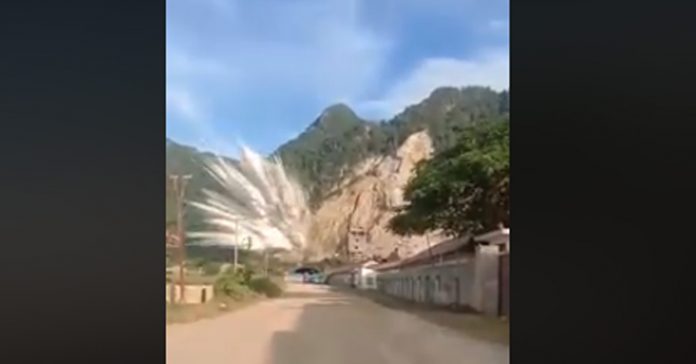
An explosion at a Chinese-owned cement plant Luang Prabang Province last Saturday has caused one death and multiple injuries.
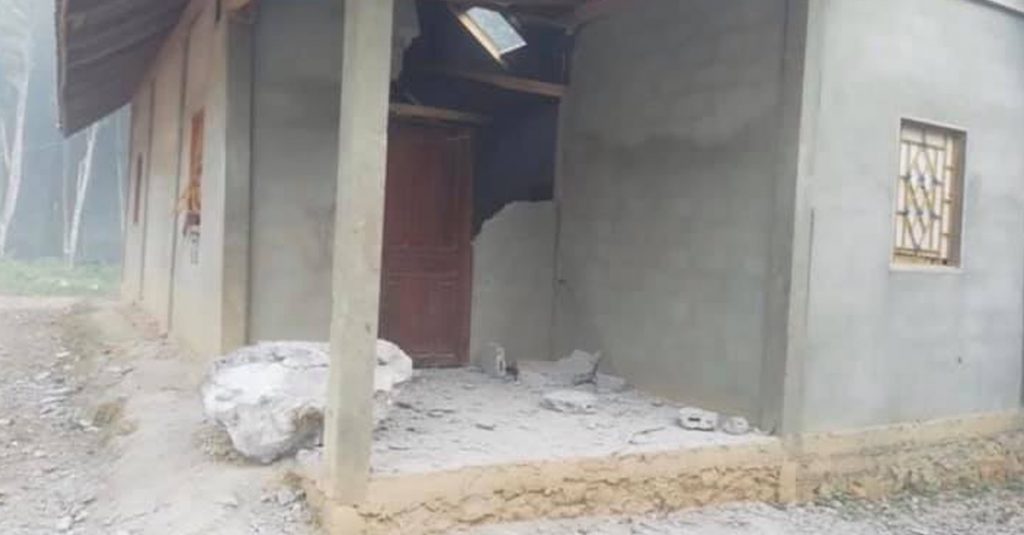
At least 20 residents of Phonemany Village, Nambak District, have been injured, while houses and vehicles were destroyed in the powerful blast.
More explosives than usual were apparently used in Saturday’s blast, causing a much larger explosion than expected.
Mr. Khamvone Keolounan, Vice Governor of Nambak District, said in an interview with the Lao Post that prior to blasting, district authorities would inspect the site, ensuring that proper preparations had been made. He said that explosions caused by the blasting had never been this powerful in the past, and debris had never reached the homes of surrounding villages.
A massive piece of debris from the explosion falls on a nearby home
During Saturday’s blast, explosives had been mounted on the side of a cliff, which may have caused debris to fly in a different direction than usual, added Mr. Khamvone.
An investigation into the incident is still ongoing, and officials will put stricter measures in place for future blasting operations.
A video of the incident can be seen below, as aired on Lao Star channel:
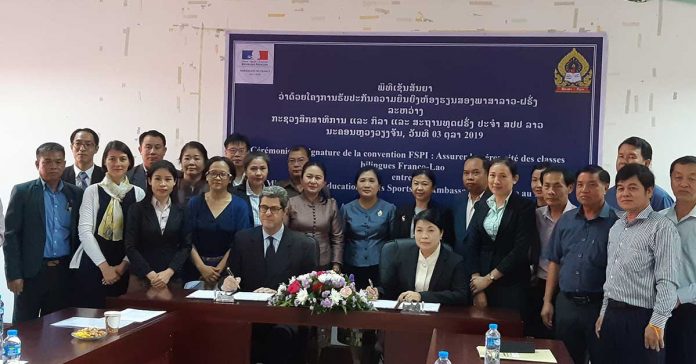
A signing ceremony was held on Friday at the Ministry of Education and Sports to officially launch the project supported by the French Embassy to upgrade the teaching of mathematics and science in Lao-French bilingual classes in line with the government’s education plan to improve education quality.
The MOU, signed by Ms. Sisouk Vongvichith, Director General of the General Education Departement of the Ministry of Education and Sports and Mr. Patrick Cohen, Head of Cooperation at the French Embassy to the Lao PDR, aims to provide new teaching-learning material in science subjects (textbooks, equipment, internet connection) and give professional development sessions and additional teacher training to in-service teachers.
This new project will not only give a fresh start to the students and new resources to the in-service teachers of secondary education, it will also benefit to the new batch of 28 students who have just entered the NUOL’s faculty of education to become tomorrow’s bilingual mathematics and science teachers.
In her speech, Ms. Sisouk declared that this project is a great asset for the French-Lao bilingual classes as it aims to further enhance the teaching practices and improve the learning outcomes of students.
The more than twenty-years-old Lao-French bilingual section has now grown significantly to reach a nationwide coverage with 13 public schools in Vientiane, Savannakhet, Pakse and Luang Prabang. Today, 3,000 students, aged 8 to 18, benefit from enhancing teaching of French language and the teaching of science subjects (mathematics, physics, chemistry and biology) in French.
Mr Patrick, Head of French cooperation, added that the already successful bilingual programme within the state education system of the Lao Ministry of Education and Sports will undoubtedly become even more attractive for students, parents and teachers.
He mentioned on this occasion that the call for 2020 scholarships to France will start next January.
All information related to applications will be available online on the Facebook Page of Campus France Laos.
KiwiPay, a Laos-based payment solution provider, is set to launch its cashless visa payment system in up to seven African countries, in a move to tap into a growing number of Chinese visitors to Africa.
KiwiPay is currently providing its cashless visa payment solutions to Vientiane’s Wattay International airport for Chinese tourists using Alipay’s facial recognition feature, Techmoran reported.
“The solution has proven the ability to speed up and ease the visa process for tourists. We are now testing the solutions with governments in several other frontier markets in South-East Asia and up to seven countries in Africa,” said Gregory Schmidt, CEO & Founder of Kiwi Group.
More than 900,000 Chinese citizens visited Laos last year, and the government is targeting more than 1.2 million Chinese tourists in 2019.
Over the past few months, Kiwi Group has signed several partnership agreements with local banks and government organizations to provide a cashless solution for visa processing at Laos’s border checkpoints.
In August the company teamed up with Lao Development Bank (LDB) to roll out the Chinese mobile payment platform Alipay, which will allow users to make payments and transactions at stores and restaurants in Laos that are partnered with LDB.
Apart from Alipay, the company provides other foreign services in Laos, such as Alipay, SamsungPay, ApplePay, WeChatPay and more.
KiwiPay, which was established in 2016, is currently processing more than USD 200 million worth of transactions yearly based on a commission fee business model, according to Techmoran.
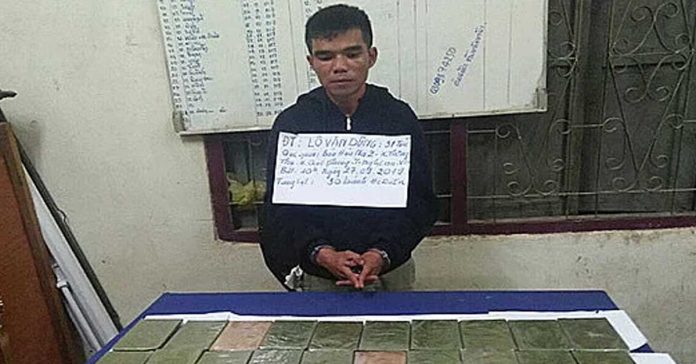
Two people, including one Lao citizen, have been arrested in Houaphan Province for smuggling heroin from Laos to Vietnam.
Vietnamese police arrested Lo Van Dung, a Vietnamese national, last Friday in the Vietnam-Laos border province for transporting 9.9 kilograms of heroin from the Lao province to the central Vietnam province of Thanh Hoa, VnExpress reported.
As a part of the investigation, the police also tracked down a Lao citizen Thao Dia Tho the next day possessing 660 grams of heroin.
The Lao authorities will handle the seized drugs.
“Vietnam is a key trafficking hub for drugs from the Golden Triangle, an intersection of Laos, Thailand and Myanmar, which is the world’s second-largest drug-producing area after the Golden Crescent in South Asia,” VnExpress explained.
Laos has beefed up its efforts to tackle illegal drug trade in recent years.
In June 2017, marking the 30th anniversary of the International Day against Drug Abuse and Illicit Trafficking, Prime Minister Thongloun Sisoulith stressed that the illegal activities must be suppressed and outlined several measures to tackle the issue.
In particular, the PM explicitly informed all party committees and authorities at all levels and sectors to consider drug prevention, control and solution efforts as their obligation and duty.
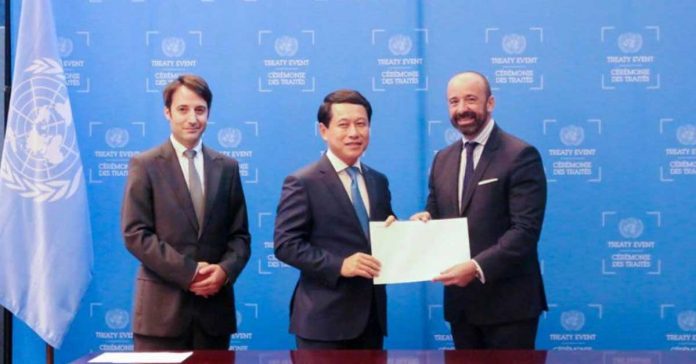
Laos has become a party to two more United Nations treaties, namely the United Nations Convention on Contracts for International Sales of Goods (CISG) and the Treaty on the Prohibition of Nuclear Weapons (TPNW).
The term “party” refers to a state that gives its explicit consent to be bound by the treaty. A party is legally bound by the provisions within the treaty and generally accepts all the treaty’s obligations, subject to legitimate reservations, understandings, and declarations.
CISG
The Lao Minister of Foreign Affairs Mr Saleumxay Kommasith on September 26 presented the letter from the government to the Under-Secretary-General for Legal Affairs and United Nations Legal Counsel, Mr Miguel de Serpa Soares, confirming Laos’ membership of CISG, Vientiane Time reported.
CISG is a treaty that codifies uniform international sales law. One of the main advantages of the convention is that it minimizes the risk of unfair treatment at the hands of trading partners because all treaty members must use the same international legal standards.
It has been ratified by 92 states, which account for a significant proportion of world trade, making it one of the most successful international uniform laws. Laos was the most recent state to adopt the convention.
TPNW
In addition, Mr Saleumxay presented Mr Miguel de Serpa Soares with the government’s ratification of TPNW, Vientiane Times added.
TPNW, or the Nuclear Weapon Ban Treaty, is the first legally binding international agreement to prohibit nuclear weapons comprehensively. The main goal of the treaty is to ban member states from developing, trialling, processing, collecting and accommodating nuclear weapons.
In order to come into effect, signature and ratification by at least 50 countries are required. So far, 79 countries have signed the treaty, and 32 countries have ratified it.
“The Lao government’s decision demonstrates its commitment to free the world from nuclear weapons as well as support the international community to ban and eliminate nuclear weapons, which pose a serious threat to all mankind,” Vientiane Times noted.
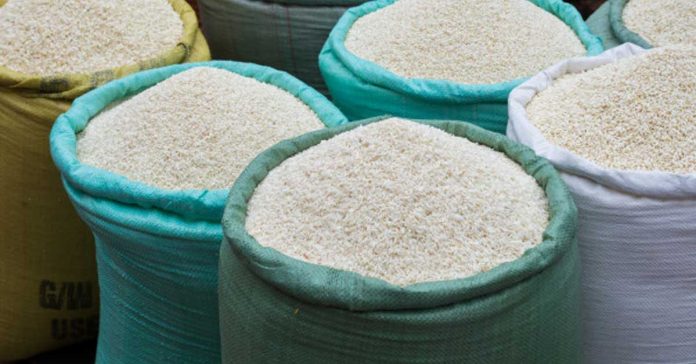
The Lao government has decided to release stockpiled rice to stabilize the market price amid a shortage of rice supply due to the impact of floods.
Rice prices began to soar in June as a series of floods affected many areas of the country, especially the country’s central and southern provinces, resulting in farmers stockpiling rice for their own consumption.
The price of rice rose by more than 20 percent above the normal rate, according to a report by Vientiane Times.
Accordingly, the Vientiane Industry and Commerce Department has directed Kamphaeng Phet Chaengsavang Agriculture Promotion to sell 2,000 tons of rice after the government and the company signed a contract to that effect.
Polished Grade B sticky rice is on sale for LAK 6,500 per kg, from September 23-30, LAK 2,000 per kg less than the current market price, a total of five locations in Vientiane, namely the Talat Xaoban Sa-ard, the Vientiane Foodstuff State Enterprise, the Lao-ITECC, the Aussie Lao fresh market, and the Ms Chanpheng rice mill.
The Lao government releases stockpiled rice every year when the market price is unstable.
The rice supply shortage has affected the country’s export capabilities despite high overseas demand.
Laos hopes to export 50,000 ton of polished rice to China under an agreement between the two countries, but Lao rice exporters might be unable to meet the target due to the impact of the floods.
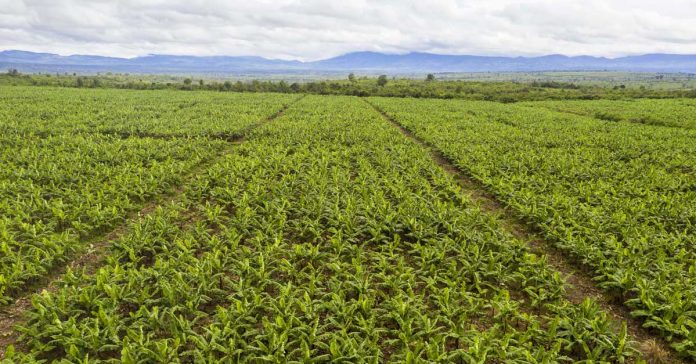
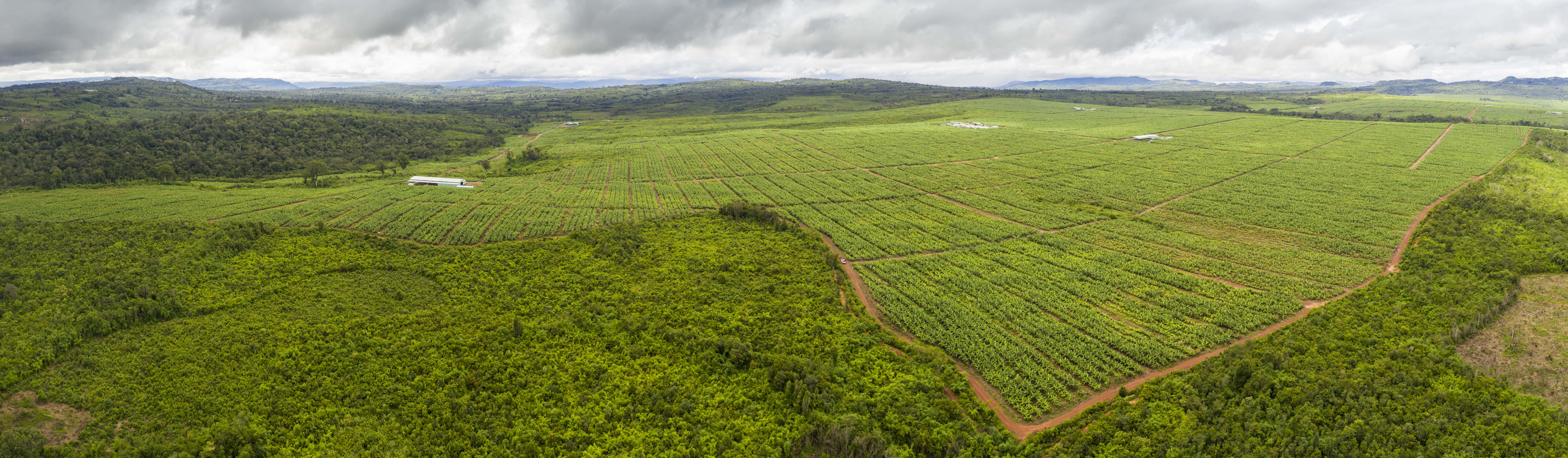
In Meuang Nong, banana plants sprawl as far as the eye can see, leafy and vibrant green, until they meet with the wild shrubbery of surrounding mountains.
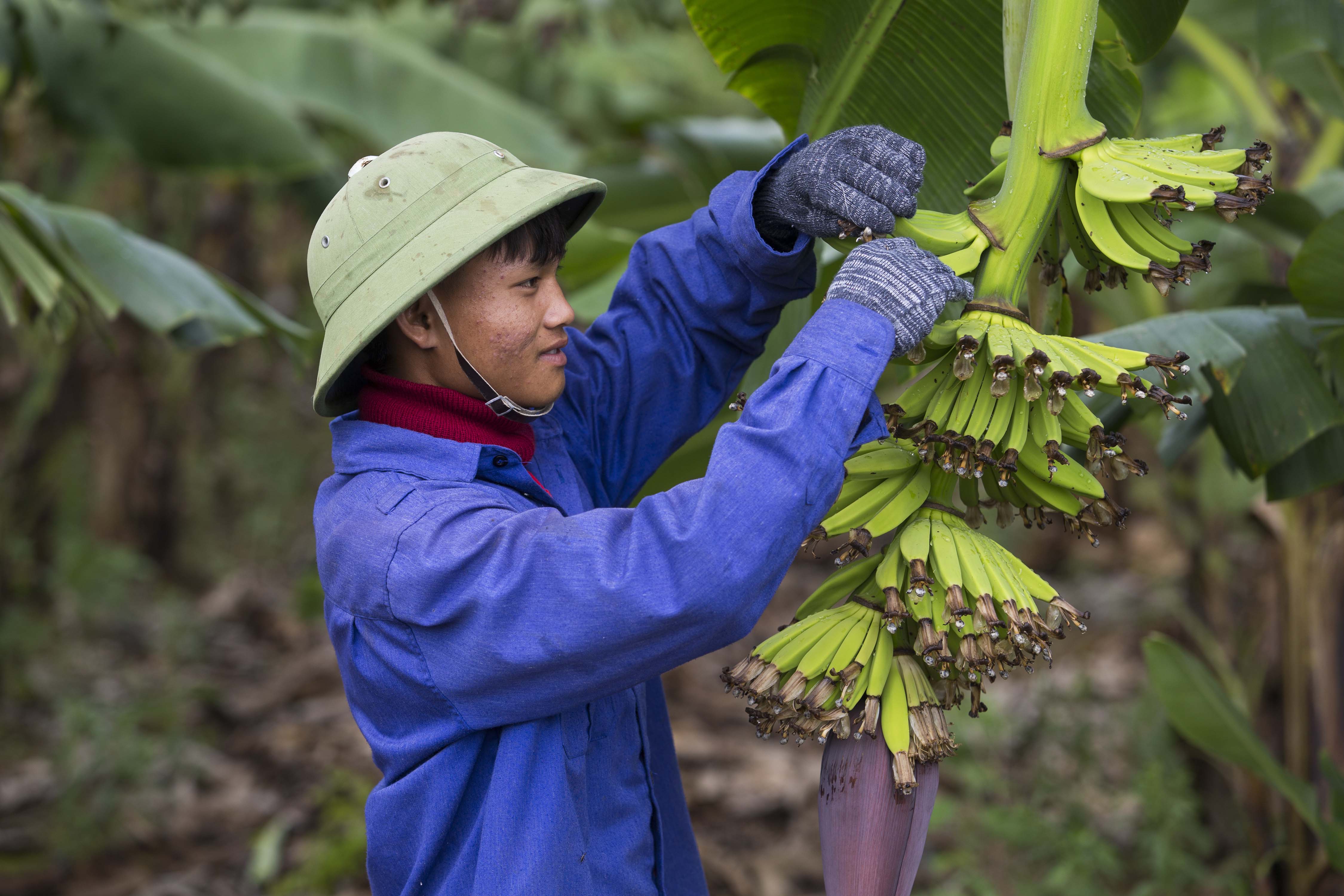
In the fields, one planter gingerly inspects a comb while another diligently takes notes, recording the quality and growth of plants. Along with a crew of several other farmers, they make their way across dozens of rows.
The banana plantation is an investment by Souk Houng Heang Company, whose goal is to create environmentally friendly and sustainable farms, using modern technology in production, as well as harvesting the silkiest, most flavorful bananas possible. Souk Houng Heang works in cooperation with Nafoods Group, a worldwide agricultural producer and exporter from Vietnam, to distribute Lao bananas to European countries and process them for other products.
“We treat our bananas how we treat the food we eat every day with our family,” says Toomkham Phoungmachan, the Lao representative of Nafoods Group.
“For us, the quality is personal, because it’s the food we eat ourselves and share with the people we love.”
Banana plantations have not always had the best reputation in Laos – and understandably, as they have historically failed their local communities. Foreign-owned banana plantations have been known for polluting water sources, killing fish and other animals, and leaving workers in poor health due to chemical exposure. In 2017, banana plantations became so hazardous to workers that the government banned the expansion of these farms outright.
Part of the mission by embarked on by Nafoods and Souk Houng Heang is to end the practice of excessive chemical use – abuse of herbicides, fertilizers, nutrients and insecticides – that cause workers to fall ill with respiratory and liver problems.
“We have worked hard to make sure that farmers will be happy and healthy, and have no issues with chemical overuse,” explains Phoungmachan. “If you don’t use the right plantation system – from the right chemicals during seeding to the proper temperature storage – this affects everyone from the banana planters to the consumers.”
Souk Houng Heang also hopes to provide safe, sustainable job opportunities to areas where many rely on work from drug trafficking and illegal wood-cutting, industries damaging both to their communities and the environment.
“We want to create a business that strengthens the community, drives the local economy, and creates secure and safe employment,” says Phoungmachan.
Despite Nafoods’ focus on supporting local communities, finding the right place for their farms hasn’t been easy. Meeting their standards requires a procedural overhaul – one many farm-owners aren’t prepared to make. From maintaining a precise temperature control during storing to the careful cataloging of plants farmers are performing today, Nafoods requires farmers to exercise an extra level of vigilance in each step of their production.
“Because we are a clean business, there are so many different things owners must comply with and change about their farms,” Phoungmachan explains. “So we are so grateful to our partners and thankful that we have finally found the right ones.”
It may be a slow, laborious process of change – but the payoff could be huge. As Phoungmachan says, “I hope one day I’ll see the Lao banana stamped safe and clean, and sold in grocery stores around the world.”
Hundreds of visitors flocked to the second Sustainable Tourism Solutions Expo (STSE) this past weekend, marking a new commitment to sustainability within the tourism and hospitality industries.
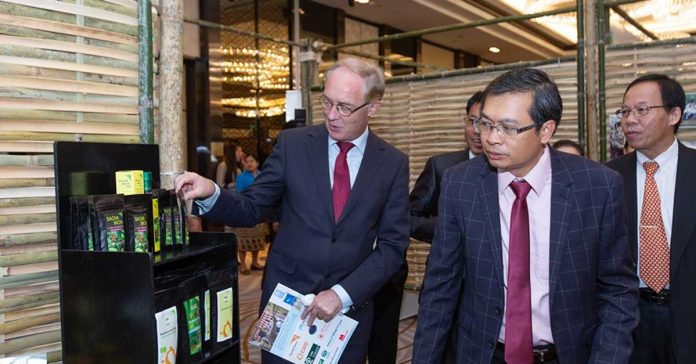
The two-day event held at the Crowne Plaza Vientiane, opened on the morning of 27 September 2019 with a ceremony presided over by Professor Dr. Bosengkham Vongdala, Minister of Information, Culture and Tourism, Mr. Ounethouang Khaophanh, Vice Minister in charge of Tourism at the Ministry of Information, Culture and Tourism, Dr. Saynakhone Inthavong, Vice Minister of Natural Resources and Environment, as well as Mr. Jens Lütkenherm, Ambassador of the Federal Republic of Germany to the Lao PDR.
“I firmly believe that this exhibition will promote the general development of tourism in the Lao PDR, especially in Vientiane Capital, on a green and sustainable path of development,” said Dr. Vongdala in his opening remarks. “It will also promote the creation of Vientiane Capital as a quality tourism destination that will become an ASEAN Clean Tourist City in the future.”
The STSE has proven itself to be the region’s leading specialized fair for the tourism industry to celebrate, explore, and exhibit the latest trends, insights, and technology in sustainable tourism and hospitality practices. This year, in handmade bamboo booths, fifty-four exhibitors from Laos and the Mekong region showcased their products, services, and initiatives over the course of event, which was free to attend. These companies represented several categories relevant to the theme at hand: eco-friendly hotel supplies, handicrafts, organic food, initiatives and projects, as well as responsible tours and accommodation.
Addressing a large crowd of business owners and managers, sustainability experts, as well as Lao government officials, the German ambassador remarked during the opening ceremony that “The tourism sector is becoming ever more important for the economy of Lao PDR. Today, it already ranks third among the export industries in this country. The Lao tourism sector has great potential to further grow and provide many more qualified jobs. In order to align the tourism industry with the overall green growth strategy, sustainable tourism solutions play a crucial role in the development of the sector.”
Feedback collected from exhibitors and visitors showed that the event was incredibly fruitful on both sides, with hundreds of new business contacts made, supplier contracts signed, and an immeasurable amount of information exchanged.
The second Sustainable Tourism Solutions Expo was organized by the Ministry of Information, Culture, and Tourism, with support from the Ministry of Natural Resources and Environment, the Lao Association of Travel Agents (LATA), the Lao Hotel and Restaurant Association (LHRA), the Small and Medium Enterprises Service Centre (SSC) operated by the Lao National Chamber of Commerce and Industry and the Department of Small and Medium Enterprise Promotion (Ministry of Industry and Commerce) and the Regional Economic Integration of Laos into ASEAN – Trade and Entrepreneurship Development (RELATED) Project of the German Development Cooperation.