While Laos may not top the list of travel destinations for Tinseltown’s most famous, several Hollywood stars have taken time out from their busy schedules to visit.
Tourism to Laos is growing steadily, with the country being named in top travel lists from Architectural Digest to the New York Times, and capturing the hearts of some well-known celebs, such as the late Anthony Bourdain, or celebrity chef, Gordon Ramsey. As the country’s profile grows, more A-listers are sure to visit!
Here are five Hollywood Stars who have visited Laos:
Harrison Ford
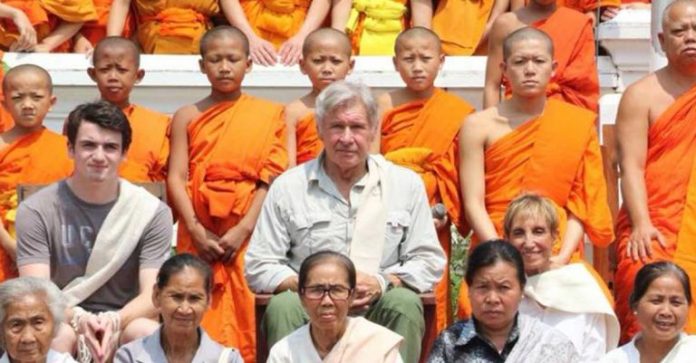
Harrison Ford, famous for his roles in the Star Wars and Indiana Jones franchises, visited Luang Prabang as part of a tour of the region in April 2018. His wife, actress Calista Flockhart of Ally McBeal fame, and their son Liam joined in visits to temples and museums.
The actor madee merit at Pha O temple, meeting with Sathou Onekeo Sittivong, the abbot of Wat Xieng Thong and Head of the Luang Prabang Buddhist Fellowship.
Jude Law & Sienna Miller
This Hollywood couple visited Laos in August 2010, choosing Luang Prabang as the location of choice for their low-key wedding. The couple chose a traditional baci ceremony to literally tie the knot, including blessings by monks and a post-ceremony feast.
Anthony Edwards
Anthony Edwards, widely known for his role as Dr. Mark Greene in the hit medical drama ER, took time off from his busy schedule to visit Luang Prabang in late 2009 as part of a trip around the world.
Michelle Rodriguez
Michelle Rodriguez, known for her role in the smash-hit franchise, The Fast and The Furious, visited Laos in late 2012, staying in Luang Prabang’s famed Amantaka Hotel. The actress sponsored an education program for children through the Big Brother Mouse publishing house.
Laos may be vulnerable after Microsoft’s decision to cease support for its Windows 7 operating system, with the latest figures showing more than 35 percent of desktop users in the country continue to use the system.
Microsoft announced it will no longer provide security updates or support for PCs with Windows 7 after January 14, 2020.
PCs will still remain functional under the old version, but it may become more vulnerable to security risks.
The news is alarming for Laos, where the outdated operating system is the second most used system.
The Windows 7 Operating System is still widely used in Laos.
According to web traffic analysis website StatCounter, among desktop users in Laos who have access to the Internet, 65.55 percent of users were using the Microsoft Windows operating system in 2019.
By version, 49.49 percent of users were using Windows 10, while 35.68 percent of users were using Windows 7.
Users for Windows 8.1 and 8 accounted for 8.11 and 3.85 percent, respectively.
Although the number does not include those who do not have access to the Internet, the number is significant enough to see the majority of desktop users in the country are vulnerable to security risks after Microsoft ends its support for Windows 7.
The American tech giant recommended users to install Windows 10 as a replacement, although it does not provide a free upgrade, which means users should purchase the new version.
However, users with a legitimately licensed copy of Windows 7 will be able to switch to Windows 10 for free by activating a digital license when installing the new version.
Internet penetration in Laos is estimated at over 2 million people.
According to certain data estimates from January 2019*, the number of internet users in Laos is somewhere between 1.26 to 2.7 million. While Google serves as the gateway to the internet for many users in western societies, the majority of local language content in Laos resides within Facebook. Sparked by the mass diffusion of affordable mobile phones and data rates, Facebook has become for many Lao, as it has for many people in developing countries, their first experience of the internet. In light of this, it is no surprise that Facebook is currently unchallenged in the social media space, taking its crown as somewhat of a mini internet for Laos.
Every day, hundreds and thousands of pictures and videos flood Facebook as both individuals and companies hungrily generate and consume content, both personal and commercial. As the social media giant’s algorithms are designed to drive the most engagement-worthy content, Lao users have responded accordingly and some have made their mark on the Facebook scene a lot more effectively than others. Models, singers, and other influencers put on their best smiles and attire and adjust their camera filters as they put on an online performance, simultaneously garnering adoration and envy. These A-list “net idols”, as they are called in Laos, have amassed huge digital followings in the process.
Posting regularly on Facebook has more often than not earned these celebrities advertising and sponsorship opportunities from big brand names. Whether it’s an energy drink or a new line of cosmetics, these net idols are purveyors of brand awareness and inspire the attention of impressionable youth and adults, evident in the sheer number of their followers which hover in the hundreds of thousands and some in the millions. Here’s a look at the most followed Lao Facebook celebrities.
Undeniably the most famous Laos-based foreign online celebrity, Somchan became a super social media phenomenon when he posted his legendary “Falang Bo Ho Nyang Leuy Va” video in which he recounts a hilarious encounter with a vendor in Luang Prabang. His fluent use of Lao, with his iconic Luang Prabang accent in particular, has won the adoration of thousands.
Upon winning the 2011 Miss Laos Pageant, Louknum became an instant social media celebrity for her beauty. After excelling at modeling and appearing on multiple magazine covers, Louknum made her debut in the acting industry in both Lao and Thai films. Her adorableness and sex appeal have caught the attention of big brands like Samsung, foodpanda, and Nam Kat Yorlapa.
As the owner and admin of Laos’ most followed Facebook Page, Una Studio, Ther Una hails from the country’s most populous province, Savannakhet, and is of Phu Tai ethnic origin. Ther Una is known for the witty and subtle humor that permeates all of his social commentary videos on Facebook and YouTube.
This Savannakhet native rose to the scene for her fresh look and dazzlingly sexy selfies on Facebook. She has appeared in many music videos and recently in a very popular movie, Huk Mayom Mayem, directed by Jear Pacific.
Super famous half-Bulgarian, half-Lao singer, actress, model, and entrepreneur Alexandra Bounxouei was born to a family with music in their blood. Often referred to as “Sandra,” this gifted girl was among the first musicians in Laos to truly go international, making waves and acquiring fans in Thailand, Australia, Japan, Europe, and America. Alexandra was the first Lao actress to star in a modern-day Thai soap opera, Rim Fung Kong, alongside Thai celebrity Sukollawat “Weir” Kanarot. Since then, she’s appeared on stage singing both Lao, Thai, Japanese and English songs, representing Laos at countless high profile national and international events.
This Savannakhet native was one of the first social media accounts to be granted a blue verification check from Facebook. Famous for her completely authentic, unfiltered, and raw posts and videos, Larnoy manages a gold/jewelry shop and often posts about her family and shop clients.
Multitalented singer, model, and businesswoman Annita Thivaphone is one of the original Lao fashion celebrities. She’s appeared on numerous magazine covers and released a number of hit singles like Sexy Boy and Bod Hien Laka Pheng. She’s also been the product ambassador for international brands like Coca Cola and Huawei. Annita’s family is the owner of Viengkham Jewelry.
Apple has been having an illustrious celebrity career in show business in Thailand and quickly rose to be among the country’s top celebrities amassing both Thai and Lao followers. She is married to Thai star Fluke Jira of the band C-Quint, with whom she has a child.
Noony rose to fame appearing as a contestant in Thailand’s hit dating television show Take Me Out Thailand, in which she won the hearts of viewers and the show’s bachelor protagonist, Aoff, with her witty use of the Lao language. The predominantly Thai audience was delightfully impressed, and so was Aoff. The two are now married, becoming one of the few couples from the show to have a viable relationship. Since then, Noony has received numerous product ambassador deals for several brands, even co-hosting the television show, The Price is Right Thailand, iconically exchanging banter in Lao with the Thai-speaking host.
Last year, the Laotian Times reported that Boualai had the most followers on Facebook in Laos with a little over 600,000 followers. Since then, his following has almost doubled in size. Boualai has been able to reign supreme in the social media sphere by posting candid videos of himself unabashedly eating in the most mouthwatering manner imaginable. The food dishes that he himself prepares and eats in his videos are gloriously delicious – oftentimes seasonally exotic – sour, unripe mango and tamarind dipped in sweet and salty fish sauce, spicy larb with live ants and eggs, long bean salad, grilled frog and squid, dried fish, boiled clams, blue crab, and many more. His extremely popular videos, which are typically set in his Paksé home or in a scenic location where he is seen with his latest wild catch, showcases the humble lifestyle of farmers and foragers in rural Laos. As a result of his mass following, he has received many corporate deals, the latest of which is Oishi.
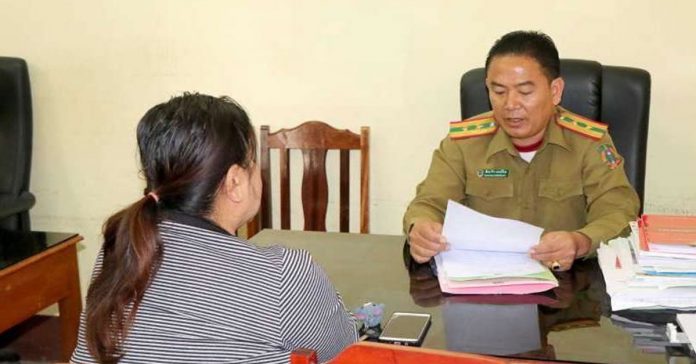
The Khammouane Police Division For Human Trafficking Prevention has imposed a LAK 9,000,000 (USD1,008) fine on a woman found guilty of online slander and defamation. She has also been obligated to undergo reeducation.
Lieutenant Colonel Kuanjai Ketvilay, Director General of the Human Trafficking Prevention Division of Khammouane, reported that 29-year-old Phetvilay had accused Thaengkham of maliciously slandering her on Facebook by posting her pictures accompanied by defamatory language.
According to a report in Lao Security News, Thaengkham, 45, confessed that she was motivated to post out of anger at the plaintiff for not paying back money that she was owed, in the amount of THB 91,300 (approximately USD 3,000). Phetvilay had already been instructed to pay back the money owed to Thaengkham in another civil court order. Apparently not satisfied with the court order, Thaengkham took matters into her own hands by publicizing the case online out of sheer frustration. It is not clear whether the debt has been paid.
Nevertheless, the fine is to be paid to Phetvilay to ease her emotional distress as a result of online public humiliation.
Comments on social media were mixed with many sympathizing on behalf of Thaengkham and decrying the fine while others expressed support for lawful protection against online slander.
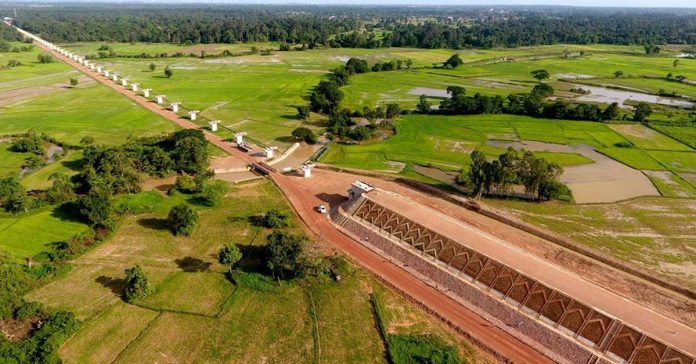
Laos and China have commenced the country’s first build-operate-transfer power grid project for the China-Laos railway.
The project, running along the China-Laos railway through five provincial administrative regions in northern Laos, will build 20 circuits of 115kV transmission lines with a total length of 268 km and extend 11 bays in 10 substations, according to Xinhua News Agency.
It is designed to supply power from Electricite du Laos (EDL)’s grid to 10 railway traction substations.
Laos-China Power Investment Company, co-sponsored by China Southern Power Grid (CSG) and the EDL, was established in November in Vientiane to invest, construct and operate the power supply project.
Xinhua quoted the CSG as saying that the project is required to be completed by the end of March 2021 to guarantee the scheduled operation of the China-Laos railway in December of the same year.
The China-Laos Railway is a strategic docking project between the China-proposed Belt and Road Initiative and Laos’ strategy to convert itself from a landlocked country to a land-linked hub.
The 414.332-km railway, with 198-km tunnels and 62-km bridges, will run from Boten border gate in northern Laos, bordering China, to Vientiane with an operating speed of 160 km per hour.
The Chinese government subsidize 70 percent of the cost of the railway, while Laos pays for the remaining 30 percent with loans from Chinese financial institutions.
In March, it was reported that the construction was almost half complete, putting it on schedule to begin service in December 2021.
The National University of Laos (NUoL) is to develop e-learning content with help from a South Korean university.
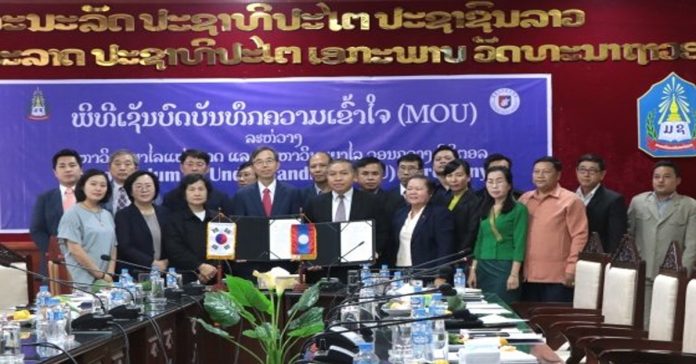
NUoL and Wonkwang Digital University signed a memorandum of understanding last week and agreed to jointly develop e-learning content, nurture necessary talent, and conduct joint research in various areas.
The university was chosen by the South Korean government in 2016 as a member university for the government’s project to promote distance learning in Southeast Asia.
Since then, the South Korean university has worked closely with NUoL through exchanges in talent and knowledge for online education.
Actor Paul Walker’s daughter, Meadow Walker, has announced plans to build a school in rural Laos after a round of fundraising.
Meadow Walker has been raising funds for the Pencils of Promise Foundation, a New York-based charity that raises funds for education, health and sanitation, and infrastructure projects for disadvantaged communities in developing countries.
The late Paul Walker, who played Brian O’Conner in the hit franchise, The Fast and the Furious, was known for his philanthropic efforts prior to his death in 2013. The actor formed Reach Out Worldwide in 2010, a foundation dedicated to providing relief for countries struck by natural disasters.
Daughter Meadow Walker, now 21 years old, has inherited this humanitarian quality. She recently announced plans to build a school in Laos with Pencils of Promise via a post to her Instagram account, sharing photos of smiling children at a school.
Her image was captioned, ‘today, I am launching a campaign with @pencilsofpromise to build a school. This is the season of giving and my biggest wish is to provide a space for these children to learn.
‘Everyone deserves a good education. We are dedicating this school to my dad, Paul Walker.’
View this post on Instagram
https://www.instagram.com/p/B5_kWv2JBRd/
According to Meadow’s fundraising page, she has already raised $19,170 of the required $50,000.
Pencils of Promise has already constructed 518 schools in Ghana, Guatemala and Laos, accommodating 108,000 students.
Lao national baseball team has won in the latest friendly matches held in Vietnam.
The Lao team participated in matches with Vietnam National University and Korean International School in Hanoi on December 27 and 28, respectively.
The team scored 14-10 victory against Vietnam National University and beat Korean International School at the score of 17-6.
The matches were sponsored by two South Korean firms, namely NH Nonghyup and KL Global.
Laos saw its first baseball team formed in 2013 and participated in the 2018 Asian Games, the first time that the country dispatched its baseball team to an international match.
The team is currently led by Kwon Young-jin, a former coach and supervisor at South Korea’s Daegu High School baseball team.
The country formed a government-backed baseball federation in 2018 and began in April this year to build its first baseball stadium in Vientiane.