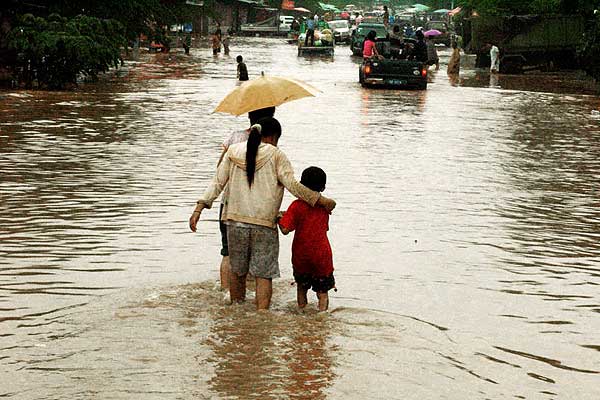
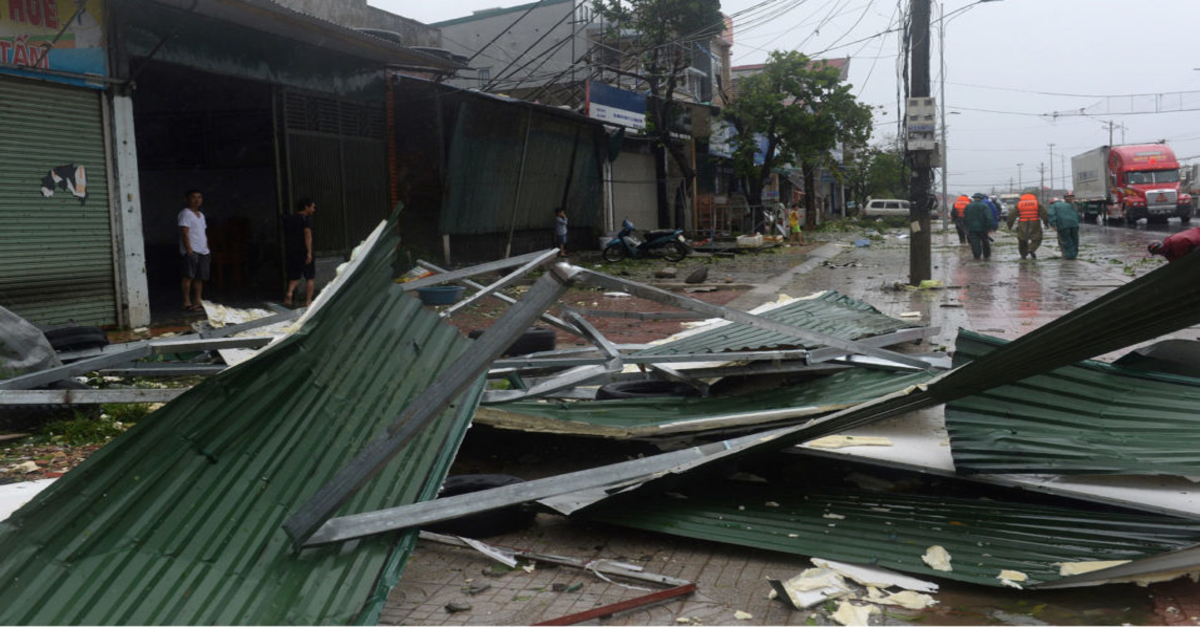
Though tropical storm Doksuri has since dissipated since making landfall on September 15th, villagers in Khammuan province are still dealing with the aftermath of it’s destruction.
According to Khammuan authorities, floodwaters have submerged six districts of the province after Doksuri tore through last week, with many of its villages still immersed in water.
The affected districts are said to be Bualapha, Xaybuathong, Yommalath, Nongbok, Mahaxay and Xebangfay.
Mr Phonevisith Khounbolom, head of the Khammuan provincial Disaster Management Division, reported that though the Xaybuathong district has yet to submit any reports detailing losses, it has been confirmed that the Bualapha district has 28 villages that are still dealing with flood damages. Over 20 houses have been damaged, with sections of several villages still under water.
According to an official from the province’s Natural Resources and Environment office, the storm battered the Vilabouly, Xepon and Nong districts in Savannakhet, however were mildly affected due to the excess rainwater receding.
A report from the provincial governor stated that almost 7,000 families in 72 villages of the Vilabouly district were affected by the storm. Over 40 electricity poles and fifteen houses were left mangled, while other buildings sustained severe structural damages.
The affected area includes 1,000 hectares of rice fields, 30-40 hectares of rubber trees, farmland and numerous livestock.
Storm Doksuri passed through the provinces of Khammuan, Borikhamxay and Savannakhet, according to the Meteorology and Hydrology Department of the Ministry of Natural Resources and Environment.
District authorities are prioritizing the repair of public facilities, electricity grids and homes.
Doksuri crossed parts of Vietnam and Laos from September 15 to 17, affecting many parts of the country and damaging many hectares of farmland.
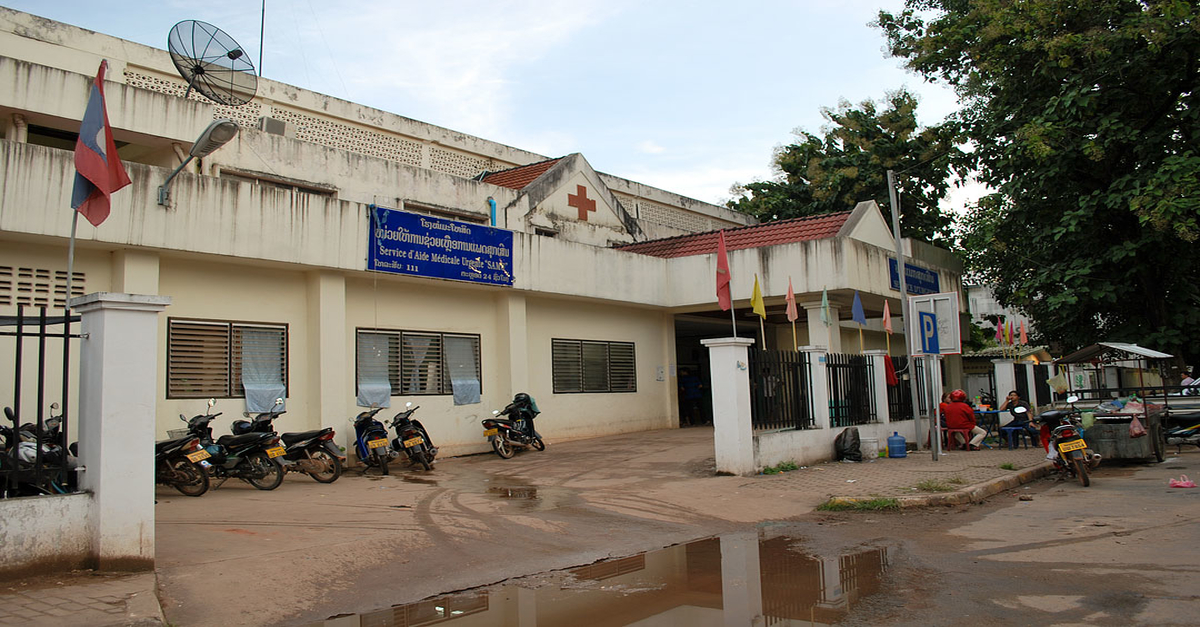
With expenses being backed by the Chinese government, the century-old Mahosot Hospital will be completely rebuilt starting the end of this year, with a completion date set for 2022.
Built in 1910, Mahosot Hospital was the first facility of its kind in the country and was run by French doctors.
Acting Director General of the Department of Healthcare, Ministry of Health, Associate Prof. Dr Bounnak Saysanasongkham, stated that the new facility will be four or five storeys high and will operate in line with international standards after it has been completed.
He also added, “We hope it will encourage more people to seek treatment in Laos instead of crossing the border to neighboring countries.”
Thus far, surveys for phases I and II of the project have been completed and the necessary information has been collected to draw up plans, with health officials preparing to present the surveys to the health ministry and the government soon.
In addition to building the new hospital, the Chinese government will also provide modern medical equipment for all the wards and will assist in staff training.
Assoc. Prof. Dr Bounnak said the hospital employs experienced and skilled doctors and nurses who have trained abroad, however it can be difficult for them to be effective when equipment is outdated.
The hospital will be fitted with modern equipment for use in general diagnostics, radiology and magnetic resonance imaging (MRI) and other fields of specialization.
The facility will continue to upgrade staff’s skills in endoscopic surgery, cardiology, hypertension and cancer. Free treatment will continue to be provided to families who cannot afford medical care, in an effort to ensure everyone has access to proper healthcare.
Currently, Mahosot consists of 31 wards and employs more than 700 medical staff, all of whom are Lao nationals. Approximately 800-1,000 patients check in to the outpatient ward daily, with 200-300 staying overnight.
The upgraded facility will have 600 beds, replacing the current 450-bed hospital, with some units over a hundred years old.
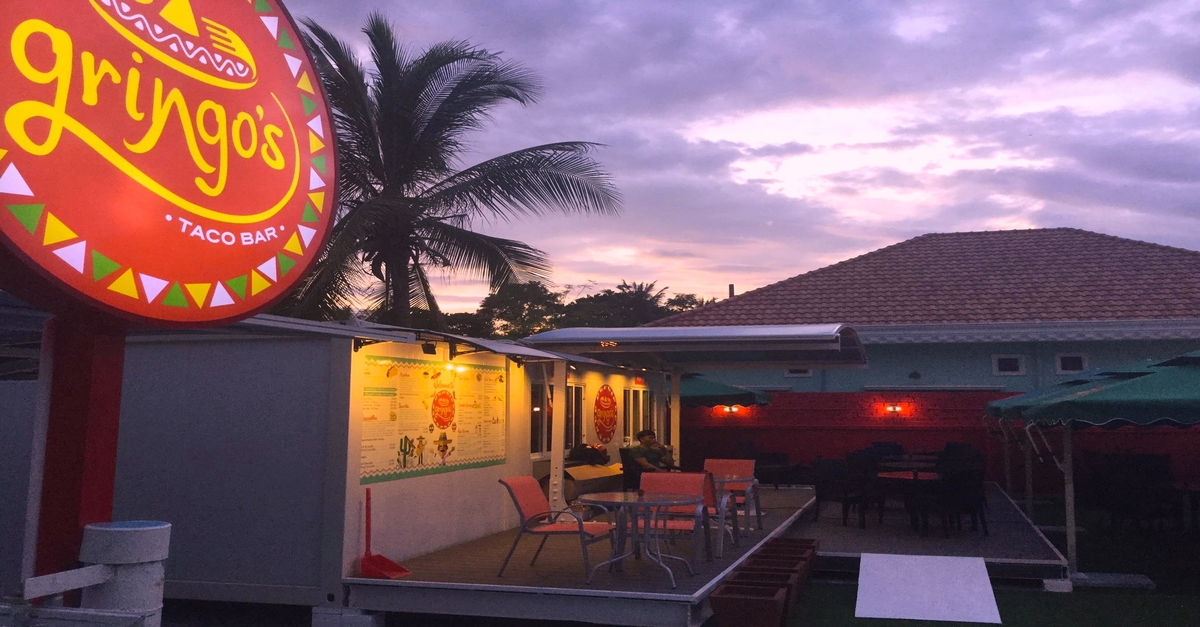
Gringo’s Taco Bar is probably the closest one can get to the Mexican border without having to catch a plane and fly half way around the world.
Tucked down an alley on Sokpalaung Road, this outdoor taco cart is a welcoming sight for those who have experienced MFD (Mexican food deprivation) while in Vientiane. With a decent sized menu serving up classic tacos, quesadillas, burritos, nachos and taco salad, all which are available in a vegetarian option, the fresh ingredients and cold cervezas (frozen margaritas, if you’re fancy) will have your tastebuds jumping for joy.
My quesadilla was in front of me 7 minutes after ordering. It was perfectly toasted on the outside, and filled with seasoned beef (chicken,pork or veggie is possible), cheddar cheese, caramelized onions and roasted bell peppers. The taco salad came in a crispy tortilla bowl, with generous portions of meat, shredded lettuce, diced tomato, black beans, cheddar cheese, and fresh corn topped with a light ranch dressing. The salsa was fresh, the margaritas were frozen (and incredibly boozy), we all left fatter and happier.
As an added bonus, Gringo’s has a padded, indoor, air-conditioned kid’s play area (honestly, why doesn’t every restaurant have a place for kids to run amok while mom and dad have a chance to enjoy their food) on site that gives customers just one more reason to love the place.
If sitting outdoors is not the most ideal situation for you, especially during the rainy season, Gringo’s offers its own delivery service, so make sure to register the next time you are passing by. They have several wait staff that speak English and the service is fast, friendly and efficient.
Though Gringo’s has a very basic menu that excludes cult favorites like enchiladas, tamales or empanadas, what they do offer, they execute well.
Gringo’s Patio Seating
Gringo’s Menu
Soft Tacos and Taco Salad
Beef Quesadilla
Kid’s Indoor Play Area
Frozen Margarita comes strong!
After suffering from MFD for longer than I can remember, I can honestly say that the void of Mexican food in Vientiane has been filled.
Gringo’s Taco Bar is open 6 days a week, Mon-Fri 11am-2pm and 4pm-9pm and Saturday’s all day from 11am-9pm. They are located on Sokpaluang Rd, Hom 9.
Laosat DTH, a local satellite service provider, has struck a deal with BBC Worldwide Asia that will now offer Lao viewers access to BBC World News, BBC Earth and CBeebies for the first time.
The channels, which will air on Laosat DTH, will be available in all 17 provinces, giving audiences access to programmes such as Blue Planet II, right after their UK broadcast.
Senior VP of South and South-East Asia for BBC Worldwide, Myleeta Aga said, “The pay TV market is set for high growth in the next few years,” and “with our partnership with Laosat DTH, we are very pleased to be part of that growth, bringing our genre-defining content to viewers there.”
The general manager of Laosat stated that there is a “strong demand for BBC content in Laos” and that the addition of the new channels would give viewers “the best British and international content.”
For more information on how to get Laosat services in your home visit their Facebook page here.
2017 has shaped up to be an unprecedented year of firsts for Laos. With the country sending its first ever participant to compete in the Miss Universe Pageant, to its first ever film submission to the Academy Awards.
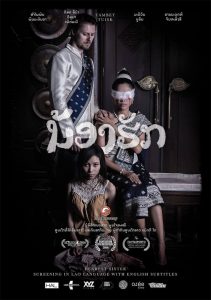
In the country’s first-ever Oscars submission, Laos has selected Mattie Do’s film Dearest Sister as its official entry for best foreign-language film at the 90th Academy Awards.
The thriller, which was selected to attend the 2014 Cannes Film Festival as part its La Fabrique des Cinémas du Monde program and had its world premiere at Austin’s Fantastic Fest in September 2016, follows Nok, an impoverished young woman who moves from her rural village to Vientiane to take care of her cousin Ana, a wealthy woman married to an Estonian expatriate. Ana is gradually losing her sight and simultaneously seeing ghosts that communicate to her a mysterious message of numbers–numbers that Nok eventually uses to win the lottery.
Dearest Sister–which is a co-production of Laos (Lao Art Media), France (Screen Division), Estonia (Oree Films)–comes as Do’s second title and the second-ever Lao horror film, with her directorial debut Chanthaly being the first. Do is also the first female director of a Lao feature film.
Movie Poster for Dearest Sister
That this is the first year Laos will send a film to the Academy of Motion Picture Arts and Sciences (AMPAS) demonstrates how young the country’s film industry is. Making films in a country where the film industry is still underdeveloped has its difficulties, according to Do.
“The greatest challenge of making a film in Laos is having to work with no resources, hardly any budget, and almost no professional infrastructure for films,” said Do.
However, following the relatively untrodden path of being a filmmaker in Laos has its upsides, too.
“The benefits of working in a new environment like Laos without pre-existing structure is actually that everything I make is new,” said Do. “Because there aren’t any locked expectations about what a Lao film should be, I have the freedom to create something completely unique that hasn’t existed before.”
Do’s film was selected by the Lao PDR’s newly formed AMPAS Selection Committee, comprised of six professionals, all Lao nationals, from the Lao film and media industries. The committee was facilitated by the Luang Prabang Film Festival, a celebration of Southeast Asian cinema held annually in Luang Prabang, the nation’s cultural capital and a UNESCO World Heritage Site. This year’s main event will take place 8-13 December 2017, and will showcase 32 feature films and several programs of shorts for over 22,000 attendees.
Luang Prabang Film Festival Board Member and Indochina Productions Founding Partner and Executive Producer, Nicholas Simon, says the Luang Prabang Film Festival formed the committee as part of the project’s mission to promote Lao film on the world stage.
“We wanted Laos to be represented in the foreign-language entries along with the rest of the world’s countries,” said Simon. “While the Lao film industry is still in its infancy, there are Lao films that deserve the Academy’s consideration. And the knowledge that a Lao film could be considered for an Oscar will only serve to improve Lao filmmaking and encourage more production.”
Director of the Lao government’s Department of Cinema, Vithoun Sundara, also sees the significance that the new Oscar eligibility will have for Lao filmmakers.
“Dearest Sister competing for Best Foreign Language Film is a wonderful development for the Lao film industry,” said Sundara. “The possibility of being considered for an Academy Award along with films from the other participating countries will surely inspire and motivate Lao filmmakers in the years to come.”
Lao actress Tot Lina plays blind character who hears voices from the other side
Dearest Sister (Nong Hak) has already caught the attention of film festivals and publications worldwide, gaining recognition from The Hollywood Reporter, Wired, ScreenDaily, and Champa Meuanglao while touting an impressive 90% critic’s rating on Rotten Tomatoes.
The Academy Awards are scheduled to take place on Sunday, March 4th, 2018.
You can support the film by buying or renting on the US iTunes Store, or on AMC’s Shudder streaming.
Hailed as Vietnam’s ‘most powerful storm in a decade’, Tropical Typhoon Doksuri made landfall in Central Vietnam today Friday, September 15th, leaving 4 dead and 10 injured.
The cyclone touched down in Ha Tinh province, with maximum sustained winds of 135 kilometers per hour, and wind gusts reaching up to 185 kph. As Typhoon Doksuri causes extensive damage throughout Vietnam and Thailand, hundreds of thousands of civilians have been ordered to evacuate their homes, and have been relocated to higher ground.
According to meteorology reports, while Laos will not have to endure the brunt of the tropical storm, it is said to expect heavy rainfall. Several embassies have sent out warnings to their citizens, instructing them to take safety precautions as unpredictable weather may cause widespread flooding, landslides and other travel disruptions. Several eyewitnesses have reported seeing trees being uprooted and power lines torn to the ground.
The Thai Meteorology Departmenthas reported that the wind waves in the Andaman Sea and the upper Gulf will gain traction and produce waves up to 2-3 meters high from 15-18 September.
Doksuri swept through the Philippines on Tuesday as a less powerful tropical depression, killing four people and leaving another six missing.
Though the Minister of Planning and Investment, Dr Souphan Keomixay, has recently acknowledged that the demand for national development in the country is on the rise, new project proposals for 2018 submitted by State sectors and authorities threaten to plunge the country into further debt.
To avoid accruing unnecessary mounting debt, government officials have requested for all State organizations and provincial authorities to propose only essential projects which are vital for the development of their sectors.
Vientiane authorities and the provinces have been directed to prioritize state investment projects in response to the demand for national development and poverty reduction of local people.
Concerns have been raised about provincial projects reporting figures and costs that have been inflated in an attempt to extract additional funds from the government.
Critics scrutinize that many of these projects are unnecessary and offer poor value for money and are only submitted in the anticipation of receiving more funds.
As of August this year, 16 ministries/ministry equivalent organizations and five provinces submitted 1,095 project proposals to the Ministry of Planning and Investment, totaling more than 7.93 trillion kip (over 950 million USD).
Meanwhile, the Ministry of Planning and Investment has instructed all sectors to submit their proposals and funding requests by this month in order for projects to be presented to the next National Assembly session in October.
Failure to submit proposals on time could delay project implementation, as only those approved by the parliament will be granted permission to proceed when the new year begins.
In previous years, officials approved an abundance of projects related to the construction of new public offices, roads, bridges, irrigation systems and power transmission lines.
Dr Souphan recommends for State sectors to diversify projects into other areas, while utilizing the existing budgets to complete current infrastructure projects.
In regards to technical development, the government has instructed State sectors to ensure that projects avoid overlapping one another. Critics have added that the thorough inspection of State investment projects is critical, given that numerous construction projects have previously overspent on their budgets exponentially.
The National Assembly approved over 5.46 trillion kip for State investment projects in 2017. Of the total figure, 3.3 trillion kip is sourced from the State budget to carry out 6,497 projects.
From January to June of this year, 3,592 projects worth over 1.78 trillion kip have been completely implemented, equating to 32.6 percent of the yearly plan.
The government will allocate 3.8 trillion kip which will be sourced from the State budget to carry out development projects in 2018. In addition, the government will source another 9.09 trillion kip from Official Development Assistance (ODA) to carry out projects to boost economic growth to at least 7 percent next year.
The Luang Prabang Film Festival (LPFF) has announced that it is looking for applicants for its 2017 Talent Lab for Southeast Asian filmmakers, to be led by Tribeca Film Institute® (TFI). The Lab, which will focus on grant writing and project pitching, will be held during the opening weekend of the eighth annual festival, which will take place 8-13 December 2017.
LPFF is a yearly celebration of Southeast Asian cinema held in Luang Prabang, a UNESCO World Heritage town in northern Laos that lacks a working movie theater. With inclusivity as core to its mission, all festival events are free and open to the public.
Building off the first iteration of this Talent Lab in 2016, this year’s Lab will be expanded to two days, and include a pitching workshop and pitch forum with feedback from a panel of film professionals. A jury will select one project from the forum to attend the TFI Network market at the 2018 Tribeca Film Festival® (18-29 April 2018).
Hosted annually by TFI, the industry market gives filmmakers the opportunity to build connections with a wide range of industry insiders who can potentially help them advance their projects.
TFI will then mentor the winning filmmaker or filmmaking team through the completion of the project. All participants in the Talent Lab will also receive preferential consideration for any of TFI’s grants.
In addition to the opportunity to attend TFI Network, participating filmmakers will have the chance to win a financial award to produce their film. Through the Aurora Producing Award, Singapore-based media investment firm Aurora Media Holdings will contribute $10,000 to one film project.
Founded by Justin Deimen, Terence Kong, and Jeremy Sim, Aurora Media is one of Southeast Asia’s leading media and entertainment asset incubation, investment and management specialists.
“We’re looking at the Talent Lab to bring new voices and vision to the filmmaking landscape in the region,” says Deimen, Group Managing Partner at Aurora Media Holdings. “Stories that challenge perceptions, yet with strong commercial leanings and an artistic core always interest us. Our hope is that we can support and create frameworks that will develop and grow this ecosystem.”
The 2016 Talent Lab had 10 participating film projects from 8 Southeast Asian countries and was led by TFI’s Manager of Artist Programs, Bryce Norbitz. At the end of the project pitching sessions, the Filipino documentary project BEASTMODE was selected to attend the 2017 TFI Network market, where their production team built connections and, later, signed with an American producer.
After a successful 2016 Talent Lab, Tribeca’s renewed involvement demonstrates their commitment to fostering the growth of the region’s film industries.
“We are honored to return to the Luang Prabang Film Festival for the second year in a row to support such talented and unique filmmakers from Southeast Asia, especially given the lack of US support to filmmakers from the region,” said Molly O’Keefe, Senior Director of Artist Programs at Tribeca Film Institute. “As part of our year-round work erasing barriers of entry to the industry for underrepresented filmmakers, we are excited to support another LPFF project this year by bringing its filmmakers to our TFI Network market to meet with members of the US and international industry.”
To read more about the 2017 LPFF Talent Lab, access the Call for Applications here.