Home Blog Page 1027

Casa Minerals Inc Announces Closing of Oversubscribed Private Placement, and Retains European Marketing Firm for Investor Awareness Services

Vancouver, British Columbia – Newsfile Corp. – February 11, 2026 – Casa Minerals Inc. (TSXV: CASA) (OTCQB: CASXF) (FSE: 0CM) (the “Company” or “Casa”), is pleased to announce closing of the final tranche of its previously announced non-brokered private placement (the “Offering”). The Company has closed a total of 2,635,000 units (each, a “Unit”) at a price of $0.125 per unit for gross proceeds of up to $329,375.00 in this tranche, which would be a grand total of 7,552,000 units (each, a “Unit”) for a gross proceed of $944,000 for the announced financing.

Each Unit consists of one common share of the Company (a “Share”) and one common share purchase warrant (each full warrant, a “Warrant”). Each of the 2,635,000 Warrants entitles the holder to acquire one additional share for a period of two years. The warrant exercise strike price is $0.15/share in the first three months and automatically converts to $0.20 per share then after for the remainder of the two years period.

All issued Securities will be subject to a 4-month and one day hold-period, during which any resale or other transfer will be restricted in accordance with applicable securities laws.

A Finder’s Fees of $18,450 has been paid to registered financial institutions for this tranche.

Net proceeds from the offering will be used for general administration, exploration and development activities on the Company’s projects in Arizona, and British Columbia, Canada. The Company will continue to raise the remaining placement in the coming week.

The completion of the private placement remains subject to approval of the TSX Venture Exchange.

None of the securities issued in the Offering will be registered under the United States Securities Act of 1933, as amended (the “1933 Act”), and none of them may be offered or sold in the United States absent registration or an applicable exemption from the registration requirements of the 1933 Act.

Company is also pleased to announce that CASA has entered into a digital marketing agreement (the “BorsenBlick Agreement”) with BorsenBlick, a European-based marketing agency, to support investor awareness and strengthen its brand visibility.

Under the agreement, BorsenBlick will provide digital marketing and awareness services designed to support investor outreach, brand visibility, and public profile enhancement for two months at 80,500 Canadian Dollars per month. The Company retains the discretion to extend the campaign or renew the agreement upon completion of the initial program. Jan Kellett is the founder of BorsenBlick and can be reached at jan@snowbridge.link. Both BorsenBlick and its principals are arm’s length to the Company and do not have any interest, direct or indirect, in the Company or its securities nor do they have any right to acquire such an interest.

About Casa Minerals Inc.

The Company is engaged in the acquisition, exploration and development of mineral properties located in Canada and the USA. Casa owns ninety percent (90%) interest in the Congress gold mine (Arizona, USA). Additionally, the Company owns a one hundred percent (100%) interest in the polymetallic Pitman (BC, Canada) and has an option to acquire a seventy-five percent (75%) interest in the Arsenault VMS Property (BC, Canada).

On Behalf of Board of Directors
Farshad Shirvani, M.Sc. Geology
President and CEO

For more information, please contact:
Casa Minerals Inc.
Farshad Shirvani, President & CEO
Phone: (604) 678-9587
Email: contact@casaminerals.com
https://www.casaminerals.com

NEITHER TSX VENTURE EXCHANGE NOR ITS REGULATION SERVICES PROVIDER (AS THAT TERM IS DEFINED IN THE POLICIES OF THE TSX VENTURE EXCHANGE) ACCEPTS RESPONSIBILITY FOR THE ADEQUACY OR ACCURACY OF THIS RELEASE.

The issuer is solely responsible for the content of this announcement.

Cyber and Supply Chain Risks Reshaping Japan’s Business Landscape, Aon Survey

  • “Geopolitical Volatility” is a top five current and future risk, highlighting the growing instability across the region
  • 83 Percent of Firms Report Rising Insurable Risk Costs

TOKYO, JAPAN – Media OutReach Newswire – 12 February 2026 – Aon plc (NYSE: AON), a leading global professional services firm, has released the Japan findings of its 2025 Global Risk Management Survey. The survey reveals that Japanese businesses are navigating a complex landscape marked by persistent cyber threats, supply chain disruptions and weather/natural disasters. The survey, which gathered insights from nearly 3,000 risk managers, C-suite leaders and executives across 63 countries, highlights the unique risks Japan businesses are facing amid global disruption.

Japan’s Top Risks:

“Cyber Attacks/Data Breach” remains the top risk for Japanese businesses, consistent with global trends. “Supply chain or distribution failure” ranks second, as extreme weather events and mounting geopolitical volatility including shifting trade policies force companies to reassess their supply chains. In addition, “Product Liability/Recall” and “Exchange Rate Fluctuation” pose significant risks, reflecting the country’s manufacturing strength and exposure to global market volatility. Notably, 63.6 percent of Japanese respondents reported losses due to product liability or recall issues and 47.6 percent cited losses from exchange rate fluctuations.

Tatsuya Yamamoto, CEO of Japan at Aon, said, “Japanese organisations are operating in an environment of unprecedented complexity. Cyber, weather and geopolitical risks continue to be acute challenges for Japan businesses, underscoring the need for robust risk management frameworks and agile strategies. As market trends shift and competition intensifies, vigilance and adaptability will be key. The interconnectedness of risks – where a cyber attack can disrupt supply chains or geopolitical volatility can trigger regulatory changes – demands a holistic, proactive approach to resilience.”

2025 Top 10 Business Risks in Japan

  1. Cyber Attacks/Data Breach
  2. Supply Chain or Distribution Failure
  3. Weather/Natural Disasters
  4. Geopolitical Volatility
  5. Business Interruption
  6. Economic Slowdown/Slow Recovery
  7. Exchange Rate Fluctuation
  8. Commodity Price Risk/Scarcity of Materials
  9. Product Liability/Recall
  10. Failure to Attract or Retain Top Talent

Risk Management: Formalisation and Focus on Insurable Risks

Japanese organisations demonstrate a strong commitment to risk management, with 74.7 percent having a formal risk management and insurance department, compared to 68.4 percent globally. Additionally, 75.3 percent measure the total cost of insurable risk and 83.3 percent report that these costs are increasing. While risk awareness is rising, most organisations have yet to quantify their exposures or leverage advanced analytics.

Japanese Businesses Risk Management Assessments for Top Three Risks

For “Cyber Attacks/Data Breaches”:

  1. 27.2 percent have assessed the risk
  2. 12.6 percent have developed continuity plans
  3. 22.3 Percent have risk management plans

For “Supply Chain or Distribution Failure”:

  1. 25 percent have assessed the risk
  2. 20 percent have developed continuity plans
  3. 26.7 Percent have risk management plans

For “Weather/Natural Disasters”:

  1. 24.1 percent have assessed the risk
  2. 22.4 percent have developed continuity plans
  3. 13.8 percent have risk management plans

Future Risks: Rapidly Changing Market Trends and Geopolitical Volatility

Looking ahead, Japanese organisations expect “Weather/Natural Disasters” and “Geopolitical Volatility” to remain critical risks, alongside “Rapidly Changing Market Trends,” which is more prominent in Japan than globally. This highlights the country’s exposure to climate events and evolving consumer preferences.

Japan’s Top Five Future Business Risks by 2028:

  1. Cyber Attacks/Data Breach
  2. Weather/Natural Disasters
  3. Geopolitical Volatility
  4. Rapidly Changing Market Trends
  5. Increasing Competition

Shinichi Kandatsu, head of Commercial Risk Solutions for Japan at Aon, said, “Cyber and weather-related risks continue to lead the rankings as top concerns for Japanese businesses today and in the future, with geopolitical volatility also ranking among the top five risks across both periods. This trend reflects the growing instability across the region, with implications for supply chains, regulatory environments and financial performance. In today’s fast-moving market, leveraging advanced data analytics is essential for businesses to anticipate emerging risks, optimise risk capital and build resilience. The findings from Aon’s Global Risk Management Survey provide Japanese businesses with actionable information to benchmark their risk strategies and identify areas for improvement.”

To access the full report and explore how Aon is helping clients navigate today’s disruption dynamic, visit Global Risk Management Survey Japan

Hashtag: #Aon

The issuer is solely responsible for the content of this announcement.

About Aon

Aon plc (NYSE: AON) exists to shape decisions for the better — to protect and enrich the lives of people around the world. Through actionable analytic insight, globally integrated Risk Capital and Human Capital expertise, and locally relevant solutions, our colleagues provide clients in over 120 countries with the clarity and confidence to make better risk and people decisions that help protect and grow their businesses.

Follow Aon on LinkedIn, X, Facebook and Instagram. Stay up-to-date by visiting Aon’s newsroom and sign up for news alerts here.

Disclaimer

The information contained in this document is solely for information purposes, for general guidance only and is not intended to address the circumstances of any particular individual or entity. Although Aon endeavours to provide accurate and timely information and uses sources that it considers reliable, the firm does not warrant, represent or guarantee the accuracy, adequacy, completeness or fitness for any purpose of any content of this document and can accept no liability for any loss incurred in any way by any person who may rely on it. There can be no guarantee that the information contained in this document will remain accurate as on the date it is received or that it will continue to be accurate in the future. No individual or entity should make decisions or act based solely on the information contained herein without appropriate professional advice and targeted research.

ATPI Strengthens Taiwan Presence with Award-Winning Travel Management Solution

2025 Global Travel Management Company of the Year recognition affirms ATPI’s leadership in localised, enterprise-ready travel management


TAIPEI, TAIWAN – Media OutReach Newswire – 12 February 2026 – ATPI Taiwan continues to strengthen its position as a trusted global travel management partner for organisations operating in Taiwan, following the recognition of ATPI’s Hong Kong and Singapore operations as Global Travel Management Company of the Year at the Travel Daily Media Travel Trade Excellence Awards 2025.

Photo caption: (Left to Right) Kelly Jones, Managing Director of ATPI Taiwan; Gary Marshall, CEO of Travel Daily Media; and Ali Hussain, Managing Director of ATPI Asia, at the TDM Travel Trade Excellence Awards 2025 – Asia

The Travel Daily Media Travel Trade Excellence Awards – Asia recognises organisations demonstrating excellence in operational delivery, technology integration and service innovation. ATPI was recognised for its ability to deliver globally integrated travel programmes supported by personalised service, secure platforms and disciplined governance across complex, multi-market environments.

Building on these globally recognised capabilities, ATPI Taiwan operates as a professional travel management organisation purpose-built for multinational and technology-driven enterprises. Its local operating model addresses key structural gaps in Taiwan’s corporate travel landscape, where many providers remain leisure-focused and reliant on manual processes that limit transparency, control and scalability.

A defining differentiator is financial transparency. Unlike traditional agencies that issue a single “all-in” receipt, ATPI Taiwan provides two separate documents:

  • a Travel Agency Receipt detailing the net ticket fare; and
  • a Government Uniform Invoice (GUI / 發票) clearly itemising the agreed service fee.

ATPI is currently the only travel management company in Taiwan offering this structure. The model enables procurement and finance teams to perform audit-level cost analysis, eliminates hidden mark-ups and supports compliance requirements for publicly listed, multinational and technology-led organisations.

ATPI Taiwan’s cloud-based global travel management platform integrates directly with ATPI’s worldwide traveller profile and governance framework. This enables organisations to enforce consistent travel policies, approval workflows and duty-of-care standards across Taiwan and international markets. Centralised dashboards provide real-time visibility of both Taiwan and global travel spend, supporting procurement oversight, financial control and data-driven decision-making for high-volume international travel programmes.

Data security is another critical differentiator. While traveller information in Taiwan is often collected via unsecured consumer messaging platforms, ATPI Taiwan operates in line with ATPI Global Standards and international data protection protocols. Traveller data is managed through the ATPI e-Profile platform, supported by PCI-compliant secure links for document submission and mandatory quarterly data-security training. To date, ATPI Taiwan has maintained a zero data-misconduct and zero data-leakage record.

ATPI also provides professional 24/7 global emergency support through its World Support Centres (WSC), ensuring continuity across time zones with full system access and defined escalation protocols — capabilities essential for mission-critical and time-sensitive travel.

“Our focus is on delivering enterprise-grade travel management that combines global consistency with local precision,” said Kelly Jones, Managing Director – Southeast Asia, China, Hong Kong & Taiwan, ATPI. “Clients choose ATPI not only for our global reach, but for the governance, transparency and personalised service that allow their travel programmes to operate with confidence and control.”

“These capabilities translate directly into measurable outcomes for our clients,” added Asa Yang, General Manager, ATPI Taiwan. “In one recent case, our team conducted a strategic fare analysis for a complex five-destination itinerary and identified a more cost-effective routing. Instead of retaining the price differential, we returned 100% of the savings to the client, delivering a direct saving of TWD 160,000. This reflects our commitment to financial transparency, integrity and proactive programme management.”

The dual awards further reinforce ATPI’s long-standing leadership in corporate and specialist travel management. Following ATPI’s acquisition by Direct Travel in September 2025, the combined organisation operates as a global travel management group, bringing together international scale and personalised service across corporate and complex travel sectors, including marine, energy, mining, sports and group travel. Together, Direct Travel and ATPI manage more than USD 6 billion in annual travel volume, with operations spanning over 100 countries across the Americas, Europe, Asia Pacific, Africa and the Middle East.

Hashtag: #atpi #corporatetravelmanagement


The issuer is solely responsible for the content of this announcement.

About ATPI

is a global leader in travel and event management, renowned for delivering innovative and highly tailored solutions across various industries including corporate, marine, mining, energy, sports, and group travel as well as event management services. Founded in 2002 and headquartered in Manchester, UK, ATPI employs approximately 2,500 people and has an operations network that spans across 100+ locations on six continents. Their robust global footprint, combined with deep local expertise, allows them to meet the unique and complex needs of a diverse clientele.

In September 2025, ATPI was acquired by longstanding partner Direct Travel to create a global Travel Management powerhouse.

About Direct Travel, Inc.

Direct Travel is one of the world’s largest travel management companies, focused on delivering exceptional, groundbreaking solutions to every client and traveller. With a long history of proven market expertise, we blend advanced technology, superior service, and expert insights to drive tangible value and meaningful savings—offering solutions across Corporate Travel, Leisure Travel, and Meetings & Events.

Through Avenir, our next-generation platform developed with leading technology partners, we provide the industry’s broadest inventory and a modern, real-time shopping experience that empowers travellers and simplifies programme management. What truly sets us apart is the human care behind the technology: an experienced, passionate team dedicated to anticipating needs and delivering exceptional service at every step.

For more information, visit.

Sustainable seafood matters to eight in ten consumers, leading to calls for retailers to support sustainable choices

MSC calls on retailers to increase their offer of sustainable seafood products ahead of the Chinese New Year, in response to insights from consumers


SINGAPORE – Media OutReach Newswire – 12 February 2026 – As families across Singapore and Malaysia prepare to toss yusheng and serve whole steamed fish for Chinese New Year, new research reveals a striking disconnect: more than eight in ten Malaysians (85%) and nearly three-quarters of Singaporeans (74%) say sustainable seafood matters to them.

Despite actively seeking out sustainable sources, a YouGov survey commissioned by the Marine Stewardship Council (MSC) found that more than half of Singapore consumers (58%) have never noticed an eco-label when shopping. Recognition of the MSC blue ecolabel label sits at 21%.

With seafood consumption expected to rise during Chinese New Year as celebrations take centre stage, it’s a critical moment for sustainable shopping choices.

Malaysia consumes more than double the global average per capita (49 kg versus 21 kg globally), while Singapore imports most of its seafood supply. Without clear labelling and retailer commitment, consumers who want to make sustainable choices often cannot.

In Malaysia, where fishing remains central to coastal livelihoods, 75% of Malaysians believe support and resources are essential for local fishermen to fish responsibly and sustainably.

In Singapore, where nearly all seafood is imported, consumers look to retailers and regulators for assurance, with 55% citing government standards and 54% citing origin information as key drivers of confidence.

“When asked what sustainable seafood means to them, consumers demonstrated a sophisticated understanding: 62% of Singaporeans and 56% of Malaysians associate it with well-managed fisheries operating under clear rules.

“It’s clear that consumers are ready and willing to seek out credible certification, so we’re urging retailers and businesses to make MSC eco-label products visible and accessible,” saidAnne Gabriel, Program Director for Oceania and Singapore at the Marine Stewardship Council.

The research also highlights expectations of retailers. More than half of Singaporeans (52%) believe supermarkets should commit to sourcing sustainable seafood. Even amid cost-of-living pressures, 38% say they are willing to pay more for sustainably sourced seafood, while many others say clear labelling would help them make better choices within their budget.

The findings suggest that as festive demand peaks, clearer eco-labelling could help consumers align their values with their shopping – without changing what’s on the dinner table.

Shoppers can find MSC certified sustainable seafood at Cold Storage Singapore, FairPrice Group and Prime Supermarket in Singapore, and at AEON Retail, Jaya Grocer and Village Grocer in Malaysia.

Key findings at a glance

  • 85% of Malaysians and 74% of Singaporeans say sustainable seafood is important
  • 63% (MY) and 58% (SG) have never noticed any eco-label on seafood
  • 75% of Malaysians believe fishermen need support to fish sustainably
  • 52% Singaporeans say retailer commitment to sustainable sourcing would encourage them to choose sustainable seafood
  • Malaysia consumes 49kg of seafood per capita annually vs 21kg global average, sources from Malaysia – Fishery and Aquaculture Country Profiles

About the research
The survey was conducted by YouGov on behalf of the Marine Stewardship Council between 15-19 January 2026. The sample comprised 1,007 adults aged 18+ in Singapore and 1,003 adults aged 18+ in Malaysia. Data was weighted to be representative of the adult population in each country.
Hashtag: #TheMarineStewardshipCouncil #MSC

The issuer is solely responsible for the content of this announcement.

About the Marine Stewardship Council (MSC)

The Marine Stewardship Council (MSC) is an international non-profit organisation. Our vision is of the world’s oceans teeming with life, and seafood supplies safeguarded for this and future generations. Our blue fish ecolabel and fishery certification program recognises and rewards sustainable fishing practices. When you see the blue fish label, you can trust the seafood was caught sustainably. For more information visit

Asia’s One-stop Home & Lifestyle Sourcing Platform: China Daily-use Articles Trade Fair to Kick Off This July

SHANGHAI, Feb. 12, 2026 /PRNewswire/ — The China Daily-use Articles Trade Fair (CDATF), one of Asia’s most established B2B sourcing platforms for homeware, lifestyle, and consumer goods, will take place July 23–25, 2026 at the Shanghai New International Expo Center (SNIEC).

The show feature 3,500+ exhibitors across 200,000 square meters, welcoming an estimated 110,000+ professional visitors from over 70 countries and regions. Over 95% of exhibitors are verified source factories with strong OEM/ODM capabilities like HAERSGROUP, D. KADI, HEENOOR, LONGSTAR, CHAHUA, and YEDA, enabling buyers to work directly with manufacturers and improve sourcing efficiency.

Categories Aligned with Korean Market Demand

CDATF presents a comprehensive product portfolio covering Kitchenware & Cookware, Drinkware & Containers, Cleaning & Bathroom Essentials, Storage & Organization, Home Textiles, Disposable Products, Smart Appliances & Electronics, and Lifestyle & Gift Products, making CDATF a highly efficient one-stop sourcing destination for Korean retailers, distributors, e-commerce platforms, and private-label brands seeking cost-effective and scalable supply solutions.

OEM/ODM Strength and Fast Market Response

Exhibitors demonstrate strong R&D, stable production capacity, and international compliance, with extensive experience serving overseas markets, including Korea. Suppliers offer end-to-end OEM/ODM services, including trend-driven product development, sustainable materials, flexible MOQs, and customized packaging—key advantages for buyers operating in fast-changing consumer markets.

Optimized for Efficient Sourcing

CDATF places emphasis on sourcing efficiency and buyer experience. Through pre-show digital sourcing tools, clear exhibitor segmentation, and onsite matchmaking, buyers can quickly identify suitable partners and shorten decision-making cycles. Onsite services such as guided sourcing tours and professional interpretation support ensure smooth communication and productive negotiations and help buyers reduce sourcing risks, accelerate product launches, and build long-term supplier partnerships.

Industry Recognition

The exhibition has gained increasing recognition among industry organizations across Asia.
Min Hyunsik, Secretary-General of the Seoul Online Business Association (Korea), commented:

“Once you attend CDATF, you’ll discover many outstanding companies hidden like gems. This fair is truly a treasure trove for sourcing, and I highly recommend it”.

Pre-register for a complimentary visitor badge:
https://reed.infosalons.com.cn/reg/RXWeb/cda26/#/en/login?track=E365MC

More information:
https://www.cdatf.com/ko.html

About RX Huabai

CDATF is organized by RX Huabai, a member of RX Global, one of the world’s leading exhibition organizers. RX operates over 350 events across 25 countries and 41 industry sectors, connecting businesses and communities worldwide.

For more information, please visit www.rxglobal.com.

Winners in the 2026 Asia-Pacific Stevie® Awards Announced

Winners in Thirteenth Annual Competition to Be Celebrated at 17 April Award Ceremony in Macau

FAIRFAX, Va., Feb. 12, 2026 /PRNewswire/ — Winners have been announced in the thirteenth annual Asia-Pacific Stevie Awards, the only awards program to recognize innovation in the workplace throughout the entire Asia-Pacific region. The list of Gold, Silver, and Bronze Stevie Award winners is available at https://Asia.StevieAwards.com.

More than 1,000 nominations about innovative achievements from the 29 markets of the APAC region were considered by the judges this year in categories such as Innovative Achievement in Product Innovation, Award for Innovative Management, and Award for Excellence in Innovation in AI Strategy & Implementation, among many others.

The Stevie Awards are widely considered the world’s premier business awards, conferring recognition for achievement over the past 24 years through programs such as The International Business Awards® and The American Business Awards®. The name Stevie is derived from the Greek word for “crowned.”

More than 1,000 nominations about innovative achievements from the 29 markets of the APAC region were considered by the judges this year in categories such as Innovative Achievement in Product Innovation, Award for Innovative Management, and Award for Excellence in Innovation in AI Strategy & Implementation, among many others.

The 2026 Asia-Pacific Stevie Awards have recognized organizations in 23 markets, including Australia, Bangladesh, Cambodia, mainland China, France, Hong Kong SAR, India, Indonesia, Japan, Korea, Malaysia, Maldives, Myanmar, New Zealand, Pakistan, Philippines, Saudi Arabia, Singapore, Sri Lanka, Taiwan region, Thailand, United States, and Vietnam.  Winners in attendance will be celebrated on stage during a gala event at the Venetian Hotel in Macau, China on Friday, 17 April.

Among the top overall winners in the 2026 Asia-Pacific Stevie Awards are SM subsidiaries including SM City La Union, SM Foundation, Inc., SM Supermalls and Ripple8, Inc. with 32 Stevie wins from their facilities in China and the Philippines. They won in categories including Award for Innovation in Cultural or Community Events, Award for Innovation in Purpose-Driven Marketing, Innovative Achievement in Diversity & Inclusion, Award for Innovation in Cultural or Community Events, and Award for Innovation in Non-Profit/NGO Publications, among others.

Megaworld Corporation of Taguig City, Philippines and its subsidiaries, including Megaworld Foundation, Inc. and Megaworld Lifestyle Malls, won 19 Stevie Awards in categories including Award for Innovation in AI-Driven Customer Service, Award for Innovation in Lifestyle Videos, Award for Excellence in Innovation in Non-Profit Organizations or NGOs, and Award for Excellence in Innovation in Education, among others.

Other winners of five or more Stevie Awards include IBM (12), Watsons (10), Manila Electric Company (9), PJ Lhuillier Inc. (Cebuana Lhuillier) (9), Tata Consultancy Services / Tata Consumer Products (9), The Catalyst For Lenovo Legion, Lenovo, and Lenovo Technology Sdn Bhd (9), Globe Telecom (8), IntouchCX (8), Kenny Rogers Roasters (7), PLDT and Smart / PLDT Global (7), Cisco Systems Inc. (6), Singapore Telecommunications Limited (6), Aboitiz Construction, Inc. (5), ACCOR (5), Bank of the Philippine Islands (5), and Samsung Electronics Philippines Corporation (5).

Gold, Silver, and Bronze Stevie Award winners were determined by the average scores of more than 250 executives worldwide who served as judges from December through February.

The 2026 Asia-Pacific Stevie Awards also includes the People’s Choice Stevie Awards for Favorite Companies, a worldwide public vote for all nominees in the competition’s Company/Organization categories. Voting will be open 16 February through 13 March 2026. Category winners in the public vote will receive a crystal People’s Choice Stevie Award.

“The thirteenth Asia-Pacific Stevie Awards drew a highly competitive and impressive range of submissions,” said Stevie Awards President Maggie Miller. “Judges noted the strong emphasis on innovation, execution, and measurable impact throughout the nominations. We congratulate this year’s Stevie Award winners and look forward to formally honoring them in Macau on 17 April.”

For details about the Asia-Pacific Stevie Awards, the 17 April awards ceremony in Macau, and the list of Stevie Award winners, visit http://Asia.Stevieawards.com.

About the Stevie® Awards
Stevie Awards are conferred in nine programs: the Asia-Pacific Stevie Awards, the German Stevie Awards, the Middle East & North Africa Stevie Awards, The American Business Awards®, The International Business Awards®, the Stevie Awards for Women in Business, the Stevie Awards for Great Employers, the Stevie Awards for Technology Excellence and the Stevie Awards for Sales & Customer Service. Stevie Awards competitions receive more than 12,000 entries each year from organizations in more than 70 nations and territories. Honoring organizations of all types and sizes and the people behind them, the Stevies recognize outstanding performances in the workplace worldwide. Learn more about the Stevie Awards at http://www.StevieAwards.com.

PR Newswire Asia is the official news release distribution partner of the 2026 Asia-Pacific Stevie Awards.

Contact: Nina Moore, Nina@StevieAwards.com, +1 (703) 547-8389

E-commerce: UPI sparks a credit card boom in India while Pix overtakes card dominance in Brazil, EBANX finds

The new Beyond Borders report identifies five major trends shaping payments in emerging markets: UPI driving local schemes in India, cards growing through installments and debit across LatAm and Africa, Pix leading e-commerce in Brazil, crypto adoption via stablecoins, and AI advancing toward autonomous buying

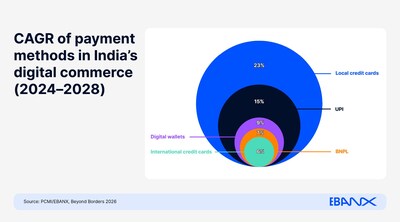
CURITIBA, Brazil, Feb. 12, 2026 /PRNewswire/ — In the home of UPI, the world’s most-used instant payment system and the backbone of how Indians shop online, the fastest-growing e-commerce payment method is credit cards. Led by domestic networks like RuPay, local cards are expected to expand at a CAGR of 23% through 2028, outpacing UPI itself (15%) and international cards (6%).
CAGR of payment methods in India's digital commerce (2024–2028)
CAGR of payment methods in India’s digital commerce (2024–2028)

The projections are featured in the new edition of Beyond Borders, EBANX’s annual comprehensive study on digital market and payment trends in emerging economies, published today, and are based on Payments and Commerce Market Intelligence (PCMI) data. The business intelligence report offers an in-depth analysis of payment trends in India, Southeast Asia, Latin America, and Africa, with data and expert perspectives on Alternative Payment Methods (APMs), cards, shopping behaviors, B2B e-commerce, and the rise of stablecoins and AI agents as personal buyers.

Click here to access the full Beyond Borders 2026 report for free.

“Our report shows that the global payments industry is undergoing a structural shift, led by emerging markets,” said Eduardo de Abreu, Chief Product Officer (CPO) at EBANX. “To meet the demands of the world’s fastest-growing digital customers, these regions have turned complex local challenges into a blueprint for the future, creating faster and more inclusive ways to pay and shifting the competitive dynamics worldwide.”

The growth of credit cards in India directly reflects this trend. In a country where APMs like UPI account for 75% of e-commerce volume, local providers found new opportunities by embedding themselves into the same rails that consumers already use daily. Under this hybrid model, domestic card schemes are linked to the UPI system, allowing real-time transactions to draw directly on credit limits. As a result, RuPay holds 33% of the Indian card market, ahead of Mastercard (20%) and American Express (4%), trailing only Visa at 43%.

“This is less about displacement and more about convergence,” Abreu emphasized. “As APMs raise the bar by reducing checkout friction and streamlining payment flows, local card schemes are responding by combining card-based credit with instant payments, wallets, and domestic infrastructure—leveraging their deeper understanding of local consumer behavior to scale faster than global rails.”

Cards’ winning moves in LatAm and Africa: installments and debit

Beyond India, this shift is turning cards into more specialised tools within broader, multi-rail payment ecosystems focused on higher-value purchases. In Latin America, they have sustained growth by leveraging the region’s longstanding installment payment culture. EBANX data shows this approach boosts average order values up to 2.7x, allowing cards to remain the backbone of e-commerce in countries like Mexico, Chile, and Peru, accounting for more than 60% of online transactions, per PCMI.

In Nigeria and Egypt, card expansion is being driven by debit, with ownership rising over 10 percentage points from 2021 to 2024, according to Global Findex. As in India, this growth is fueled by the rise of local schemes that leverage their deep understanding of domestic markets to offer tailored solutions, such as reliable processing of very low-value transactions and support for multiple refund paths. Nigeria’s leading scheme, Verve, has issued 100 million cards in a country of 232 million people.

“What determines success for payment methods in emerging markets is how well each system understands local reality,” said Abreu. “Local schemes succeed because they are built around domestic spending habits, regulatory frameworks, and technical constraints. Whether it is an instant payment system, a digital wallet, or a card, scale comes from local intelligence, not global standardisation.”

Pix overtakes cards in Brazil

Unlike UPI in India, Pix remains the fastest-growing payment method among digital consumers in Brazil. The system became the most-used option for online shopping in 2025, ending cards’ long-standing dominance. Last year, 42% of the total value of purchases in the country were paid with Pix, edging out cards at 41%. The new leader will continue to accelerate at a CAGR of 18% through 2028, when it will account for 50% of transactions compared to 36% for cards—a 14 percentage-point gap.

This sustained growth stems not only from volume but from Pix’s rapid evolution beyond one-off payments to support more complex commerce models. Last year, the system introduced recurring transactions with Pix Automático. In operation since June 2025, the feature has been growing at a rate of 41% per month, according to EBANX internal data, driven by the roughly 60 million Brazilians without credit cards who can now access services such as video and audio streaming.

“This growth reinforces that high adoption does not mean saturation. Pix is used by 95% of Brazil’s adult population, yet new demand is unlocked with each additional functionality introduced,” Abreu explained. “That momentum is now extending to businesses, particularly small and medium-sized enterprises, which are increasingly adopting Pix and reducing their reliance on corporate credit cards for their B2B purchases.”

EBANX data shows that eight out of ten companies in Brazil using Pix through EBANX are micro-businesses, with 84% of them relying on it to purchase software, opening a previously inaccessible market for global providers.

A similar dynamic is unfolding across other emerging economies. In India, a major global software-as-a-service (SaaS) company that enabled UPI Autopay via EBANX attracted more than 4,000 new customers daily during the first three months. APMs like GCash (Philippines), Mercado Pago (Latin America), Nequi (Colombia), Yape (Peru), OPay (Nigeria), and Capitec Pay (South Africa) are also expanding their ecosystems and seeing growing adoption.

Stablecoins and AI agentic buyers as the next evolution of digital payments

Beyond Borders also highlights how emerging markets are exploring crypto’s value for real-world commerce through stablecoins. They’re used to preserve value, move money efficiently, and enable cross-border transactions in economies facing inflation, currency controls, or high banking costs.

Data from Triple A analysed in EBANX’s study shows that more than 15% of the population in Brazil, Argentina, Thailand, and Vietnam already owns digital currencies, rising to 20% in Turkey. In Argentina, nearly 90% of crypto purchases are made up of dollar-pegged stablecoins.

Another trend explored in Beyond Borders is agentic commerce, where artificial intelligence evolves from a discovery tool to an autonomous buyer. In this model, AI compares prices, selects merchants, and executes transactions end-to-end—often without users visiting websites—making prompt quality and consumer context more decisive than sophisticated storefronts or visual design. Competition shifts towards pricing, availability, reliability, and trust.

McKinsey reports that 20% of consumers would be comfortable having agents complete purchases on their behalf, while Deloitte projects that up to 30% of global e-commerce value could be influenced by this technology by 2030.

“Stablecoins and agentic commerce may seem like separate trends, but they point in the same direction: payments are becoming more programmable, more automated, and less dependent on legacy assumptions. Like APMs before them, these technologies are solving problems traditional rails can’t address—and once again, emerging markets are positioned to lead adoption and shape how they evolve,” Eduardo de Abreu stated.

ABOUT EBANX

EBANX is the leading payments platform connecting global businesses to the world’s fastest-growing digital markets. Founded in 2012 in Brazil, EBANX was built with a mission to expand access to international digital commerce. Leveraging proprietary technology, deep market expertise, and robust infrastructure, EBANX enables global companies to offer hundreds of local payment methods across Latin America, Africa, and Asia. More than just payments, EBANX drives growth, enhances sales, and delivers seamless purchase experiences for businesses and end-users alike.

For further information, please visit:

Website: https://www.ebanx.com/en/
LinkedIn: https://www.linkedin.com/company/ebanx

Media Contact: 
Shan Huang
shan.huang@ahgstrategies.com 

ADB grants PH fintech leader GCash with $30-M credit facility to expand loan access to MSMEs, women entrepreneurs, especially in high poverty areas

MANILA, Philippines, Feb. 12, 2026 /PRNewswire/ — The Asian Development Bank (ADB) and Fuse Financing Inc., the lending arm of GCash, are set to spur the growth of the Philippine micro, small, and medium enterprise (MSME) sector with a $30-million landmark loan program, a first-of-its-kind partnership in the Asean fintech landscape.

[L-R] Acting Regional Director Jay Acar, Department of Trade and Industry; Martha Sazon, President and CEO of Mynt, the parent company of GCash; Secretary Cristina Roque, Department of Trade and Industry; Tony Isidro, President and CEO of Fuse Financing Inc.; Christine Engstrom Director General for Sectors Department 3 in Finance of the Asian Development Bank; and Subhashini Chandran, SVP, Mastercard Center for Inclusive Growth.  The private and public sectors are working together to promote financial inclusion for micro, small, and medium enterprises (MSMEs) and women entrepreneurs. On February 6, the Asian Development Bank and Fuse Financing Inc., the lending arm of GCash, launched a landmark loan partnership for MSMEs together with Mastercard and DTI and conducted a financial literacy workshop to support their growth.
[L-R] Acting Regional Director Jay Acar, Department of Trade and Industry; Martha Sazon, President and CEO of Mynt, the parent company of GCash; Secretary Cristina Roque, Department of Trade and Industry; Tony Isidro, President and CEO of Fuse Financing Inc.; Christine Engstrom Director General for Sectors Department 3 in Finance of the Asian Development Bank; and Subhashini Chandran, SVP, Mastercard Center for Inclusive Growth. The private and public sectors are working together to promote financial inclusion for micro, small, and medium enterprises (MSMEs) and women entrepreneurs. On February 6, the Asian Development Bank and Fuse Financing Inc., the lending arm of GCash, launched a landmark loan partnership for MSMEs together with Mastercard and DTI and conducted a financial literacy workshop to support their growth.

“This fintech partnership is the first-of-its kind for ADB in the Asean region and marks a significant step in advancing financial inclusion in the Philippines,” said Isabel Chatterton, Director General, Private Sector Operations Department of Asian Development Bank.

There are 1.24 million registered business establishments as of 2024, over 99 percent of which are MSMEs. Yet, access to financing remains a key barrier. According to an ADB study, access to credit and capital ranks as the second most significant challenge for MSMEs, after access to markets. With the lack of access to reliable funding, some small businesses are forced to shut down operations in less than 12 months[1].

“This investment enables us to accelerate our support for women entrepreneurs and small businesses in underserved areas, sectors with immense potential to drive the country’s long-term growth,” Fuse Financing Inc. President and CEO Tony Isidro said.

“Our partnership with ADB strengthens our company’s foundation for sustainable and inclusive growth. This underscores our commitment to supporting MSMEs’ impact and scale,” Mynt President and CEO Martha Sazon said.

The Mastercard Impact Fund, administered by the Mastercard Center for Inclusive Growth also extended funding  to support Fuse in effectively reaching and serving the priority MSME segments.

This milestone partnership was witnessed by over 250 MSMEs at an event in Taguig City. 10 MSMEs nominated by the Department of Trade & Industry (DTI) were awarded capitalization support to help advance their business operations. “More than the scale of financing, what makes this partnership meaningful is its intent: to ensure that capital reaches entrepreneurs who are ready to grow but have long been underserved by traditional systems. By aligning public-sector priorities with private-sector innovation, this collaboration helps widen the path to formal, fair, and sustainable access to finance for MSMEs.” DTI  Secretary Ma. Cristina Roque said.

For more information, please visit www.gcash.com

[1] Philippine Institute for Development Studies. Evaluation of the Sustainable Livelihood Program’s Seed Capital Fund for Microenterprise Development. https://www.pids.gov.ph/publication/research-paper-series/evaluation-of-the-sustainable-livelihood-program-s-seed-capital-fund-for-microenterprise-development