Home Blog Page 271

Lintes Technology Unveils Shared NPC and NPO Interconnect Platform for Next-Generation AI Servers

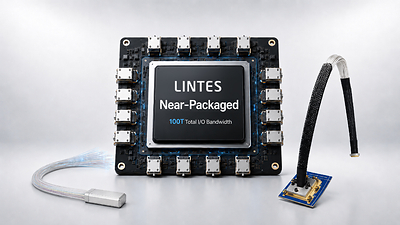
Lintes Technology’s next-gen AI server near-packaged interconnect solution integrates a co-shared NPC/NPO Socket platform to optimize bandwidth, flexibility, and routing. 

TAIPEI, June 22, 2026 /PRNewswire/ — Lintes Technology (TWSE: 6715), a global leader in high-bandwidth connectivity solutions, today announced the launch of its comprehensive, modular optoelectronic interconnect solution for next-generation AI servers. Addressing the critical bottleneck of high-density data centers, the platform encompasses both Near-Packaged Copper (NPC) and Near-Packaged Optics (NPO) technologies, featuring a shared patented socket architecture.


Unlike conventional hardware designs with fixed interface configurations, this innovative architecture empowers data center operators with infrastructure flexibility. The platform enables direct selection between optical and electronic interfaces within a single system, allowing operators to configure the channel count and bandwidth allocation routed through either NPC or NPO via individual sockets based on actual data throughput requirements. This breakthrough significantly optimizes system routing agility and cost-efficiency for next-generation AI infrastructure.

Bridging the CPO Market Gap

As AI workloads continue to drive demand for higher computing performance, conventional transmission architectures are approaching practical limits in bandwidth, power, and system design. While Co-Packaged Optics (CPO) remains a key area of industry focus, challenges related to optical engine yield, ASIC integration, and cost efficiency are expected to delay large-scale deployment.

In contrast, Lintes’s near-packaged interconnect solutions have already completed design validation and are sampling with customers. This makes the platform a concrete, immediately deployable solution for high-density AI servers, effectively bridging the technological gap as the industry transitions to advanced architectures.

Modular Near-Packaged Interconnect for AI Scalable Bandwidth

To meet the 100T aggregate bandwidth demands of AI chips, Lintes’s near-packaged interconnect solutions utilize a patented socket design that simultaneously supports both NPO and NPC. A single socket delivers a transmission bandwidth of up to 6.4T. Depending on specific server and data center infrastructures, this bandwidth can be flexibly configured as four 1.6T or eight 800G transmission paths, helping customers adapt to high-bandwidth, modular, and scalable AI system requirements.

This flexible architecture supports both transmission modes based on distance, cost, and layout requirements:

  • Intra-Server and Intra-Rack Transmission (Scale-up): Operators can deploy NPC to connect with other AI chips or PCIe signal connectors. This can be paired with rack cabling options such as DAC, AEC, AOC, and ACC, leveraging copper’s cost efficiency and deployment maturity to satisfy high-speed interconnect needs within servers and racks.
  • Cross-Rack Long-Distance Networking (Scale-out): The system can adopt NPO and be paired with high-density multi-fiber connectors like MPO, MTP, and MMC to meet the demands of cross-rack extensions, data center horizontal scaling, and high-bandwidth optical interconnects.

Through this modular and platform-based design, Lintes enables AI server and data center customers to flexibly implement near-packaged interconnect solutions for varied computing demands, transmission distances, and deployment costs, while minimizing major changes to existing system architectures and cable configurations.

US$84 Million Capital Expenditure Approved to Target 2027 Volume Production

To support this growth, Lintes’s Board of Directors approved an annual capital expenditure budget of up to approximately US$84 million (NT$2.65 billion) on June 11, 2026. This capital will be allocated toward cleanroom renovations for a new manufacturing facility and the procurement of multi-channel, multi-mode, and single-mode optical module production equipment, expanding advanced hardware manufacturing capacities.

With these near-packaged interconnect solutions already sampling with customers, the company aims to align with customer deployment schedules and achieve volume production by 2027, transforming these technological breakthroughs into long-term operational momentum.

About Lintes Technology

Lintes Technology is a leading provider of high-speed interconnect solutions, delivering advanced cables, connectors, and optical modules for data-intensive applications. With deep expertise in signal integrity and system integration, Lintes enables scalable AI connectivity from edge devices to hyperscale data centers supporting reliable, high-bandwidth communication across next-generation infrastructure.

Learn more at lintestech.com or follow us on LinkedIn.

Media Contact
marketing@lintestech.com

UN GLOBAL COMPACT LAUNCHES FIRST PRACTICAL GUIDE FOR COMPANIES LEADING ON BLENDED FINANCE

New Playbook empowers businesses to take an active role in structuring deals within the $24B blended finance market.

LONDON, June 22, 2026 /PRNewswire/ — The UN Global Compact CFO Coalition for the SDGs today launched Business-Led Blended Finance: A Practical Playbook, the first guidance document written specifically to help real economy companies move from passive recipients of blended finance to active architects of deals that strengthen economic resilience and align with country-led development priorities.

Blended finance, the strategic use of public or philanthropic capital to improve the risk-return profile of investments and unlock private capital in underserved markets, has grown significantly over the past five years, with total annual flows rising from US$14 billion in 2020 to US$24 billion in 2024. Yet nearly all existing blended finance guidance is written for capital providers: governments, development finance institutions (DFIs) and multilateral development banks (MDBs).

Released during London Climate Action Week 2026, Europe’s largest city-wide climate festival, the Playbook addresses a fundamental imbalance in the global blended finance market. Business leaders are key project developers and capital deployers for blended finance but have been left without a roadmap.

The Playbook changes that. Grounded in empirical data from Convergence and in-depth interviews with companies that have successfully structured and executed blended finance transactions, from multinationals to SMEs in emerging markets, it provides real economy players with the practical tools they need to engage with confidence.

Sanda Ojiambo, CEO and Executive Director of the UN Global Compact, commenting at the Playbook’s launch said: “The private sector has a unique and largely untapped role to play in blended finance, but as an architect of deals that drive systemic impact across industries and markets. This Playbook is the operational tool that enables finance leaders to step into that role. At a time when public balance sheets are under pressure and the SDG financing gap stands at $4 trillion annually, we cannot afford to leave corporate leadership on the sidelines. Nor can we afford financing models that are disconnected from country priorities. This Playbook helps align private capital with nationally driven pathways to resilience and growth.”

Mahar Al-Haffar, CFO of Cemex and co-Chair of the Advisory Board for the UN Global Compact CFO Coalition for the SDGs said: “Blended finance can play a critical role in accelerating investment into sustainable infrastructure and industrial decarbonization, particularly in markets where risks and financing costs can otherwise slow progress. But while the opportunity is significant, the structuring process can often be complex and resource-intensive. Clearer, more standardized tools are essential to help companies engage more confidently and efficiently. This Playbook is an important step forward because it helps translate blended finance from a niche financing concept into a practical mechanism that businesses can use to support long-term growth, resilience and sustainability.”

Koushik Chatterjee, Executive Director and CFO of Tata Steel and co-Chair of the Advisory Board for the UN Global Compact CFO Coalition for the SDGs said: “Blended finance has the potential to become one of the most powerful tools in sustainable finance, particularly in supporting capital-intensive decarbonization and transition initiatives. Our experience demonstrates that large-scale industrial transformation is only possible when governments, business and financial institutions work in close partnership to align long-term economic resilience with sustainability objectives. This Playbook is important because it gives companies practical guidance on how to engage earlier, structure transactions more effectively and help shape projects that deliver both commercial viability and measurable impact.”

The Playbook identifies energy and infrastructure as the twin drivers of corporate engagement in blended finance, together accounting for nearly three-quarters of corporate investment activity. It finds that these sectors, under geopolitical pressure on energy security and supply chain resilience, are natural entry points for business-led approaches, as their tangible, long-term assets align with both corporate sustainability commitments and investor mandates.

Case studies range from FCC Construcción, which coordinated 13 organizations across five countries to fast-track digital infrastructure permitting through the EU’s Horizon Europe programme, to Safaricom’s collaboration with other telecoms companies, backed by the International Finance Corporation and Multilateral Investment Guarantee Agency, to expand access in Ethiopia and the partnership between Tata Steel and the UK Government to decarbonize steel manufacturing at Port Talbot.

Beyond case studies, the Playbook includes a Toolkit for Blended Finance Risk Management and Capital Structuring and a Checklist for Navigating Due Diligence & Project Preparation, practical resources that can be utilized by corporate finance and sustainability teams when considering and designing blended finance transactions.

Notes to Editors

About the UN Global Compact

As a special initiative of the United Nations Secretary-General, the UN Global Compact is a call to companies worldwide to align their operations and strategies with Ten Principles in the areas of human rights, labour, environment and anti-corruption. Our vision is clear: to mobilize business to transform sustainability ambition into action at the scale the world demands. With more than 25,000 participants and a presence in over 100 countries through 5 Regional Hubs and more than 70 Country Networks and expansion territories, the UN Global Compact is the world’s largest corporate sustainability initiative.

For more information, follow @globalcompact on social media and visit our website at unglobalcompact.org

Lao National Arrested in Bangkok With Over 1,000 Ketamine Packets Disguised as Coffee Products

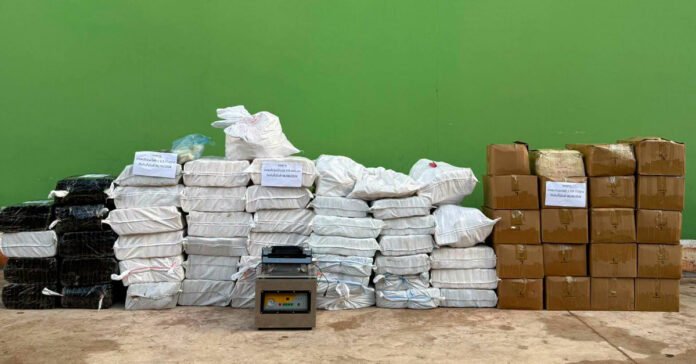
A picture of a 22-year-old Lao national arrested by Thai police in Bangkok with over 1,000 ketamine packets disguised as coffee products. (Photo by Oneday Today)

On 16 June, Thai police in Bangkok arrested a 22-year-old Lao national after seizing more than 1,000 ketamine packets disguised as coffee products in an operation targeting small-scale drug distribution networks linked to entertainment venues.

According to Wang Thonglang Police Station, officers detained the suspect near a convenience store in Lat Phrao district during a routine patrol after noticing suspicious behavior.

Police said the suspect was carrying large quantities of ketamine packaged in small plastic sachets prepared for distribution. The total seized weight was approximately three kilograms.

Officers also confiscated 80 sachets of powdered drink products weighing a combined 2.79 kilograms, branded “COFFEE HOUSE” and “Just Do It,” which later tested positive for methamphetamine compounds. Authorities said the items are believed to be part of a so-called “happy water” drug mixture commonly linked to nightlife and entertainment venues in the region.

Additional items seized included packaging materials, containers, a motorcycle, and equipment allegedly used for storing and distributing narcotics.

According to Thai media, the suspect has been charged with possession of drugs with intent to sell, possession of methamphetamine-type substances with intent to distribute, and overstaying permission to remain in Thailand.

Authorities said the suspect has been transferred to investigators at Wang Thonglang Police Station for further legal proceedings, as investigations continue into possible links to wider drug distribution networks operating in Bangkok.

Over 10 Million Meth Pills Seized in Major Drug Bust in Vientiane

Vientiane police seized over 10.4 million meth pills and arrested five suspects in one of the capital's largest drug busts in recent years. 06 June 2026. (Photo: Xaythany Police).

Authorities in Vientiane seized more than 10 million methamphetamine pills in early June, in one of the city’s largest drug busts in recent years.

Xaythany police reported the case on 19 June, confirming that the operation took place on 6 June, when officers carried out coordinated raids across three districts and arrested five suspects.

The operation began before dawn when officers stopped two vehicles in Xaythany district. They arrested two men and seized seven sacks of methamphetamine bundles, totaling 2.8 million pills.

Using leads from the arrests, police then raided three more locations the same day.

In Phontong village, officers arrested three more suspects and seized the bulk of the haul, including more than 6.4 million methamphetamine pills, over 1,200 kilograms of crystal meth, and 6.5 kilograms of heroin, along with cash in Lao and Thai currency.

At a residence in Hadsayfong district, police seized a car and six motorcycles believed to be linked to the network.

In Xaymoungkhoun village, Naxaythong district, officers recovered 1.2 million more methamphetamine pills, along with a motorcycle and cash.

In total, police seized more than 10.4 million methamphetamine pills, 1,235 kilograms of crystal meth, 6.5 kilograms of heroin, three cars, seven motorcycles, and roughly LAK 25.3 million (about USD 1,140) in cash.

Authorities say the case remains under investigation as they work to identify the masterminds behind the network and track down any remaining members still at large.

Hongkong Land Recognised as Global Leader in Sustainability Industry Rankings


  • A signatory of the United Nations Principles for Responsible Investment
  • Reduced Scope 1 and 2 emissions by 37% against a 2019 baseline, outpacing the halfway mark towards 2030 targets
  • Launched new Long-Term Incentive Plan linking senior management remuneration to key sustainability milestones

HONG KONG SAR – Media OutReach Newswire – 22 June 2026 – Hongkong Land Holdings Limited (“Hongkong Land” or the “Company”) has been recognised as a global leader in sustainability, achieving top-tier results in the latest ESG industry rankings. The company has maintained its position as a member of the Dow Jones Best-in-Class World Index for a second consecutive year and was included in the Dow Jones Best-in-Class Asia Pacific Index for the fourth consecutive year, ranking among the top 6% of global performers in the property sector.

Hongkong Land retains status as constituent of Dow Jones Best-in-Class World Index and becomes a signatory of UNPRI

In the past year, the company has made significant progress in sustainable practices including reducing Scope 1 and 2 carbon emissions by 37% in 2025 against a 2019 baseline, exceeding the halfway mark of previously stated 2030 carbon reduction targets. Hongkong Land has further strengthened governance and accountability through a new Long-Term Incentive Plan where senior management remuneration is linked to long-term performance and success in achieving key sustainability objectives.

In 2025, the company also reinforced its commitment to responsible investment by becoming a signatory of the United Nations Principles for Responsible Investment (UNPRI), an international framework that promotes responsible investment practices and the integration of ESG factors into investment decision-making.

Earlier this year, Hongkong Land launched Singapore’s largest commercial real estate private fund, the Singapore Central Private Real Estate Fund (SCPREF), which focuses on ultra-premium and green-certified assets, aligning capital allocation with the company’s decarbonisation pathways. SCPREF is also the company’s inaugural private real estate fund and lists other high-profile founding, sustainability-focused investors including APG Asset Management and Qatar Investment Authority.

Michael T. Smith, Group Chief Executive of Hongkong Land, said: “Our leading ESG rankings demonstrate that sustainability is built into our core business strategy. Becoming a UNPRI signatory demonstrates our long-term commitment to responsible investment practices, embedding sustainability throughout our culture and shaping sustainable, future-ready cities in partnership with our stakeholders. This disciplined approach ensures we deliver long-term growth while continually enhancing the resilience of our assets.”

Hashtag: #HongkongLand #ESG #Sustainability #CSR #Business #Corporate


The issuer is solely responsible for the content of this announcement.

Hongkong Land

Hongkong Land is a major listed property development, investment and management group. It focuses on developing, owning and managing premium and ultra-premium mixed-use real estate in Asian gateway cities, featuring Grade A office, luxury retail, residential and hospitality products. With over US$50 billion in assets under management, Hongkong Land’s ultra-premium mixed-use real estate footprint spans over 1.97 million sq. m. lettable area in operation and 1.43 million sq. m. lettable area under development, with flagship mixed-use projects in Hong Kong, Singapore and Shanghai. Its properties hold industry leading green building certifications and attract the world’s foremost companies and luxury brands. Established in 1889, Hongkong Land takes a long-term view, investing significantly alongside its capital partners and concentrating its portfolio where it can create the most value for tenants, customers and investors. Hongkong Land Holdings Limited has a primary listing on the London Stock Exchange, with secondary listings in Singapore and Bermuda. Hongkong Land is a member of the Jardine Matheson Group.

Hong Kong’s AI Adoption Outpaces Organizational Change, Microsoft Work Trend Index 2026 Finds

  • 18% of Hong Kong workers using AI are the most advanced group known as Frontier Professionals, higher than the global average at 16%
  • Just 19% Hong Kong AI users say leadership is clearly and consistently aligned on AI, and only 10% say they’re rewarded for reinvention even when results aren’t immediate
  • Organizational factors such as culture, manager support, and talent practices drive 2x more AI impact than individual factors alone
  • Microsoft is also announcing the launch of Copilot Cowork, bringing multi-model capabilities to help organizations close the gap between AI adoption and how work is designed by enabling end-to-end, multi-step workflows

HONG KONG SAR – Media OutReach Newswire – 22 June 2026 – Hong Kong employees are moving faster than their organizations when it comes to using AI, creating a growing gap between AI adoption and how work is actually designed, according to Microsoft’s 2026 Work Trend Index. The research warns of a “Transformation Paradox”: while AI use is accelerating across the workforce—with more Frontier Professionals using agents for multi-step workflows and building multi-agent systems, leadership alignment, culture, and operating models are not evolving at the same pace, limiting impact and increasing pressure on employees.

The 2026 Work Trend Index draws on analysis of trillions of anonymized Microsoft 365 productivity signals, combined with survey insights from AI users and perspectives from experts in AI, work, and organizational psychology. The conclusion is consistent: the constraint is no longer what people can do, but how work is structured around them.

  • AI is lifting output but not yet transforming organizations. The data shows that AI is already raising the ceiling on individual performance in Hong Kong. A privacy-preserving analysis of more than 100,000 chats in Microsoft 365 Copilot shows that 49% of all conversations support cognitive work—helping workers analyze information, solve problems, evaluate and think creatively. This shift is visible in outcomes: 57% of AI users in Hong Kong say they are producing work they could not have a year ago, rising to 73% among Frontier Professionals, the most advanced AI users in the research.
  • The Transformation Paradox reflects the need for systemic change, with the gap more pronounced in Hong Kong than globally. 75% of Hong Kong AI users fear falling behind if they do not adapt quickly, yet 57% say it feels safer to focus on current goals than to redesign work with AI. [i] At the same time, only 19% say their leadership is clearly and consistently aligned on AI, and just 10% say they are rewarded for reinventing work with AI even when results are not immediate, revealing a widening gap between individual adoption and organizational change. [ii]
  • As AI and agents take on more execution, human value is shifting rather than diminishing. When asked which skills matter most as AI becomes more embedded in work, Hong Kong AI users ranked quality control of AI output (48%) and critical thinking (42%) at the top, underscoring that AI is redesigning work, not replacing people.

From Using AI to Being Frontier Professionals Who Refuse to Outsource Thinking
The Work Trend Index identifies the rise of Frontier Firms—organizations that deliberately rebuild their operating models around human‑agent collaboration, rather than layering AI onto existing ways of working.

Realizing this shift requires transformation at both the individual and organizational level. The research outlines four modes of human-AI collaboration to help employees take the first step toward becoming Frontier Professionals, before progressing to designing agentic workflows:

  • Delegate execution—Employees hand off routine or repeatable tasks to AI to gain speed and scale, while retaining responsibility for the outcome.
  • Ask for information—Employees turn to AI for context, clarification, or insight when they need to quickly get up to speed.
  • Collaborate on reasoning—People work alongside AI to analyze information, test ideas, and solve problems, using AI as a thought partner rather than a shortcut.
  • Explore new possibilities—AI is used to explore open‑ended questions, reframe problems, and surface options when the path forward is not yet clear.

These patterns matter because Frontier Firms do not aim to maximize AI use everywhere. Instead, they intentionally match the right level of human involvement to the outcome, enabling speed without sacrificing quality or accountability.

Leadership and Culture Are the Real Multipliers
The research makes clear that technology alone is not the differentiator, but by how organizations lead, operate, and evolve. Organizational factors, including culture, manager support, and talent practices, account for more than twice the AI impact of individual mindset and behavior. In Hong Kong, Frontier Professionals are significantly more likely to say their managers set clear quality standards for AI work[iii], create space for experimentation[iv], and encourage more ambitious redesign of work[v].

“This is the Transformation Paradox facing Hong Kong today,” said Leo Liu, General Manager of Microsoft Hong Kong and Macau. “AI adoption is moving fast on the ground, but many organizations are still trying to fit it into old operating models. To unlock real value, leaders must move beyond pilots and productivity gains, and intentionally redesign how work gets done—how teams collaborate, how managers lead, and how success is measured.”

Microsoft is also announcing the launch of Copilot Cowork, designed to support this shift toward workflow redesign. Built on Microsoft’s multi-model approach, this agentic system enables long-running tasks across multiple tools, with usage-based pricing, cost management, and governance capabilities to balance quality, performance, and cost, and helps organizations run complex workflows more efficiently at scale.

Microsoft brings this perspective as Customer Zero, applying the same principles internally to redesign workflows, build human‑agent teams, and embed continuous learning into everyday work. Using Copilot Studio and Microsoft Foundry, Microsoft transformed its “Ask Microsoft” web agent from a standalone chatbot into a multi‑agent system that routes conversations more effectively and supports more dynamic, context‑aware interactions. This shift improves how customer intent is understood and addressed, while steering queries to the right resources or teams and allowing sales to focus on higher‑value, high‑intent engagement.

The solution delivered measurable business impact across customer engagement and operational efficiency, achieving up to 61% lower response latency and 70% fewer human escalations. Users who engaged with the agent were 10 times more likely to sign up for services and drove a 16% increase in product trial initiations.

“Inside Microsoft, we’ve learned that AI transformation is not a tooling exercise. It’s an operating model shift,” said Lorraine Bardeen, Corporate Vice President, MCAPS AI Transformation, Microsoft. “When leaders clarify how humans and agents work together, set standards for quality and judgment, and create room to experiment, organizations move faster and learn faster. That’s what separates Frontier Firms from everyone else.”

“We are entering a new era of work, where the traditional value formula is being rewritten,” said Nancy Wang, Head of LinkedIn Greater China. “We call it the ‘new math of work’—a concept introduced in LinkedIn’s new book, Open to Work. The people and organizations that emerge strongest will be those who use the time freed up by AI to build work around what’s actually harder to automate—the specific, contextual, human judgment that no tool can fully replicate, because no tool has lived what you’ve lived or knows what you know.”

The message of the 2026 Work Trend Index is clear: access to AI will soon be table stakes. How work is designed around it will define the next generation of competitive advantage for Hong Kong organizations. For more insights, read the 2026 Work Trend Index Report.


[i] A higher share of AI users in Hong Kong are Frontier Professionals (18% vs. 16% globally), reflecting talent readiness. However, despite greater pressure to adapt to AI (75% vs. 65% globally), day-to-day demands often take precedence, with more in Hong Kong choosing to prioritize current goals over redesigning work with AI (57% vs. 45% globally).

[ii] This pattern is closely linked to limited organizational support. Only 19% of Hong Kong AI users say their leadership is clearly and consistently aligned on AI (vs. 26% globally), and just 10% say they are rewarded for reinventing work with AI even without immediate results (vs. 13% globally). Without stronger top-down direction, support, and recognition, employees naturally default to the safer path.

[iii] 79% Frontier Professionals say their manager sets quality standards for AI work, compared with 59% of Non-Frontier Professionals.

[iv] 80% Frontier Professionals say their manager creates space for experimentation, compared with 61% of Non-Frontier Professionals.

[v] 81% Frontier Professionals say their manager encourages more ambitious work redesign, compared with 63% of Non-Frontier Professionals.

Hashtag: #Microsoft

The issuer is solely responsible for the content of this announcement.

About Microsoft

Microsoft (Nasdaq “MSFT” @microsoft) creates platforms and tools powered by AI to deliver innovative solutions that meet the evolving needs of our customers. The technology company is committed to making AI available broadly and doing so responsibly, with a mission to empower every person and every organization on the planet to achieve more.


“Happiness from Europe” Returns to Hong Kong with PizzaExpress Partnership


HONG KONG SAR – Media OutReach Newswire – 22 June 2026 – The “Happiness from Europe” campaign is back in Hong Kong this summer through a partnership with PizzaExpress. From 23 June to 7 September 2026, 19 PizzaExpress branches will feature a special Grana Padano PDO menu in honor of Restaurant Weeks.

menu

The three-year campaign is co-funded by the European Union and centered on Grana Padano PDO, a hard cheese from the Pianura Padana (Po River Valley) in Northern Italy, known for its fine, granular texture and 900-year production history. In 2026 the campaign returns to PizzaExpress with a dedicated three-dish Grana Padano PDO menu running across 19 branches for the length of the promotion. The partnership puts the cheese in front of diners through one of Hong Kong’s most familiar restaurant brands.

Each of the three dishes uses Grana Padano PDO in a different way, from the sauce of a pizza to the finishing of a pasta. The menu is designed to show how the cheese works across familiar dishes diners already order.

The Menu

The starter is a Cheesy Crab Dip with Grana Padano PDO. Grana Padano PDO is stirred through the dip to balance the sweetness of the crab, and the dip is served with a Grana Padano PDO cheese flatbread for tearing and dipping. It is built to be shared and finished before the rest of the meal arrives.

The Grana Padano PDO Pizza is built on a béchamel base rather than tomato sauce, with Grana Padano PDO worked into the sauce and shaved generously over the top. It is layered with fresh porcini, mortadella, mozzarella, and sliced peach. The combination of sweet peach, cured mortadella, and earthy porcini gives the pizza its character, and the cheese running through both the base and the finish brings the flavors together.

The Spaghetti Seafood Bianco with Grana Padano PDO brings together prawns, clams, and mussels in a garlic and white wine sauce with chili flakes and Grana Padano PDO. The cheese is stirred through the sauce, giving the dish more body than a typical white-wine seafood pasta.

About Grana Padano PDO

Grana Padano is one of the oldest cheeses still in continuous production. It was first made in 1135 at the Abbey of Chiaravalle near Milan, where Cistercians monks developed it as a way to preserve surplus milk. The name comes from its texture: “grana” means “grainy”, a reference to the fine, granular structure the cheese develops as it ages.

Each wheel is handcrafted from fresh milk produced in the Po River Valley of Northern Italy. The cheese is naturally lactose-free thanks to the production process. Maturation takes at least nine months, with some wheels aged for over two years. Younger wheels are milky and slightly sweet; longer-aged ones become richer, nuttier, and faintly crystalline. Grana Padano is the world’s most consumed PDO cheese in Europe.

The Consorzio Tutela Grana Padano is a non-profit making organization charged with protecting, promoting and enhancing the product, providing consumer information and generally taking care of the interests regarding its P.D.O. status.

The absence of lactose is a natural consequence of the traditional Grana Padano production process. It contains less than 10 mg/100 g of galactose.

Ciao! Buon appetito everyone!

For campaign updates and participating branches, visit www.happinessfromeu.com or follow the campaign on Instagram and Facebook.

FOOTER EN

Funded by the European Union. Views and opinions expressed are however those of the author(s) only and do not necessarily reflect those of the European Union or of the granting authority. Neither the European Union nor the granting authority can be held responsible for them.

Hashtag: #HappinessfromEurope

The issuer is solely responsible for the content of this announcement.

Korea Deep Learning Secures Back-to-Back Global AI Benchmark Wins Over Big Tech

SEOUL, South Korea, June 22, 2026 /PRNewswire/ — Korea Deep Learning, a pioneer in enterprise-grade Document AI and vision intelligence solutions, today announced that its proprietary Document AI has secured the #1 overall ranking on ParseBench, a premier global document parsing benchmark organized by LlamaIndex.

Korea Deep Learning’s Document AI ranks #1 overall in LlamaIndex’s ParseBench

ParseBench evaluates AI models on their ability to read, structure, and extract information from approximately 2,000 pages of complex, real-world enterprise documents across finance, insurance, and government sectors. In the latest evaluation, Korea Deep Learning ranked #1 overall in the VLM category with a score of 76.4, ahead of the next-highest-scoring models (75.0 and 67.8). The company also secured the top spot in Visual Grounding with a score of 78.8, establishing a commanding 19-point lead over the next-highest-scoring model (59.8).

The win was driven by KDL-Frontier-Parser-nano, a 1.2-billion-parameter single model. Despite its compact size, it delivered superior accuracy against massive Big Tech systems at a fraction of the operational cost, proving that specialized AI tailored for business workflows can outperform broad, general-purpose LLMs. Its core edge lies in Korea Deep Learning’s Near-Zero Hallucination technology, which simultaneously analyzes layout, field relationships, and spatial positioning to minimize error rates and extract data with context-aware precision.

Trained on over 400 million images and documents, Korea Deep Learning’s solutions support secure on-premise and SaaS deployments. Validated across major enterprise and public sectors, the technology powers administrative data restructuring for the Gyeonggi Provincial Government and serves over 80 major corporations, including Hyundai Capital and LG CNS—slashing document-processing times by up to 96%.

Today’s ParseBench victory builds on a consecutive string of global milestones. In March 2026, the company’s proprietary Vision-Language Model, KDL Frontier, clinched the #1 spot in the English category of OCRBench v2 with a score of 68.1, outperforming other leading models. In recognition of this sustained technological leadership, Forbes Asia officially named CEO Jihyun Kim to its prestigious 2026 ’30 Under 30′ list in the Consumer & Enterprise Technology category last month.

“Our strategy has always been to build specialized AI that decodes complex document structures as intuitively as a human, rather than focusing on massive LLMs,” said Jihyun Kim, CEO of Korea Deep Learning. “This milestone validates our architecture as the most practical solution for the ‘AI Agent’ era, enabling autonomous decision-making and total workflow automation.”

Backed by an $8 million (KRW 12 billion) Series A funding round secured in December 2025 and a strategic partnership with NVIDIA, Korea Deep Learning is aggressively accelerating its global expansion into international enterprise markets.

About Korea Deep Learning

Founded in 2019, Korea Deep Learning is a premier vision intelligence and Document AI company developing enterprise-grade AI agents that automate document-based workflows. Its proprietary DEEP Agent platform combines advanced OCR, document parsing, and vision-language models to help organizations seamlessly extract, structure, and act on information from complex documents, images, and visual data.