Legendary icons and trailblazing pioneers exemplify the American Dream
LOS ANGELES, Sept. 30, 2026 /PRNewswire/ — Global legacy platform Asian Hall of Fame announced its Class of 2026 to be inducted on November 5, 2026, in Los Angeles, California. The 22nd Induction Ceremony supports 100 Women In Tech, Entertainment, Science & Sports (WinTESS) scholarships. Title Sponsors are Chairwoman Melinda Rogers, CJ Group, and TAO.
“During times of worldwide conflict, Asian Hall of Fame serves as a beacon of cross-cultural collaboration and interracial synergy. Class of 2026 Inductees and Goodwill Ambassadors are role models whose endearing legacies advance culture, commerce, and community for generations to come,” states Maki Hsieh, President & CEO of Asian Hall of Fame.
CBS LA Anchor Suzie Suh is Master of Ceremonies. Ed Roth (Goodwill Ambassador 2022) is Musical Director. Prior honorees presenting incoming inductees include The Honorable Fiona Ma, William Wang, and Soo Man LEE.
Preshow begins at 4:00 p.m. PST with red carpet arrivals, charity casino, and pop-up boutique. The program starts at 6:00 p.m. with the UCLA Air Force ROTC Honor Guard and National Anthem. The finale features Miss Asian Hall of Fame Ambassadors and showcases heritage costumes from around the world.
Class of 2026 Medalists Hideo Nomo, Hall of Fame Sports Pioneer Inductee Miky Lee, Centennial Medal of Lifetime Achievement Sophie Chang, Humanitarian Service Medal of Honor Heritage Excellence Medal to Lynn and Steve Valbuena, Rich Le Roy, Sabrina Castaneda
ABOUT ASIAN HALL OF FAME Established in 2004, Asian Hall of Fame strengthens interracial synergy by advancing mainstream recognition of Asian achievement and Indigenous legacy. Contact: press@asianhalloffame.org, (626) 600-9418, www.asianhalloffame.org.
SHANGHAI, Sept. 30, 2026 /PRNewswire/ — A report from SMG.
WorldSkills’ New Drone Event Takes Flight in Shanghai
The 48th WorldSkills Competition opened in Shanghai on September 22nd, bringing together young skilled professionals from around the world to compete across dozens of trades and professions. Among the events making their debut this year is Unmanned Aerial Systems, reflecting the rapid growth of the drone industry and rising demand for workers with multidisciplinary technical skills.
In the new event, competitors are required to assemble a drone from more than 200 parts, program its flight-control system and make it fly autonomously — all within 18 hours. The tasks combine mechanical assembly, electronics, computer programming and artificial intelligence.
The addition of the event comes as China’s drone industry continues to expand. In 2025, the output value of China’s civilian drone industry reached 176.1 billion yuan, up around 20 percent year on year, with industrial drones accounting for more than 70 percent of the total.
In Shanghai, drones are being used to inspect power transmission lines, replacing some tasks that once required workers to climb towers. He Bing, a specialist engineer with State Grid Shanghai Municipal Electric Power Company, said around 100 drones are deployed for inspections across the city every day.
“Before, a person had to climb the tower. Maybe one hour. Now, in 10 minutes, we can use the drone to inspect the tower,” He said.
The technology is also moving into entertainment, engineering and overseas markets. Shanghai-based Aoying Tech has operated drone light shows involving more than 14,000 aircraft, while Vertaxi has deployed industrial drones for applications including oil-pipeline inspections overseas.
The growth of the industry is also creating demand for a new type of skilled worker.
Yue Tingting, vice president of Vertaxi, estimates that China’s drone industry faces a talent shortage of more than one million people, including hardware engineers, R&D engineers, drone operators and test engineers.
Vocational schools are responding to that demand. Shanghai Business and Information College plans to introduce a new program in drone assembly, tuning and maintenance, with the potential to train around 100 students.
For students such as Chen Yixuan, drone training already goes far beyond learning how to fly an aircraft. It involves assembly, soldering, programming, flight control and autonomous-flight algorithms.
“The first module is assembly. The second is test flight. The third is coding — making it fly on its own,” Chen said. “Autonomous flight is one of the biggest challenges.”
The debut of Unmanned Aerial Systems at WorldSkills Shanghai therefore reflects a broader shift taking place beyond the competition arena.
As drones move from consumer products into power-grid inspections, engineering, agriculture, emergency response and passenger transportation, companies increasingly need workers who understand not just how to operate an aircraft, but how to build, program, test and maintain an entire unmanned system.
For WorldSkills, that changing industry has created a new competition event. For China’s rapidly expanding drone sector, it has created a new question: who will have the skills needed to build and operate the next generation of unmanned aircraft?
SHANGHAI, Sept. 30, 2026 /PRNewswire/ — A report from SMG
The 48th WorldSkills Competition
The 48th WorldSkills Competition concluded in Shanghai on September 27th, bringing together around 1,400 young competitors from across the world to compete in 64 skill categories ranging from traditional trades to emerging technologies.
Hosted in Shanghai, the biennial international competition showcased not only some of the world’s most highly skilled young professionals, but also how rapidly changing industries are reshaping the skills needed in the workplace.
Seven disciplines made their WorldSkills debut at this year’s competition, reflecting growing demand for new skills as technologies, industries and occupations continue to evolve.
But beyond the medals and competition results, Shanghai 2026 also raised a broader question: How should vocational education keep pace with a changing world of work?
That question is particularly relevant in China, home to the world’s largest vocational education system and one of the world’s largest manufacturing and service economies.
SMG reporter Stephen Rancourt visited vocational schools, spoke with competitors, educators and WorldSkills officials, and explored how competition standards are entering classrooms and training workshops — and why Shanghai has become a meeting point between WorldSkills’ global standards and China’s rapidly evolving demand for skilled talent.
SHANGHAI, CHINA – Media OutReach Newswire – 30 September 2026 – During HUAWEI CONNECT on September 17, 2026, Eric Xu (Huawei’s Rotating Chairman) and Dr. Liao Heng (Chief Scientist of HiSilicon) had a Q&A session with journalists of media outlets to discuss Huawei’s Peerium Computing Architecture for the AI era as well as UnifiedBus (UB).
At last year’s HUAWEI CONNECT, Eric Xu gave a keynote speech and released Ascend chips and their roadmap (including the 950, 960, 970, and SuperPoDs and SuperClusters). He also announced the open release of the UnifiedBus protocol.
At this year’s HUAWEI CONNECT, Huawei announced the Ascend 950 and the Atlas 950 SuperPoD. While the industry is talking about SuperPoDs or supernodes, the ways of making these products differ hugely. The key of SuperPoDs is about allowing several thousand or even tens of thousands of processors to work as one computer.
Today, Huawei announced a SuperPoD based on the Ascend 950 chip. The SuperPoD is powered by a new computing architecture that Huawei has pioneered. This architecture now can make one million processors work as one computer. This architecture is called Peerium, and it can achieve strong scaling to the million-processor level through nested parallelism, unified memory addressing, and peer-to-peer interconnect. It extends the parallelism paradigm of Turing with the introduction of Nested BSP (Nested Bulk Synchronous Parallel).
This architecture also extends the von Neumann single-machine architecture and overruns the master-slave design paradigm that has prevailed for decades. Given that the available technologies in the industry could not support this architecture, Huawei invented a key interconnect technology – UnifiedBus. Ultimately, one million processors can truly work as one larger computer.
UnifiedBus is a high-speed bus that uses an open protocol to scale without a limit to connect CPUs, NPUs, memory, SSDs, interface cards, and switches. With UnifiedBus, peer-to-peer interconnect is achieved across compute, storage, and networking. This fundamentally overruns the traditional master-slave architecture.
The Atlas 950 SuperPoD is a product built upon the Peerium Computing Architecture. A SuperCluster with 256,000 computing cards is currently being deployed and tested.
Q: Dr. Liao, your paper mentioned a SuperPoD that’s made up of 256,000 cards. Is that the upper limit of your technology? Can you tell us more about market demand for your products?
Liao Heng: 256,000 or roughly 200k, this number is not an arbitrary number.
First of all, the purpose of these large clusters is for training. It has a hardware infrastructure that can support the training of foundation models, which today are already in the 5T parameter range.
Over the next two years, there will be roughly 6 or 7 frontier AI labs in China, and all will aim at training foundation language models of sizes ranging from 10 to 40 trillion parameters. These numbers kind of match up to the memory capacity and the size of the SuperPoD. So you need such a scale of infrastructure to train these models.
The second thing is that in China, most data centers have a national plan on this power grid. So 200,000 is a relatively conservative number, given the design of the power delivery system in a single autonomous zone and single data center campus.
As I said, everybody must be quite familiar with the AI model race that’s happening across the globe. And in China, there are at least 3 or 4 tier-1 players that are already well recognized and have achieved tier-1 status.
Q: What are your plans to encourage Chinese model providers to use Ascend chips for training?
Eric Xu: For the Ascend 950, we first launched the 950PR to the market. It’s primarily used for AI inference, and currently the total volume of supply available in the market is not very big. The SuperPoDs based upon the Ascend 950DT are mainly used for AI training. Right now, they are under testing, and their large-scale supply will start at the end of this year or early next year. We are having extensive dialogues and discussions with AI model providers. The testing result of using the Ascend 950DT for training is pretty good. I believe that starting from next year, a lot of AI model training will be based upon SuperPoDs that use the Ascend 950DT. I think at the end of the day, it’s not about how hard we are going to push model providers, but about how much supply capacity we will have. We can only supply based on how much that’s produced. And we hope the value chain will expand its capacity faster to increase supply.
Q: What is Huawei’s take on recent calls by leading AI model providers in the US to slow down AI development?
Eric Xu: We need to look at the level and cadence of AI development in China and the US. AI models in China are largely open-source models and their progress is relatively transparent. If we look at the mainstream model providers in the US, they have more computing power, so maybe only they themselves know where they are in terms of the level of sophistication of their models. The market feeling about AI risks might be weaker in China than in the US. Model providers in China need to speed up their pace to reach a level where they could also feel the risks from AI development. And then, maybe they will feel the same as the leading US model providers. But I always believe that we need to strike a balance between driving AI development and managing AI risks. At the very least, the bottom line is we need to ensure AI for good, not AI for evil.
Q: Does Huawei have plans to bring the Atlas 950 SuperPoD to other markets outside China? If yes, which markets are you going to target? Can you share with us data about your market share in China? What is your take on China’s push for chip self-sufficiency?
Eric Xu: Since we don’t have enough capacity to even satisfy the demand in China, we don’t have plans to expand to the international market in a fully-fledged way. But indeed, there are several countries that have very strong demand. We are doing some testing, and we are providing some supply to those countries, but the volume is quite limited.
Right now, it’s pretty hard to collect data about the market share of NVIDIA in China. But based on the data we have collected, Ascend has surpassed NVIDIA.
China’s push for chip self-sufficiency is an inevitable path forward. China is a country of 1.4 billion people and it’s an industrial powerhouse, so the way people work and live is closely tied to chips. Chinese people have a keen sense of urgency, and will not accept a future in which others decide whether or not we can have access to certain products. Even though our chips may be less advanced, at least their supply is assured, so that you don’t have to worry about chip supply day in and day out. I think that’s certainly the path forward. For the Chinese government, for the domestic industry, and for Huawei, the path forward is undoubtedly to push for full self-sufficiency in terms of chips and the entire semiconductor value chain. We also believe this will become a reality sooner or later.
HONG KONG, CHINA – Media OutReach Newswire – 30 September 2026 – Lee Kum Kee Sauce (“Lee Kum Kee”), the century-old sauce brand, has been honoured with the Gold Award in the inaugural Packaging Reduction Charter by the Environmental Protection Department (EPD) of the Government of the Hong Kong Special Administrative Region. Recognised for outstanding performance in driving packaging reduction and sustainable development, Lee Kum Kee was among the first signatories to the Charter and is one of the first cohort of food manufacturers to receive the award. The honour reflects its role as a responsible corporate citizen committed to advancing sustainable packaging.
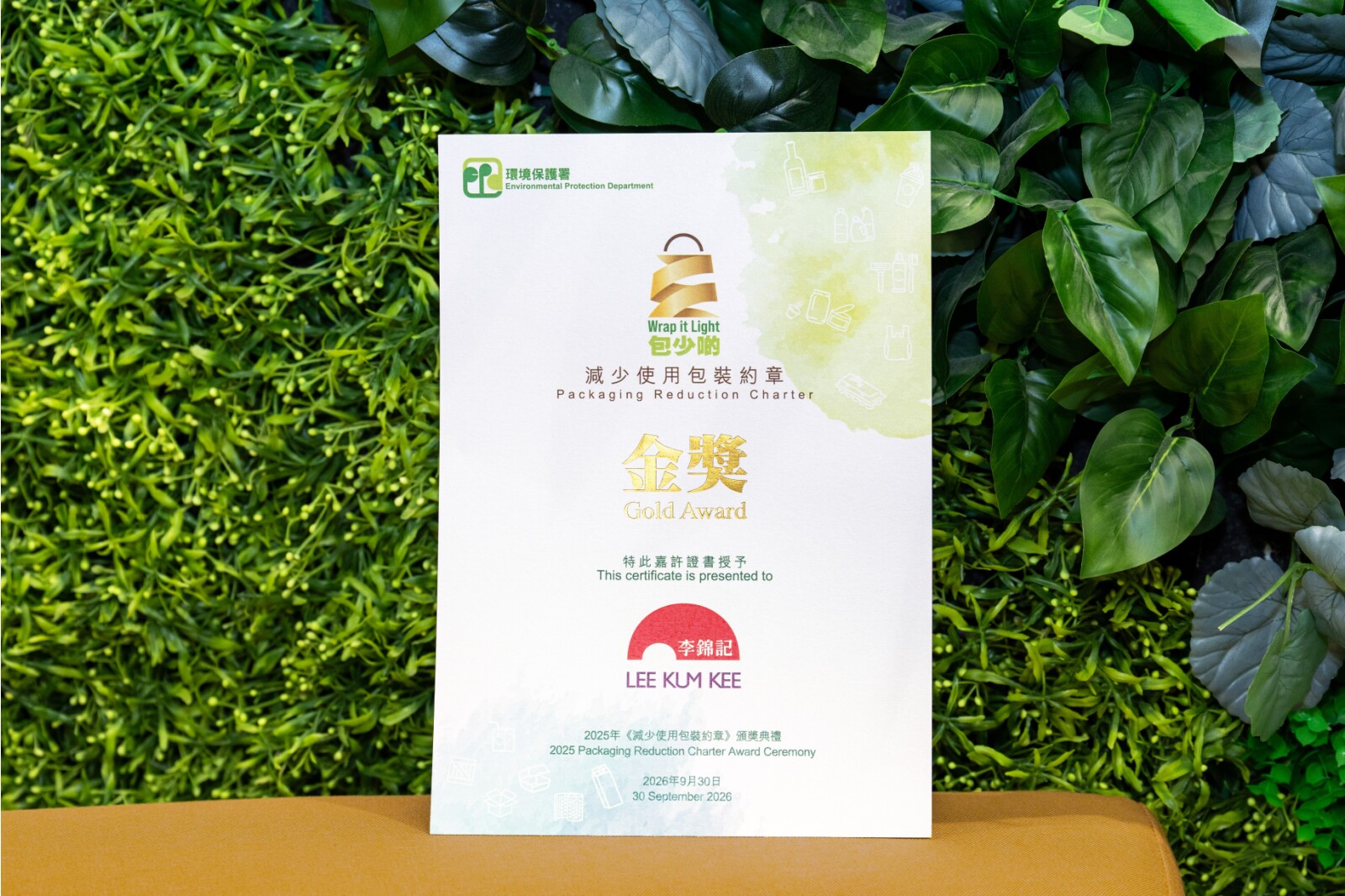
Lee Kum Kee receives the Gold Award in the Packaging Reduction Charter.
Launched by the EPD on 31 March 2025, the Packaging Reduction Charter encourages businesses to reassess and reduce packaging usage, foster a waste-reduction culture in the commercial sector, and support Hong Kong’s long-term goal of carbon neutrality. To date, over 140 companies across sectors including retail, logistics, electronics, and food & beverage have joined, with Lee Kum Kee being one of the first. Participating companies undergo an annual professional assessment for packaging reduction, recyclability, reuse/recycling, sustainability, and promotion of packaging reduction. Lee Kum Kee demonstrated multiple packaging optimisation achievements during the assessment process, ultimately earning the Gold Award.
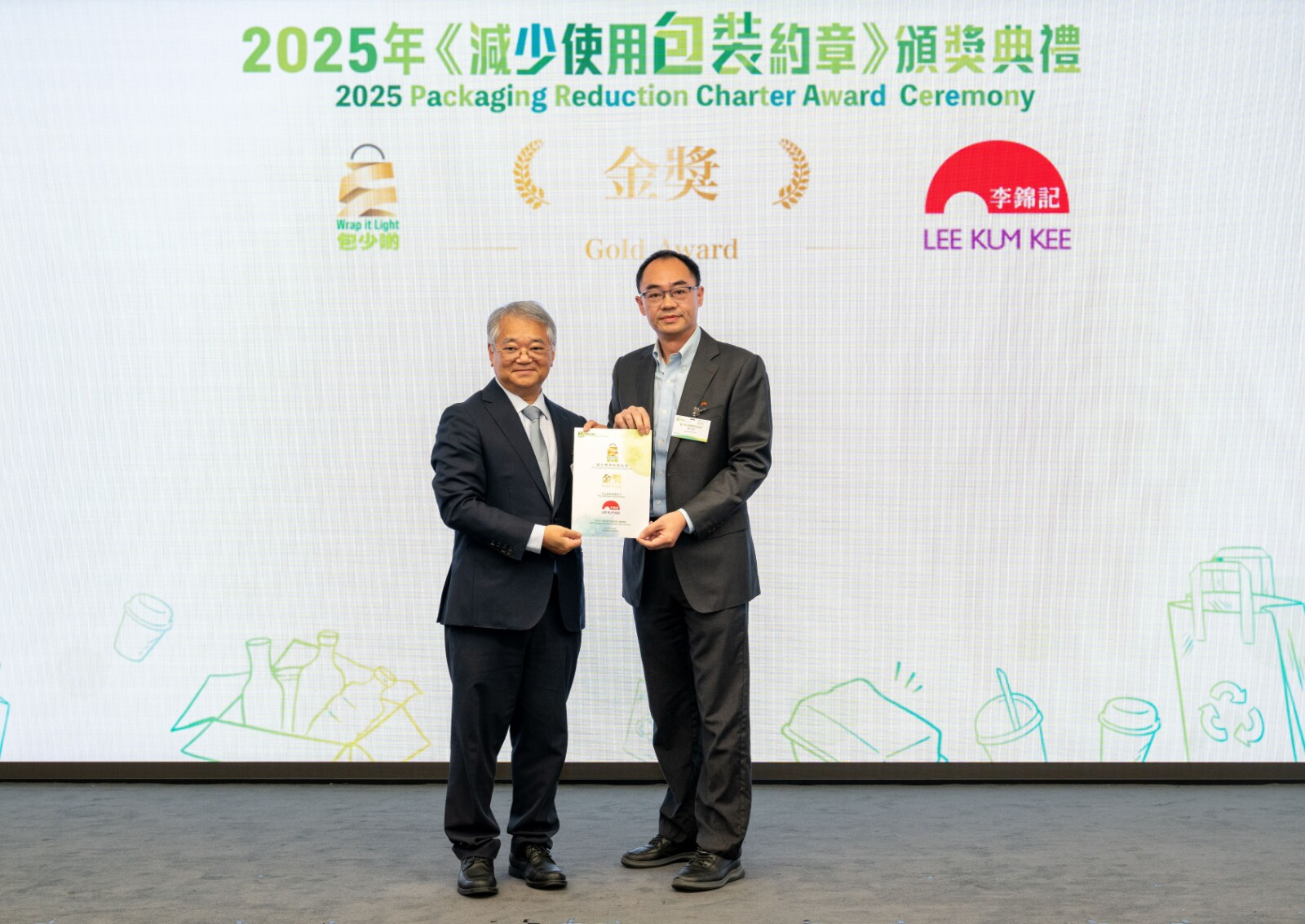
Jan Ling (right), Vice President – Technical Business Development at Lee Kum Kee Sauce receives the award presented by Dr. Chui Ho Kwong, Samuel (left), JP, Director of Environmental Protection Department.
Dodie Hung, Executive Vice President – Corporate Affairs at Lee Kum Kee Sauce, said, “This award is a significant recognition of Lee Kum Kee’s long-standing commitment to sustainable packaging transformation. Guided by our value of ‘Si Li Ji Ren’ (Considering Others’ Interests), we are committed to integrating sustainable development into every aspect of our business operations. Through innovative thinking, we continuously optimise packaging design for greater efficiency and recyclability, delivering high quality, delicious and environmentally responsible products to consumers. Moving forward, we remain dedicated to collaborating with the industry to support Hong Kong’s vision of achieving carbon neutrality.”
Lee Kum Kee continuously refines its packaging with reference to the Practical Guides on Packaging Reduction and Management published by EPD and the Golden Design Rules developed by the Consumer Goods Forum (CGF), driving packaging weight reduction while enhancing recyclability and circular value. Since 2002, Lee Kum Kee has consistently reduced the weight of its glass bottles; for example, in 2025, it cut the weight of its 32-ounce oyster sauce bottles from 410 to 390 grams, saving 10 tonnes of glass throughout the year. Additionally, the company has saved more than 200 tonnes of carton material annually through improved carton designs. Over 95% of packaging materials, by weight, are recyclable.
Lee Kum Kee’s sustainable packaging was featured in the 2026 Golden Design Rules Case Study Booklet during the CGF China Day in early September, confirming that its initiatives align with both local policy directions and international best practices.
For details on Lee Kum Kee and sustainability, please refer to the Lee Kum Kee Global Sustainability Highlights 2025: https://corporate.lkk.com/en/csr Hashtag: #LeeKumKee #LKK
The issuer is solely responsible for the content of this announcement.
About Lee Kum Kee Sauce
Lee Kum Kee Sauce is the global gateway to Asian culinary culture, dedicated to promoting Chinese culinary culture worldwide. Since 1888, it has brought people together over joyful reunions, shared traditions and memorable meals. Beloved by consumers and chefs alike, Lee Kum Kee Sauce’s range of more than 300 sauces and condiments sparks creativity in kitchens everywhere, inspiring professional and home chefs to experiment, create, and delight. Headquartered in Hong Kong, China and serving over 100 countries and regions, Lee Kum Kee Sauce’s rich heritage, unwavering commitment to quality, sustainable practices and “Constant Entrepreneurship” combine to enable superior experiences through Asian cuisine for people worldwide. For more information, please visit www.LKK.com.
About the Packaging Reduction Charter
The Packaging Reduction Charter was launched by the Environmental Protection Department of the Hong Kong Special Administrative Region Government in 2025. The Charter aims to bring together enterprises and organisations to advance sustainable packaging solutions through collaborations, reduce packaging waste, and contribute to Hong Kong’s long-term goal of carbon neutrality. The Charter assesses signatories against five key areas, packaging reduction, packaging recyclability, packaging reuse, sustainable packaging, and promotion of packaging reduction, to recognise companies with outstanding performance. For more information, please visit: www.lesspackaging.hk
BEIJING, Sept. 30, 2026 /PRNewswire/ — A news report from China Daily:
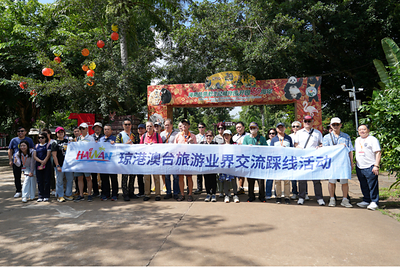
Taiwan tourism industry representatives visited Hainan during a weeklong exchange program from Sept 20 to 26, 2026, joining counterparts from Hainan, Hong Kong and Macao in Haikou on Sept 25 to celebrate the Mid-Autumn Festival.
A total of 79 tourism industry representatives from Hong Kong, Macao and Taiwan gathered in Hainan on Sept 25 — the Mid-Autumn Festival — together with their counterparts from the island province to turn a new page in cross-Strait cultural and tourism cooperation.
Thirty-three guests were from China’s Taiwan region, accounting for over 60 percent of the specially invited delegation and forming a core presence at the event. They represented leading industry bodies including the Travel Agent Association of Taiwan and the Taiwan Self-Drive Travel Association.
They undertook a seven-day, in-depth, round-island inspection tour of Hainan’s tourism sites, marking the longest route and the richest itinerary of the program.
Rising market figures underscore keen interest from Taiwan’s travel trade in Hainan. In the first eight months of this year, the province received 181,800 inbound visits from Hong Kong, Macao and Taiwan, and visits from Taiwan alone stood at 44,000. In 2024, Hainan registered 29,200 overnight visits from Taiwan.
Air connectivity took centre stage during panel discussions. Wu Ying-liang, chairman of the Travel Agent Association of Taiwan, has nearly four decades of experience in the sector and has witnessed Hainan’s transformation firsthand.
Hainan and Taiwan share similar climates, he said, making the island a year-round destination for Taiwanese visitors, while its healthcare and wellness facilities also hold strong appeal. He called on the two sides to work together on themed tourism products and promote two-way travel flows.
He acknowledged, however, that while arrivals from Taiwan keep climbing, growth has not kept pace with that of the 2017-19 period, with limited flight capacity standing as the main constraint.
Before the COVID-19 pandemic, direct passenger flights linked Taipei and Kaohsiung with Haikou, as well as Taipei and Sanya. All services were suspended in 2020 amid the pandemic and other factors, and none have resumed to date.
Taiwanese visitors travelling to Hainan now mostly transit via Hong Kong, and lengthy layovers have dampened the appetite for travel and affected the travel experience. “Restoring direct flights and improving accessibility will undoubtedly bring more Taiwanese visitors to Hainan,” Wu said.
Wey Rong-jinn, chairman of Dollar Travel based in Taiwan’s Kaohsiung, examined the opportunity from a niche-market perspective. Before the pandemic, he recalled, direct flights from Kaohsiung to Hainan took only around two hours. Hainan’s mild winters and high-standard golf courses unlock great potential for golf tourism, he said.
According to incomplete statistics from the Chinese Taipei Golf Association, Taiwan is home to more than one million golf enthusiasts, most of whom travel to Thailand and other parts of Southeast Asia for golf trips.
Should direct flights between Hainan and Taiwan resume, Wey suggested, this pool of golfers could be diverted to Hainan, unlocking substantial new business. “Even attracting 10,000 to 20,000 golfers in the initial phase would produce a remarkable effect,” he noted.
Chen Yi-hsuah, chairwoman of the Taipei Association of Travel Agents, shared practical ideas on leveraging the Mid-Autumn Festival as a seasonal tourism brand.
She sees Hainan as an ideal destination for family reunions during the festival, thanks to its pleasant climate and festive vibe. Cycling and heavy-motorcycle self-drive tours could be developed to cater specifically to corporate clientele from Taiwan, she added.
While showcasing Hainan’s tourism strengths, the Taiwanese delegation also voiced hope that the Hainan Provincial Department of Tourism, Culture, Radio, Television and Sports would press ahead with plans for cultural tourism study tours to Taiwan, to further strengthen exchanges across the Strait.
MUTSAMUDU, Comoros, Sept. 30, 2026 /PRNewswire/ — MEXC, a pioneer in 0-fee digital asset trading, today announced the addition of another 1,000 BTC to its Guardian Fund, marking the second major BTC allocation to the fund this year. The latest addition follows MEXC’s May commitment to expand the Guardian Fund from $100 million to $500 million over two years, further strengthening the fund to keep pace with changing market conditions, security risks, and broader user protection needs.
MEXC Adds Another 1,000 BTC to Guardian Fund, Strengthening User Protection.
Following the latest allocation, the Guardian Fund now comprises 100 million USDT and 2,000 BTC, further strengthening MEXC’s user protection reserves as the digital asset industry continues to face evolving security risks. A series of security incidents across the industry has highlighted the changing risk landscape facing crypto platforms and users. Recent attacks have again demonstrated that security threats are not static, and that user protection requires ongoing investment in capital reserves, technology, and risk-management infrastructure.
MEXC’s first 1,000 BTC allocation in May established Bitcoin as a long-term reserve component of the Guardian Fund alongside liquid USDT reserves. The latest addition marks the next stage of that strategy, reflecting MEXC’s approach to treating user protection as a continuously reinforced system rather than a reserve established at a single point in time. MEXC will continue strengthening the fund as its global user base, asset coverage, and operating environment grow and change.
MEXC has made its Guardian Fund holdings publicly traceable on-chain through disclosed wallet addresses, enabling users to independently verify the reserves. The additional BTC further strengthens the fund as MEXC continues working toward its $500 million target while investing in security, transparency, and risk-management infrastructure designed to protect users over the long term.
“Security and user protection is not a one-time investment. It is a continuous commitment,” said Vugar Usi, CEO of MEXC. “The risks facing digital asset platforms continue to evolve, and the resources behind user protection need to evolve with them. Adding another 1,000 BTC to the Guardian Fund reflects our long-term approach to building stronger protection for users and ensuring that the infrastructure behind that protection continues to grow with MEXC.”
First BTC allocation: 1MDVjZdX8QD212pT8Z8EMP7DuFQHKqN3mx
Second BTC allocation: 19KYQDpyssRUtpfa4pfAWiNQLeysThd1us
About MEXC
Founded in 2018, MEXC is a leading global multi-asset trading platform built as your 0-fee gateway to infinite opportunities. Serving users across 170+ markets, MEXC provides simple and efficient access to crypto, stocks, tokenized assets, derivatives, and a growing range of TradFi-linked opportunities through one account and one gateway.
With 0 trading fees, deep liquidity, broad asset coverage, and a high-performance trading experience, MEXC is designed for retail users who want to discover earlier, act faster, and trade with fewer barriers. As crypto and traditional finance continue to converge, MEXC is committed to making global opportunities more accessible, helping users trade freely and MEXCmize every opportunity.
This content does not constitute investment advice. Given the volatility of financial markets, including digital assets, tokenized assets, and traditional financial products, investors should carefully assess market conditions, underlying asset fundamentals, and potential financial risks before making any investment or trading decisions.
RIYADH, Saudi Arabia, Sept. 30, 2026 /PRNewswire/ — Dar Global, the London-listed luxury international real estate developer, recently announced its unaudited interim results for the six months ended 30 June 2026 (HY 2026), reporting a 66% revenue increase to US$258.0 million (HY 2025: US$155.4 million). The performance was driven by the Group’s projects and sustained demand across its diversified portfolio in the GCC, Europe, and the UK.
DAR GLOBAL DELIVERS 66% REVENUE GROWTH IN HY 2026 AS PORTFOLIO GDV REACHES US$23BN
Gross profit rose 85% to US$87.7 million, expanding margins to 34% (from 31%). EBITDA increased 73% to US$46.3 million, while net profit surged 149% to US$30.4 million (HY 2025: US$12.2 million). Growth was anchored by revenue recognition from landmark projects, including The Astera, Interiors by Aston Martin and Neptune, Interiors by Mouawad.
Gross Development Value (GDV) nearly doubled year-on-year to US$23.0 billion, while cumulative contracted sales rose to US$3.9 billion across 4,380 units. The Group maintained a robust balance sheet with a Net Asset Value of US$613.3 million and total cash balances of US$847.9 million, including US$231.6 million in free cash, supporting total available liquidity of US$579.3 million.
In Saudi Arabia, the Group partnered with The Trump Organization in January to launch Rayana, a 2.6 million sq. m gated community in Diriyah featuring luxury mansions and a championship golf course, and later awarded a SAR 338 million (~US$90 million) infrastructure contract to Compass and Bin Omairah Company. Dar Global also unveiled Trump Plaza Jeddah (GDV US$383.6 million) and the adjacent Padel Living Residences (GDV US$142 million) within the Amaya masterplan.
In April, the Group closed a US$250 million syndicated term loan facility. In August, following the period, Dar Global appointed Gulf Asia Contracting to execute podium construction for the 80-storey, ~350-metre Trump International Hotel & Tower on Dubai’s Sheikh Zayed Road.
Ziad El Chaar, Chief Executive, commented: “We have delivered a resilient performance through uncertain times in the region, supported by the quality of our international portfolio. Buyer demand across our markets remained robust. Looking ahead, we remain focused on growing our GDV across both existing and new growth markets, while maintaining a disciplined focus on execution and delivery. With a strong balance sheet, disciplined capital management and a healthy project pipeline, Dar Global is well positioned to continue creating long-term value for its stakeholders.”





 www.LKK.com