Home Blog Page 426

Officials Link Pig Farm Wastewater to Mass Fish Deaths in Vientiane Province

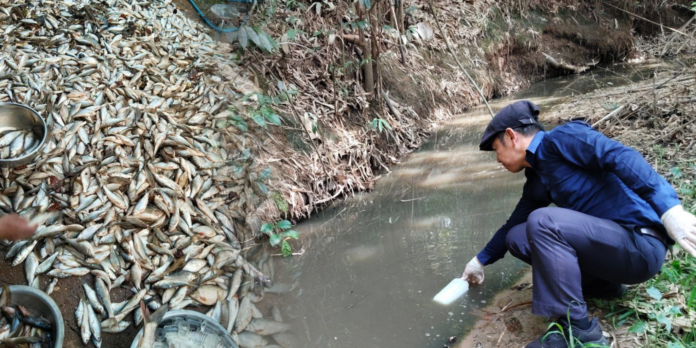
A picture of the authority from Agriculture and Environment checking and testing water quality at Nam Cheng river. (Photo by Agriculture and Environment News)

Authorities in Vientiane Province have identified untreated wastewater from a pig farm as the primary cause behind the mass fish deaths reported along the Nam Cheng river in Viengkham and Phonhong districts earlier this month.

The incident occurred after heavy storms and rainfall between 7 and 8 May, when residents observed and reported the water turning dark black and muddy, accompanied by a strong foul smell, while large numbers of fish were found dead as well. 

According to findings released by the Department of Natural Resources and Environmental Inspection on 11 May, officials conducted field inspections together with relevant departments to collect water samples from three locations.

Laboratory analysis found that water quality levels had exceeded national environmental standards. As a result, pH levels reached between 9 to 11, indicating highly alkaline and toxic conditions unsuitable for fish. 

Dissolved oxygen levels also dropped below standards for sustaining fish and other aquatic species.

Officials pointed out the polluted water contained large amounts of waste, which consumed oxygen in the stream as it broke down. This caused the water to smell bad and left fish and other aquatic animals struggling to live. 

Following on-site inspections, officials identified the most likely source of pollution was wastewater discharged from the Zhang Weixing breeding and commercial pig farm project, according to the official Facebook page of the Lao Ministry of Agriculture and Environment.

According to the page, untreated pig waste overflowed from the farm’s final wastewater pond after heavy rainfall and flowed directly into Nam Tao Reservoir before entering the Nam Cheng river.

In response, the Vientiane provincial authorities have temporarily suspended the pig farm’s operations while authorities review its environmental management systems.

Officials also announced additional measures, including expanded water quality monitoring, inspections of businesses operating along the river, environmental risk assessments, and legal investigations into those responsible for the pollution and environmental damage.

Second Major River Pollution Case in Weeks

The Nam Cheng pollution case comes just two weeks after another major fish death incident was reported along the Xe Don River in Salavanh and Champasak provinces.

On 2 May, Lao authorities concluded that wastewater discharged from the Khounmeexay Khongsedone Cassava Starch Factory caused hundreds of fish deaths after untreated wastewater was released directly into the river.

Officials said the pollution significantly reduced oxygen levels in the water, while pH levels reached 11.3, making conditions impossible for fish to survive.

Authorities later suspended the factory’s operations as legal and environmental investigations continued. Residents living near the river were also advised not to consume dead fish or use river water until conditions returned to safe levels.

Doremi3babies Helps Hong Kong Parents Choose the Right Caraz Playmat Size Amid Limited Living Space


HONG KONG SAR – Media OutReach Newswire – 18 May 2026 – Doremi3babies is one of Hong Kong’s most comprehensive retailers of Caraz baby playmats and playpens, with years of accumulated experience serving local families and maintaining quality standards for every product carried. Observing that size mismatches are among the most common issues parents encounter after purchase, Doremi3babies has drawn on its local service experience to compile a practical size selection reference based on actual Hong Kong residential floor areas, helping parents identify the most suitable mat size and playpen configuration for their home.

Space Is Limited in Hong Kong Homes — Choosing the Right Size Matters
According to Hong Kong’s Census and Statistics Department 2021 Population Census, the median per capita residential floor area stands at approximately 172 sq ft. The latest Housing Bureau supply statistics (2025) show that 88% of private residential units currently in the development pipeline have a usable area of less than 70 square metres (approximately 753 sq ft). In a space-constrained home, a playmat that’s even slightly misjudged in size can disrupt daily living — making preparation before purchase all the more important.

4 Steps to Choosing the Right Size
The following steps help parents confirm their needs before buying, reducing the chance of a mismatch after the mat arrives home:
1. Measure the net usable area: Measure the actual spot where the mat will be placed — deducting furniture and walkways from the total floor space, not the overall unit size.
2. Consider your baby’s developmental stage: Crawling infants (approx. 4–10 months) need continuous flat surface area; toddlers (approx. 10–18 months) benefit more from playpen boundaries to define a safe zone.
3. Decide whether to pair with a playpen: If combining a mat with a playpen, calculate the usable area inside the playpen — not the mat’s outer dimensions.
4. Choose the style based on your confirmed space: Once space constraints are clear, foldable or modular designs help maximise what’s available.

A General Size Reference Based on Unit Floor Area
One of the most common mistakes Hong Kong parents make when buying a playmat is estimating size based on the total unit area, rather than the net usable floor space after accounting for furniture. The gap between the two is often what leads to a mismatch once the mat arrives home.

Caraz playmats, for example, offer a range from compact sizes suited to a corner of a single room, through to larger formats that can cover the main activity zone of a living area. Using net usable floor area as the starting point, the general reference is as follows:
* Under 200 sq ft: A mat around 70×140cm is a common starting point. The foldable design is especially practical — it can be stored upright against a wall when not in use, freeing up the living space.
* 300–400 sq ft: Mid-size options such as 120×160cm to 140×200cm are the most common choice among Hong Kong families, balancing play space with storage flexibility.
* 400 sq ft and above: Larger formats such as 160×200cm or above give infants a dedicated zone for crawling and first steps without compromising daily living.

If a playpen is being added alongside the mat, the playpen’s overall outer footprint needs to be estimated separately — it cannot be read directly from the mat dimensions alone.

Three Practical Directions for Compact Homes
For families with limited floor area, these approaches are worth considering:
* Choose a foldable mat: Fold it away when not in use to free up everyday living space.
* Consider a modular playpen system: Adjustable configurations adapt to irregular room layouts without being locked into a fixed size.
* Base your size decision on net usable area: The right standard is whether it fits and gets used — not simply bigger is better.

Hashtag: #Doremi3babies

The issuer is solely responsible for the content of this announcement.

About Doremi3babies

Founded in Hong Kong in 2017, Doremi3babies is Hong Kong’s most comprehensive Caraz retailer, offering the full product range — playmats, playpens, and baby houses — with new arrivals in sync with the Korean market. The company has served over 6,000 families and delivered more than 16,000 baby products, with every item personally tested by the store owner before introduction. All Caraz products are manufactured in Korea and meet KC and CE international safety certification standards.
For more playmat size recommendations, visit the.

CK Life Sciences’ Sequencio Therapeutics Appoints Emily Tan as Chief Operating Officer


HONG KONG SAR – Media OutReach Newswire – 18 May 2026 – Sequencio Therapeutics, a subsidiary of CK Life Sciences Int’l., (Holdings) Inc. (“CK Life Sciences”, Stock Code: 0775) today announced the appointment of Emily Tan as Chief Operating Officer. A 30-year biopharmaceutical veteran, Ms Tan will oversee the company’s global operations and drive execution across its development pipeline.

Ms Tan joins Sequencio Therapeutics with an extensive track record across global pharmaceutical companies, leading contract research organisations, and innovative biotechnology companies, bringing deep expertise in clinical development, operations, quality, regulatory execution, and commercial strategy.

Ms Tan most recently served as Senior Vice President, Business Development at IQVIA, where she led commercial activities in Asia Pacific and supported clients in developing and executing global integrated go-to-market strategies.

Her career includes C-suite roles at China-based biotech startups Unixell Biotechnology, Bennu Biotherapeutics, and Oricell Therapeutics, where she scaled operations and led successful global Investigational New Drug (IND) and China Investigator-Initiated Trial (IIT) submissions. She previously held leadership positions at PAREXEL, Syneos and Pfizer.

“Emily brings a rare combination of operational excellence, clinical development experience, and regional and global leadership,” said Dr Melvin Toh, Vice President and Chief Scientific Officer of CK Life Sciences. “Her appointment strengthens Sequencio Therapeutics’ leadership team as we advance our pipeline and build the operational foundation to support our next stage of growth.”

“I am excited to join the Sequencio Therapeutics team at this important stage of its development,” said Ms Tan. “Building on the company’s strong scientific foundation, I look forward to strengthening operational capabilities and supporting the continued advancement of the pipeline.”

Ms Tan holds a Bachelor of Science in Pharmacy (Honours) from the National University of Singapore and a Master of Science in Epidemiology from the London School of Hygiene and Tropical Medicine.
Hashtag: #CKLifeSciences #Sequencio #Therapeutics #COO #ChiefOperatingOfficer #CancerVaccines #R&D #Pharmaceutical #Biotechnology

The issuer is solely responsible for the content of this announcement.

Sequencio Therapeutics Company Limited

Sequencio Therapeutics Company Limited, a subsidiary of CK Life Sciences Int’l., (Holdings) Inc., is focused on developing next‑generation therapeutic cancer vaccines that harness a patient’s own immune system to achieve durable, long‑term remission with a favourable safety profile, addressing key limitations of current standard‑of‑care therapies. Sequencio Therapeutics is driven by a long‑term vision to shift cancer treatment from transient tumour reduction toward sustained, immune‑controlled remission.

Beyond the Hype: AI+ Power 2026 Explores How AI Drives Real Business Value

Tech Giants Microsoft, Adobe, BytePlus, HP, and iFLYTEK Headline the Event; Over 10,000 Professional Visits Expected to Bridge the “Deployment Gap” through High-Impact Exhibitions, Strategic Summits, and Hands-on Skills Labs


HONG KONG SAR – Media OutReach Newswire – 18 May 2026 – 2026 represents a definitive turning point as Artificial Intelligence transitions from experimental “pilot” phases to industrialized, enterprise-scale implementation. AI+ Power 2026, Hong Kong’s premier exhibition & conference for commercial AI applications, returns to the Hong Kong Convention and Exhibition Centre (HKCEC) from 4-5 Jun 2026. Now in its sixth edition, the event actively responds to the HKSAR Government’s “AI+” development strategy. Under the theme “AI+ Power in Action,” the expo focuses on how AI creates value and unlocks new market opportunities for enterprises. By showcasing a diverse array of AI solutions on-site, the event empowers businesses to remain competitive in an increasingly challenging business environment.

The 2026 Enterprise Imperative: Beyond Prompting – Agentic AI Enters the Era of Autonomous Execution

For today’s business leaders, the challenge is no longer understanding AI — it is choosing the right tools and applying them effectively. According to Gartner’s 2026 Strategic Trends, the enterprise landscape has moved beyond the initial GenAI hype into the era of Agentic AI — autonomous systems capable of independent decision-making and workflow execution. While most enterprises have begun AI deployment, the ultimate differentiator for 2026 is achieving the transition from “conversation to execution” and securing a measurable Return on Investment (ROI).

Culsin Li, Founder and Chief Visionary Officer of AI+ Power, noted: “In 2026, the most critical executive skill is becoming leaders who can strategically direct AI adoption. With AI applications entering the ‘no-code’ era, technical implementation is no longer the primary hurdle; the focus for leadership returns to the core of business: identifying operational pain points and defining strategic needs. AI+ Power 2026 serves as a premier platform where attendees can gain insights from expert-led case studies and source ready-to-deploy AI solutions to immediately resolve bottlenecks. We provide a comprehensive one-stop ecosystem, enabling decision-makers to transition seamlessly from strategic inspiration to procurement and final implementation.”

AI+ Power 2026 features six high-impact pillars designed to accelerate AI adoption:

Pillar 1: AI+ Summit – Strategic Roadmaps for Vertical Transformation

The AI+ Summit features a formidable roster of global pioneers, including Microsoft, HP, Adobe, BytePlus, and iFLYTEK, who will dissect the shift from smart office revolutions to autonomous AI agents.

To address the critical pillars of corporate governance and financial practice, the Summit has curated two flagship strategic forums:

  • CEO Panel: AI Transformation for Hong Kong’s Legacy Leaders — Moderated by Dr. Toa Charm, Chairman of the Data and AI Literacy Association (DALA), this session explores how C-suites navigate AI strategy and talent governance while balancing technological innovation with business value creation. It also examines how leaders can accelerate the scalable adoption of AI across Hong Kong, the Greater Bay Area (GBA), and Asia to ensure AI visions translate into tangible organizational impact.
  • FinTech 2.0: From Future of Work to Agentic Workflows — Moderated by Mr. Peter Koo, Convenor, FinTech Specialist Group of Hong Kong Computer Society. Partners from the “Big 4” (EY, Deloitte, KPMG, and PwC) will share the stage for a rare joint session to dismantle how Agentic AI automates KYC and risk monitoring, and explores “Data-to-Revenue” pathways. The forum will also address the convergence of AI with Tokenisation, Stablecoins, Digital Assets, and RegTech.

The Summit will also cover MarTech, enterprise productivity, retail, and education, featuring leaders from MTR Lab, HSBC, Maxim’s Group, Hong Yip, HKT, PrimeCredit, and Logitech, alongside academic representatives.

Pillar 2: AI+ Expo – The Modern Workplace & Smart Living Revolution

Industry leaders Canon HK, Logitech, Shure, and iFLYTEK will demonstrate how AI-driven hardware eliminates operational friction, allowing teams to focus on core creativity.

Pillar 3: AI+ Skills Lab — Zero-Barrier Mastery for Decision Makers

To address the enterprise talent gap, the AI+ Skills Lab has been launched this year to provide hands-on, practical training. Led by a team of veteran practitioners including Arik Chan from GDG HK (CISSP-certified), Frankie Wu from GDG HK and also Founder of Nexamind AI, and Roland Leung, Director of Datality Lab, the lab is tailor-made for non-technical decision-makers. It emphasizes a “small-class, laptop-ready” approach; featured highlights include OSINT-driven fraud detection using Google Gemini, the deployment of privacy-safe enterprise AI agents, and rapid AI-powered commercial video creation using Seedance 2.0 and KlingAI 3.0. This practical experience empowers participants to “Learn Today, Apply Tomorrow,” transforming AI into real-world productivity.

Pillar 4: Embodied AI & Robotics — The First “Smart Living Experience Zone”

Breaking away from pure software solutions, the event debuts the first “Smart Living Experience Zone,” presenting the physical manifestation of AI integrated with robotics in environmental management, medical rehabilitation, and gerontech. Highlights include environmental robots capable of automatic waste classification and autonomous cleaning; medical assistant systems for physical therapy and ward delivery; and non-invasive “passive fall detection” care solutions. These innovations are setting new benchmarks for automated operations across the property management, healthcare, and social welfare sectors.

Pillar 5: AI Strategic Advisory Hub & Industry Networking — Unlocking New Business Opprtunities

The event proudly presents the “AI Strategic Advisory Hub,” a flagship initiative designed to disrupt the traditional one-way nature of business matching. Technical experts from leading providers will transform into “Consultants”, offering decision-makers immediate diagnostics and tailored deployment advice. Navigating a vast array of technical choices can be overwhelming; this “Advisory Hub” is dedicated to helping enterprises pinpoint high-ROI implementation pathways, ensuring that technology investments translate directly into tangible profitability. Furthermore, the two-day event features exclusive industry networking sessions to foster deep dialogue and strategic exchanges between technology pioneers and enterprise leaders.

Pillar 6: AI+ Power Awards 2026 — Recognizing the Future Leaders of Commercial AI

The AI+ Power Awards 2026, a highly anticipated flagship event, returns to honor the region’s most innovative, impactful, and commercially viable AI applications. This year has seen an unprecedented level of competition, and the first-round finalists have officially been announced. Shortlisted organizations in key categories such as “AI+ in Business” and “AI+ Project of the Year” include industry pioneers such as Maxim’s Group, CITIC Telecom CPC, iFLYTEK, ASTRI, and Lingnan University. The final winners will be grandly unveiled in late May.

Capturing the Momentum of AI Scaling: Building a New Era for Innovation

AI+ Power 2026 responds proactively to the HKSAR Government’s “AI+” strategy, embodying the core spirit of “AI+ Power in Action.” We are committed to transforming policy vision into commercial reality, helping enterprises successfully transition from AI “observers” to “active practitioners.”

Through high-level summit exchanges, immersive exhibition experiences, step-by-step practical training, and prestigious award recognition, we empower every attendee to seize first-mover advantages in the age of AI scaling. Together, we are driving Hong Kong’s evolution into the premier Asia-Pacific hub for commercial AI innovation.

Secure Your Advantage: Register Now

Online pre-registration for AI+ Power 2026 is now officially open. Trade visitors and industry professionals are invited to register for free admission and pre-book seats for keynote summits and hands-on Skills Lab workshops. Please note that workshop seating is limited and available on a first-come, first-served basis.

Register Now: https://bit.ly/3R9W3fC

Event Details:

  • Date: 4-5 June 2026 (Thursday–Friday)
  • Venue: Hall 5FG, Hong Kong Convention and Exhibition Centre (HKCEC)
  • Admission: Free for trade visitors (Pre-registration required; group registration available)
  • Official Website: www.aipluspower.com

Hashtag: #AIPower #AIPower2026

The issuer is solely responsible for the content of this announcement.

About AI+ Power’s Organizer – Baobab Tree Event Management Co., Ltd.

Baobab Tree Event Management Co., Ltd. (BTE) is a Hong Kong–based event and exhibition organizer founded in 2011, with offices in Guangzhou, Shanghai, and Beijing. With over 20 years of industry experience, the company specializes in event management, exhibition operations, marketing, sales, and on-site delivery.

The company manages the delivery of Hong Kong’s signature mega events, including the Hong Kong Chinese New Year Parade and the Hong Kong Wine & Dine Festival, both organized by the Hong Kong Tourism Board, while also developing and managing professional exhibitions across multiple industry sectors such as AI and digital technology, Food & Beverage, Veterinary, Non-Woven, Professional AV, and PCB & electronics manufacturing, serving regional and international markets.

Committed to sustainable development, the company integrates ESG principles into its operations and has completed an independent ESG assessment, achieving Level 1 status under an assessment framework developed by the The University of Hong Kong and ESG Development Co., Ltd.

Official website:

Philanthropy Deployed as Risk Capital Holds Potential to Scale Early-Stage Innovations in Asia, New Report Finds

  • Asia’s development challenges are outpacing conventional funding models, with early-stage, high-risk innovations chronically underfunded
  • Philanthropy Asia Alliance and Centre for Asian Philanthropy and Society’s new research explores how Asian funders are bridging this gap, and the lessons to scale impact across the region

SINGAPORE – Media OutReach Newswire – 18 May 2026 – A new report released today at the sixth Philanthropy Asia Summit highlights what becomes possible when philanthropy in Asia is deployed as risk capital: funding that absorbs the risks of unproven solutions that governments are unable or unwilling to back, markets cannot yet price, and social innovators cannot bear alone. It also sets out what it will take to scale this approach and accelerate impact across the region.

The report spotlights 10 cases spanning climate, health, housing, water, waste, and digital inclusion where philanthropic risk capital underwrote the earliest and riskiest stages of social innovation. These range from sustainable housing and carbon removal technologies to public health interventions, with early backing helping solutions attract follow-on funding and achieve adoption within public systems. Collectively, these efforts have reached more than 210 million people across 13 Asian economies, a scale that demonstrates the model’s potential, even as these cases represent only a small fraction of the region’s needs.

“Philanthropy as Risk Capital in Asia: Bridging Innovation to Impact“ was researched and written by the Centre for Asian Philanthropy and Society (CAPS) and commissioned by the Philanthropy Asia Alliance (PAA). Drawing on 10 case studies and 37 in-depth interviews with philanthropists, fund managers, social enterprise founders and programme leads across 13 markets, the report explores how and when Asian philanthropy functions as risk capital, and its potential to address development challenges in Asia at scale. It also examines what drives funders to take these risks, how capital is deployed across different instruments and stages of innovation, and the strategies used to manage risk while maximising impact.

Key findings
The findings point to several consistent patterns in how Asian philanthropists featured in the study approach early-stage risk:

  • Philanthropy as risk capital in Asia is often patient and conviction-driven; funders are prepared to commit long-term capital to enable solutions to scale. The largest and longest commitments came from individual philanthropists and families driven by personal conviction and direct experience of the challenges they seek to address. For example, The Tahija Foundation in Indonesia provided more than US$17 million over ten years to test a novel approach to dengue control using Wolbachia bacteria. A randomised controlled trial demonstrated a 77% reduction in dengue transmission, and the method has since been adopted into Indonesia’s national health plan, with an estimated 14 million people now protected. Institutional funders complement this with more targeted, milestone-linked discipline and deep trust in founders.
  • Funders are experimenting beyond traditional grants to explore a range of instruments across different growth stages. From concessional debt to equity, funders are exploring instruments across the spectrum, with some sequencing different forms of capital as trust and results develop over time. However, knowledge gaps and regulatory constraints in some markets continue to limit broader adoption.
  • Funders are leveraging relationships, community trust and government access to manage risk and extend reach. They bring networks, credibility, and access to government stakeholders alongside capital, reducing implementation risk and laying the groundwork for long-term partnerships. The funder’s proximity to the communities they serve, and alignment with domestic policy priorities, can prove as consequential as the funding itself.
  • Funders are supporting alignment with public sector priorities from the outset, as early integration with public systems matters when government adoption is the pathway to scale. The projects that achieved the greatest reach did so through early engagement with government, with funders helping to align solutions with national or local priorities from the outset. For example, the Vanke Foundation made community waste management a thematic priority in support of China’s zero-waste city ambitions, and backed INSPRO, a social enterprise using insect-based bioconversion to recycle organic waste. Beyond funding, the foundation facilitated access to district government stakeholders, enabling INSPRO to establish operations in Yantian and scale its technology for agricultural use. Similarly, Tata Trusts aligned its digital initiatives with the Government of India’s Digital India programme, providing early-stage funding and ecosystem support to Haqdarshak, a platform improving access to government welfare schemes.

“For these Asian philanthropists deploying capital to support early-stage innovation, we observe how trust in the capabilities of the people behind the ideas is critical to managing these risks,” says Dr. Ruth Shapiro, Co-Founder and CEO of CAPS. “And we see the importance of aligning with government as key to legitimacy and scale. The same strategies to manage risk are being leveraged to maximise impact for the community.”

“The report highlights what makes early philanthropic capital unique,” said Shaun Seow, CEO of PAA. “Taking an early position absorbs the risk of an untested solution and builds the evidence and regulatory confidence that later investment requires. PAA’s role is to help connect funders across the region so those early commitments compound rather than sit in isolation.”

Research methodology
The findings are based on a region-wide scan of social enterprises, programmes, and initiatives centred on novel or unproven solutions. Ten cases were selected through a targeted assessment identifying high-potential pathways for philanthropic risk capital across climate, health, and inclusive development. The research was conducted between October 2025 and January 2026, through 37 in-depth interviews and a review of academic and non-academic literature.

The cases examined include Agros, BillionBricks, Equatic, Haqdarshak, Inspro, Seven Clean Seas, Urban Spring, Wadhwani AI, Wateroam, and the World Mosquito Programme in Yogyakarta.

Download the full report: https://p-aa.org/PhilanthropyAsRiskCapitalReport (Live on 18 May)

The issuer is solely responsible for the content of this announcement.

About Philanthropy Asia Alliance (PAA)

Philanthropy Asia Alliance (PAA) is a Temasek Trust initiative dedicated to catalysing collaborative philanthropy in Asia through dynamic multi-sector partnerships. By harnessing collective strengths, PAA multiplies impact, accelerates positive change, and takes urgent action to address the pressing environmental and social challenges of our time. PAA’s flagship programme is the annual Philanthropy Asia Summit. For more information, visit

About the Centre for Asian Philanthropy and Society (CAPS)

Established in 2013 and working across more than 17 economies in Asia, the Centre for Asian Philanthropy and Society (CAPS) is a nonprofit organization committed to improving the quantity and quality of philanthropic and private giving throughout Asia. Our mission is to maximize private capital for public good, conducting research, advisory, convening and capacity building to engage philanthropists, foundations, family offices, corporates, government bodies, social sector organizations and experts on best practices, models, policies and strategies to facilitate private giving and social investment in the region. For more information, and .

New Report Identifies 250+ Climate Adaptation and Resilience Solutions for Asia Amidst Rising Funder Interest

  • Asia-focused report by the Centre for Impact Investing and Practices (CIIP) and collaborators identifies 250+ priority climate adaptation and resilience solutions for Asia,[1] based on over US$100 billion in financing flows over 5 years[2]
  • Study’s survey of 165 Asian funders managing over US$1 trillion in funds finds climate adaptation and resilience emerging as top impact theme by activity and interest
  • Report introduces a first-ever framework to mobilise coordinated action, mapping solutions across 3 tiers of commercial viability, highlighting entry points for commercial, philanthropic, and public capital to enable cross-sector climate adaptation action
  • Accompanying fund flows dashboard provides visibility on public, private and philanthropic capital flows and funding gaps in climate adaptation and resilience across China, India, and Southeast Asia

SINGAPORE – Media OutReach Newswire – 18 May 2026 – The Centre for Impact Investing and Practices (CIIP), in partnership with Temasek, Invesco, and ImpactSF (CGIAR Hub for Sustainable Finance), and with support from Dalberg, today launched a new report on climate adaptation and resilience (CA&R) in Asia. This regional study identifies more than 250 priority climate adaptation and resilience solutions for Asia, grounded in the region’s unique climate risks, hazards, and priorities, and informed by analysis of over US$100 billion in climate adaptation and resilience financing flows between 2021 and 2025.[3]

Launching at Ecosperity Week’s Impact Investing Roundtable 2026 on 19th May, the report “Climate Adaptation and Resilience in Asia: Pricing Risk, Sizing Opportunities, Financing Solutions” examines the region’s climate risks, financing gaps, and barriers constraining investment in adaptation and resilience solutions. This includes persistent data gaps, limited visibility of investable opportunities, and unclear financing pathways.

The CA&R solutions for Asia span three tiers of commercial viability. These include 94 low or no commercial viability solutions but which are foundational in terms of building regional resilience, 93 emerging opportunities that are promising but need catalytic capital to scale, and 65 commercially viable solutions that have proven track record across markets. Together, they offer clear entry points across the spectrum of capital to support solutions at different stages of maturity — from early-stage innovation and ecosystem development to scaling proven technologies and infrastructure.

Accompanying the report are:

  • A first-of-its-kind fund flow intelligence dashboard mapping public, private and philanthropic capital flows across China, India, and Southeast Asia (SEA) and impact opportunities
  • The Climate Adaptation and Resilience in Asia Case Study Library featuring 50 real-world examples of companies, financial institutions and philanthropies advancing CA&R in respective ways.
  • A sectoral deep dive, Building a Climate-Adapted and Resilient Agri-Food System in Southeast Asia, focused on agri-food resilience in SEA – a top priority across the region’s National Adaptation Plans

“Climate adaptation and resilience financing in Asia remains constrained by limited data, fragmented approaches, and uncertainty around where capital can be most effective. We hope this report helps to provide greater clarity on the opportunities and roles different stakeholders can play in advancing solutions across the region. As climate risks intensify, stronger coordination between public, private, and philanthropic capital will be essential to accelerate action,” said Ms. Dawn Chan, CEO, Centre for Impact Investing and Practices.

Rising climate risks, widening financing gap

As a region, Asia is warming at twice the global average. Since 2000, 3.7 billion people in Asia have been affected by climate-related disasters – more than triple that in the rest of the world. These risks are already translating into significant economic and social costs.

By 2030, Asia will account for around 75% of the global CA&R financing gap, and Asian companies are projected to bear around US$336 billion in annual climate costs.

Despite this, annual CA&R financing flows in Asia remain significantly below current funding needs. More than US$200 billion is required annually across the region, yet current flows stand at only around US$19 billion.

Agriculture is among the sectors most significantly affected by climate change. While the sector contributes 9.8% to SEA’s GDP, average annual production growth of key staple food[4] has remained below 1.3% over the past decade. Climate stress could reduce crop yields by as much as 41%, with much of the burden and impact of declining production falling on the region’s 100 million smallholder farmers, many of whom live on less than US$2 a day.

“Impacts of climate risks vary according to crop or livestock, where they are and when the risk is going to be experienced. This determines the necessary strategy required for resilience uplift. ImpactSF uses CGIAR produced scientific data along with AI-based approaches to support investment processes in risk identification and mitigation and impact reporting for investees. This is extremely critical because if risks are ignored, they will eventually impact the financial bottom line of businesses in the agriculture and food sector,” said Dr. Godefroy Grosjean, Co-Lead, CGIAR Hub for Sustainable Finance (ImpactSF).

Barriers to unlocking capital

Several structural barriers constrain capital deployment into CA&R. These include underdeveloped policy and regulatory environments; limited access to data on local climate, risk, and costs; and mismatches between solutions and the funding available.

Many CA&R solutions are also highly context-specific, making them harder to implement at scale and require longer investment periods. This calls for coordinated action across the spectrum of capital.

“While it’s clear that investing for climate adaption and resilience is still at a nascent stage, the critical work of identifying barriers, assessing commerciality and mapping context-specific investment opportunities is a major step forward that can move investors from exploration to tactical implementation. This analysis helps bring greater transparency to where capital is most needed across Asia, and where investable opportunities may be emerging,” said Mr. Norbert Ling, Head of Fixed Income Portfolio Management, APAC, Invesco

From fragmented responses to coordinated action

Promisingly, funder interest is growing. Among 165 Asia funders surveyed by this study, CA&R ranks as the leading impact theme, with 81 funders (49%) already actively investing and 47 (28%) exploring entry into the space. Collectively, these 165 funders represent over US$1 trillion in Annual Funds Managed (AUM).

Translating interest into capital deployment, however, requires addressing key constraints faced by funders. Pipeline challenges are the top concern for both active or interested funders, as well as inactive funders in this space. Macro-level challenges and deal structuring are also key issues for active or interested funders, while main barriers for inactive funders include limited mandate to invest in the space, alongside knowledge and capacity gaps. Addressing these requires a comprehensive approach that strengthens business models, de-risks projects, and builds capacity and data systems.

Seven key building blocks

Recognising the multifaceted needs of the sector, this report sets out a roadmap for scaling CA&R finance in Asia through seven key actions. These include

  • Catalysing action
    • Embedding climate adaptation as both a value and growth driver
    • Strategic capital mobilisation across the spectrum
  • Improving decision-making
    • Better climate-risk pricing and valuation of resilience
    • Impact-linked decision pathways
    • Shared data and knowledge infrastructure
  • Laying the foundations
    • Climate-aligned financial system
    • Cross-sector collaboration and delivery for scale

Further details are set out in the appendix.

For more insights, access the report highlights here. The full report and fund flow dashboard will be available from 19 May.

APPENDIX

7 key building blocks for building lasting CA&R at scale

Catalyse Action

1. CA&R as growth engine and value driver. Investing in CA&R for business operations is not only a defensive strategy but can also unlock new markets and improve competitive advantage. Embedding CA&R into BAU and scaling investable solutions today can help build momentum for broader industry and system transformation.

2. Strategic capital mobilisation across the spectrum. Financing CA&R requires leveraging all forms of capital. Blended and innovative finance can help unlock investment, but only when grounded in strong fundamentals. Successful deployment depends on viable business models, robust data, and execution capacity.

Inform Decisions

3. Climate risk pricing and resilience valuation. Climate risks and resilience benefits, including avoided losses and induced economic, environment, and social impacts, remain systematically undervalued today, distorting investment decisions. Embedding avoided losses and broader impacts into pricing and valuation is key to unlocking capital at scale.

4. Clear impact-linked decision pathways. Clear impact pathways are essential to crowd in capital for CA&R. Given contexts across Asia require that solutions that are highly local and diverse, scaling requires credible causal pathways from action and investment to resilience impact, such as those anchored in a Theory of Change (TOC) and supported by standardised frameworks and comparable indicators rather than uniform metrics.

5. Shared data and knowledge foundations. Closing critical data and capacity gaps is essential to improve risk understanding and decision-making in CA&R. However, data cannot exist in siloes – coordinated investment in localised but interoperable data systems will unlock better pipeline development and capital allocation.

Lay Foundations

6. CA&R aligned-financial systems. Financial services are a foundational enabler of resilience across firms and communities, whether by funding CA&R (e.g., expanding access to capital, financing ecosystem services), or building financial resilience (e.g., by enabling risk transfer and building safety nets that are critical to absorb and manage climate shocks).

7. Cross-sector collaboration and delivery for scale. Lasting CA&R outcomes depend on coordinated action across public, private, and community stakeholders. Stronger collaboration mechanisms, whether among governments, philanthropists, investors, or businesses, can reduce fragmentation and enable faster, more effective capital deployment and action at scale.

Methodology

Insights from the report are based on engagement with ~250 stakeholders, including a survey of 165 funders deploying capital into Asia and 105 interviews. Stakeholders interviewed include commercial and philanthropic funders, financial institutions and insurance companies, corporates, ventures, and ecosystem enablers.

The identification and prioritisation of CA&R solutions for Asia involved narrowing down from 1,400+ recognised global climate adaptation and resilience (CA&R) solutions, aligned with Asia’s climate risks and needs, with maladaptive solutions removed at each stage. Each of the 250+ prioritised solutions were assessed for impact potential and commercial viability, leveraging tracked funding data of ~US$100B over the past five years.


[1] Asia coverage in the report largely covers East Asia, South Asia, and Southeast Asia, with a deep-dive focus on China, India, and all Southeast Asian markets

[2] From 2021 to 2025

[3] The solutions focus on nine key sectors: infrastructure, water, agriculture and allied sectors, energy, industry and commerce, disaster management, health, ecosystems and biodiversity, and social systems (pg. 14 of report)

[4] Such as rice, maize, soybean, sugarcane, cassava

The issuer is solely responsible for the content of this announcement.

About Centre for Impact Investing and Practices

The Centre for Impact Investing and Practices (“CIIP”) is a non-profit centre based in Singapore. Established in 2022 by Temasek Trust, a steward of philanthropic endowments and gifts, the centre’s mission is to foster impact investing and practices in Asia and beyond. CIIP is the anchor partner for the United Nation Development Programme’s Private Finance for the SDGs, providing Asia investors and businesses with clarity, insights and tools that support their contributions towards achieving the SDGs. Temasek and ABC Impact are CIIP’s strategic partners.

About Temasek

Temasek is a global investment company headquartered in Singapore, with a net portfolio value of S$434 billion (US$324b, €299b, £250b, RMB2.35t) as at 31 March 2025. Its Purpose “So Every Generation Prospers” guides it to make a difference for today’s and future generations. Temasek seeks to build a resilient and forward-looking portfolio that will deliver sustainable returns over the long term.

It has 13 offices in 9 countries around the world: Beijing, Hanoi, Mumbai, Shanghai, Shenzhen, and Singapore in Asia; and Brussels, London, Mexico City, New York, Paris, San Francisco, and Washington, DC outside Asia.

About Invesco Ltd.

Invesco Ltd. is one of the world’s leading asset management firms serving clients in more than 120 countries. With US$2.2 trillion in assets under management as of March 31, 2026, we deliver a comprehensive range of investment capabilities across public, private, active, and passive. Our collaborative mindset, breadth of solutions and global scale mean we’re well positioned to help retail and institutional investors rethink challenges and find new possibilities for success. For more information, visit .

About ImpactSF

The CGIAR Hub for Sustainable Finance (ImpactSF) works to deliver locally relevant evidence & analytics to unlock capital aligned with SDG impacts that enable the food, land and water systems transformation. Hosted by the Alliance of Bioversity & CIAT, ImpactSF builds on CGIAR evidence to deliver data driven solutions that enable financial institutions and investors to de-risk investments through AI-enabled analytics of climate and environmental risks and impacts. As a key technical partner, ImpactSF integrates evidence-based socio-environmental dimensions in all areas of the investment lifecycle, including pipeline development, investment screening & due diligence, investment implementation and post investment monitoring reporting and verification.


Agoda Simplifies Trip Planning with Multi-Product Booking in One Checkout

SINGAPORE, May 18, 2026 /PRNewswire/ — Digital travel platform Agoda has introduced a new multi-product booking engine that allows travelers to book hotels, flights, and activities in a single seamless, transaction.

With this enhancement, travelers can plan and book entire trips in one flow, eliminating the need to manage separate checkouts across different travel components. Once booked, all elements of the journey are brought together in the My Trips section of the Agoda platform, where users can view, organize, and even rename trips for easy reference.

Behind the scenes, Agoda’s booking engine coordinates across multiple suppliers into one unified experience, handling payment processing, fraud checks, and inventory confirmation in a single, streamlined workflow. The result is a simplified booking journey with one checkout, one confirmation, and one place to manage the entire trip. 

Idan Zalzberg, Chief Technology Officer at Agoda, said, “Travelers want simplicity and convenience. They shouldn’t need to manage separate bookings, payment processes, and confirmations. By bringing flights, accommodation, and activities into a single booking flow, we’re making it easier to plan and manage trips from start to finish, while handling the complexity behind the scenes.”

The new capability is designed to work seamlessly across Agoda’s global network, adapting to different supplier requirements and regional variations while maintaining a consistent user experience, regardless of what travelers are booking or where they’re booking from. 

Agoda offers more than 6 million holiday properties, 130,000 flight routes, and 300,000 activities, all available via Agoda.com or in the Agoda mobile app.

New Green Computing Application Showcase: SHPT’s Hydrogen Power Generation Products to Be Deployed in Egypt’s First Data Center Hydrogen Emergency Power Supply Project

SHANGHAI and CAIRO, Egypt, May 18, 2026 /PRNewswire/ — Recently, fuel cell power generation products of SHPT have been shipped and will be applied to Egypt’s first data center hydrogen emergency power supply project. Serving Egypt’s mobile operator with the largest user base, SHPT’s hydrogen power generation products can provide 2 hours of uninterrupted power supply as a backup power source when the data center’s main power supply is interrupted, ensuring reliable operation and data security of the data center.

To meet the diversified application demands of “photovoltaic + hydrogen energy”, SHPT, together with its partners, has achieved rapid deployment. Adopting a green power direct connection model, it provides customers with a highly reliable and fast-delivery comprehensive green backup power solution, truly realizing green power for green computing.

The solution connects three major links: green power hydrogen production, solid-state hydrogen storage, and energy storage power generation. It is equipped with functional modules including PEM water electrolysis hydrogen production equipment, solid-state hydrogen storage equipment, fuel cell power generation systems, and battery UPS systems, achieving efficient full-chain collaboration, safe and reliable operation, simple operation and convenient maintenance. Featuring high comprehensive energy supply efficiency, fuel cell power generation products integrate hydrogen safety flexible isolation, online fault diagnosis and multi-energy flow regulation technologies, which effectively mitigate the impact of extreme working conditions and fully guarantee the stable and reliable operation of the power generation system.

Solid-state hydrogen storage stands out as a highlight of the solution. Compared with high-pressure gaseous hydrogen storage and low-temperature liquid hydrogen storage, solid-state hydrogen storage is safer during storage and transportation, less prone to leakage, and lowers the risks of explosion and fire. It better meets the stringent requirements of data centers for power supply safety and environmental safety.

In the era of intelligent computing, data centers are growing increasingly important as key infrastructure. The exponential surge in computing power demand has driven up the power consumption of data centers, placing higher demands on power continuity and stability. Global AI infrastructure is advancing rapidly toward large-scale, efficient and green development, leading to a marked rise in demand for green power supply solutions.

Egypt’s first data center hydrogen emergency power supply project marks a new benchmark for SHPT in expanding the application scenarios of “green power + green computing”. Leveraging its mature fuel cell technology, SHPT has delivered a host of landmark projects, including China’s largest 2.5MW microgrid combined heat and power demonstration project under construction, and a 100kW distributed power station in Singapore. Meanwhile, its 300kW stationary power station has been operating stably for two years in Inner Mongolia’s first integrated hydrogen production, storage, refueling and utilization project. These practices have fully verified the maturity and applicability of its technologies, laying a solid foundation for SHPT to further expand green computing application scenarios.

This project also represents a new milestone for SHPT’s overseas expansion into the Middle East. As Africa’s second-largest economy, Egypt launched its national hydrogen energy strategy in 2024 and now ranks first among Arab countries in the number of hydrogen energy projects. In addition, Egypt’s digital economy is developing at a rapid pace, with the communication and information technology industry maintaining continuous growth for more than five consecutive years. Seizing the dual opportunities from regional policies and industrial development, SHPT will help the Middle East achieve diversified clean energy development and empower the high-quality growth of the local digital economy.