Home Blog Page 6121

China Dongxiang Announces Operational Results for Q4 and Twelve Months of FY2020/21

The Retail Performance for the Overall Platform Registered a Mid-Sixties Growth yoy in Q4

Same-Store-Sales Grew by High-Single-Digit yoy in Q4

HONG KONG SAR – Media OutReach – 20 April 2021 – The leading international sportswear brand enterprise in the PRC, China Dongxiang (Group) Co., Ltd. (“China Dongxiang” or “the Company”, together with its subsidiaries, “the Group”, HKEx stock code: 3818) announces the operational data for the three months ended 31 March 2021 (”FY2020/21 Q4”) and the twelve months ended 31 March 2021 (”Twelve Months of FY2020/21”).

For the FY2020/21 Q4, the retail performance of Kappa stores (excluding Kappa kids’ apparel business) for the overall platform registered a mid-sixties growth on a year-on-year basis, of which the offline business recorded a low-seventies growth, while the e-commerce business recorded a high-thirties growth. The retail performance of the overall platform for the Twelve Months of FY2020/21 registered a mid-teens growth on a year-on-year basis, of which the offline business recorded a low-teens growth, while the e-commerce business recorded a low-thirties growth.

As for the same-store-sales (“SSS”), for the FY2020/21 Q4, in respect of Kappa stores (excluding Kappa kids’ apparel business) which have been in operation since the beginning of the same quarter the previous year, the SSS for the overall platform registered a high-single-digit growth on a year-on-year basis. Among them, the offline business recorded a mid-single-digit growth, while the e-commerce business recorded a high-thirties growth. The SSS for the overall platform for the Twelve Months of FY2020/21 registered mid-teens growth on a year-on-year basis, of which the offline business recorded a mid-to-low single-digit decrease, while the e-commerce business recorded a low-thirties growth.

For the Q4 ended 31 March 2021, the number of retail stores of the Group under the Kappa brand was 1,170 (excluding Kappa kids’ apparel business), representing a net increase of 41 as compared with that as at 31 March 2020 (”the end of FY2019/20”).

About China Dongxiang (Group) Co., Ltd. (Stock code: 3818)

China Dongxiang (Group) Co., Ltd. is a leading international sportswear brand enterprise in China which has been listed on the Main Board of the Hong Kong Stock Exchange since 10 October 2007. The Group is primarily engaged in the design, development, marketing and wholesale of branded sportswear in China. Currently, China Dongxiang owns all rights to the internationally renowned Kappa brand in Mainland China and Macau. Since April 2008, the Group became the owner of the brand PHENIX. PHENIX is a well-known skiing brand in the international market.

Fortinet Advises Macau Organizations to Step Up Cybersecurity on Three Fronts

MACAU – Media OutReach – 20 April 2021 – COVID-19 has been a catalyst for faster digital transformation across all sectors. As organizations have overcome the uncertainties and difficulties of the pandemic and achieved greater efficiency, new ways of working have also led to new cyber threats emerging to take advantage of the current situation.

On a typical day in 2020, Macau’s Cybersecurity Incident Alert and Response Centre received 1,600 initial cybersecurity risk alerts. It also issued 38 warnings to critical information infrastructure operators last year. Macau recognizes the importance of cybersecurity and introduced the Macau Cybersecurity Law (MCSL) in 2019. Under the MCSL, public and private critical infrastructure operators have to maintain adequate management and security levels for their information networks and computer systems, adopt cybersecurity systems and establish reporting mechanisms.

To safeguard Macau organizations from cyberattacks while they push forward with digital transformation, Fortinet suggests three measures to step up cybersecurity capabilities.

1. Adopt Zero-Trust Access and segmentation strategies


Ransomware remains a prevailing threat that can cause enormous loss of money and reputation, especially for healthcare, professional services, consumer services companies, public sector organizations and financial services firms. FortiGuard Labs data shows a sevenfold increase in ransomware activity in the second half of 2020 compared to the first half, with multiple trends responsible for this increased threat.

To effectively deal with the evolving risks of ransomware, organizations will need to ensure data backups are timely, complete, and secure off-site. Adopting zero-trust access and segmentation strategies can minimize risk and segmentation is especially critical when collecting and correlating large amounts of data in single and multiple network environments. Consistent policies across the network can more effectively manage and secure the movement of data and applications.

2. Use an Automated Security Fabric Platform to safeguard the expanded digital attack surface

Under the MCSL, all critical infrastructure operators must adopt a cybersecurity management system and develop internal measures for monitoring and responding to security incidents. However, the increased use of personal devices for remote working outside the corporate network can make organizations vulnerable to cyber threats as it expands the attack surface.

An automated security fabric platform has become essential for organizations with increasingly complex network environments, enabling then to operate securely across the core network, multi-cloud environments, branch offices and remote workers. The platform minimizes risk by providing broad visibility and control over the entire potential digital attack surface. Powered by machine learning, this automation level looks out for new cyber threats, to enable speedy prevention, detection and responses.

3. Provide education to overcome the cybersecurity skills gap


With increasing cyber threats and the implementation of the MCSL, the need for skilled cybersecurity professionals in Macau is more crucial than ever. According to the Center for Strategic and International Studies, global shortages in cybersecurity talent affect 82% of organizations. To address this skills gap and establish a more secure organization, education and training are fundamental, but they should be customized to address different roles’ unique situation. The underlying principles of cybersecurity awareness should run as a common thread throughout every training program.

Cyber criminals are leveraging advances in computing power to create new and advanced threats at unprecedented speed and scale. To staying one step ahead of cyberthreats and comply with the MCSL, organizations must act now to maximize their investments in cybersecurity platforms designed to provide comprehensive visibility and protection across the entire digital infrastructure, including networked, application, multi-cloud, and mobile environments.

About Fortinet

Fortinet (NASDAQ: FTNT) secures the largest enterprise, service provider, and government organizations around the world. Fortinet empowers our customers with complete visibility and control across the expanding attack surface and the power to take on ever-increasing performance requirements today and into the future. Only the Fortinet Security Fabric platform can address the most critical security challenges and protect data across the entire digital infrastructure, whether in networked, application, multi-cloud or edge environments. Fortinet ranks #1 in the most security appliances shipped worldwide and more than 480,000 customers trust Fortinet to protect their businesses. Both a technology company and a learning organization, the Fortinet Network Security Expert (NSE) Training Institute has one of the largest and broadest cybersecurity training programs in the industry. Learn more at https://www.fortinet.com, the Fortinet Blog, or FortiGuard Labs.

Copyright © 2021 Fortinet, Inc. All rights reserved. The symbols ® and ™ denote respectively federally registered trademarks and common law trademarks of Fortinet, Inc., its subsidiaries and affiliates. Fortinet’s trademarks include, but are not limited to, the following: Fortinet, FortiGate, FortiGuard, FortiCare, FortiManager, FortiAnalyzer, FortiOS, FortiADC, FortiAP, FortiAppMonitor, FortiASIC, FortiAuthenticator, FortiBridge, FortiCache, FortiCamera, FortiCASB, FortiClient, FortiCloud, FortiConnect, FortiController, FortiConverter, FortiDB, FortiDDoS, FortiExplorer, FortiExtender, FortiFone, FortiCarrier, FortiHypervisor, FortiIsolator, FortiMail, FortiMonitor, FortiNAC, FortiPlanner, FortiPortal, FortiPresence , FortiProxy, FortiRecorder, FortiSandbox, FortiSIEM, FortiSwitch, FortiTester, FortiToken, FortiVoice, FortiWAN, FortiWeb, FortiWiFi, FortiWLC, FortiWLCOS and FortiWLM.

Other trademarks belong to their respective owners. Fortinet has not independently verified statements or certifications herein attributed to third parties and Fortinet does not independently endorse such statements. Notwithstanding anything to the contrary herein, nothing herein constitutes a warranty, guarantee, contract, binding specification or other binding commitment by Fortinet or any indication of intent related to a binding commitment, and performance and other specification information herein may be unique to certain environments. This news release may contain forward-looking statements that involve uncertainties and assumptions, such as statements regarding technology releases among others. Changes of circumstances, product release delays, or other risks as stated in our filings with the Securities and Exchange Commission, located at www.sec.gov, may cause results to differ materially from those expressed or implied in this press release. If the uncertainties materialize or the assumptions prove incorrect, results may differ materially from those expressed or implied by such forward-looking statements and assumptions. All statements other than statements of historical fact are statements that could be deemed forward-looking statements. Fortinet assumes no obligation to update any forward-looking statements, and expressly disclaims any obligation to update these forward-looking statements.


DFA Hong Kong Young Design Talent Award 2021 Applications Now Open until 28 June

Bringing Hong Kong Young Designers to the Global Stage with Immersive Work or Study Experiences Abroad


HONG KONG SAR – Media OutReach – 20 April 2021 – In this volatile era where opportunities come with challenges, design talent with global perspectives and innovative thinking are highly desired around the world. The DFA Hong Kong Young Design Talent Award (DFA HKYDTA) supports Hong Kong’s young designers to gain immersive experiences and unleash their potentials by providing them with overseas work or study opportunities. The Award is now open for applications until 28 June 2021.

The DFA HKYDTA awardees may receive up to HK$500,000 sponsorship to pursue 6 to 12-month work at renowned design companies or 6 to 18-month study at reputable institutes abroad. Since 2005, over 110 designers have gained rewarding overseas learning experiences through the programme.

Prof. Eric Yim, Chairman of Hong Kong Design Centre (HKDC) , said, “During these challenging times, designers with a creative and adaptable mindset play a crucial role as they help organisations come up with future-oriented solutions to create a better future for all. By offering global learning opportunities through the DFA HKYDTA, we hope to equip Hong Kong’s young designers with advanced skills and a global perspective for them to contribute to the local creative industries and open up new opportunities in the new normal.”

DFA HKYDTA is organised by Hong Kong Design Centre, supported by Create Hong Kong of the Government of the Hong Kong Special Administrative Region (“CreateHK”) as lead sponsor, and Hong Kong Design Institute and the School of Design of The Hong Kong Polytechnic University as sponsors.

Online Application Details

Application period: 20 April 2021 (9am) – 28 June 2021 (5pm) (Hong Kong time)

Online application website: ydta.dfaawards.com

Application Requirements
Hong Kong permanent residents aged 18 to 35, who are either design practitioners with relevant working experiences; design graduates with Higher Diplomas, Associate Degrees or Bachelor Degrees from local educational institutions; or design graduates with Master Degrees from local or overseas educational institutions in 2021. Eligible design practitioner or design graduate needs to be nominated by a design-related organisation or professional to apply.

Judging Criteria
A judging panel comprising locally and internationally recognised professional designers and experts will assess the candidates based on latter’s (1) potential contributions to the design and innovation development in Hong Kong; (2) personal aspirations, talents and achievements in specific fields with potential continuous development; (3) effectiveness of communication and presentation skills; (4) portfolio of design works and (5) overseas work / study proposal.

The DFA HKYDTA 2020
The DFA HKYDTA 2020 granted awards to a total of 16 young designers including 8 design practitioners and 8 design graduates. Among them, 13 awardees receive sponsorship totalling up to HK$500,000 for their overseas work or study.

Photos are available at:

http://www.hkdc.hk/download/awards/DFA_HKYDTA_2021_Call_for_Applications.zip

Visit our website and social media pages for more information:

Website: ydta.dfaawards.com

Facebook: https://www.facebook.com/HKDC.Awards

Instagram: https://www.instagram.com/dfa_awards/

About DFA Hong Kong Young Design Talent Award

(ydta.dfaawards.com)

Established in 2005, the DFA Hong Kong Young Design Talent Award, one of the programmes of the DFA Awards which are organised by Hong Kong Design Centre and sponsored by Create Hong Kong of the Government of the Hong Kong Special Administrative Region (“HKSAR Government”), aims to support and nurture Hong Kong’s up-and-coming designers and design graduates aged 18 to 35. Awardees may receive sponsorship to work in overseas renowned design companies or study in overseas institutes to unleash their potential and contribute to Hong Kong’s design and creative industries’ development upon their return.

About Hong Kong Design Centre

(www.hkdesigncentre.org)
Hong Kong Design Centre (HKDC) is a non-governmental organisation, and was founded in 2001 as a strategic partner of the HKSAR Government in establishing Hong Kong as an international centre of design excellence in Asia. Our public mission is to promote wider and strategic use of design and design thinking to create business value and improve societal well-being.

HKDC’s flagship programmes include Business of Design Week (BODW; since 2002) – Asia’s leading annual event on design, innovation and brands; DFA Awards (since 2003) – a well-recognised annual awards that celebrate outstanding designs with Asian perspectives; and Knowledge of Design Week (KODW; since 2006) – an annual thematic programme that gathers the global design community to explore how design can solve complex challenges of our society.

We also manage a Design Incubation Programme and a Fashion Incubation Programme (since 2012 and 2016) – 2-year programmes to nurture future design and fashion entrepreneurs; and launched FASHION ASIA HONG KONG (since 2016) – an initiative combining conversations, interactions and cultural exchanges to position the city as an Asian hub for fashion trade and business development.

These programmes are all sponsored by Create Hong Kong of the HKSAR Government.

About Create Hong Kong

(www.createhk.gov.hk)
Create Hong Kong (“CreateHK”) is a dedicated agency set up by the HKSAR Government in June 2009. It is under the Communications and Creative Industries Branch of the Commerce and Economic Development Bureau and dedicated to spearheading the development of creative industries in Hong Kong. Its strategic foci are nurturing talent and facilitating start-ups, exploring markets, and promoting Hong Kong as Asia’s creative capital and fostering a creative atmosphere in the community. CreateHK has been the lead sponsor of the DFA Hong Kong Young Design Talent Award since 2012 and sponsors the flagship programmes organised by Hong Kong Design Centre and other projects to promote Hong Kong design.

Disclaimer:

The Government of the Hong Kong Special Administrative Region provides funding support to the project only, and does not otherwise take part in the project. Any opinions, findings, conclusions or recommendations expressed in these materials/events (or by members of the project team) are those of the project organizers only and do not reflect the views of the Government of the Hong Kong Special Administrative Region, the Communications and Creative Industries Branch of the Commerce and Economic Development Bureau, Create Hong Kong, the CreateSmart Initiative Secretariat or the CreateSmart Initiative Vetting Committee.

Far East Hospitality rides on first quarter’s momentum for regional expansion

  • Signs Strategic Alliance Agreement with ARTOTEL Group in Indonesia
  • Opens second Village property in Yokohama, Japan

SINGAPORE – Media OutReach – 20 April 2021 – Riding on the momentum of opening two properties – The Clan Hotel Singapore and Quincy Hotel Melbourne, in the first quarter of 2021, Far East Hospitality today announced that it will continue with its regional expansion plans.

Teaming up with ARTOTEL Group

To kick things off, the homegrown operator signed a Strategic Alliance Agreement with ARTOTEL Group – Indonesia’s leading boutique hospitality and lifestyle group. The Group covers a wide range of offerings, including integrated hospitality, food & beverage, creative event management, and artsy merchandising. Under the terms of the partnership, both parties will collaborate across operations, branding, and training, as well as support business growth across markets.

“Singapore and Indonesia are key inbound markets for our respective tourism sectors. As such, we see strong synergies for both countries,” said Arthur Kiong, Chief Executive Officer of Far East Hospitality Management. “ARTOTEL Group also has a large network in Indonesia where we do not have a presence in. From a brand architecture perspective, it fits into a niche segment which we are currently not represented. Amid discussions to explore a ‘travel bubble’ between both countries, we look forward to leveraging our combined portfolio to appeal to both domestic and regional markets.”

As part of the agreement, both Far East Hospitality and ARTOTEL Group will be represented as an “Affiliate Brand” on the respective parties’ distribution channels and ecosystem. Far East Hospitality will also work with ARTOTEL Group to enhance its presence in Indonesia – Southeast Asia’s largest market – and gain meaningful market share. Both parties will also conduct training exchanges to share industry best practices and increase internal knowledge and expertise across markets.

Doubling its portfolio of hotels in Japan


[Photo: Far East Hospitality’s second property in Japan – Far East Village Hotel Yokohama]

Slated for opening in June this year, Far East Village Hotel Yokohama will be Far East Hospitality and the Village brand’s second property in Japan. This opening comes almost a year after the opening of Far East Village Hotel Ariake in July 2020. The 277-key property will be managed by Far East Hospitality under a Hotel Management Agreement (HMA) with Far East Organization.

Situated in the heart of downtown Yokohama, the property targets business travellers. It is a five-minute drive to the central business district and a three-minute walk to Sakuragicho and Kannai stations. It also offers visitors easy access to Minato Mirai District which houses attractions such as the Cup Noodle Museum and Colette Mare Shopping Mall. The largest Chinatown in Japan is also located close by with temples, traditional gates, delicious food, and colourful festivals for travellers to Eat, Play, and Explore like a local. Sports fans can also catch a game of baseball at the Yokohama Stadium nearby.

Expanding on homeground

Looking ahead, Far East Hospitality will also be expanding into the resort and spa category with the opening of Oasia Resort Sentosa in the second half of 2021.

The 191-key property consists of Suites, Wellness Premier Rooms, and Deluxe Rooms, and will be the fourth property on Sentosa island managed and operated by Far East Hospitality. Guests will have the opportunity to experience a wellness lifestyle that promotes a holistic state of being, where one’s mental, physical and emotional health are in sync. They are able to participate in activities such as spa treatments, fitness routines, mind-body practices, as well as connect with nature. Wellness journals, self-care checklists, and access to a collection of guided meditation audio are amongst the many items that are made available to guests during their stay.

Commenting on the expansion plans, Far East Orchard’s Group Chief Executive Officer, Alan Tang said, “We have not let the pandemic detract us from our goal of growing our hotel portfolio through Far East Hospitality. We are looking ahead and positioning ourselves for the eventual recovery, by deepening our presence in markets where there is a long-term positive outlook for hospitality and tourism.”

About Far East Hospitality

Far East Hospitality Holdings Pte Ltd (Far East Hospitality) is an international hospitality owner and operator with a diverse portfolio of 9 unique and complementary brands of hotels, serviced residences and apartment hotels, including Oasia, Quincy, Rendezvous, Village, Far East Collection, Adina Hotels, Vibe Hotels, Travelodge Hotels and TFE Hotels Collection.

Far East Hospitality owns more than 10 hospitality assets and operates a combined portfolio of more than 16,500 rooms under its management across 100 hotels and serviced residences in eight countries – Australia, Denmark, Germany, Hungary, Japan, Malaysia, New Zealand and Singapore, with more in its development pipeline. In 2020, the group ranked amongst the top 100 hotel companies by HotelsMag.

Far East Hospitality is a 70-30 joint venture formed in 2013 between Far East Orchard Limited (a listed company under Far East Organization) and The Straits Trading Company Limited. In the same year, Far East Hospitality, through its wholly-owned subsidiary Far East Hospitality Investments (Australia) Pte Ltd, completed a 50-50 joint venture with Australia’s Toga Group to form Toga Far East Hotels (TFE Hotels).

For more information, visit https://www.FarEastHospitality.com/.

CPA Australia: Dynamic Filipino small businesses may be weighed down by financing difficulties

  • Filipino small businesses made greater use of digital technologies in 2020.
  • Difficulty accessing finance may act as a brake on small business growth in 2021.
  • A young workforce and strong focus on innovation will boost small business momentum.

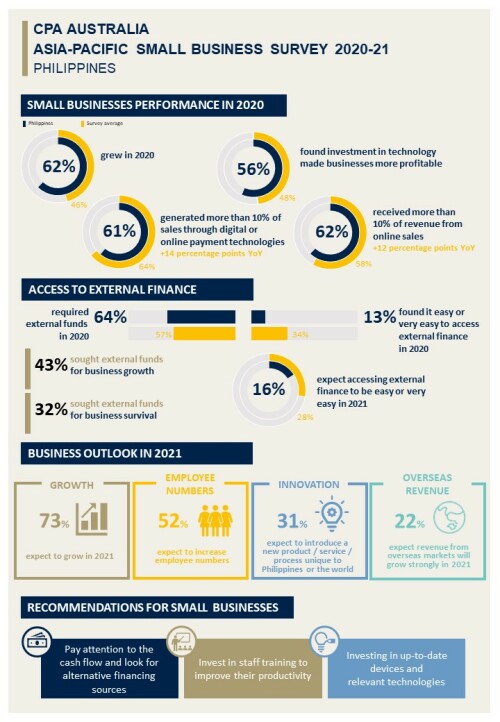
MANILA, PHILIPPINES – Media OutReach – 20 April 2021 – Small businesses in the Philippines significantly increased their use of online payment technologies and sales in 2020. However, difficulty accessing external finance may hamper their growth prospects in 2021, according to CPA Australia‘s 2020-21 Asia-Pacific Small Business Survey.

The survey canvassed 4,227 small businesses in 11 markets across the Asia-Pacific region, including Australia, Mainland China, Malaysia and Vietnam. Three hundred Filipino small businesses took part.

More than half (58 per cent) of Filipino respondents reported being negatively impacted by COVID-19. However, 46 per cent say they have already recovered or expect to recover in 2021. Sixty-two per cent of small businesses grew in 2020.

“The survey shows that small businesses in the Philippines are eager to innovate and engage with customers through social media. A vibrant and youthful workforce together with growing domestic demand supported the sector in 2020,” said Mark Chau, Regional General Manager of Business Development International at CPA Australia.

“Pending the effectiveness of the rollout of COVID-19 vaccinations and the control of COVID-19 cases, the dynamism of Filipino small businesses should help drive an economic rebound this year as restrictions are gradually eased and global economic activity returns to normal,” Chau said.

Filipino small businesses made greater use of digital technologies in 2020 as the pandemic accelerated the use of e-commerce. Twenty-seven per cent of Filipino small businesses reported that they began or increased their focus on online sales in response to COVID-19.

Sixty-one per cent of respondents received more than 10 per cent of sales from digital or online payment technologies such as GCash, DragonPay and PesoPay, up from 47 per cent in 2019. Sixty-two per cent of small businesses received more than 10 per cent of their revenue from online sales, up from 50 per cent in 2019.

“A re-opening of the economy in 2021 is likely to contribute to the continued expansion of e-commerce and digital transactions in the Philippines,” said Chau.

Seventy-three per cent of Filipino small businesses expect to grow in 2021, with 52 per cent intending to increase employees. Twenty-two per cent anticipate that revenue from overseas markets will grow strongly. Thirty-one per cent say they will introduce a new product, process or service to the local or overseas markets, the second highest of the markets surveyed.

Nevertheless, cashflow difficulties are having a negative effect on some Filipino small businesses. Sixty-four per cent of respondents sought external funds last year; 43 per cent sought funds for business growth and 32 per cent sought funds for survival.

However, only 13 per cent of respondents found accessing external finance easy or very easy, the lowest of the markets surveyed. This may explain why respondents mainly sought funds from friends or family (21 per cent) or personal resources (21 per cent), compared to 15 per cent from a bank.

Only 16 per cent of Filipino small businesses expect accessing external finance to be easy or very easy in 2021, which is lower than the survey average of 28 per cent.

“Difficulties in accessing external finance may hinder business plans to hire more employees, invest in technology or expand to new markets. Small businesses in the Philippines should consider seeking professional advice to maximise their success in obtaining external finance,” Chau said.

CPA Australia recommends that Philippines small businesses consider the following actions to improve their recovery prospects:

  • Seek advice from a trusted adviser to maximise success in obtaining external finance.
  • Improve cashflow by collecting outstanding debts.
  • Keep innovating products and services.
  • Invest in staff training to improve their productivity.
  • Invest in up-to-date devices and relevant technologies.

Download CPA Australia Asia-Pacific Small Business Survey 2020-21

About CPA Australia

CPA Australia is one of the largest professional accounting bodies in the world, with more than 168,000 members in over 100 countries and regions. Our core services include education, training, technical support and advocacy. CPA Australia provides thought leadership on local, national and international issues affecting the accounting profession and public interest. We engage with governments, regulators and industries to advocate policies that stimulate sustainable economic growth and have positive business and public outcomes. Find out more at cpaaustralia.com.au

Cable Stolen from Vang Vieng Expressway Tunnel

Cable Stolen from Vang Vieng Expressway Tunnel

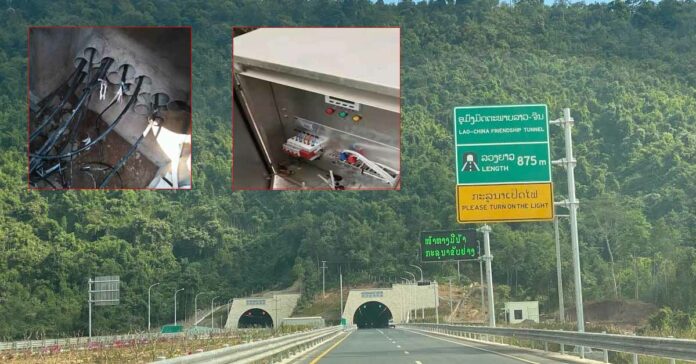
Authorities have reported that cabling used for lighting inside the tunnels of the Vientiane to Vang Vieng Expressway has been stolen, causing the tunnel to go dark.

30 Killed in Road Accidents During Lao New Year Celebrations

30 Killed on Roads in Laos During Lao New Year 2021

The Lao New Year holiday period saw 30 people killed in road accidents across the country.

XA Network expands and appoints senior advisory board, as Southeast Asia digital economy races ahead

  • Community: XA Network is the leading tech executives’ investment network with members from a wide range of technology companies including Alibaba, Gojek, Grab, Google, Amazon, Netflix and Twitter to invest in the Southeast Asia start-up community to help them scale.
  • Opportunity: Southeast Asia’s digital economy is set to grow 3x to $300b by 2025 as it becomes hub for startups
  • Growth: XA Network has grown to 100 members in just 2 years, made 30 investments and have already had their first exit with Lomotif, Singapore’s video-sharing service, acquisition for US$125 million. Two-fifths of the portfolio has already gone on to Series A/B rounds.
  • Appointments: John Wood (ex-Microsoft, Room To Read), Steve Chen (YouTube cofounder), Maya Hari (Twitter, ex-Google, ex-Samsung) and David Thevenon (Balderton Capital, ex-Google) appointed to advisory board

SINGAPORE – News Direct – 20 April 2021 – The XA Network [the X denotes any tech firm with $1b+ valuation and the A refers to Alumni], the leading member-based investment network of executives from prominent tech firms in Southeast Asia, has today appointed an advisory board. The appointments signal the organisation’s growth and reach, as the Southeast Asian digital economy proves resilient and is racing ahead at full velocity.

Pictured – XA Network advisory board (L to R): Steve Chen (YouTube), David Thevenon (Balderton Capital), Maya Hai (Twitter) and John Wood (ex-Microsoft)


John Wood (ex-Microsoft, Room To Read), Steve Chen (co-founder of YouTube), Maya Hari (Twitter) and David Thevenon (Balderton Capital, ex-Google) have been appointed to advisory board positions. They will work directly with the members as the organisation scales and will champion the new purpose – to be an organisation that fosters inclusive innovation for the benefit of startups across Southeast Asia.

On his appointment, John Wood, advisory board member at XA Network commented: “I’m delighted to join this esteemed board to support and drive the ambitious community of investors. The XA Network brilliantly embodies Metcalfe’s law – e.g., the value of a network rises exponentially as the number of users grows. I believe this generation of technology leaders, by working together to support the start-up ecosystem in Southeast Asia, will have an immense impact on the region. We are all very committed to the power of smart capital, intense mentoring and fuelling inclusive innovation. This approach resonates with me on many levels and I look forward to helping XA Network scale to the next level”.

The XA Network is made up of 100 tech leaders from companies including Alibaba, Gojek, Grab, Google, Amazon, Netflix, YouTube amongst others. These investors offer an unmatched array of skills and counsel to their portfolio companies from engineering advice, product management, to marketing and partnership building experience. As a collective, this is embodied in their purpose to foster inclusive innovation beyond simply investing in startups. The XA Network exists to empower the tech community in Southeast Asia with its inclusive innovation approach.

The Southeast Asia digital economy is forging new ground every year1 and 2020 was no different, despite COVID-19. Over 70% of the region is now online, accounting for 400 million people (of a total population of 580 million). Digital adoption of consumer-service businesses increased as more people spent time online during lockdowns. HealthTech and EdTech based companies are earmarked to take-off in the coming years. Overall, the digital economy added USD $100 billion to the region and is poised to grow to over USD $300 billion by 2025.

The XA Network portfolio businesses are making a positive impact across the region such as Indonesian startups, Sampingan who enable access to the gig economy and Bukukas who enable small businesses to digitize their operations. Meanwhile, Singapore-based mentor platform Tigerhall is connecting the world’s most successful people with young professionals.

Nellie Wartoft, CEO at Tigerhall commented: “We raised $2m in 2020, it was a huge milestone for the company but we had a lot to do. The XA Network members are some of the absolute most supportive investors I’ve ever had on my cap table. They’re never afraid of rolling up their sleeves and doing real work either, which is rare to find amongst investors. They feel much more like an extended team than just financial investors to me, and have been key to Tigerhall’s success.”

The appointments come at an exciting time for XA Network as they achieved their first exit. Lomotif, Singapore’s video-sharing service, was acquired by a syndicate for US$125 million. The deal is said to be one of the biggest exits by a tech startup in Singapore in recent years.

XA Network highlights (since January 2020)

  • Membership base increased from 50 to 100 people in March 2021
  • XA Network portfolio includes 30 startups in a range of sectors including mobility, healthtech, foodtech, edtech, adtech, fintech, social commerce, proptech
  • Portfolio companies have also gone on to raise $82m in follow-on capital
  • Achieved its first exit with Lomotif

Notes to the editor

1 e-Conomy SEA 2020 Report

About the XA Network

The XA Network [the X denotes any tech firm with a $1b+ valuation and the A refers to Alumni] is an investment network comprising senior executives from prominent tech companies including Alibaba, Gojek, Grab, Google, Amazon, Netflix and Twitter amongst others.

Its mission is to invest and empower early-stage companies across Southeast Asia through their inclusive innovation approach, by exposing these businesses to the wide array of skills in the network. Since 2018, they have made 30 investments and expanded their member base to 100 people.

XA Network has invested in a wide variety of promising companies including Bukukas, Tigerhall, Sampingan, Neuron, and Infradigital as well as the Vertex Southeast Asia and India fund.

Website: https://xanetwork.co/

Follow us on LinkedIn and Twitter.