Home Blog Page 6407

Laos-China Railway to Spur Border Zone Development

The Laos-China railway will provide significant momentum for the development of the Boten-Mohan border economic cooperation zone, experts have noted.

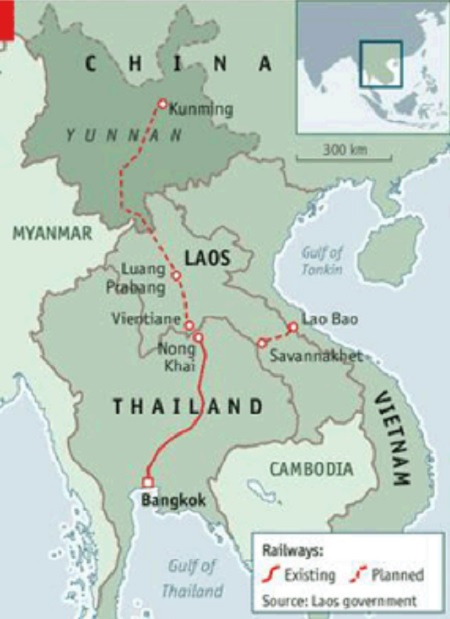
The railroad, a key project under China’s Belt and Road initiative, will link the Mohan-Boten border crossing in northern Laos to Vientiane, over a distance of 427 kilometres.

Experts are optimistic that the border economic cooperation zone could become a regional hub for trade, investment and tourism once the almost-US$6 -billion railway is complete.

Chinese Premier Li Keqiang told his visiting Lao counterpart Thongloun Sisoulith in Beijing last week that China is willing to work with Laos to push forward the development of the railway and economic cooperation zone.

The two premiers witnessed the signing of two cooperative documents on border trade and the economic cooperative zone.

Mr Thongloun said he was committed to building the railway as it was of great importance to Laos in transforming the land-locked country into a land link within the region.

The political commitment by the two countries aims to ensure that the two projects progress as planned.

Located at the Mohan Border Port, which is China’s gateway to Laos and provides access to Southeast Asia’s most convenient land route, the economic zone has significant investment potential.

The Boten Specific Economic Zone is located in Luang Namtha province and is accessible by Road No. R3.

The zone is being developed by two Chinese companies – Yunnan Hai Cheng Industrial Group Stock Co., Ltd. and Hong Kong Fuk Hing Travel Entertainment Group Ltd.

Vice President of the zone’s management board, Mr Vonekham Phetthavong, told Vientiane Times recently that the developers are concentrating on infrastructure development and providing facilities to accommodate the investment and tourism sectors.

We are building two hotels which could be as high as 15 storeys, to accommodate tourists, he said.

About 1,000 tourists visit the zone each month. Our activities include trekking in forests, watching cultural performances and other activities.

The US$500 million project covers 1,640 hectares and comes with a concession period of 99 years.

The Chinese developers will focus on four large-scale projects: a duty free centre, bus station complex, warehousing and a resort featuring a large natural marsh, hotel, meeting hall and leisure areas.

Mr Vonekham said many more investors and visitors will head to northern Laos once the economic cooperation zone in the Boten-Mohan border area is fully operational.

However, so far the project has not progressed as anticipated. As of August this year, only a little over US$50 million had been spent on the Boten Specific Economic Zone by the new Chinese developers.

The China-Laos railway is a vital part of the trans-Asia railway network that will link China with ASEAN nations to boost economic cooperation and people-to-people ties.

Construction is expected to start simultaneously in a number of provinces this month, with the whole railway scheduled for completion over the next five years.


Source: Vientiane Times
Audit Aims to Recover Loss of State Properties

Action to recover the losses from state land concession fees and transference of properties to capital will take a long time as related regulations will be need to be devised as regulatory tools.

State Audit Organisation President, Dr Viengthong Siphandone revealed the circumstances when talking to media last week about the results of the audit made for 2014/15.

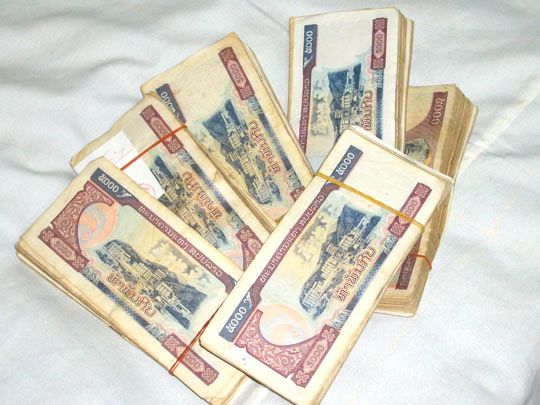
According to the audit report, 14.5 billion kip has been lost caused by declarations of concession fees lower than that determined by the Presidential Ordinance No.2 in relation to projects authorised in 2013/14.

If the calculation was made following the ordinance the state would have received 64.1 billion kip as revenue from the business.

This difference in the amount occurred because the Ministry of Natural Resources and Environment and the Ministry of Finance have not made joint comparisons in the calculation of the fees. The declaration of the fees did not comply with the ordinance, Dr Viengthong said.

She said the State Audit has made comment on this issue every year in the past eight years but the same problem has remained chronic with necessary regulations still not in place.

In addition, more than 190 billion kip has been uncovered by the audit as losses caused by the failure of provincial and local budgetary units in monitoring the implementation of concession fees on state land.

The audit found that 65.7 billion kip was passed on by project developers to the accounts of Departments of Planning and Investment in some provinces.

However the funds owed to the central government in relation to these transactions were not always passed on.

In addition, 28.3 billion kip was passed on to development funds, and 46.5 billion kip as compensation for residents’ properties.

The audit also found some government agencies used 52.1 billion kip of the uncovered revenue in paying rent fees.

The audit report uncovered 302 billion kip related to the transference of property to capital in the 2015/16 fiscal year but the amount has been not recorded in state revenue, while the deals which were made did not follow the procedure of bidding auctions and procurement.

Five ministries are related to the deals made in 2013/14 and 2014/2015, and the audit organisation was ordered by the prime minister to audit and identify whether the transference has been made in compliance with the related laws or not.

Dr Viengthong noted that 302 million kip was the value of transference, not including the value of related projects, explaining that the value of transference should be higher than the value of the project.

Due to the lack of specific regulations, the government has ordered a stop to the policy on transference of property to capital recently as it did not bring sufficient benefits to the state, and has even brought some losses.

According to Dr Vientgthong, the State Audit Organisation plans to audit two projects next year related to the transferences in three ministries, focusing on each project separately.

She said the losses would be recovered but this may take more time as the required specific regulations are not yet in place.


Source: Vientiane Times

Foreign Markets Interested in Lao Organic Coffee

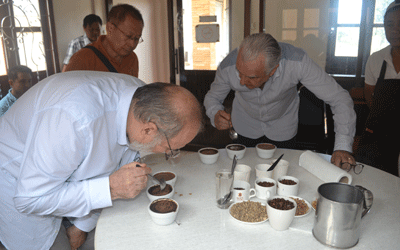
A famous chef from France has tasted the organic coffee in Pakxong district, Champassak province and agreed to place an order for the top quality beans for coffee shops in Europe including France.

The order is expected to serve as a boon for the region’s image as a coffee producer in foreign counties including France.

The Bolaven Plateau Coffee Producers’ Cooperative has been exporting more than 1,000 tonnes of organic coffee per year to many foreign counties, which is currently valued at some US$5 million.

France is the top overseas buyer of its coffee at some 800 tonnes per year.

Famous chef from France, Mr Alain Ducasse joined representatives of Malongo company in France and Cafe Ma company in Switzerland to visit the Bolaven Plateau Coffee Producers’Cooperative in Paxong district last weekend.

The visit was aimed to sample some of the best of Lao coffee and discuss its promotion in overseas destinations including Europe.

The Bolaven Plateau Coffee Producers’ Cooperative and their development partners have supported local farmers in Pakxong district, Champassak province, Thataeng district, Xekong province and Lao-ngam district, Saravan province to increase the cultivation of organic coffee to support local and foreign markets.

The members of the Bolaven Plateau Coffee Producers Cooperative now comprise some 1,391 families from three provinces, including 826 families engaged in the organic process.

There are also 56 producers’ groups, including 36 groups in the organic process. More than 1,000 tonnes of coffee is exported by the cooperative annually.

The current area dedicated to growing the cooperative’s organic coffee is around 3,000 hectares, covering the three districts of Pakxong, Thataeng and Lao-ngam, with the produce 100 percent owned by local farmers.

According to the Bolaven Plateau Coffee Producers Cooperative, in 2016-2017, the yield was estimated at more than 8,000 tonnes of Arabica coffee and more than 1,000 tonnes of Robusta coffee, which was sold on both domestic and foreign markets.

The foreign markets still require more Lao organic coffee year to year, therefore the coffee producers’ cooperative plans to increase its plantation areas and producers’ groups for organic coffee in an effort to meet the demand.

The president of the Bolaven Plateau Coffee Producers’ Cooperative, Mr Bounthong Thepkaysone said that many foreign counties especially in Europe are interested in Lao organic coffee and have offered a better price than what is received for normal coffee.

He said this is because organic coffee is high quality, good for people’s health and also certified.

The Bolaven Plateau Coffee Producers’ Cooperative was established in 2007 as an organisation to improve the living conditions of Lao coffee smallholders and fight against poverty in the area.

The coffee producers cooperative and the Malongo company are not only cooperating in relation to business; they also support capacity building and infrastructure development in local communities, as well as work to improve farming practices for all members.

The Lao Coffee Association has reported that most of the Lao coffee crop is exported to France, Chinese Taiwan, Italy, Japan, Spain, Poland, Germany, USA, Belgium, Sweden, Thailand and Vietnam.

Due to a slump in coffee prices on the world market, the sale price of Lao coffee and export volumes have been declining in recent years.

In 2013, Laos exported 30,000 tonnes of coffee valued at US$72 million. In 2014, total coffee exports dropped to 26,000 tonnes valued at US$60 million. Last year exports fell further to 23,000 tonnes valued at US$50 million.


Source: Vientiane Times

Laos-Viet Border Crossings Considering Extended Opening Hours

The Ministry of Transport of Vietnam has proposed expanding opening hours at Vietnam-Laos border crossings to boost investment, trade and tourism between the two nations and region.

Vietnamese Minister of Transport, Mr Truong Quang Nghia submitted the proposal to the Minister of Public Works, Dr Bounchanh Sinthavong at the end of last month during his delegation’s working visit to Laos.

Mr Truong Quang Nghia proposed to Dr Bounchanh Sinthavong to extend the closing time for Viet-Laos borders from 5pm to 8pm.

Laos’ nine provinces of Huaphan, Xieng Khuang, Luang Prabang, Borikhamxay, Khammuan, Savannakhet, Saravan, Xekong and Attapeu share borders with Vietnam.

The busy Namphao-Cau Treo international border crossing between the two countries has already extended opening hours from 6am to 9pm.

Meanwhile, at lower volume traditional border crossings between Laos and Vietnam the opening hours will remain 8am to 4pm.

Director of Khammuan provincial Finance Department Mr Khamven Panyanouvong, told Vientiane Times on Monday that the Namphao-Cau Treo crossing opening hours were approved following agreement between the province and Vietnam’s Nghe An province.

The central government has yet to give the green light to extending opening hours for all Laos and Vietnam borders from 5 pm to 8 pm preferring to let Lao and Vietnamese provinces to make the decision on a case by case basis.

Deputy Head of the Administration Office in Khammuan province Mr Vannavong Vongprachanh also said that Naphao-Chalo international border between Laos and Vietnam in the province was open for freight trucks from 8 am to 5:30 pm, but stayed open for bus tours and travellers until 7:30 pm.

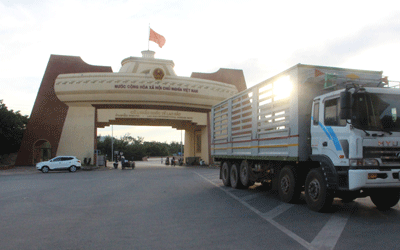
Director of the Savannakhet provincial Public Works and Transport Department, Mr Prasongsin Chaleunsouk, said Dansavan-Lao Bao international border has had an operational one door, one stop service since early 2015 which has reduced the time it takes vehicles to cross the border since its introduction.

The single window service means vehicles entering Laos from Vietnam are not checked at the Vietnamese border but only at the Lao border. Meanwhile vehicles from Laos entering Vietnam have to present their documents on the Vietnamese side only.

It now takes only 15 minutes for trucks to complete customs declarations at the Lao Bao-Dansavan border crossing between Vietnam and Laos. Vietnam needs to quickly build a strategy and policies for the development of cross-border transport, especially transport corridors.

The Nam Heuang-Nakaxeng International border in Xayaboury province also has an operational one door, one stop service.


Source: Vientiane Times

Intercontinental Set for 2021 Laos Debut

Intercontinental Hotels Group (IHG) is set to open its first Intercontinental-brand property in Laos in 2021, as part of the new mixed-use World Trade Centre development. The more than 400-room Intercontinental Vientiane will join a retail mall, medical centre, conference centre, office tower and residential towers when it opens.

The hotel and development will be situated next to Lan Cang Avenue, Vietnam Street and French Street, in close proximity to key buildings including the Prime Minister’s office, numerous international embassies and major convention centres. Meanwhile Wattay International Airport is a short drive from the location, and public transportation options will allow for convenient access to Lao National Museum and the Morning Market.

“Laos is currently one of the region’s fastest growing nations with close to five million international arrivals each year and future infrastructural and industrial developments underway to continue boosting economic growth and attract foreign investment,” said Leanne Harwood, vice president, operations for IHG, South East Asia and Korea. “It is well on its way to becoming one of the region’s busiest business and tourist destinations and it’s a great time to be bringing the Intercontinental brand into the country to tap on this potential.”

Guests at the hotel will be able to make use of the brand’s signature Club Lounge, in addition to a swimming pool, spa and fitness centre. A specialty restaurant, all-day international restaurant, lobby lounge and bar will make up the F&B offerings.

Speaking about the opening, Lao International Development Co. CEO, Xiao Long, said: “In looking for a hotel management partner we were seeking one with a strong track record in operating hotels in new markets and a well-known premium hotel brand to complement the mix of offerings which would draw business and leisure travellers to stay with us when they travel.”


Source: Business Traveller 

BCEL-KT: Trade Summary (Dec 1, 2016)

Trade summary

Lao stock market marked was quiet day on the final day of the week, index closed up by 0.13 percent or 1.33 points to stay at 1,028.48 points because of rising from BCEL’s price, making 400 shares traded and worth about 2,040,000 kip. EDL-Gen had the small trading volume with 300 shares, traded unchanged price at 5,100 kip. On the other hand, BCEL moved up during the price 5,000 kip to 5,100 kip, which had trading volume of just 100 shares.  In the meantime, other stocks saw no matching, with LWPC closing at 5,400 kip, PTL at 2,500 kip and SVN at 3,000 kip.

Infant Immunisation against Polio Falling Short of Target in Meun District

Only 70 percent of children under the age of five in 22 target villages in Meun district, Vientiane province, have been immunised against polio and given protection against seasonal diseases.

The district health office had set a target for 98 percent of children under the age of five to be vaccinated against polio, with the vaccines made available in villages and at dispensaries. But some dispensaries were failing to administer the vaccines.

The number of children being immunised against polio may fall short of the target because children under the age of five did not always make use of the service, according to a district health official, Dr Seng Soixa.

Dr Seng spoke to the media recently about the progress made in the ongoing supplementary immunisation campaign, which aims to secure the gains made against polio through stronger immunisation of children under the age of five.

“We know that not all children under the age of five are being vaccinated as their parents don’t understand the importance of vaccination.”

Since the launch of the supplementary immunisation campaign to prevent outbreaks of disease in the district, health officials and village volunteers have been entrusted to collect information directly from villagers, he added.

The figures collected revealed that the vaccination rate for this age group was less than the figure recorded by the authorities.

The programme aims to immunise and protect all children in the one-to-five age group through oral polio vaccines.

Children in the district are being vaccinated to further boost their immunity against polio under the government’s policy to provide effective public health services.

“The number of children being vaccinated in this district has continued to decline as many parents living in remote areas of the country don’t make use of health services because they don’t understand their importance,” Dr Seng said.

Children under five years of age are at risk of polio infection due to the failure to inoculate the entire population, highlighting the vital importance of this round of vaccinations in fully eradicating the virus.

According to the WHO Laos office, the organisation will boost the Ministry of Health’s initiatives on the prevention of polio by focusing on children at risk in target provinces. If their plan succeeds, polio will be eradicated in Laos by 2017.


Source: Vientiane Times

Entrance Fees Taking Toll on Champassak Tour Operators

The imposition of entrance fees to tourist sites in Champassak province is causing a downturn in visitor numbers, according to local tour operators.

As a result, some operators have halted their services while others still running are complaining about the decline in visitor numbers, blaming the fees.

Entrance fees are currently being collected from local and foreign visitors at World Heritage-listed Vat Phou Champassak and at the Phasuam and Khonephapheng waterfalls.

A hotel operator in Champassak, who did not wish to be named, told Vientiane Times on Thursday that tour operators can still conduct tours but are shying away from the main attractions because of the entry fees.

“Some tour companies have suspended services because the lack of visitors is making their businesses unviable,” she said.

“This year we are encouraging visitors to go to Nheuan, Fan, Phasuam, Nong Luang, Champee Nang Sida, and Lakpaed waterfalls, along with Don Nong Luang waterfall, which are all beautiful spots that tourists can enjoy,” she added.

“Some tour operators have commented that it’s acceptable for tourist sites to collect fees, but visitors shouldn’t have to pay 50,000 kip at Vat Phou,” the hotel operator said.

To add to their woes local operators are finding the going tough because they can’t compete with the lower prices of tour packages.

Thai tourists like to visit Vat Phou and Khonephapheng Waterfall, whereas visitors from Europe and the US prefer Khong district and the waterfalls in Pakxong district.

According to the Management Office at the Vat Phou World Heritage Site, about 600,000 tourists visit Champassak, but only about 100,000 people make it to Vat Phou each year.

Deputy Director of the Management Office, Mr Amphol Sengphachanh, said it was possible that newly introduced road tolls on the road leading to the province from Thailand were having a negative impact on visitor numbers.

But an official from the provincial Department of Information, Culture and Tourism, Mrs Mala Chanthalam, said the sheer number of tourist sites now available was giving visitors more attractions to choose from.

Overall, the total number of foreign tourist arrivals in Laos increased from 2.7 million people in 2011 to 4.1 million last year.


Source: Vientiane Times