

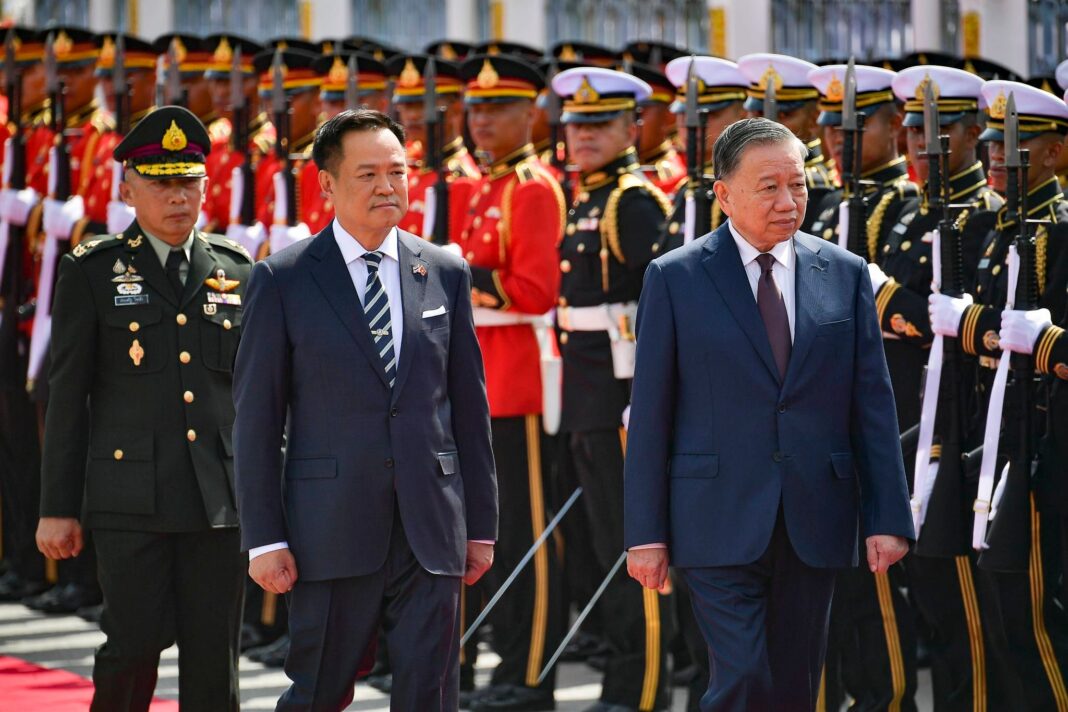
Thailand and Vietnam pledged deeper economic and security cooperation on 28 May as the two countries marked 50 years of diplomatic relations and set a target of reaching USD 25 billion in annual trade “as soon as possible”.
At Government House in Bangkok, Thai Prime Minister Anutin Charnvirakul and Vietnamese President To Lam witnessed the signing of four cooperation agreements covering trade, technology, aviation and education, while both sides described bilateral ties as entering a “new phase”.
Currently, the bilateral annual trade is at approximately USD 24 billion per year, Anutin said.
The agreements signed on 28 May included a 2026–2031 action plan for the Thailand-Vietnam comprehensive partnership, a science and technology cooperation agreement, a memorandum on developing an aircraft maintenance, repair and overhaul (MRO) centre at U-Tapao International Airport, and an academic cooperation agreement between Khon Kaen University and the Vietnam Academy of Public Administration and Governance.
The aviation agreement between Thailand’s Eastern Economic Corridor Office and Vietjet Group was among the most commercially significant announcements during the visit and reflects growing cooperation in logistics and infrastructure between the two Southeast Asian economies.
First Visit
The visit by To Lam, who serves as President and Secretary-General of the Communist Party of Vietnam, was his first official trip to Thailand under the current government.
The two sides also discussed what officials called the “3 Connect” strategy, aimed at linking supply chains and production chains, strengthening local economic connectivity, and expanding cooperation in green energy and energy security.
Thailand and Vietnam also agreed to increase military and defence cooperation and intensify efforts against transnational crime, particularly online scam networks, human trafficking, illegal fishing and drug trafficking.
The leaders agreed to implement extradition agreements under the ASEAN framework.
Anutin said Thailand was also ready to expand cooperation in science, technology and innovation, including biotechnology, satellites and space technology.
The Vietnamese leader also highlighted the importance of infrastructure connectivity across the Mekong sub-region and the East-West Economic Corridor to support trade and transportation links.
Thailand and Vietnam are among the largest economies in mainland Southeast Asia and have increasingly positioned themselves as regional manufacturing and logistics hubs as global companies diversify supply chains away from China.
