

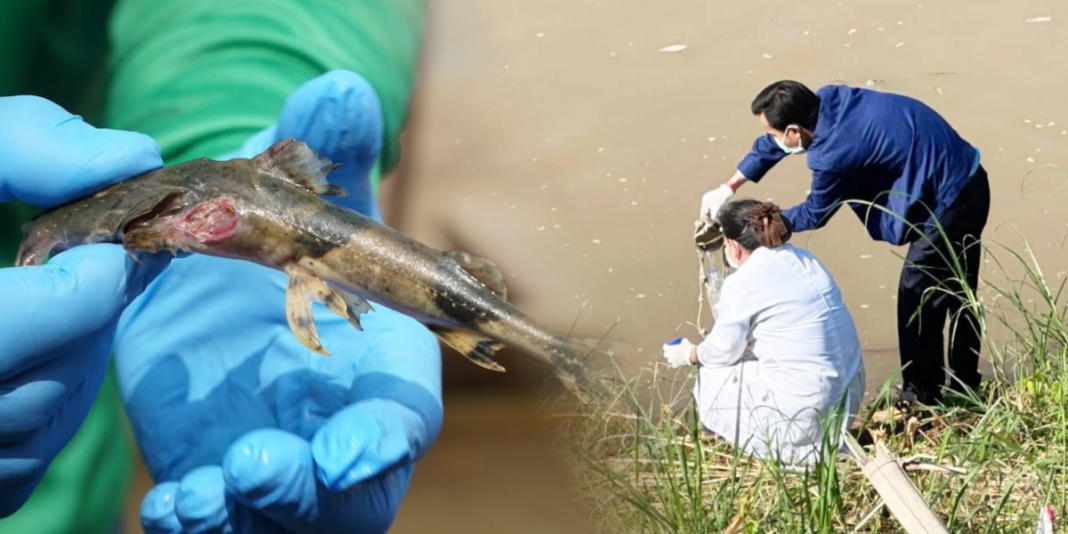
Water authorities in Vientiane Capital and Bokeo Province have found no arsenic in the Mekong River or local tap water following online reports of sick and dead fish.
The assurances follow reports in Thai media on 17 November of arsenic detected across the river in Nong Khai Province, Thailand, bordering Laos as well as social media posts showing fish with sores and bumps along the Mekong. Because public water plants in Vientiane draw directly from the river to supply households, the reports raised concern among Lao residents.
A day after the Thai report, the Vientiane Capital Water Supply State Enterprise tested raw river water and treated tap water at the Chinaimo Water Treatment Plant. Laboratory results detected no arsenic, keeping levels below the Ministry of Health safety limit of 0.01 milligrams per liter.
Farther upstream in northern Laos, the Bokeo Provincial Water Supply State Enterprise had already tested raw water across five Mekong River pumping stations between 9 and 17 November. Teams sampled water at two locations in Huayxai District and three locations in Tonpheung District.
Results showed zero arsenic and confirmed the supply meets national safety standards. Both utilities said tap water remains safe for normal household use.
Thai Tests
Yet the test results in Laos contrasts sharply with recent data from neighboring Thailand.
On 17 November, Thai media said its Pollution Control Department reported arsenic levels at or slightly above the 0.01 milligrams per liter limit at three points in Nong Khai, directly opposite Vientiane. Readings reached 0.011 in Sangkhom District, 0.01 in Nong Khai City, and 0.012 in Phon Phisai District.
While Thai officials said treated tap water remains safe, local fishermen in Nong Khai reported sores on bagrid catfish and falling fish sales.
According to Thai media, their Department of Disease Control also found elevated arsenic levels in urine samples from 39 residents across four Mekong border provinces: Loei, Nong Khai, Bueng Kan, and Nakhon Phanom. Among them, 17 people in Nong Khai were referred to a hospital for further medical checks as authorities investigate potential exposure sources.
Those reports quickly drew skepticism on Lao social media, where residents questioned how the same waterway could test positive for arsenic on the Thai bank while coming back completely clear in Laos.
Despite the results, the Vientiane-based Mekong River Commission has not commented on the Thai and Lao findings.
Mining, River Pollution Concerns in Laos
Public skepticism over the Mekong test results comes amid a string of recent mining-related river pollution incidents across Laos.
Earlier this week, authorities suspended a rare earth mine in Houaphanh Province after a pond breach contaminated local rivers, while a central task force linked five companies to muddy runoff in Vientiane Province’s Nam Song River, following a similar July suspension over unauthorized iron ore mining.
