

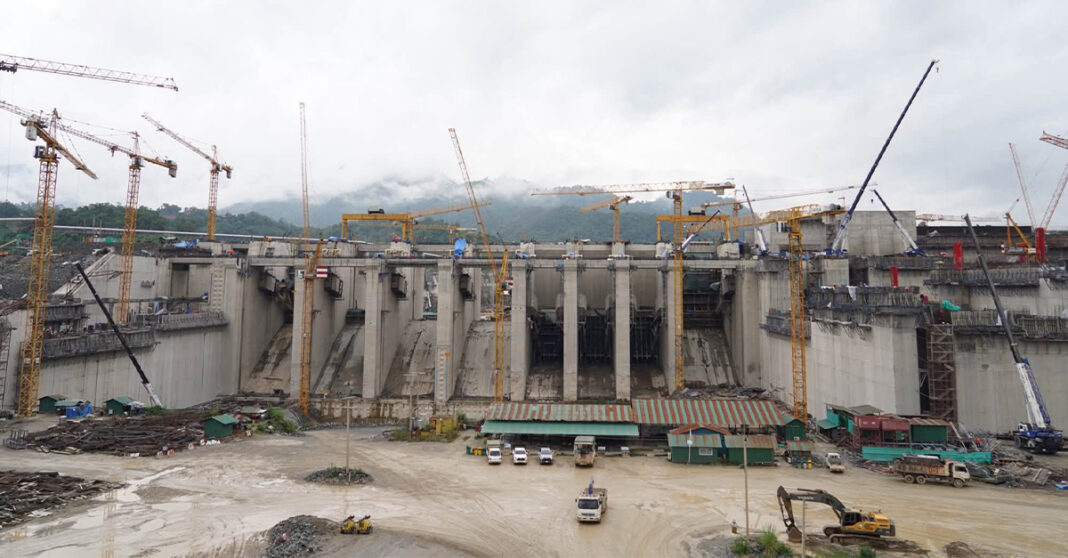
The USD 5 billion Luang Prabang hydropower dam on the Mekong River remains on track to begin generating electricity in 2030, with construction now more than 72 percent complete, Lao and Thai officials said following a high-level site visit on 18 July.
The project is one of several major dams planned along the Mekong as Laos continues to expand its role as a regional electricity exporter. Most of the power generated by the Luang Prabang dam will be sold to Thailand, according to state reports.
Located about 25 kilometers from Luang Prabang town, the dam stretches between Chomphet and Pak Ou districts, around 4 kilometers downstream from where the Nam Ou River joins the Mekong. It sits between the planned Pak Beng dam upstream and the Xayabouly dam downstream.
The dam is designed as a run-of-river project and will generate electricity year-round through seven 200-megawatt turbines, giving it a total installed capacity of 1,460 megawatts.
The structure will stand about 80 meters high with a crest length of 281 meters. It has also been designed to allow 500-ton cargo vessels and passenger boats to pass through in about 40 minutes and to meet seismic safety standards.
Ownership and Shareholders
The Luang Prabang Dam is owned by Luang Prabang Power Company Limited (LPCL), which holds the Lao government concession to design, build, and operate the project.
Thailand’s CK Power is the largest shareholder with a 50 percent stake, followed by Gulf Hydropower with 20 percent. CH. Karnchang, TTW Public Company, and Laos’ PT Sole each hold 10 percent
Once completed, the Luang Prabang project will become Laos’ third hydropower dam on the Mekong mainstream, following the Xayabouly and Don Sahong dams, which began operating respectively in 2019 and early 2020.
Six more mainstream dams are currently planned along the Mekong: Pak Beng, Pak Lay, Sanakham, Pak Chom, Ban Koum and Phou Ngoy.
Earlier this month, Laos and Myanmar also signed an agreement to study the feasibility of building a hydropower dam along the section of the Mekong River they share.
The Luang Prabang project affects 22 villages with a combined population of about 7,000 people across Chomphet district of Luang Prabang province, Hongsa district in Xayabouly, and Nga district in Oudomxay. Some residents have already been relocated to new settlements.
Authorities said the developer is carrying out the resettlement in line with government policy, with the aim of improving living conditions after relocation.
Heritage Concerns
Because the dam is just outside Luang Prabang, the public has often questioned whether it could affect the city’s UNESCO World Heritage status.
International experts and heritage groups have previously warned that changes to the Mekong River and the surrounding landscape could undermine the historic character of Luang Prabang, which has been on UNESCO’s World Heritage List since 1995.
However, during the 18 July site visit, Lao authorities said those concerns had been addressed through environmental studies and lessons learned from the Xayabouly dam. They’d confirmed that the project includes measures to help fish migrate and was designed to reduce environmental and social impacts while protecting the World Heritage city.
Hydropower Still Drives Laos’ Energy Plans
Hydropower remains Laos’ main source of electricity, producing about 70 percent of the country’s power.
According to the latest public data, Laos operates 94 power plants, including 81 hydropower dams, with a combined installed capacity of more than 11,600 megawatts.
The country’s electricity capacity has grown steadily, from 9.4 gigawatts in 2020 to 12.3 gigawatts in 2025. That figure is expected to nearly triple to 30 gigawatts by 2035, with hydropower continuing to make up around 80 percent of total capacity.
Under the government’s latest power strategy, hydropower is expected to provide about 75 percent of Laos’ domestic electricity by 2030. Solar, wind and other renewable energy sources are expected to account for around 11 percent of the country’s power mix.
