

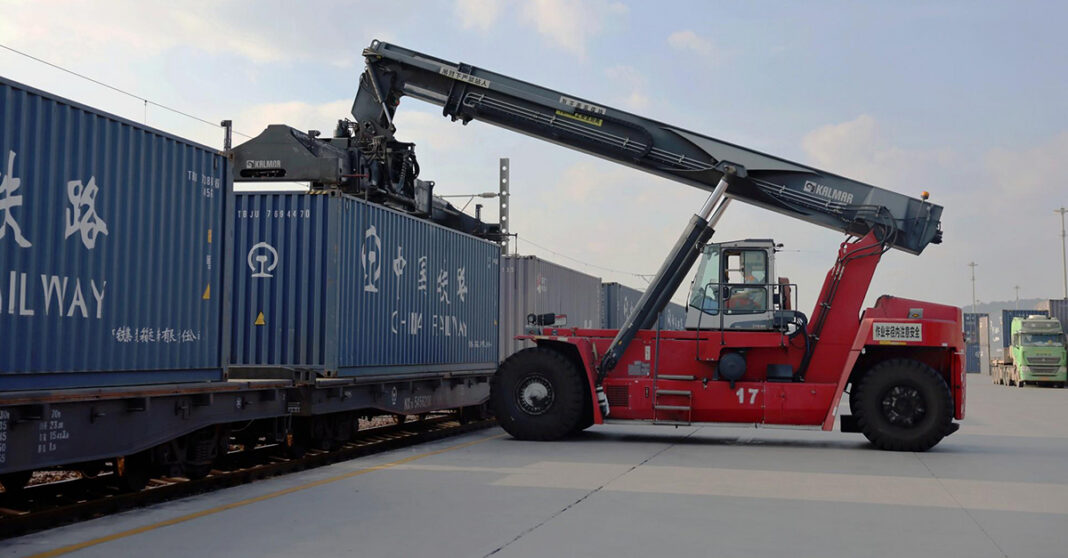
Trade along the Laos-China Railway continued to grow sharply in the first half of 2026, with imports and exports reaching CYN 17.17 billion (USD 2.53 billion), up 33.8 percent from a year earlier.
The figures, released on 18 August by China Railway Kunming Group Co., Ltd., come as the railway approaches its fifth year of operation and continues to develop into a major regional trade route.
Since trains began running in December 2021, the railway linking Kunming with Vientiane has carried more than 90 million tonnes of freight, including more than 21 million tonnes of cargo transported across the China-Laos border.
Freight volumes have accelerated particularly quickly this year. By mid-June, the railway had already moved more than 10 million tonnes of freight in 2026, more than three times the three million tonnes recorded during the first half of 2025.
The number of trains using the route has grown alongside the cargo. More than 80,000 freight trains have travelled along the railway since its opening, including more than 23,000 cross-border trains.
At its busiest, the railway now handles up to 23 cross-border freight trains a day, according to an official at the Kunming Logistics Center.
The trains can also carry more than they did when the railway first opened. Their capacity has increased from about 2,000 tonnes to as much as 2,800 tonnes per train following upgrades to the route and freight infrastructure.
The railway has also opened new opportunities for trade in agricultural products. Refrigerated trains connecting China, Laos and Thailand have been operating since February 2023, allowing fresh fruit from Southeast Asia to reach Chinese markets in as little as three days.
China imported more than 185,000 tonnes of fruit through the railway in the first half of 2026, a 73.1 percent increase from the same period last year.
The range of goods carried along the railway has expanded at the same time. From just over 10 categories when the line opened, the number has grown to more than 4,000, with goods now reaching 19 countries and regions, including Myanmar, Cambodia, Thailand, Vietnam, Malaysia, Singapore and Bangladesh.
The railway has also connected Laos more closely with China’s wider domestic market, with goods travelling to 31 Chinese provinces.
A wider regional network
The railway’s growth has also brought new investment and expansion along its route.
In June, Boten Railway Station in Luang Namtha Province began its first major expansion and renovation since the railway opened, as freight and passenger traffic continue to increase.
The railway is also becoming part of a wider network beyond Laos and China. In June, Lao railway authorities signed an agreement in Tajikistan for Laos to join an international rail framework linking Vientiane with the Baltic Sea through China, Vietnam, Central Asia and Russia.
For the Laos-China Railway, Chinese and Lao railway authorities have credited closer coordination with the continued rise in freight traffic.
Since its launch, improvements to cross-border operations and increased capacity have helped move more goods through the route, while the growing number of destinations and products has expanded its role in regional trade.
