

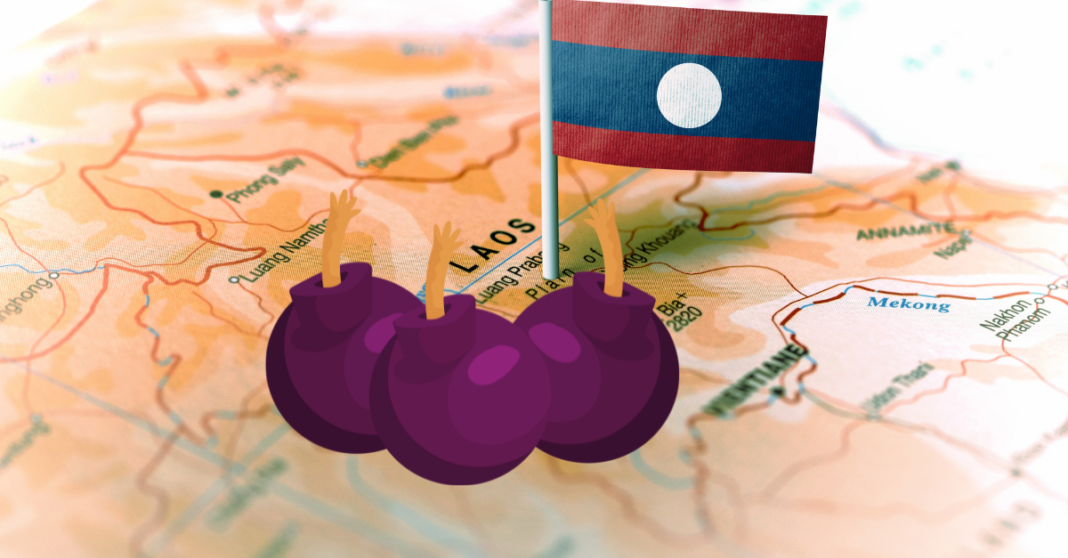
Laos is hosting the Convention on Cluster Munitions’ Third Review Conference 16 years after it hosted the First Meeting of States Parties in 2010, which produced the original Vientiane Declaration and Action Plan.
More than 800 delegates are attending the conference, which runs from 14 to 18 September and is expected to adopt the five-year Vientiane Action Plan for 2027–2031. The plan focuses on three priorities: faster survey, clearance and risk education; sustainable assistance for victims; and predictable international cooperation aligned with the development goals of affected countries.
Lao Prime Minister Sonexay Siphandone opened the conference, saying it marked a crucial milestone in turning commitments into measurable action. Speaking under the theme “Fulfilling the Promise of the Convention: Toward a World Free of Cluster Munitions,” he said Laos’ experience showed how the damage caused by these weapons can persist for decades after a war ends.
He described the Convention as a vital legal framework for one of the countries most heavily affected by cluster munitions and linked clearance efforts to Sustainable Development Goal 18, “Lives Safe from UXO.”
A Toll That Persists
The conference comes as Laos continues to record casualties from wartime contamination.
Laos remains the most heavily bombed country per capita in history: between 1964 and 1973, during the Vietnam War, US forces dropped more than 2 million tons of ordnance on a country whose population numbered around three million at the time, including cluster bombs that scattered hundreds of smaller submunitions on impact.
Roughly 30 percent failed to explode. Tens of thousands of Lao citizens have been killed or injured since, and the danger has not gone away, officials reported 15 accidents and 25 casualties in 2025, including six deaths, caused by decades-old bomblets rather than active use of the weapons.
Globally, cluster munitions killed or injured at least 1,063 people in 2025, the third-highest annual toll on record, according to the newly released Cluster Munition Monitor 2026.
Momentum Slipping Globally
International Committee of the Red Cross Vice President Jürg Lauber opened his remarks by crediting Laos with “powerful voice and strong moral authority” as host, given the country’s own history with the weapons.
He cautioned, however, that global momentum toward universal adherence has stalled: States Parties grew from just 110 to 112 over five years, as three nations joined while Lithuania became the Convention’s first-ever withdrawal in March 2025.
At the same time, countries outside the Convention continue to use and produce the weapons.
The Cluster Munition Monitor 2026 recorded use by Iran, Myanmar, Russia, Thailand and Ukraine during the reporting period. It also identified 18 countries that still produce cluster munitions or reserve the right to do so, none of which are party to the Convention.
The report found evidence of new production in China, India, Israel, Myanmar, North Korea, Poland, Romania, Russia and South Korea. It also reported evidence of transfers involving North Korea and Russia, as well as Israel and the United States.
Lauber urged countries to strengthen the international stigma against cluster munitions, work toward universal adherence to the Convention, and maintain funding for clearance and victim assistance.
Funding Remains a Concern
The pressure is not limited to the weapons themselves. The report also warns that declining humanitarian funding could undermine efforts to clear contaminated land and support survivors.
Around USD 116 million in international and national funding was provided to address cluster munition contamination in 2025. But the US foreign assistance freeze and subsequent grant cancellations disrupted clearance and victim assistance programs in several affected countries.
In Laos, the main multi-year project supporting victim assistance was forced to close following cuts to US funding, according to the report.
The Cluster Munition Coalition said the funding cuts are coming at a time when humanitarian needs are growing.
“This year’s findings show a convention that keeps delivering results to affected communities,” said Tamar Gabelnick, director of the Cluster Munition Coalition. “Yet the rising human toll, continued and new use, production, and transfers by states not party are stark warnings that these gains cannot be taken for granted.”
“And as humanitarian needs grow, funding cuts are stripping away the care survivors depend on.”
Despite these challenges, the amount of land released from cluster munition contamination by States Parties increased by 15 percent in 2025 compared with the previous year.
“The choice facing governments in Vientiane is not simply whether to reaffirm commitments made 16 years ago, but whether to dedicate the political leadership and resources needed to deliver on them,” Gabelnick said.
“For communities living with cluster munition contamination and for survivors requiring lifelong support, progress on paper must translate into meaningful change in their daily lives.”
