

On Sunday, 1 March, Thailand initially announced a suspension of fuel exports due to escalating tensions in the Middle East, sparking concerns over potential shortages in Laos.
However, less than 24 hours later, the Thai government made an exception for Laos, allowing the continued flow of fuel despite the ongoing crisis.
The decision to suspend exports came in response to the closure of the Strait of Hormuz by Iran, which disrupted vital global oil supply routes.
On 1 March, Thailand’s Minister of Energy, Auttapol Rerkpiboon, confirmed that the country would halt fuel exports as a precautionary measure to protect domestic reserves amidst the volatile situation.
This followed the killing of Iran’s Supreme Leader Ali Khamenei, after which Iran launched missile and drone attacks in retaliation, triggering widespread uncertainty in global oil markets.
Despite the suspension, the Thai government clarified that Laos, as a key partner and consumer of Thai oil, would be granted an exception.
This temporary relaxation safeguards Laos’ fuel supply, which relies heavily on Thai imports, while also providing leverage as Thailand remains dependent on Laos for energy.
Diesel fuel alone accounted for more than a quarter of Laos’ total imports from Thailand in 2025, underlining the importance of uninterrupted trade between the two nations.
The situation has raised fears of rising fuel prices and potential energy shortages across the region, with global trade routes disrupted and countries scrambling to secure alternative energy supplies.
Local Impact
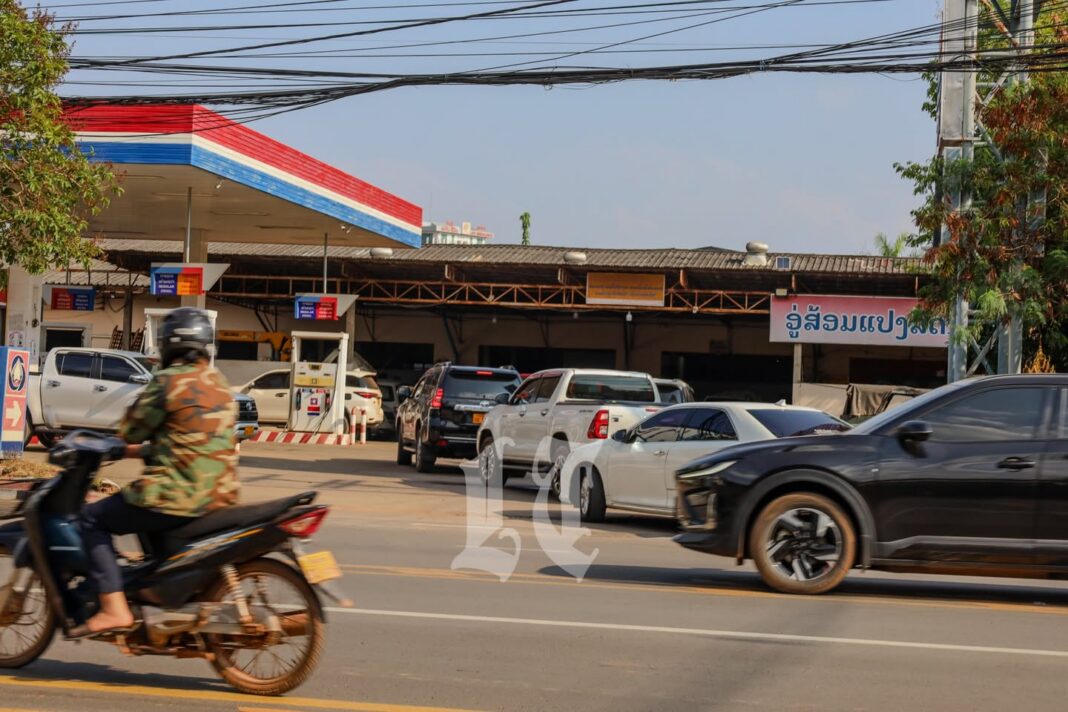
On 2 March, drivers in Vientiane rushed to gas stations, causing long queues as residents scrambled to fill up.
Amid the rising uncertainty, the Lao Ministry of Industry and Commerce issued a directive on the late afternoon of Monday, requiring all fuel import-export companies and domestic distributors to report their import and supply plans daily by 4:00 PM to the Department of Internal Trade. The notice aims to ensure the stable fuel supply during the Middle East unrest.
The Ministry also prohibited operators from hoarding fuel or manipulating the market, and ordered that stations not close without valid reasons. Operators are now required to notify local authorities three days in advance if they plan to temporarily or permanently close.
Authorities across Laos, including provincial, capital, and district offices, have been tasked with monitoring compliance and inspecting fuel distribution.
For now, the Lao Ministry of Industry and Commerce has reassured the public that the country’s fuel supply remains stable, urging residents to use fuel only when necessary to avoid disruptions.
