Home Blog Page 1437

Innovators Show Up: CES 2026 Opens Today

LAS VEGAS, Jan. 7, 2026 /PRNewswire/ — CES® 2026 officially opens its doors today, welcoming visionaries, industry and government leaders, investors, and media to the global gathering place for technology. Spanning more than 2.6M net square feet, CES 2026 is where breakthrough ideas come to life and where innovators show up to highlight what’s next in tech. As the world’s most powerful tech event, CES is the convergence of more than 4100 exhibitors showcasing innovation across accessibility, AI, digital health, energy, enterprise solutions, immersive entertainment, mobility, quantum, robotics, and more.

The show kicked off with two dynamic Media Days, packed with major product and partnership announcements and exclusive product demonstrations. Hosted by the Consumer Technology Association (CTA)®, CES 2026 runs today through Friday, January 9, across 13 venues in Las Vegas, including the newly renovated Las Vegas Convention Center (LVCC). CES will be the first event to use the space, marking the completion of the $600 million renovation of the LVCC legacy campus.

“CES is where innovators show up, business accelerates, partnerships ignite, and technology transforms real-world challenges into bold opportunities,” said Gary Shapiro, Executive Chair and CEO, CTA. “We’re thrilled to see global innovators show up and unveil the breakthroughs that will shape the future.”

“From global brands to trailblazing startups, the entire tech ecosystem comes together at CES,” said Kinsey Fabrizio, President, CTA. “CES is where innovation moves from idea to impact. There’s no better place to witness the possibility of how tech can improve lives for millions of people.”

CTA’s State of the Industry Address, delivered by Shapiro and Fabrizio, set the tone for the show — highlighting how AI is igniting innovation, CES is the proving ground where it takes off, and people are at the heart of it all.

Keynotes

AMD

AMD Chair and CEO Dr. Lisa Su discussed how the company’s portfolio of AI products and deep cross-industry collaborations are turning the promise of AI into real-world impact, highlighting that AI is everywhere and for everyone. Su unveiled new AI-focused products, including the Ryzen AI 400 Series for next-gen AI PCs, the MI440X GPU for enterprise, and the Ryzen AI Halo developer platform, emphasizing AI integration from data centers to edge devices and real-world applications with partners like OpenAI. She also provided an early look at its “Helios” rack-scale platform. Michael Kratsios, the President’s Science & Technology Advisor, joined Su on stage for a conversation on the role of public-private collaboration in advancing AI innovation, competitiveness, and opportunity. AMD announced a commitment of $150 million to bring AI into more classrooms and communities.

Siemens

Siemens AG President and CEO, Roland Busch, unveiled technologies to accelerate the industrial AI revolution. NVIDIA founder and CEO Jensen Huang joined Busch on stage to expand their partnership to build the industrial AI operating system. Siemens launched Digital Twin Composer software to power the industrial metaverse at scale. Athina Kanioura, CEO, Latin America and Global Chief Strategy and Transformation Officer of PepsiCo discussed how PepsiCo uses the Digital Twin Composer software to simulate upgrades to its facilities in the U.S. with plans to scale globally. Siemens highlighted new technologies for accelerating drug discovery, autonomous driving, and shop floor efficiency. In manufacturing, Siemens announced a collaboration to bring Industrial AI to Meta Ray-Ban AI Glasses.

Media Days (January 4-5)

Press Conferences

Leading brands unveiled major announcements and sparked global media buzz at press conferences at Mandalay Bay. Eight companies participated including Bosch, Doosan Bobcat, Geely Auto Group, Hisense, Hyundai, LG Electronics, Sony Honda Mobility Inc., and The LEGO Group.

CES Unveiled

CES Unveiled Las Vegas, the official press event of CES 2026, featured more than 225 companies and their groundbreaking innovations such as Baracoda’s Kolibree gamified toothbrush for kids, Coro’s breast feeding monitor, Earflo‘s non-invasive device to relieve children’s ear pressure, Dephy’s robotic exoskeleton device, Plaud’s wearable AI note taker, and Skywheel’s electric skis.

CES Tech Trends to Watch

Brian Comiskey, senior director, innovation and trends, CTA, and Melissa Harrison, vice president, marketing and communications, CTA, presented the CES 2026 Tech Trends to Watch. This media-only event offered insights into the future of tech, highlighting how AI enables more personalized consumer experiences and advances digital health solutions to support longer, healthier lives. The U.S. Consumer Technology Industry Forecast concluded that the industry is projected to reach $565 billion in revenue in 2026, growing 3.7% year over year. 

More at CES

With a record-number of CES Innovation Awards® 2026 submissions, additional honorees were recognized this week. Attendees can explore select winning products in person at the CES Innovation Awards Showcase at the Venetian, booth #50043.

During a ribbon cutting unveiling the LVCC renovation and marking the start of CES, CTA announced it intends to award $125,000 in support of two major City of Las Vegas sustainability projects through the CES 2026 Green Grants program. The includes contributions to the citywide tree planting initiative and energy-efficient streetlight upgrades. These projects support Las Vegas’s sustainability efforts and show that collaboration between government, community, and tech can produce effective solutions.

The CES Foundry, a new community uniting leaders in AI and quantum, will open on Wednesday, January 7 for two-days of programming, demos, and networking at the Fontainebleau.CES 2026 features more than 400 conference sessions with top tracks and stages like Great Minds, Accessibility, C Space®, Digital Health, Innovation Policy Summit, Manufacturing, and more. More than 1300 speakers will take the stage including celebrities and government officials. Visit CES.tech for live updates and streams from CES 2025 programming.

Download the CES App on the Android and Apple app stores to plan your show and navigate onsite.

About CES®:    

CES is the most powerful tech event in the world – the proving ground for breakthrough technologies and global innovators. This is where the world’s biggest brands do business and meet new partners, and the sharpest innovators hit the stage. Owned and produced by the Consumer Technology Association (CTA)®, CES features every aspect of the tech sector. CES 2026 takes place Jan. 6-9 in Las Vegas. Learn more at CES.tech and follow CES on social.  

About Consumer Technology Association (CTA)®:    
As North America’s largest technology trade association, CTA is the tech sector. Our members are the world’s leading innovators – from startups to global brands – helping support more than 18 million American jobs. CTA owns and produces CES® – the most powerful tech event in the world. Find us at CTA.tech. Follow us @CTAtech.  
 

NVIDIA CEO Jensen Huang Awarded 2026 IEEE Medal of Honor, Technology’s Most Prestigious Recognition

PISCATAWAY, N.J., Jan. 7, 2026 /PRNewswire/ — IEEE, the world’s largest technical professional organization of more than 500,000 worldwide, dedicated to advancing technology for humanity, proudly announces that Jensen Huang, founder and CEO of NVIDIA, has been named the recipient of the 2026 IEEE Medal of Honor, the organization’s highest accolade, and its accompanying $2 million prize.

Huang is being recognized for a lifetime of visionary leadership and pioneering work in accelerated computing, which has propelled NVIDIA to the forefront of technological innovation. This joins Huang’s other recent honors including the Queen Elizabeth Prize for Engineering, Person of the Year from Financial Times and TIME Magazine, and the Professor Stephen Hawking Fellowship. Under his guidance, NVIDIA – which became the first company to top $5 trillion in market cap in October 2025 – invented the first graphics processing unit (GPU) in 1999—a breakthrough that revolutionized computing and enabled advancements across medicine, engineering, robotics, autonomous vehicles, manufacturing, and more. Huang’s foresight in accelerated computing laid the foundation for today’s AI technologies and industrial revolution.

“The IEEE Medal of Honor represents the pinnacle of career achievement,” said Mary Ellen Randall, IEEE President. “Jensen Huang’s contributions have advanced the frontiers of technology and enabled innovations whose impact is yet to be imagined. IEEE is proud to honor work that not only defines excellence in our field, but inspires the next generation of engineers and technologists.”

Established in 1917, the IEEE Medal of Honor is awarded to individuals whose contributions have profoundly shaped technology and engineering. Its recipients boldly envision the new and revolutionary and expand the limits of what’s possible. Their accomplishments inspire today’s technologists to make the world a more innovative and better place. These pioneers transform radical ideas into world-changing realities that reshape how we live, work, and connect. Huang joins a distinguished lineage of Medal of Honor laureates whose work has transformed modern life, including Vinton G. Cerf and Robert Kahn (Internet architecture), Bradford W. Parkinson (GPS), and Morris Chang (semiconductors).

NVIDIA’s accelerated computing platform powers every industry, from enabling generative AI models like ChatGPT to building up the world’s leading AI factories and data centers. Huang’s commitment to innovation and his ability to operate decades ahead of industry trends have created an infrastructure that empowers technologists globally and impacts millions of lives daily.

“Receiving the IEEE Medal of Honor is deeply humbling. This recognition reflects the life’s work of thousands of engineers and researchers at NVIDIA,” said Huang. “From the invention of the GPU to the engines of modern AI factories, we’ve helped ignite a new industrial revolution. This award belongs to the entire community that built the CUDA ecosystem, advanced computing beyond Moore’s Law, and continues to push the frontier of artificial intelligence. Together, we’re building an incredible future for our planet.”

For the second consecutive year, the IEEE Medal of Honor includes a $2 million prize, underscoring both the award’s stature as one of the most significant recognitions in technology worldwide, as well as the integral nature of engineering and science in addressing global challenges and advancing the world forward.

About IEEE

IEEE is the world’s largest technical professional organization and is a public charity dedicated to advancing technology for the benefit of humanity. Through its highly cited publications, conferences, technology standards, and professional and educational activities, IEEE is the trusted voice on a wide variety of areas ranging from aerospace systems, computers and telecommunications to biomedical engineering, electric power, and consumer electronics. Learn more at https://www.ieee.org.

Samsung Outlines the Impact FAST, Creators and Live Experiences Are Having on the Future of Television at CES 2026

Samsung Tech Forum series continues at CES 2026 with industry leaders convening to explore the evolution of streaming

LAS VEGAS, Jan. 7, 2026 /PRNewswire/ — Samsung Electronics Co., Ltd. yesterday held “FAST Forward: How New Streaming Models Are Shaping the Next Generation of TV” as part of its Tech Forum panel series at CES 2026. Taking place at The Wynn in Las Vegas, Nevada, the panel brought together leaders from entertainment and media to explore the evolution of streaming and the rapid rise of free-ad-supported television (FAST).


Samsung Outlines the Impact FAST, Creators and Live Experiences Are Having on the Future of Television at CES 2026


The session highlighted the interconnected relationship between today’s rapidly evolving consumer behaviors and preferences, the transformation of content by technology and monetization models, the expanding role of creators as studios and the ways in which interactive and live experiences are catalyzing a shift from passive viewing into active engagement.

Moderated by Natalie Jarvey of The Ankler, the panel featured Salek Brodsky, SVP and Global Head of Samsung TV Plus; Alessandra Catanese, CEO of Smosh and Bruce Casino, EVP, Sales & Distribution, U.S., NBCUniversal Global TV Distribution.

FAST Gains Momentum as Audiences Recalibrate Value

As audiences grapple with subscription fatigue and a fragmented streaming landscape, the panel focused on how FAST is restoring simplicity and value to television. Samsung TV Plus anchored the conversation as a platform designed to reduce friction, offering hundreds of live and on-demand channels in one free, easily accessible experience across Samsung TVs and devices worldwide.

“The TV experience today can often feel like too much work for the viewer,” said SVP Brodsky. “Our goal with Samsung TV Plus is to simplify television again and combine the power of linear discovery with a modern, connected experience that feels effortless, curated and truly valuable.”

The panelists emphasized that FAST has evolved into a core part of the streaming ecosystem, complementing subscription and traditional models while delivering premium, proven programming at scale. For Samsung TV Plus, that evolution is rooted in shared experiences that elevate viewing and meet users not just where they already are, but where they want to be.

Hybrid Models Redefine the Streaming Ecosystem

Panelists emphasized that the evolution of streaming is less about replacing traditional models and more about expanding how audiences engage with content. FAST, subscription and linear distribution models are increasingly working in tandem, allowing studios to extend the life of proven franchises, reach new viewers and unlock additional value without sacrificing performance elsewhere. By leveraging data, audience behavior and decades of content insight, media companies are deploying FAST to complement existing channels and create a more resilient and diversified ecosystem.

EVP Bruce Casino highlighted how this approach has enabled NBCUniversal to bring both classic and contemporary content to FAST audiences while continuing to see strong performance across platforms. “FAST doesn’t replace traditional distribution, it extends it,” said Casino. “What we’re seeing is that when great content shows up in multiple places, it creates incremental value rather than cannibalization — allowing franchises to thrive across FAST, streaming and linear channels.”

Creators Emerge as the New Studios

The panel also examined how the changing nature of consumer habits and television platforms means content creators do not have to work exclusively with legacy studios to reach a broad audience. As this medium expands from social platforms to the living room, FAST is helping bridge digital culture and traditional TV, while also serving to elevate its production quality.

Samsung TV Plus was highlighted as a platform that helps creators evolve from digital-first brands into full-fledged television studios, helping expand reach, unlock new monetization opportunities and introduce content to broader, global audiences.

One of the clearest examples of a brand that has taken the step from digital-first brand to legitimate TV studio is sketch comedy-improv collective Smosh. By launching a FAST channel with Samsung TV Plus, Smosh has been able to strengthen its connection with its already-dedicated fans while gaining access to a much larger viewer base. Due to this evolution, Smosh has enhanced long-term growth.

“Partnering with Samsung TV Plus allowed us to elevate our production quality and invest in the future of the Smosh brand,” said CEO Alessandra Catanese. “It was the right platform to help us reach a broader audience while positioning our content in a premium environment that supports where we’re headed as a company.”

Live and Interactive Experiences Drive Engagement

Looking beyond on-demand viewing, panelists discussed how live programming like concerts and interactivity are reshaping the television experience by creating shared moments that audiences actively participate in.

With features such as synchronized premieres and real-time participation, technology is transforming television from a passive activity into an interactive experience — fostering connection, excitement and a sense of belonging that brings viewers together organically.Together, the panelists agreed that the future of television will be defined by flexibility, cultural connection and experiences that invite participation, not just consumption.

“Authentic content that creates cultural connection and brings people together is what matters most,” said SVP Brodsky. “That’s why we’re investing in live events, creator programming and interactive formats that remind people why TV has always been the center of the home.”

As streaming continues to evolve, Samsung is focused on helping shape a TV ecosystem that delivers value for viewers, opportunity for creators and scale for advertisers, — redefining what television can be in 2026 and beyond.

About Samsung Electronics Co., Ltd.

Samsung inspires the world and shapes the future with transformative ideas and technologies. The company is redefining the worlds of TVs, digital signage, smartphones, wearables, tablets, home appliances and network systems, as well as memory, system LSI and foundry. Samsung is also advancing medical imaging technologies, HVAC solutions and robotics, while creating innovative automotive and audio products through Harman. With its SmartThings ecosystem, open collaboration with partners, and integration of AI across its portfolio, Samsung delivers a seamless and intelligent connected experience. For the latest news, please visit the Samsung Newsroom at news.samsung.com.

About Samsung TV Plus

Samsung TV Plus is a premium global entertainment service committed to delivering exceptional experiences for everyone and every moment. As a leader in FAST with more than 88 million monthly active users, Samsung TV Plus offers thousands of shows and movies on-demand all in one place. Globally, the streaming service carries over 3,500 ad-supported linear channels in 30 countries and is accessible on over 630M active Samsung devices. Samsung TV Plus is the exclusive FAST home to curated channels and live events including the Jonas Brothers’ JONAS 20 Tour, Letterman TV, Conan O’Brien TV, The Ringer from Spotify, BillboardTV, and top digital Creators featuring Mark Rober TV, Dhar Mann TV and Michelle Khare’s Challenge Accepted. Samsung TV Plus is available on Samsung TVs, Galaxy devices, Samsung Smart Monitor, and Family Hub, all subscription-free. To learn more, visit samsungtvplus.com. Follow us on Instagram, Facebook, X and LinkedIn.


GIGABYTE Launches AORUS GeForce RTX™ 5090 INFINITY Graphics Card with Innovative Cooling and Compact Design at CES 2026

TAIPEI, Jan. 7, 2026 /PRNewswire/ — GIGABYTE, the world’s leading computer brand, unveils the latest AORUS GeForce RTX™ 5090 INFINITY graphics card at CES 2026, showcasing a breakthrough design that combines compact dimensions with a next-generation cooling solution. Featuring the revolutionary WINDFORCE HYPERBURST Cooling System and GIGABYTE’s first separated PCB layout, this latest flagship model redefines airflow performance and form factor footprint for elite gaming setups.

GIGABYTE Launches AORUS GeForce RTX™ 5090 INFINITY Graphics Card with Innovative Cooling and Compact Design at CES 2026

A well-designed cooling system is the key to unleashing the full potential of a GPU, and it has always been the top priority for every GIGABYTE graphics card. Powered by NVIDIA Blackwell, GeForce RTX 50 Series GPUs bring game-changing capabilities to gamers and creators. Equipped with a massive level of AI horsepower, the RTX 50 Series enables new experiences and next-level graphics fidelity. Multiply performance with NVIDIA DLSS 4, generate images at unprecedented speed, and unleash creativity with NVIDIA Studio.

Featuring a separated advanced PCB design first pioneered by NVIDIA,the AORUS GeForce RTX™ 5090 AORUS INFINITY graphics card with the new WINDFORCE HYPERBURST Cooling System and Double Flow Through design enables penetrating airflow on both sides of the backplate to achieve streamlined, unobstructed cooling. At the center of the card, an additional Overdrive Fan activates under intense workloads to deliver an extra burst of cool air for optimal gaming performance and fully unlock RTX AI computing power.

This innovative card features a circular design accented by a bold die-cast metal plate, a specially crafted circular heat sink, and GIGABYTE’s iconic RGB Halo lighting to showcase the build with uncompromising performance. Combined with premium craftsmanship, a breakthrough cooling solution, and an industry-defining design, the card maintains a compact footprint with only 33 cm in length and 14.5 cm in height, ensuring compatibility with a wide range of chassis.

From elite gaming to accessible AI, GIGABYTE continues to push boundaries at every level of performance and design. Please visit the GIGABYTE EVENT | CES 2026 for more information. To experience all showcased products in person, visit the GIGABYTE Booth #8519 at LVCC North Hall during CES 2026 or join media and VIP sessions at Venetian Ballroom Level 3 Lido 3004, 3005, and 3104.

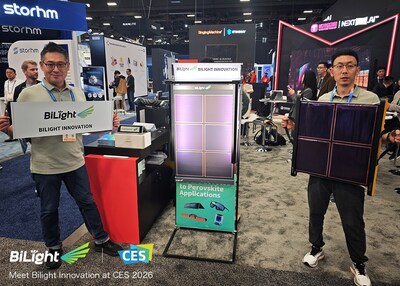
Perovskite Technology Takes Center Stage: BiLight Innovations Unveils Three Disruptive Products at CES 2026

LAS VEGAS, Jan. 7, 2026 /PRNewswire/ — At CES 2026, BiLight Innovation introduced three groundbreaking perovskite-based products, transforming residential and commercial energy solutions. The world’s first rollable photovoltaic curtain, the industry’s only battery-free electronic nameplate, and a revolutionary portable solar scroll demonstrate the company’s leadership in flexible technology, drawing significant industry attention.

Bilight Innovations unveiled three revolutionary perovskite photovoltaic (PV) products at CES 2026

The ultra-thin rollable PV curtain measures just 0.1mm thick and weighs under 150g/sq.m, with a bending radius below 10mm, challenging the rigidity of conventional photovoltaic modules. Achieving over 18% conversion efficiency with exceptional low-light performance, it integrates seamlessly into interior design—mounted on standard curtain rails while generating power from natural or ambient indoor lighting to supply lamps, smart devices, and energy storage systems. The curtain also provides thermal insulation and solar shading, delivering multifunctional performance in a single installation.

The lithium-battery-free electronic nameplate combines perovskite photovoltaic panels with low-power e-paper displays. Operating under typical 500-lux indoor lighting conditions, it enables continuous operation without charging or battery replacement. Bluetooth connectivity supports real-time content updates, displaying names, meeting agendas, and contact information for conference rooms or workstations, eliminating paper waste and battery degradation concerns for sustainable workplaces.

Expanding perovskite applications to the outdoor sector, BiLight also debuted a revolutionary portable flexible photovoltaic panel. Built on the company’s core flexible materials, this scroll-style solution redefines on-the-go power. Users simply pull both ends to instantly unfurl the compact unit into a full-sized generator. With a fabric-like thickness that fits easily into a backpack, it eliminates the bulk of traditional rigid panels, making it the ideal power companion for hiking, camping, and beach excursions.

These innovations showcase perovskite technology’s advantages in low-light efficiency, mechanical flexibility, and low-power adaptation, expanding photovoltaic applications from industrial to everyday settings. Industry insiders suggest the products represent a significant advancement in flexible, battery-free photovoltaic solutions.

BiLight Innovations specializes in perovskite photovoltaic research and development, democratizing clean energy across residential, commercial, and IoT applications to accelerate the global low-carbon transition.

CONTACT: Hugo Ni, hugoni@bilight.com


Stena RoRo enters into a 5 year charter contract with Marine Atlantic, Canada

GOTHENBURG, Sweden, Jan. 7, 2026 /PRNewswire/ — Stena RoRo has chartered out the ship A Nepita, ex Superfast X, to Canadian Crown Cooperation Marine Atlantic Inc for a 5-year period.

The ship will enter into service during the fall of 2026 following a period of customization to the intended trade such as ship to shore ramp arrangements, ships livery, a 5-year preventive maintenance program etc.

The A Nepita is currently chartered to the French operator Corsica Linea and trading in the Mediterranean Sea. She is ice-class rated, equipped with three bow thrusters and a stern thruster for superior maneuverability and designed to transport both passengers and commercial vehicles.

“We are pleased to be able to offer such a suitable ship to Marine Atlantic, which we will adapt and optimize for one of the most demanding ferry services in the world”, says Per Westling, CEO of Stena RoRo AB, Sweden.

Basic specifications:
Length Over all: 203.24 m
Width: 25.7 m
No of Passengers: abt. 1200
Cargo capacity: 1,920 cargo lane meters
Ice Class: 1A
Speed: abt. 22 kn
Build year: 2002

Photo: A Nepita in current charter to Corsica Linea

For more information, please contact,
Per Westling, CEO, Stena RoRo AB
Tel: +46 31 855154; +46 704 85 51 54
Email: per.westling@stena.com

Since 1977, Stena RoRo has led development of new marine RoRo cargo and RoRo passenger concepts. We provide custom-built vessels, as well as standardized RoRo and RoPax vessels. The company leases about fifteen vessels to operators worldwide, both other Stena companies and third parties. Stena RoRo specializes above all in using its technical expertise for the design and production of new vessels and the conversion and technical operation of existing vessels in order to deliver tailor-made transport solutions to its customers. We call this “Stenability”. Since 2016 Stena RoRo has taken delivery of 12 RoPax ships of the E-Flexer class and 2 roro ships of the NewMax class. Since 2013, we have had responsibility for the design and completion of the world´s largest civilian hospital vessel, owned and operated by Mercy Ships, the Global Mercy. The ship was delivered in 2021.
www.stenaroro.com

About Marine Atlantic  
Marine Atlantic is a federal Crown corporation, and is committed to providing a safe, environmentally responsible ferry service between the Island of Newfoundland and the Province of Nova Scotia in a reliable, courteous, and cost-effective manner.  Marine Atlantic serves two routes. The first is a year-round, 96 nautical mile daily ferry service between Port aux Basques, Newfoundland and North Sydney, Nova Scotia. The second, offered from mid-June until late September, is a 280 nautical mile ferry service between Argentia, Newfoundland and North Sydney, Nova Scotia.
www.marineatlantic.ca

This information was brought to you by Cision http://news.cision.com

https://news.cision.com/stena-roro/r/stena-roro-enters-into-a-5-year-charter-contract-with-marine-atlantic–canada,c4289039

The following files are available for download:

https://mb.cision.com/Main/9515/4289039/3863914.pdf

Stena RoRo enters into a 5 year charter contract with Marine Atlantic, Canada

https://news.cision.com/stena-roro/i/a-nepita-in-current-charter-to-corsica-linea,c3498762

A Nepita in current charter to Corsica linea

Laos Targets Upper-Middle-Income Status by 2055

Laos sets a long-term goal to reach upper-middle-income status by 2055, with steady growth targets outlined in its next five-year plan. This photo is used for representational purpose only.

Laos has set a long-term goal to become an upper-middle-income country and move closer to high-income status by 2055, according to a strategic roadmap unveiled at the 12th National Congress of the Lao People’s Revolutionary Party (LPRP).

President Thongloun Sisoulith presented the vision at the opening session of the congress on 6 January. The three-day meeting, the Party’s 12th since its first congress in 1955 in Houaphanh Province, sets out national priorities aimed at strengthening economic foundations and navigating both domestic and global challenges.

The roadmap, known as Vision 2055, places strong emphasis on modernisation, including the use of advanced technologies such as artificial intelligence in governance and production. 

Planned reforms focus on improving transparency, strengthening accountability in the civil service, and giving greater authority to local administrations, as Laos seeks to build a more self-reliant and competitive economy.

Laos is currently classified by the World Bank as a lower-middle-income country and remains a Least Developed Country (LDC), with the government targeting graduation from LDC status in 2026.

To support the long-term vision, the 2026-2030 National Socio-Economic Development Plan sets out key economic targets. 

Authorities aim for average GDP growth of at least 6 percent per year, with GDP per capita expected to reach USD 3,104 by 2030 and gross national income per capita projected at USD 2,914. 

Prime Minister Sonexay Siphandone noted that average GDP growth over the past five years reached 4.24 percent, slightly above the original target, with growth in 2025 estimated at 4.2 percent.

Fiscal stability also features prominently in the plan. The government aims to reduce public debt from about 88 percent of GDP in 2025 to below 70 percent during the next five-year period, while keeping inflation under 5 percent, compared to an average of 7.7 percent in 2025. Budget revenue is projected to reach LAK 554.4 trillion (approximately USD 25.6 billion), or about 20.95 percent of GDP, supported by a broader tax base including land, building, and environmental taxes.

Total investment is expected to reach LAK 636.2 trillion (about USD 29.4 billion), equivalent to at least 24 percent of GDP. The plan prioritises private sector growth and investment in key industries, alongside the development of renewable energy sources such as solar, wind, and nuclear power, as Laos works toward its long-term development goals.

[CES 2026 Deep Dive] From Fingertips to the Stars: Lens Technology Debuts Aerospace-Grade UTG, Reshaping the LEO Satellite “Energy Canopy”

LAS VEGAS, UNITED STATES – Media OutReach Newswire – 7 January 2026 – Amidst a CES 2026 landscape dominated by AI headlines and humanoid robots, a quiet corner of the Lens Technology booth has unexpectedly become a focal point for commercial space analysts.

There are no flashy RGB lighting effects here, only a sheet of glass as thin as a cicada’s wing, being repeatedly rolled and unrolled like a tape measure. This is the public debut of Lens Technology’s aerospace-grade UTG (Ultra-Thin Glass) photovoltaic encapsulation solution. This technology marks the official entry of the manufacturing titan—best known as a giant in the Apple supply chain—transferring its precision manufacturing capabilities from consumer electronics to humanity’s next trillion-dollar market: space infrastructure.

As leading global satellite companies begin the mass deployment of third-generation (V3) satellites, the Low Earth Orbit (LEO) internet race is entering a “second half” defined by heavy payloads, long lifespans, and low costs. Lens Technology’s entry aims to untie the knot that has long plagued the aerospace industry: the trade-off between flexibility and durability.

Farewell to the “Plastic Feel”: The Material Battle in Space

At the Lens Technology booth, engineers demonstrated the core contradiction to the audience: Traditional aerospace solar cell covers are either heavy Cerium-doped Glass (CMG) or expensive Fused Silica, typically ranging from 100μm to 500μm in thickness. They are robust, but too heavy and impossible to bend.

To adapt to the massive power demands of next-generation satellites (such as those supporting direct-to-cell services), solar wing designs are rapidly evolving from rigid panels to Roll-Out Solar Arrays (ROSA-like structures). This shift forced designers to temporarily turn to polymer materials like transparent Polyimide (CPI).

“However, polymers have a fatal weakness in space,” explained a Lens Technology on-site technical lead. “The LEO environment is filled with high-energy Atomic Oxygen (AO) and strong UV radiation. Under long-term exposure, polymer molecular chains break, causing the material to yellow, become brittle, and suffer a drastic drop in light transmission. This efficiency decay was tolerable for early satellites with 5-7 year lifespans, but for the new generation of mega-constellations pursuing higher commercial returns, it is unacceptable.”

Lens Technology’s answer is Aerospace-Grade UTG. As an inorganic material, glass possesses innate “immunity” to Atomic Oxygen and UV aging, ensuring high light transmission throughout the satellite’s lifecycle. More importantly, its dense structure provides an effective barrier against water vapor and micrometeoroids, offering physical protection for delicate ultra-thin HJT or future Perovskite batteries.

The 30-Micron “Moat”: A Perfect Match for Next-Gen Satellites

In the demo area, a piece of glass only 30μm-50μm thick is bent to an astonishing radius of R1.5mm. This level of flexibility drew gasps from the audience.

This is exactly the characteristic most coveted by top global satellite companies today. To reduce the cost per launch, next-generation mega-satellites must be stowed with origami-like efficiency inside the rocket fairing. Lens Technology’s UTG solution allows solar wings to be tightly wound like a tape measure during launch, and instantly recover to a flat state upon orbital deployment.

However, making glass thin is the first step; keeping it from shattering during the violent vibration of a rocket launch is the real challenge.

Analysts point out that Lens Technology’s core competitiveness lies in its proprietary chemical strengthening processes and laser/diamond wire cutting technologies. Glass fractures often originate from micro-cracks invisible to the naked eye. Leveraging processes honed on foldable smartphones, Lens has significantly reduced the density of micro-defects on the glass edges and surfaces. This means that even under immense tension and vibration, this “glass skin” remains tough and resilient.

Dimensional Strike: Reshaping Aerospace Costs with “Consumer-Grade” Capacity

If technical specifications are the ticket to entry, then capacity and cost control are Lens Technology’s ultimate weapons.

“The logic of commercial space has changed; it is now the era of industrial mass production,” commented an industry analyst at the scene. Compared to the small-batch, lab-grade customization model of traditional aerospace glass manufacturers, Lens Technology brings the scale of consumer electronics manufacturing.

Facing the grand ambition of global satellite leaders planning to launch tens of thousands of satellites annually, supply chain elasticity is critical. Lens Technology stated that it has the capability to rapidly expand existing pilot lines or flexibly retrofit mass production lines. This potential for “ten-thousand-satellite scale” delivery and yield control can significantly lower the BOM (Bill of Materials) cost per satellite—addressing the most sensitive pain point for commercial space giants today.

Outlook: The New Cornerstone of Next-Gen Space Energy

At CES, Lens Technology also “spoiled” its future technology roadmap.

As Perovskite/Silicon tandem cells are viewed as the mainstream for future satellite power, UTG will serve not just as a cover, but as an encapsulation substrate. Lens Technology revealed it is developing next-generation composite UTG integrated with Anti-Static (ESD) coatings and Selective Radiation coatings, which will not only protect chips from electrostatic discharge damage but also assist in regulating battery temperature.

Although this business currently accounts for a tiny fraction of Lens Technology’s massive revenue and is in a period of intensive validation with global top-tier photovoltaic component manufacturers (Tier 2) and top commercial space clients (Tier 1), its signal significance cannot be ignored.

From smartphone screens to satellite wings, Lens Technology is proving that in the era of scaled expansion for space infrastructure, ground-based industrial giants possessing extreme craftsmanship and mass manufacturing capabilities will be indispensable “pavers” for the interstellar journey.

Hashtag: #LensTechnology

The issuer is solely responsible for the content of this announcement.