Home Blog Page 375

Lao-American Chef Saeng Douangdara Launches Debut Cookbook in New York

Lao-American chef Saeng Douangdara launched his debut cookbook, The Lao Kitchen- Lao Flavors and Stories Told Through Family Recipes, at the Museum of Food and Drink in New York City.

Lao-American chef Saeng Douangdara has launched his debut cookbook, The Lao Kitchen: Lao Flavors and Stories Told Through Family Recipes, at the Museum of Food and Drink in New York City.

Published on 21 April by Ten Speed Press, the book traces Lao culinary traditions across generations, from Savannakhet to diaspora communities in the United States, while introducing key flavors such as padaek, jaews, and larb.

The launch event drew a full audience and featured a conversation between Saeng and Lao-American performer Jujubee, focusing on identity, migration, and the cultural significance of Lao food.

Among the dishes presented was a plant-based version of larb leuad pang ped, traditionally made with duck blood. Saeng used beetroot juice as a substitute to retain the dish’s color and flavor while making it more accessible.

The event also brought together members of the Lao community un the US and representatives linked to the Lao Mission to the United Nations.

The release comes as Lao cuisine gains wider international recognition. Through a mix of recipes and personal narratives, the book highlights Lao food as a distinct culinary tradition.

Lao cuisine has historically received limited global recognition, often overshadowed by or grouped with neighboring cuisines in the region. However, dishes such as sticky rice, larb, and tam mak hoong have gradually gained visibility through diaspora communities, restaurants, and social media, helping introduce Lao flavors to wider audiences.

In recent years, Lao chefs and food advocates abroad have played a growing role in documenting and promoting traditional recipes, contributing to a broader understanding of Lao culinary identity. Publications like The Lao Kitchen strengthen this shift, positioning Lao food within global culinary conversations.

Following the launch, Saeng has begun a US tour, with strong turnout in multiple cities. A recent stop in Buffalo featured a moderated discussion, small bites inspired by the book, and a signing session.

The cookbook is also available in Laos through Monument Books.

Fish Deaths Spread Along Xe Don in Champasak as Water Tests Raise Concerns

Local communities have reported several fish death cases along the Xe Don River in Champasak, with similar incidents previously recorded upstream in Salavan, raising concerns over water quality as authorities continue investigations.

Authorities in Sanasomboun district, Champasak, reported large numbers of dead fish along the river on 3 May.

The provincial Department of Agriculture and Environment conducted field inspections across three villages on 2 May, confirming that fish deaths occurred between 28 April and 3 May. Officials observed carcasses along riverbanks, accompanied by murky water and foul odors.

Initial water quality tests showed unusually high alkalinity levels, ranging from pH 10.16 to 11.3, exceeding the normal range of pH 5 to 9.

Authorities said such conditions could be linked to alkaline substances, including chemicals associated with industrial processes or untreated wastewater. However, no industrial facilities have been identified in the affected area.

Further testing is underway, with water and aquatic samples sent for laboratory analysis. The exact cause and source have not yet been confirmed.

Local authorities in Sanasomboun district have issued warnings following the incident.

Residents have been advised not to consume fish found already dead and to avoid using river water for daily activities or livestock until conditions return to normal. Officials are also removing dead fish and monitoring potential health risks.

Earlier Reports in Salavan

Earlier incidents were reported in Khongxedon district, Salavan, on 23 April, where residents observed dead fish along the riverbank along with a strong odor.

At the time, local authorities attributed the deaths to high temperatures and low water levels, stating that water quality remained within normal limits.

The difference between earlier findings in Salavan and more recent test results in Champasak has prompted further investigation.

Authorities said they are reviewing the situation and will release updates as additional test results become available.

ADECCO GROUP DIVIDEND 2026: ANNOUNCEMENT OF FINAL TERMS

AD HOC ANNOUNCEMENT pursuant to Art. 53 Listing Rules of SIX Swiss Exchange

Group press release

  • Scrip dividend take-up rate of 53.01%
  • Reference share price of CHF 18.02, with an issue price of CHF 16.94
  • 5,268,324 new shares to be issued

ZURICH, May 5, 2026 /PRNewswire/ — Adecco Group’s Annual General Meeting, held on April 15, 2026, offered its shareholders the option to receive the 2025 dividend in cash or in new Adecco Group shares.

The Adecco Group announces today that 53.01% of the dividend for the financial year 2025 was elected to be paid in the form of new Adecco Group AG shares, while the remaining 46.99% will be paid out in cash.

The reference share price was set at CHF 18.02, based on the daily volume-weighted average price of existing Adecco Group AG shares traded on the SIX Swiss Exchange between April 21, 2026 and May 4, 2026. The issue price of the new shares of CHF 16.94, was set at a 6.0% discount to the reference share price, resulting in a conversion ratio of 16.940.

5,268,324 new Adecco Group AG shares will be issued through a capital increase for the scrip dividend. The delivery of new shares and the total CHF 79 million cash dividend payment is planned for May 7, 2026.

Denis Machuel, Adecco Group CEO, commented:

“We are pleased with the take-up of our scrip dividend and thank our shareholders for their partnership and support of the Group’s strategy. We remain focused on ensuring an attractive and sustainable dividend policy, delivering attractive returns to our shareholders while retaining financial flexibility to invest in our competitive differentiators and prioritize deleveraging.”

Adecco Group will be reporting its first quarter results on May 13, 2026.

The Adecco Group is the world’s leading talent and technology expertise company. Our purpose is making the future work for everyone. Through our three global business units – Adecco, Akkodis and LHH – across 60 countries, we enable sustainable and lifelong employability for individuals, deliver digital and engineering solutions to power the Smart Industry transformation and empower organizations to optimize their workforces. The Adecco Group leads by example and is committed to fostering sustainable employability and supporting resilient economies and communities. The Adecco Group AG is headquartered in Zurich, Switzerland (ISIN: CH0012138605) and listed on the SIX Swiss Exchange (ADEN).

For further information please contact:

Investor Relations
investor.relations@adeccogroup.com
+41 (0)44 878 88 88

Press Office
media@adeccogroup.com
+41 (0) 79 876 09 21

Think 2026: IBM Delivers the Blueprint for the AI Operating Model as the AI Divide Widens

  • Next-generation agent orchestration and agentic development give enterprises a unified way to plan, build, deploy, and govern AI agents at scale
  • Real-time, AI-ready data foundation gives enterprises the governed, connected information agents need to act with speed
  • AI-powered hybrid cloud management connects infrastructure, security, and operations across hybrid environments
  • Built-in governance and sovereignty controls let enterprises run AI at scale

BOSTON, May 5, 2026 /PRNewswire/ — Today, at its annual Think conference, IBM (NYSE: IBM) announced its most comprehensive expansion of enterprise AI and hybrid cloud management capabilities to date. Products and capabilities unveiled today include the next generation of IBM watsonx Orchestrate for multi-agent orchestration, IBM Confluent to bring real-time data to AI, IBM Concert platform for intelligent operations, and IBM Sovereign Core for operational independence.

IBM Corporation logo.

The announcements address the defining challenge facing enterprises: many have invested heavily in AI, but only few believe it is paying off. The products and capabilities unveiled today address this gap for enterprises.

“The enterprises pulling ahead are not deploying more AI – they’re redesigning how their business operates,” said Arvind Krishna, Chairman and CEO, IBM.Running AI in the enterprise requires a new operating model, and IBM is enabling organizations to manage AI-driven systems with the same rigor, governance, and scale as their most critical infrastructure.”

A New Operating Model for the Agentic Enterprise
AI requires a new operating model, built on four integrated systems working together: agents through coordinated AI that executes and adapts across the business; data through real-time, connected information that gives teams a shared view of what’s happening; automation through end-to-end infrastructure and automated workflows that scale across processes; and hybrid through operational independence for sovereignty, governance, and security that allows AI to run consistently and with controls. Each is a separate priority that enterprises are chasing. Together, they represent a fundamental shift from improving parts of the business to changing how the business operates. Today’s announcements represent the next evolution of IBM’s portfolio, to deliver against the operating model.

Agents: Orchestration and Development at Scale
As organizations move from deploying a handful of agents to managing thousands, built by different teams on different platforms, the core challenge shifts from building agents to keep them governed and auditable in near real time.

IBM is announcing the next generation of watsonx Orchestrate (available in private preview), evolving it into an agentic control plane for the multi-agent era, where organizations can deploy agents from any source with consistent policy enforcement and accountability.

Alongside watsonx Orchestrate, IBM recently announced:

  • IBM Bob (generally available), an agentic development partner designed for the enterprise, partners with developers to build agents with security and cost controls built in.

Data: AI-Ready Foundation
For most enterprises, data is siloed and without meaning. To effectively power agentic systems with up-to-date data, IBM is delivering, real-time, AI-ready data foundation through its recent acquisition of Confluent for real-time data streaming built on Kafka and Flink technologies, and pairing new capabilities coming to watsonx.data with a real-time context layer for AI.

Additional announcements include:

  • Context in watsonx.data (available in private preview) extends watsonx.data with an open, federated context layer that makes enterprise AI reason reliably over business data — applying semantic meaning, enforcing governance at runtime, and making decisions explainable. Featuring new capabilities including context, OpenRAG, and OpenSearch on watsonx.data, and Confluent’s Real-Time Context Engine.
  • Confluent and Tableflow integration with watsonx.data (generally available) and Confluent and Flink integrations with watsonx.data deliver unified AI and analytics across all data, connecting real-time event streaming with batch workloads across the hybrid enterprise.
  • watsonx.data GPU-accelerated Presto (available in private preview) showed the potential to significantly reduce the cost of running certain workloads and processing time on large enterprise datasets in internal benchmark testing with NVIDIA. In a proof of concept with Nestlé, the engine delivered 83% cost savings and an overall 30x price-performance improvement on a global data mart spanning 186 countries.
  • IBM Z Database Assistant (available in private preview) gives Db2 and IMS database administrators an AI-powered workspace to monitor performance, automate routine tasks, and optimize configurations across complex IBM Z environments.
  • HCP Terraform powered by Infragraph (available in public preview) delivers unified infrastructure visibility through a centralized, event-driven knowledge graph by connecting data across cloud environments, infrastructure-as-code workflows, security tooling, and operations platforms to help streamline operations and automate remediation.

Automation: Intelligent Infrastructure Operations
Running AI at the core of the business can make infrastructure exponentially more complex, and most enterprises are managing that complexity through fragmented tools, siloed teams, and humans serving as the connective layer between systems that were never designed to work together.

IBM is announcing IBM Concert platform (available in public preview), an AI-powered operations platform to move organizations from passive monitoring to coordinated, intelligent response. Where traditional tools capture metrics, the Concert platform brings systems together. It correlates signals together into a single view across applications, infrastructure, network, without requiring organizations to rip and replace existing tooling.

Concert delivers this through three interconnected capabilities: cross-domain understanding to eliminate silos and surface what matters most; context-driven decisions that correlate signals across risk and dependencies, so teams act from a shared, clear view; and coordinated execution that moves organizations from insight to action with built-in governance and human oversight.

The threat landscape is changing— AI can now identify and exploit vulnerabilities in hours, not days. IBM Concert Secure Coder (available in public preview) addresses this by embedding security management directly into the developer workflow. Available in IBM Bob and VS Code, it identifies and prioritizes risks as code is written, and can generate automatic remediations to fix vulnerable code, or patch OS, middleware, packages and images. This makes security continuous and proactive and can help identify vulnerabilities before they are exploited.

Additional announcements include:

  • HCP Terraform powered by Infragraph (available in public preview) transforms infrastructure into a live, intelligent system with real-time visibility and context-aware automation across the infrastructure lifecycle.
  • IBM Vault 2.0 (generally available) introduces AI-driven analysis of leaked secrets for rapid triage, dynamic short-lived credentials across major cloud providers, and automated secrets rotation to reduce credential sprawl.
  • IBM zSecure Secret Manager (planned availability June 2026) brings enhanced security automation to RACF mainframe environments, integrating with IBM Vault Self-Managed for IBM Z and LinuxONE to streamline certificate lifecycle management.

Hybrid: Operational Sovereignty
AI embedded into the core of business means it operates in the most sensitive and complex environments: regulated data, critical infrastructure, cross-border jurisdictions. For those contexts, compliance cannot be a configuration choice.

IBM is announcing the general availability of IBM Sovereign Core, a platform that embeds policy at the infrastructure runtime level, so governance can be addressed as regulatory requirements evolve, while prioritizing workload portability. IBM Sovereign Core includes an extensible catalog that organizations can curate for their own users, with their own applications, or populated with pre-vetted IBM, third-party and open-source software and services from an ecosystem of partners that includes: AMD, ATOS, Cegeka, Cloudera, Dell, Elastic, HCL, Intel, Mistral, MongoDB and Palo Alto Networks.

Built on open, enterprise-grade technologies like Red Hat OpenShift and Red Hat AI, IBM Sovereign Core enables organizations to extend existing investments across hybrid and partner environments.

Supporting Materials:
Blog: Manage all your AI agents in one place with watsonx Orchestrate
Blog: Shifting from AI-assisted coding to AI-assisted delivery with IBM Bob
Blog: Real-time context for AI across hybrid environments
Blog: Introducing GPU acceleration for IBM watsonx.data
Blog: IBM Data Gate for Confluent: Turning Z data into real-time action
Blog: IBM Z Database Assistant brings intelligent operations for the AI era
Blog: Introducing IBM Concert platform: Closing the gap between insight and action
Blog: Announcing IBM Concert Secure Coder: Bringing security to the moment code is written
Blog: Introducing HCP Terraform powered by Infragraph: Now in public preview
Blog: Vault Enterprise 2.0 modernizes identity security at scale
Blog: Introducing IBM zSecure Secret Manager: Bringing automated certificate lifecycle management to IBM z/OS
Blog: IBM Sovereign Core creates AI-ready sovereign environments with verifiable control

Statements regarding IBM’s future direction and intent are subject to change or withdrawal without notice and represent goals and objectives only.

Examples presented are illustrative only. Actual results will vary based on client configurations and conditions and, therefore, generally expected results cannot be provided.

About IBM

IBM is a leading provider of global hybrid cloud and AI, and consulting expertise. We help clients in more than 175 countries capitalize on insights from their data, streamline business processes, reduce costs and gain the competitive edge in their industries. Thousands of governments and corporate entities in critical infrastructure areas such as financial services, telecommunications and healthcare rely on IBM’s hybrid cloud platform and Red Hat OpenShift to affect their digital transformations quickly, efficiently and securely. IBM’s breakthrough innovations in AI, quantum computing, industry-specific cloud solutions and consulting deliver open and flexible options to our clients. All of this is backed by IBM’s long-standing commitment to trust, transparency, responsibility, inclusivity and service.

Visit www.ibm.com for more information.

Media contact:

Kate Lehman
IBM
Kate.Lehman@ibm.com

Cleveland Clinic, RIKEN, and IBM Model a 12,635-Atom Protein – the Largest Known to Be Simulated with Quantum Computers

Milestone simulation of biologically meaningful molecules expands quantum-centric supercomputing’s role as a scientific tool

YORKTOWN HEIGHTS, N.Y. and CLEVELAND, May 5, 2026 /PRNewswire/ — Scientists at Cleveland Clinic, RIKEN, and IBM (NYSE: IBM) have used IBM quantum computers and two of the world’s most powerful supercomputers to simulate protein complexes spanning up to 12,635 atoms. These are the largest-known simulations of biologically meaningful molecules performed with quantum hardware yet, and signal that quantum computers are maturing into useful scientific tools which can help solve fundamental problems in biology, chemistry, and life sciences.

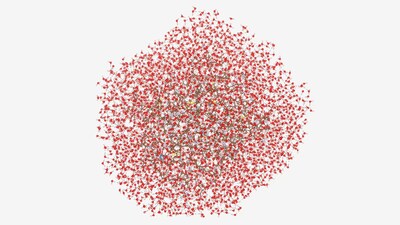
Researchers at IBM, Cleveland Clinic, and RIKEN used quantum-centric supercomputing to model the protein trypsin, a 12,635-atom protein and the largest known to be simulated with quantum computers. (Credit: IBM, Cleveland Clinic, and RIKEN)

The results were achieved in part by an innovative algorithm that optimizes how quantum and classical computers can work together, a framework known as quantum-centric supercomputing. Using this approach, the team captured the behavior of two biochemically relevant proteins that are roughly 40 times larger than what this same method could initially achieve just six months ago. Additionally, the accuracy of the simulations in a key step of the workflow improved by up to 210 times over this same period.

The decision to explore if quantum computers could offer value in the simulation of protein complexes was motivated by challenges faced today by researchers when studying how a drug candidate could bind to a protein. This can be one of the most difficult and expensive problems in life sciences research, and one that today’s existing computational methods have struggled to exactly solve as molecules increase in size. Doing so accurately and early in the discovery process could meaningfully shorten drug development timelines that currently can stretch over a decade and require substantial investment to produce a single medicine.

“This work marks an important advance and underscores quantum computing’s emerging role on systems of relevance to drug discovery,” said Kenneth Merz, Ph.D., lead author of the study and staff scientist in Cleveland Clinic’s Computational Life Sciences Department. “By crossing the 12,000-atom barrier, we have significantly expanded the scale of biologically meaningful molecular simulations possible with quantum computing and demonstrated a framework for applying these methods to scientifically relevant problems at a larger scale.”

“For years, quantum computing has been a promise. Now, quantum computers are producing results that matter to science,” said Jay Gambetta, Director of IBM Research and IBM Fellow. “The systems we simulated here are the kind of molecules that biologists and chemists work with in the real world. Quantum computers are no longer proving they are viable tools – they are proving they can contribute meaningful results in quantum-centric supercomputing architectures.”

The breakthrough research, reported in a pre-print study, builds on a series of milestones from the three institutions. This includes work on the cover of Science Advances that introduced techniques to model electronic states in molecules, first demonstrated on iron sulfides, and more recently, the 303-atom benchmark molecule called Trp-cage – the first-known full quantum-centric simulation made of 20 amino acids.

Quantum and Classical Computers, Working in Tandem

This approach – what IBM calls quantum-centric supercomputing – pairs quantum processors with classical computers so each computational tool can solve the parts of a problem where it excels. In this work, classical computers deconstructed the protein-ligand complexes into computable fragments. IBM’s 156-qubit IBM Quantum Heron processors, running within the IBM quantum computers at both Cleveland Clinic in the United States and RIKEN in Japan, calculated the quantum-mechanical behavior of those pieces in tandem with two of the most powerful classical supercomputers – Fugaku at RIKEN and Miyabi-G, operated by the University of Tokyo and the University of Tsukuba. The strength of IBM’s quantum hardware was essential to the accuracy and success of the computation, which required up to 94 qubits running nearly 6,000 quantum operations within certain parts of the simulation. Results were reassembled on classical computers to obtain a complete representation of the molecule.

As published on arXiv, the jump in scale was made possible by both algorithmic innovation and access to cutting-edge computing infrastructure. The novel quantum-classical hybrid algorithm, coined EWF-TrimSQD, dramatically reduced computational overhead and accelerated the ability to directly represent the chemistry of these molecular systems on quantum hardware. As a result, the frontier for what is possible with quantum-centric supercomputing has been pushed forward to previously inaccessible molecule sizes, and there is a clear path to further increase the size and accuracy of such calculations.

A Step Towards Drug Discovery

The team views this work as a starting point. Looking ahead, the ability to scale simulations of molecular systems with accuracy is a step towards helping researchers better predict how medicines may interact with protein targets. Computational improvements in drug discovery rest on two fundamental capabilities: first, modeling the movement of atoms as biological processes unfold; and second, accurately computing their energies, for which these results provide evidence that quantum‑centric supercomputing can support.

As quantum computers advance, integrating them into computational workflows could offer higher accuracy in energy calculations at larger scales, and potentially open the door to simulating enzyme catalysts, drug mechanisms, and other molecular behaviors that today can only be studied through experimentation.

More broadly, this breakthrough marks a shift in what quantum computing means to science. For most of its history, the field of quantum computation has measured progress in qubits, gates, and error rates. Now, its capabilities can also be measured by the size and significance of the problems it can help to solve.

For more information on this milestone, visit: https://www.ibm.com/quantum/blog/cleveland-clinic-riken-chemistry

Research Support

This research is supported by NEDO (New Energy and Industrial Technology Development Organization), an organization under the jurisdiction of Japan’s Ministry of Economy, Trade and Industry (METI)’s “Research and Development of Quantum-Supercomputers Hybrid Platform for Exploration of Uncharted Computable Capabilities” (Project Leader: Mitsuhisa Sato) as part of the “Project for Research and Development of Enhanced Infrastructures for Post 5G Information and Communications Systems (JPNP20017).”

About IBM

IBM is a leading global hybrid cloud and AI, and business services provider, helping clients in more than 175 countries capitalize on insights from their data, streamline business processes, reduce costs and gain the competitive edge in their industries. Thousands of governments and corporate entities in critical infrastructure areas such as financial services, telecommunications and healthcare rely on IBM’s hybrid cloud platform and Red Hat OpenShift to affect their digital transformations quickly, efficiently and securely. IBM’s breakthrough innovations in AI, quantum computing, industry-specific cloud solutions and business services deliver open and flexible options to our clients. All of this is backed by IBM’s legendary commitment to trust, transparency, responsibility, inclusivity and service.
For more information, visit https://research.ibm.com.

About Cleveland Clinic

Cleveland Clinic is a nonprofit multispecialty academic medical center that integrates clinical and hospital care with research and education. Founded in 1921 by four renowned physicians with a vision of providing outstanding patient care based upon the principles of cooperation, compassion and innovation, Cleveland Clinic has pioneered many medical breakthroughs, including coronary artery bypass surgery and the first face transplant in the United States. Cleveland Clinic is consistently recognized in the U.S. and throughout the world for its expertise and care. Among Cleveland Clinic’s 83,000 employees worldwide are more than 6,600 salaried physicians and researchers, and 21,900 registered nurses and advanced practice providers, representing 140 medical specialties and subspecialties. Cleveland Clinic is a 6,725-bed health system that includes a 173-acre main campus near downtown Cleveland, 23 hospitals, 300 outpatient facilities, including locations in northeast Ohio; Florida; Las Vegas, Nevada; Toronto, Canada; Abu Dhabi, UAE; and London, England. In 2025, there were 15.9 million outpatient encounters, 343,000 hospital admissions and observations, and 336,000 surgeries and procedures throughout Cleveland Clinic’s health system. Visit us at clevelandclinic.org. Follow us at x.com/CleClinicNews. News and resources are available at newsroom.clevelandclinic.org.

Media contacts

Brittany Forgione
IBM
Brittany.Forgione@ibm.com

Erin Angelini
IBM Research Communications
edlehr@us.ibm.com

Alicia Reale-Cooney
Cleveland Clinic
realeca@ccf.org  
216.408.7444

Researchers at IBM, Cleveland Clinic, and RIKEN have rapidly scaled the size of molecules they can model using quantum-centric supercomputing. Their progression from simple chemical systems of just 10 atoms to biologically important proteins with more than 12,000 atoms illustrates how quantum computers — working alongside the world’s most powerful classical supercomputers — are beginning to tackle the kinds of complex molecular systems relevant to biology and chemistry.


The IBM quantum computer installed at Cleveland Clinic in Ohio. (Credit: IBM and Cleveland Clinic)


IBM Corporation logo.


KC GLOBAL MEDIA DISTRIBUTION ANNOUNCES NEW DRAMA “A CONTROVERSIAL ENTERTAINER” TO PREMIERE WORLDWIDE

The new Taiwanese drama to air on Netflix, iQIYI, NOW TV and Singtel beginning in May

TAIPEI, May 5, 2026 /PRNewswire/ — KC Global Media Distribution has announced the upcoming worldwide premiere of the new ten-episode Taiwanese series “A Controversial Entertainer.” The highly anticipated comedic drama, which was introduced by KC Global Media Distribution at last year’s Asia TV Forum & Market (ATF), is set to premiere on Netflix, iQIYI and NOW TV on May 15. Singtel will follow June 8. Additional territories will be announced in the near future.

The highly anticipated Taiwanese comedy drama “A Controversial Entertainer” is set to premiere on Netflix, iQIYI and NOW TV on May 15.

“A Controversial Entertainer” follows the story of Pan Hao, a petty gangster whose insatiable desire for diamonds leads him into the confines of a psychiatric hospital. Amidst the frenzy of being pursued, he and a group of people each with their own hidden stories, take refuge in a male escort club. In a turn of absurd and glamorous fate, they transform into five sought-after escorts. The cast includes Shih Chih Tian, Wes Lo, Alex Chou, Ben Wu, Marcus Chang and Chen I. The show will air in Mandarin with English subtitles.

“We are delighted by the strong momentum ‘A Controversial Entertainer’ has gained following our KC Global Media distribution showcase at ATF 2025,” said Bonnie Wiryani, Vice President, Revenue and Head of Content Sales, KC Global Media. “The level of interest not only reinforces our commitment to championing Asian content but also opens up opportunities for remakes and localized adaptations across the globe, with several partners already expressing keen interest in this title. We look forward to bringing the content to audiences around the world.”

KC Global Media’s latest global deal reinforces its continued commitment to growing its distribution arm, expanding strong creative partnerships, and delivering a diverse lineup of high-quality stories with broad international appeal, shining a spotlight on Asian storytelling.

Trailer:
https://youtu.be/WwUc7mqSUn8?si=GPVUt9b5fTCIdXmZ

About KC Global Media

KC Global Media Entertainment LLC is a global multi-media company headquartered in the United States, with offices in Singapore, Taiwan, Malaysia, China, The Philippines, and South Korea. The brainchild of former Sony executives Andy Kaplan and George Chien, KC Global Media Asia (KCGM Asia) is Asia’s leading entertainment hub through the production, distribution and programming of quality, ground-breaking content. Backed by over three decades of industry experience, KCGM Asia boasts an impressive portfolio of premium brands in Asia, including English-language general entertainment network AXN, Japanese anime content network Animax, Korean general entertainment network, ONE, Japanese entertainment network, GEM, English language general entertainment FAST network, KCM, and AXN Sports.

KCGM Asia also expanded its distribution footprint by announcing a joint venture with JOURNY of NextTrip, Inc., bringing luxurious travel-lifestyle content across India, Southeast Asia, Australia and New Zealand, creating a powerful source of travel inspiration with a reach of 250 million viewers. By combining award-winning and well-loved entertainment formats with extensive knowledge and insight into the Asia Pacific market, KCGM Asia is paving the way for a new standard of entertainment in Asia and beyond.

Website: www.KCGlobalMedia.com | Facebook: @KCGlobalMedia | Instagram: @KCGlobalMediaAsia | LinkedIn: @KCGlobalMediaAsia

Think 2026: IBM Makes Digital Sovereignty Operational with General Availability of IBM Sovereign Core

New capabilities help enterprises, governments, and service providers operationalize digital sovereignty with continuous compliance and control across hybrid environments

BOSTON, May 5, 2026 /PRNewswire/ — At Think 2026, IBM (NYSE: IBM) today announced the general availability of IBM Sovereign Core, a new software platform designed to help organizations build and operate AI-ready sovereign environments and verify their control — giving enterprises and governments an end-to-end approach to digital sovereignty.
IBM Corporation logo.

As AI adoption accelerates, digital sovereignty has become a critical requirement, extending beyond data residency to include control over infrastructure, operations, and AI systems. Organizations must balance maintaining necessary authority with the pace of innovation, while facing increasing scrutiny from regulators, auditors, and boards. Yet most platforms can struggle to provide consistent, auditable answers to these requirements — creating a gap between policy and operational reality.

“AI has made sovereignty a runtime requirement, not a policy statement. With IBM Sovereign Core, organizations don’t have to choose between deploying AI at speed and verifying their control. Sovereignty shouldn’t be a constraint on innovation — with the right software foundation, it’s an enabler of it,” said Dinesh Nirmal, SVP, IBM Software.

Defining Digital Sovereignty for the AI Era
IBM defines digital sovereignty across four pillars:

  • Operational Sovereignty — Control over how environments are operated
  • Data Sovereignty — Control over data at rest, in use, and in motion
  • Technology Sovereignty — Open, modular architecture that avoids vendor lock-in
  • AI Sovereignty — Control over where models run and how inference is governed

Together, these pillars form the foundation of IBM’s unified approach to digital sovereignty—bringing control across operations, data, technology, and AI.

A Unified Approach for Digital Sovereignty
IBM Sovereign Core introduces a new model for operational sovereignty, where governance, compliance, and control are built into the system from the start to enable organizations to scale AI while maintaining their sovereignty, trust, and operational independence. IBM Sovereign Core delivers an integrated sovereign software platform that combines control plane, identity, security, compliance, and AI execution functions operate within a single deployment model.

Key capabilities include:

  • Customer-operated control plane enabling full authority over configuration, operations, and lifecycle management
  • In-boundary identity, encryption, and data services, ensuring all access, secrets, keys, logs, and audit evidence remain under customer control
  • Continuous compliance monitoring and evidence generation, providing real-time audit readiness
  • Preloaded regulatory frameworks to accelerate company defined compliance postures across regions and industries
  • Governed AI execution, ensuring models, inference, and agent operations run within defined sovereign boundaries
  • Open, modular architecture built on open standards, supporting portability and avoiding vendor lock-in

Together, these capabilities establish a sovereign control plane that enables organizations to operate environments and verify their control across data, operations, and AI.

Continuous, Verifiable Compliance
IBM Sovereign Core enables organizations to move from static compliance models to dynamic continuous, verifiable compliance models that are verifiable. Integrated monitoring, drift detection, and automated evidence generation allow organizations to:

  • Validate compliance in real time
  • Maintain audit-ready evidence within the sovereign boundary
  • Reduce reliance on manual validation and point-in-time audits

This ensures sovereignty is not only defined, but observable, enforceable, and provable at scale.

AI Governance Within Your Sovereign Boundary
As AI systems become central to enterprise operations, governance must extend beyond data to include models, inference, and agent behavior. IBM Sovereign Core enables organizations to deploy and operate AI models, agents, and inference workloads entirely within the sovereign boundary, ensuring their:

  • Control over where AI processing occurs
  • Traceability of model execution and decisions
  • Governance over access, updates, and lifecycle management

This ensures that AI systems operate with accountability, transparency, and control, even in highly regulated environments.

Extensible Ecosystem and Deployment Flexibility

Built on open, enterprise-grade technologies like Red Hat OpenShift and Red Hat AI, IBM Sovereign Core enables organizations to extend existing investments across hybrid and partner environments.

 IBM Sovereign Core includes an extensible catalog that organizations can curate for their own users, with their own applications, or populated with pre-vetted IBM, third-party and open source software and services from an ecosystem of software and infrastructure partners that includes: AMD, ATOS, Cegeka, Cloudera, Dell, Elastic, HCL, Intel, Mistral, MongoDB, and Palo Alto Networks.

CPU, GPU, and AI inference environments can be provisioned using standardized templates and automated configuration profiles, enabling teams to deploy and manage workloads consistently across sovereign regions while maintaining alignment to their compliance and sovereignty requirements.

Designed for Regulated Regions, Enterprises and Governments
IBM Sovereign Core is designed for organizations that require greater control, flexibility, and compliance across sensitive workloads.

  • Enterprises can run regulated applications and AI workloads within controlled environments
  • Governments and public sector organizations can support sovereign operations for critical services
  • Service providers and regional cloud operators can deliver sovereign cloud and AI services at scale

Across these use cases, IBM Sovereign Core enables organizations to innovate with AI while maintaining demonstrable authority over their systems, data, and operations. IBM Sovereign Core is now generally available.

Supporting Quotes
“Control and compliance have long been barriers to enterprise AI adoption,” said Marjorie Janiewicz, Chief Revenue Officer at Mistral AI. “IBM Sovereign Core delivers a ready-to-deploy foundation that allows our models to operate within trusted boundaries from day one, enabling organizations to accelerate AI adoption while maintaining full control over their data. We’re pleased to be the first model provider partner for Sovereign Core to certify our frontier models and support enterprise customers globally.”

“AI is reshaping how nations, governments and enterprises operate, making digital sovereignty not just a policy discussion, but a leadership priority,” said Philip Guido, EVP & Chief Commercial Officer, AMD. “As organizations deploy AI at scale, control over technology becomes increasingly critical. Together with IBM and Red Hat, we’re enabling clients to exercise greater autonomy and flexibility in their digital sovereignty choices across the full IT stack through an open, secure and transparent approach.”

“As organizations navigate increasingly complex compliance and regulatory requirements, we’re seeing strong demand for digital platforms and software that allows sensitive data to remain within controlled, compliant boundaries,” said Gaetan Willems, VP Cloud & Digital Platforms, Cegeka. “Partnering with IBM to offer a pre-architected solution through our in-country environment enables us to deliver enterprise-ready software to our clients, while allowing them to address local compliance standards.”

“As part of our strategic alliance with IBM, Deloitte is focused on enabling a Sovereign Core technology stack that supports clients in building secure, scalable, and compliant cloud ecosystems. Leveraging IBM’s platform capabilities alongside Deloitte’s deep regulatory and transformation expertise, we help organizations address critical imperatives such as data localization, security, regulatory compliance, and India’s DPDP requirements.”  Vinay Prabhakar  Chief Commercial Officer Deloitte AP & National Sales & Alliances Leader Deloitte South Asia

India deserves cloud infrastructure that is sovereign by design. At NxtGen, that has always been our operating principle and our promise to customers: superior performance, lower TCO, and zero trade-offs on compliance. The IBM Sovereign Core collaboration is a direct expression of that commitment, bringing secure, compliant cloud capabilities built for India’s regulatory reality.” A S Rajgopal, MD & CEO, NxtGen

“The ability to establish—and prove—control over data, models and operations is quickly becoming a differentiator for trust, resilience and innovation in AI adoption,” said Bill Pearson, vice president of data center and AI software, Intel Data Center Group. “Establishing sovereign AI frameworks, spanning open hybrid architectures and transparent governance, requires a foundation built for performance, security, and control. Intel continues to innovate with technologies such as Intel Xeon 6 processors and Intel TDX to provide in‑use protection for data and AI workloads across environments with CPU and GPUs to support sovereign infrastructure initiatives like IBM Sovereign Core.”

Supporting Materials
Blog: IBM Sovereign Core: The new end to end system for Sovereign AI
IBM Sovereign Core Product Page
IBM Sovereign Core Ecosystem Catalog
IBM Sovereign Core Compliance Center
Statement of Direction for IBM Sovereign Core

About IBM
IBM is a leading provider of global hybrid cloud and AI, and consulting expertise. We help clients in more than 175 countries capitalize on insights from their data, streamline business processes, reduce costs and gain the competitive edge in their industries. Thousands of governments and corporate entities in critical infrastructure areas such as financial services, telecommunications and healthcare rely on IBM’s hybrid cloud platform and Red Hat OpenShift to affect their digital transformations quickly, efficiently and securely. IBM’s breakthrough innovations in AI, quantum computing, industry-specific cloud solutions and consulting deliver open and flexible options to our clients. All of this is backed by IBM’s long-standing commitment to trust, transparency, responsibility, inclusivity and service.

Visit www.ibm.com for more information.

Media contact:

Kate Lehman
IBM
Kate.Lehman@ibm.com

 

Laos Steps Up ASEAN Diplomacy Ahead of Regional Summit

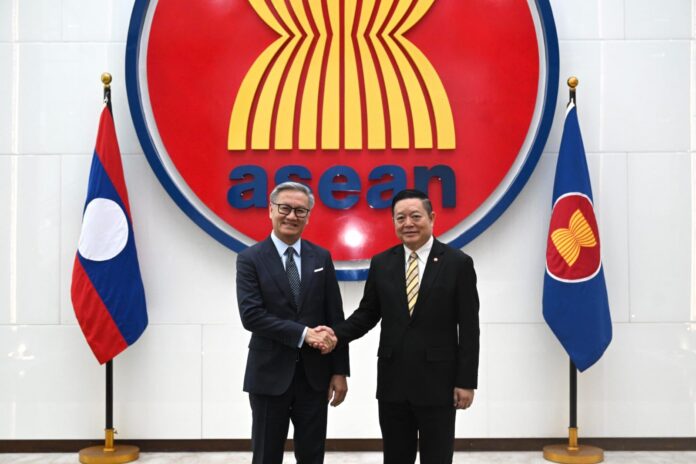
ASEAN Secretary-General Kao Kim Hourn received Lao Deputy Prime Minister and Foreign Minister Thongsavanh Phomvihane at the ASEAN Secretariat. (Photo: ASEAN)

Laos is intensifying its regional diplomacy efforts ahead of the 48th ASEAN Summit, with senior officials engaging partners across Southeast Asia to strengthen cooperation and coordination.

Deputy Prime Minister and Foreign Minister Thongsavanh Phomvihane visited Indonesia from 4 to 5 May, where he met Indonesian Foreign Minister Sukiyono to review bilateral relations and expand cooperation across key sectors.

Both sides highlighted nearly 70 years of diplomatic ties and agreed to deepen cooperation in trade, investment, tourism, and human resource development. They also discussed preparations for the 70th anniversary of diplomatic relations in 2027.

The visit also included meetings with business leaders and friendship associations to promote investment and strengthen people-to-people ties, alongside a visit to PT Pupuk Indonesia to explore potential economic cooperation.

ASEAN Engagement Expands

During the trip, Thongsavanh also met ASEAN Secretary-General Kao Kim Hourn at the ASEAN Secretariat. Discussions focused on ASEAN priorities, regional developments, and ongoing community-building efforts.

He also held talks with the Committee of Permanent Representatives and presented a rosewood carving of Laos’ iconic landmarks to the ASEAN Secretariat, stressing Laos’ cultural and diplomatic engagement within the bloc.

Focus Shifts to Cebu Summit

The diplomatic outreach comes as Prime Minister Sonexay Siphandone prepares to attend the 48th ASEAN Summit and related meetings on 7–8 May in Cebu, Philippines.

The summit, held under the theme “Shaping the Future of ASEAN Together,” will bring together regional leaders to discuss cooperation, economic integration, and shared challenges.

Sonexay is also expected to hold bilateral meetings with several ASEAN counterparts on the sidelines, as Laos continues to strengthen its role within the regional grouping.

Officials say the recent engagements reflect Laos’ continued focus on building stronger partnerships within ASEAN while advancing both bilateral and regional cooperation.