JAKARTA, INDONESIA – Media OutReach – 15 August 2022 – Sunfert International Fertility Centre (Sunfert) garnered the ‘Fertility Centre of the Year in Asia Pacific’ title at the recent GlobalHealth Asia-Pacific Awards 2022. This reflects the centre’s steadfast endeavours to provide top-notch service and treatments to its patients at all times.
Lakshmi Menon, General Manager of Sunfert Group, is excited to welcome couples from near and far to the ‘Fertility Centre of the Year in Asia Pacific’.
The GlobalHealth Asia-Pacific Awards recognises medical and related facilities in the region for their excellence in healthcare and patient care. The ‘Fertility Centre of the Year in Asia Pacific’ award is the culmination of customer sentiment combined with inputs from industry experts, market research and industry insights. With this title, Sunfert is acknowledged for maintaining high standards in delivering quality care and pushing boundaries to delight their customers at every stage and in every interaction.
According to Dr Wong Pak Seng, Founder and Managing Director of Sunfert, “We are humbled to receive this award. It is a testament to the commitment and diligence of the team at Sunfert as well as the confidence of our patients.”
The fertility centre takes pride in being at the forefront of innovations in fertility, led by healthcare professionals who are prominent industry figures at the helm of reproductive medicine. With a well-established international partner, Fertility Associates NZ, a leading fertility service provider in New Zealand, Sunfert leverages the latest advancements to provide the best proven fertility treatments.
In 2020, Sunfert established Malaysia’s first private oncofertility hub, providing Ovarian Tissue Cryopreservation services. Its Bangsar South branch also has an in-house genetic testing laboratory with cutting-edge medical equipment for pre-implantation genetic testing procedures.
This win is also set to reinforce Malaysia’s position as the Fertility Hub of Asia. “Fertility centres in Malaysia have recorded high success rates, which are comparable to world standards. With this award, we are excited to be able to support the national healthcare travel agenda.
We welcome couples from around the world to come and ‘conceive your dreams with us’. Enjoy the attractions here and, hopefully, return home with happy news,” said Lakshmi Menon, General Manager of Sunfert Group.
For more details on Sunfert International Fertility Centre, please visithttps://www.sunfert.com/. Hashtag: #SunfertInternationalFertilityCentre #Sunfert
Edible coffee cups invented by a Lao national (Photo:Econews Laos)
Ladavanh Keodala, an 18-year-old Lao inventor, won second place in the Toyota Incubation Programme this year with her eco-friendly invention “Eat Your Cups.”
Shop Green with Shopee connects users to shop sustainably and supports eco-friendly sellers
KUALA LUMPUR, MALAYSIA – Media OutReach – 15 August 2022 – Shopee is spotlighting more local and sustainable sellers to offer the best value for eco-friendly products to meet demand as more Malaysians become increasingly environmentally conscious. According to Shopee’s data trends¹, users are searching for more eco-friendly household products such as solar lights, solar panels, and inverter air conditioners, with keyword searches higher by 14% between 1 January to 25 July 2022 compared to the six months prior.
Users want to trust that what they buy is sustainable and beneficial for long-term use. By introducing Shop Green with Shopee, users can reach out to more eco-friendly sellers, learn more about sustainable living and habits, and inspire others to take action for the environment.
The surge in demand for eco-friendly alternatives reflects Malaysians’ greater awareness and desire for sustainable living. During the first half of 2022 versus the second half of 2021, Shopee sellers saw demand increase for biodegradable items that help the environment like reusable bags and biodegradable plates (19%) andpersonal hygiene items such as natural deodorant, shampoos, and body soaps (33%).
Malaysian consumers’ desire to lead a sustainable lifestyle has created new market opportunities for local sellers, particularly in the wellness, cosmetics, and personal care industries. Shop Green with Shopee will enable sellers offering eco-friendly products to gain higher visibility and greater brand awareness.
Huiyan Pan, Head of Brand Marketing at Shopee Malaysia said: “Living sustainably means making greener choices today that will positively impact the environment tomorrow. While we see consistent and healthy demand for eco-friendly products in Malaysia, we will continue to work closely with sellers to offer users more affordable and responsible products.”
“Shop Green with Shopee is one way we are connecting users to sellers who have clearly stated their commitment towards environmental sustainability, identified as recycled or reusable materials, and are made locally in the spirit of minimizing carbon footprints.”
Shopee has an array of local eco-friendly sellers and product types spanning categories such as cosmetics and grooming, beauty and fashion, and household, among others. Products from brands include but are not limited to HYGR, The Hive, Minus Zero Waste, PYNGzerowaste, and Green Eco Paradise.
The local and popular eco-friendly seller, HYGR, shared the following perspective for being part of Shopee.
“With all the toxic chemicals found in products, the importance of eco-friendly products has never been crucial. We hope more Malaysians will spread awareness and educate one another on sustainable living. With Shopee as one of our partners, we can expand our customer base and encourage the community to go green.” said Ivor Lim Xian Z and Chew Hoi Meng, Founders of HYGR.
As more users continue to seek sustainable alternatives, Shopee will support eco-friendly sellers and their innovations that allow users to reduce environmental impact. Shopee hopes to connect users with more brand choices with a social impact mission and lean towards a more sustainable direction.
Shopee is the leading e-commerce platform in Southeast Asia & Taiwan. Shopee promotes an inclusive and sustainable digital ecosystem by enabling businesses to digitalise and grow their online presence, helping more people access and benefit from digital services, and uplifting local communities.
Shopee offers an easy, secure, and engaging experience that is enjoyed by millions of people daily. Shopee is also a key contributor to the region’s digital economy with a firm commitment to helping homegrown brands and entrepreneurs succeed in e-commerce.
Shopee is part of Sea Limited (NYSE: SE), a leading global consumer internet company. Sea’s mission is to better the lives of consumers and small businesses with technology through its three core businesses: Shopee, Garena and SeaMoney.
When it comes to buying baby gifts, it is often a decision between affordability, presentability and quality. Pineapple switches things up, making prime-quality customisable baby hampers that are not just delightfully beautiful but also highly accessible at inexpensive prices.
SINGAPORE – Media OutReach – 15 August 2022 –Those looking to get the perfect baby gifts and gift hampers need no longer make a choice between affordability, presentability and quality. Pineapple, a newly launched business in Singapore, bridges the three through their customisable gift boxes and hampers consisting of carefully selected gift options for babies and mothers alike.
On top of letting customers choose the items that go into their hampers, Pineapple Singapore allows for further personalisation through gift items — such as swaddles, teether chains and baby bibs — that feature the option to incorporate the baby’s name for added personal touch, turning items that, while essential, may appear too generic for one’s liking, into unique and memorable gifts that better express sincerity and thought.
Pineapple also commits to artful presentation of their baby gift hampers, with each hamper being decorated with masterful artistry and dedication. They also offer reliable doorstep-delivery services for all their baby gift hampers, such that those who have placed an order do not need to drive to the store and struggle keeping the hamper intact and in-shape when transporting it from place to place.
Tackling the Tussle of Three
Getting great baby gifts have always been difficult, with most baby gift options being one of three things: too expensive, too unpresentable, or of too low a quality. Nick and Debbie, like many others, experienced this firsthand, scrawling through the vast online space to find a suitable present for a baby shower they were to attend.
While there were several brands that offered seemingly perfect gifts, none of them were wallet-friendly enough for the pair, who then scoured the likes of online marketplaces for more affordable options — which they then easily found, albeit ones that were mostly too generic in nature to aptly convey their excitement, and altogether lacklustre in terms of presentability.
Eventually, they decided to get a baby gift hamper they came across which was both affordable and fairly presentable. However, when it arrived, they discovered the hamper items were low-quality in nature, and that spurred their motivation to make a change in the industry of baby gifts and gift hampers.
Soon thereafter, Pineapple was launched, with a commitment to creating baby gift hampers that give people the best bang for their buck, in terms of both quality and presentability, at an affordable price point to boot.
Customisable Gift Sets for Both Baby and Mum
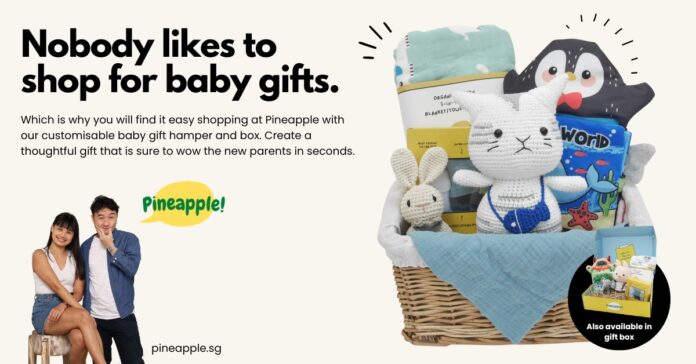
Pineapple’s customisable gift sets come in both gift boxes and hampers, with the former holding four to six items and the latter holding four to eight. Each and every item made available for incorporation into Pineapple’s personalised baby gift box or hamper is carefully picked out for their practicality, essentiality and uniqueness. Currently, the items available as components to Pineapple’s customisable gift boxes and hampers include:
Personalisable teether chains in various colours featuring 100% food-grade silicone beads, soft maple wood beads, and a bite-and-pull resistant rope designed for babies to chew on when teething.
Fruit-themed sleeveless rompers made from a mesh cotton blend designed to ensure babies stay cool in Singapore’s heat.
Interactive puppet storybooks with interesting textures and materials for the baby to touch and play with as parents read them their first story.
Pineapple’s signature reversible baby bibs that come in an assortment of colour options with the baby’s name embroidered on the fabric. .
3-in-1 multipurpose blanket/towel/swaddles made from breathable organic cotton that is soft, stretchy, and water-absorbent.
Hand-crocheted rattle toys and soft toys made from luxuriously soft yarn derived from the pulp of organically-grown bamboo trees that are resistant against biting, throwing and tearing.
Handwritten card with a message of up to 160 characters.
Pineapple Singapore makes baby gifting more meaningful through customisable gift sets that are pragmatic, presentable, high-quality, and affordable. Check out their FAQ page to find out more about their services, or reach out to them directly for your baby gifting needs.
No-frills and fuss-free concept offers memberships from only AUD18.95 per week
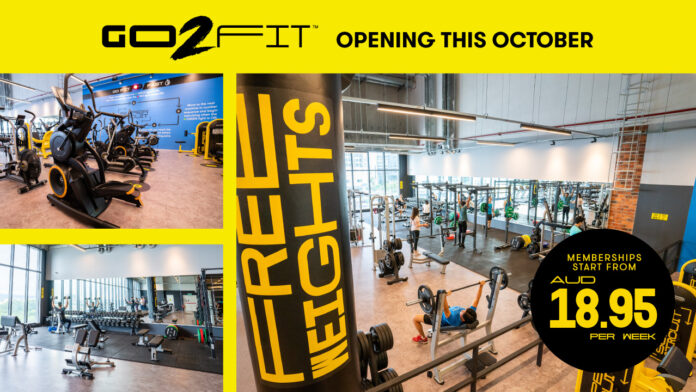
QUEENSLAND, AUSTRALIA – Media OutReach – 15 August 2022 – Aussie gym goers and fitness enthusiasts can look forward to a smart new way to train as high value, low price (HVLP) brand Go2Fit makes its Australian debut in the suburb of Sunnybank, Brisbane this October. Guided by its brand values of Smart, Bold, and Invigorating, Go2Fit, which trades under the GoFit brand in other markets, is poised to change the way people think about budget gyms. With membership prices starting from AUD18.95 per week with no prepay or joining fee, Go2Fit is not just affordably priced, but also very well equipped with a wide range of cardio, strength and Olympic lifting equipment catering to all levels of gym goers – from the new-to-fitness customer to the more serious fitness lover. It keeps membership prices low by using technology as an enabler, self-service approaches, and a low staffing model.
Go2Fit makes its debut Down Under as a result of a licensing agreement between Asia’s largest health club operator Evolution Wellness Group (Evolution Wellness), whose portfolio also includes popular gym brand Fitness First, and Urban Active Leisure Pty Ltd.
Jeremy Marmur, Urban Active Founder & Chief Executive Officer said, “Go2Fit fulfills a gap in the market with its on trend, next gen tech approach to fitness that’s suitable for all levels of gym goers. I have no doubt that it will change the way the market perceives budget gyms, given its high quality, best in class range of cardio, strength, and weight equipment, high quality virtual workouts, smart fitness mirrors, and fitness assessments.”
Access to Go2Fit is gained through an app for increased security, while a self-managed membership system makes it easy for members to purchase add-on services such as a session on the HydroMassage Lounger1, or a personal fitness assessment. Members can also participate in a Signature GoFit workout, SuperCircuitTM2.
Go2Fit will be a part of Urban Active’s ‘world first’ ecosystem of leading global wellness and fitness brands, the first of which will be housed within a 2000m2 site in Sunnybank which will also include a café, member lounge, retail, and social hub. Another Evolution Wellness licensed brand, FIRE Fit – a premium boutique gym concept and the third licensed FIRE Fit location in Australia – will also feature. There is a total of 15 such Urban Active sites in the pipeline that will be owned outright across Australia and the Asia Pacific.
“We considered all of the license and franchise fitness brands available to Australia while putting together the concept for our Urban Active precincts, and were immediately attracted to Evolution Wellness’s GoFit and FIRE Fit brands for its unique concepts and fresh takes on fitness. We are looking to Go2Fit as the ‘next gen’ weights and plates element, while FIRE Fit will offer HIIT, boxing, and indoor cycling classes,” Jeremy continued.
Chris Lee, Licensing Director, Evolution Wellness, said, “We’re extremely delighted at the recognition of GoFit’s no frills concept as a game changer in the HVLP gym category, which effectively removes a barrier for those who cite cost as a reason for not exercising. With GoFit, we’ve successfully demonstrated that a budget gym brand can still be a modern, high quality space for people to engage in fitness. We’re excited to partner with Jeremy and his team at Urban Active to open the first Aussie version of GoFit – Go2Fit – and the opportunity to work alongside them as they scale across Australia and beyond.”
Evolution Wellness currently offers competitive global licensing programmes for two of its brands – GoFit, and FIRE Fit – for those looking to venture into the vibrant fitness industry, backed by the expertise and commercial support of Asia’s leading health club operator. For more information about Evolution Wellness’s global licensing programmes, please contact Chris Lee (chris.lee@evolutionwellness.com) or visit https://bit.ly/IWantaGoFit.
Get Smart. Go. Get started with Go2Fit today. Founding memberships available now.
Notes:
HydroMassage provides an invigorating recovery programme delivered by travelling water jets under a waterproof skin (so the user doesn’t get wet) to help alleviate muscle and soft tissue injuries.
SuperCircuit™ is a proprietary GoFit programme, with a mixture of cardio and strength training to give you that full-body burn. Members train in a designated zone for SuperCircuit™ where our equipment selection has been carefully constructed to ensure ease of use, adding to the efficiency the workout.
Hashtag: #Go2Fit
About GoFit
GoFit was created with the intention of making fitness accessible to more people. Guided by its brand values of Smart, Invigorating, and Bold, GoFit aims to provide members with a convenient approach to fitness using technology as an enabler, in line with its brand positioning ‘to energise life through easy and affordable fitness.’ It offers members a smart new way to train through a no-frills, fuss-free gym experience. Malaysia is home to the pioneer GoFit club, which opened in November 2019. Go2Fit is the Australian variant of GoFit.
About Urban Active Urban Active is an amalgamation of fitness-focused partners and people joining forces to create a community that inspires, motivates, and guides all to reach their full fitness and well-being potential. A justice league all-star ensemble who separately are trusted standalone fitness providers; however, in the UA precinct, collectively, they are a force of nature and the leaders of a UA fitness team who supports inclusivity, diversity and the flexibility of choice. Urban Active facilitates different pathways to allow members to choose their own fitness adventure, creating a new standard that answers the call to duty. The focus is on U.
About Evolution Wellness Evolution Wellness was established in 2017 by Navis Capital Partners and Oaktree Capital Management by bringing together two leading fitness brands in Southeast Asia – Celebrity Fitness and Fitness First – to form one of the largest, wholly-owned fitness club networks in the fast-growing Asian region. In just a few years our portfolio now has 7 brands, and our collective expertise spans the spectrum from HVLP fitness clubs to Luxury Wellness Retreats and is scaling globally through brand licensing and management services.
For more information about Evolution Wellness and our portfolio brands, please visit www.evolutionwellness.com.
KUALA LUMPUR, MALAYSIA – Media OutReach – 15 August 2022 – On the occasion of the international Forex broker’s 11th anniversary, OctaFX has taken on the exciting task of reviewing what turned out to be a vivid decade for the Foreign Exchange market. Let us get right into some specific yet crucial events that helped shape the foreign exchange market
1. The notorious Forex probe (2013) 2013 made room for a formidable Foreign Exchange scandal that came to be known as the infamous ‘Forex probe’. Upon independent investigation, a major corruption chain was uncovered that showed how international banks colluded for at least ten years to temper exchange rates on the Forex market.
2. China materialises as the world’s largest economy (2015) As of this writing, seven years have passed ever since the International Monetary Fund (IMF) announced that the People’s Republic of China has officially climbed to the first place as the world’s largest economy.
3. The European Union overextending itself—the Greek debt crisis (2015) The Greek economy turned out to be especially fragile and prone to the economic turbulences stemming out of the worldwide financial crisis of 2007. Athens’ state default was almost imminent, until the European Union stepped in to grant new loans to the tune of 86 billion to Greece for it to maintain its due payments. This government bailout has been unprecedented in the scope of modern history.
4. Great Britain leaves the European Union (2016) A close call, but still, 51.9% of British voters voted to leave the European Union in 2016. This has been harshly criticized in the EU itself. Even though the decision was set, British society arrived at a crossroads of economic and political uncertainty. The British pound sterling weakened significantly since then.
5. Oil prices collapse during the Trump phenomenon When Donald J. Trump offered his Republican candidacy for POTUS back in 2015, there weren’t that many who expected him to succeed. Nonetheless, after an outspoken and at times controversial campaign effort, he emerged as the winner of the 2016 U.S. presidential election. This sent shock waves through the political, social and economic sphere of the country and the entire world.
At that time, crude oil prices made steep price drops. The markets got accustomed to crude oil prices trading between 75 USD and 115 USD per barrel for the first half of the 2010s. 2014 was the year when the U.S. marked a doubled oil production, in contrast to 2008. A sudden end came in 2016 when the oil price collapsed to 26 USD per barrel. A continual trend that defined the last decade’s second half. So much so that the 26 USD per barrel sank even further to 20 USD per barrel in 2020 due to the coronavirus pandemic.
6. 2011—2015: U.S. shale revolution (crude oil and natural gas) The shale revolution refers to the combination of new technologies and innovative practices in the oil and natural gas industry in the United States. The transformative effect of the shale boom has been so dramatic that on 18 December, 2015, Barack Obama, the 44th President of the U.S., signed a law that repealed the country’s decades-long ban on oil exports.
The United States no longer relies on significant imports of oil and natural gas to bridge the gap between its strong demand and gradually declining production. On the contrary, the country now plays an active role as a global supplier—particularly that of LNG.
7. The U.S.-China trade war (2018) One of President Trump’s main talking points and policy areas was his ambitions to change trade relations with Beijing. Trade imbalances that were disadvantageous to the U.S. bothered Trump. Since the result was a long-standing, enormous trade deficit, one of Trump’s strategies was the tariff roll-out to directly challenge Chinese export on the global markets.
In economic terms, liberal analysts defined Trump’s presidency as a modern variant of ‘isolationism’ or ‘protectionism’. It favoured domestic manufacturing and trade arrangements over global trading habits that had Washington at a perceived—by Trump and his team at least—disadvantage.
8. The U.S. elections (2020) Hoping to repeat his 2016 victory and enter a second term, President Trump lost to his democratic challenger—Joe Biden. Once the results came in, controversy followed, that led to some discontent in U.S. society.
Social issues, especially, were widely contested, as well as the role of the media itself, which illustrated a huge split in American public opinion—one that eventually gave Joe Biden a very close victory.
9. The infamous COVID-19 pandemic and recession it caused (2020) 9 March 2020 marked the stock market crash. Soon afterwards, the Dow Jones Industrial Average (DJIA) plummeted to a low up to that point. All thanks to the relentless COVID-19 pandemic that spread like wildfire. Due to the crash, investors the world over feared the coronavirus contagion and its ability to spread and debilitate asset behaviour and prices globally. Soon, anticipations of yet another series of oil price drops and a new recession were confirmed.
10. The rise and fall of crypto (2021) In March 2020, during the so-called ‘black swan’ crypto event, bitcoin saw a significantly low price of 4.826 USD. Coincidently, this was during the first huge shock waves of the COVID-19 pandemic that hit the world economy. Bitcoin recovered fast and pushed to 10.000 and, towards the conclusion of 2020, to almost 30.000 USD. During that time, an influx of retail investors and traders flooded the industry. In June 2021, bitcoin breached 52.000 USD, before flying even higher towards 65.000 USD in October and 67.500 USD in November.
After that, a downtrend crept in that eventually started to turn bearish once 2022 started.
11. New COVID-19 Strains while UK and EU reach agreement post-Brexit Fears of coronavirus mutations and possible new strains of COVID-19 brought renewed uncertainty about the prospects of eventually overcoming the pandemic in 2021. Vaccine development and its worldwide administering were officially in process.
Enormous amounts of newly minted currency units flooded the economy to safeguard against the troubles caused by COVID-19 restrictions on the job market, in the social sector, and in international trade.
Whichever way you look at it, the past decade was full of unique opportunities and challenges. Gazing at current world affairs, the Forex community can say with good conscience and some certainty that there is a risky but exciting ride ahead of them. Legacy finances are in a very dynamic shift—ushering in a ‘financial reformation’—that could make Asia the new focal point of financial supremacy and leadership.
Hashtag: #OctaFX
The issuer is solely responsible for the content of this announcement.
About OctaFX
OctaFX is a global broker providing online trading services worldwide since 2011. It offers everything one needs to reach their investment goals, providing top-notch conditions utilised already by clients from over 150 countries worldwide.
The company is involved in a comprehensive network of charity and humanitarian initiatives, including improvement of educational infrastructure, short-notice relief projects, supporting local communities and small to medium enterprises.
On a side note, OctaFX has also won more than 45 awards since its foundation, including the 2021 ‘Best Forex Broker Asia’ award from Global Banking & Finance Review and 2021 ‘Best ECN Broker’ award by World Finance.
With the launch of their highest-grade Manuka Honey, MGO800+, and fresh honeycomb from New Zealand, Herbal Pharm has positioned itself as a market leader in supplements and premium lifestyle products.
SINGAPORE – Media OutReach – 15 August 2022 – Having noticed the lack of authentic premium quality honey within the country, Singapore-based brand Herbal Pharm has introduced its premium range of Manuka Honey for the Singapore market, making it available at both retail stores and online. Aside from the common strength of MGO 50+, Herbal Pharm also offers MGO100+, 300+ and 500+ with higher therapeutic benefits, as well as the highest grade available on the island – Manuka Honey MGO800+. All five different strengths of Manuka Honey are packaged in 250g jars.
Containing 100% pure Manuka honey directly from New Zealand, each jar boasts a signature smoothness and richness in taste that is second to none, while the MGO 500+ and MGO800+ Manuka Honey provide consumers with stronger immune benefits and only the best therapeutic benefits for their health.
In addition to the Manuka Honey line, Herbal Pharm also launched a new product to the consumers in Singapore – pure honeycomb product flown directly from New Zealand, freshly cut and unprocessed.
Carefully Sourced With Your Health In Mind
Customers can enjoy peace of mind knowing that Herbal Pharm’s range of natural honey is true-to-label, having consistently passed every marketplace audit. The Methylglyoxal (MGO) designation and rating is a highly sought-after and well-respected trademark. MGO is the organic compound responsible for Manuka Honey’s strong antibacterial properties. The higher the MGO rating, the stronger the level of antibacterial properties. All MGO licence holders must go through audits to meet stringent standards in production, manufacturing, sampling, and handling. As part of the testing process, every batch of honey must undergo a series of additional checks to ensure ultimate authenticity, quality, and safety.
Herbal Pharm’s line of Manuka Honey is made using 100% natural honey, without artificial sweeteners or sugars, to give their consumers pure and healthy goodness with every spoonful. As a trusted brand in Singapore, the company also chooses sustainable and reliable suppliers to ensure the quality of every jar of honey and fresh honeycomb. As such, the MGO value of all Herbal Pharm Manuka Honey has been awarded by certified laboratories only.
With numerous scientific studies proving its unique antimicrobial and nutritional properties, it is no wonder that people are praising Manuka Honey as a ‘superfood’. Besides boosting immunity, Manuka Honey boasts benefits like:
Aiding in skin conditions
Offer relief from sore throat
Treating minor wounds and burns
Supporting digestive health
Releasing of melatonin within the body to promote a good night’s rest
Herbal Pharm’s Commitment To Their Customers
Since 2004, Herbal Pharm has been working hard to bring customers quality health and personal care products. Herbal Pharm was founded by Mr Vejaiyan, a health and fitness enthusiast who saw a need for quality products that could be trusted. Herbal Pharm products are manufactured in a cGMP facility to meet stringent guidelines for “Current Good Manufacturing Practices,” with only the finest and purest ingredients used in the formulation. This ensures Herbal Pharm products are of the utmost quality and true-to-label.
Hashtag: #HerbalPharm
About Herbal Pharm
Since starting out 18 years ago, Herbal Pharm’s main mission is to deliver premium quality products and all-natural nutritional supplements. The company spares no resources to procure natural ingredients from the world over to formulate their array of products. For more information, visit https://www.herbalpharm.com.sg/
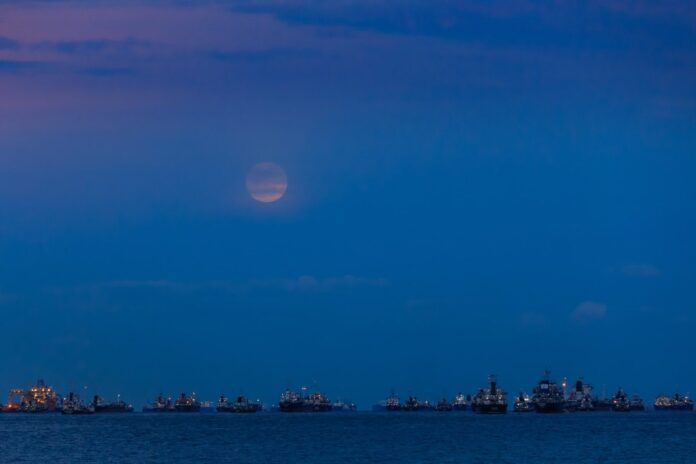
One of the most bustling shipping routes in the world, the Singapore Strait, is experiencing a rise in sea robberies as economic pressures drive more to crimes of desperation.








 FAQ page

 www.gofit-gym.com
 chris.lee@evolutionwellness.com


 OctaFX


 https://www.herbalpharm.com.sg/