Home Blog Page 6301

Project Extends Assistance to Cut Emissions from Deforestation

The Climate Protection through Avoided Deforestation project is providing support for Luang Namtha and Xayaboury provinces to help reduce emissions from deforestation and forest degradation (REDD) next year.

This information was revealed by the Deutsche Gesellschaft für Internationale Zusammenarbeit (GIZ) GmbH during a meeting held recently in Huaphan province to present and discuss the provincial REDD+ Action Plan (PRAP), which has been designed to guide the implementation of policies, actions and measures.

The meeting’s aim was to outline the PRAP development process which has been agreed upon during the first consultations in mid-2016 and present the outcomes of the two rounds of district consultations.

As a pilot province, Huaphan is also the first province in Laos to develop a PRAP and five other provinces under the Emission Reductions Programme will follow the approach applied in Huaphan, said GIZ.

The Climate Protection through Avoided Deforestation project is working in Huaphan as one of its pilot provinces. The project supports the Lao government in its REDD readiness process at the national and sub-national levels.

The PRAP in Huaphan province is aligned to the provincial 8th Socio-Economic Development Plan and designed to achieve emission reductions to serve the emission reductions programme under the Carbon Fund, the provincial Agriculture and Forestry Department official said.

PRAPs can be seen as a tool to design and guide the implementation of REDD activities at provincial and local levels. They will be developed in six provinces that have been selected for the country´s Emission Reductions Programme under the Forest Carbon Partnership Facility (FCPF) Carbon Fund.

Laos was accepted into the FCPF Carbon Fund in late 2015 and must now prepare an Emission Reductions Programme Document, which must be submitted to the Carbon Fund by early 2018, added GIZ.

The PRAPs can be seen as a building block providing concrete plans which together will serve as the foundation for Laos’ Emission Reductions Programme in order to receive REDD performance-based payments.

PRAPs are developed using a participatory process based on consultations with broad stakeholders from different key sectors (e.g. agriculture, forestry, planning and investment, energy and mining etc.) These actors should have a sense of ownership to the PRAP and support not only its planning process but also take responsibility for future implementation.

The Deutsche Gesellschaft für Internationale Zusammenarbeit (GIZ) GmbH is providing policy advice and capacity development measures to support the creation of a national and provincial REDD framework, as well as REDD planning processes. It is testing local-level mitigation, and is also developing pro-poor REDD mechanisms and sustainable financing models.

GIZ is cooperating closely with the financial component of the project, which is funded by the German Government through the KfW Development Bank.

Source: Vientiane Times

SDGs’ Message Dispersed in Luang Prabang

About 500 officials, lecturers and students at Souphanouvong University in Luang Prabang province gained insight about the implementation of the nation’s Sustainable Development Goals (SDGs) this week.

The information on SDGs was presented in Luang Prabang on Monday by speakers from international agencies along with the Ministry of Foreign Affairs and Ministry of Planning and Investment.

Attendees heard how the government is pursuing the national development policy and has mainstreamed the SDGs into its 8th Five-Year National Socio-Economic Development Plan (2016-2020), the Development Strategy 2025 and Vision 2030.

Some 193 leaders from United Nations (UN) member countries, including former Lao President Chommaly Sayasone attended the historic UN summit in New York on September 25, 2015 for the adoption of the international development agenda under the theme “Change Our World”.

The 2030 Agenda for Sustainable Development involves 17 SDGs that cover three dimensions – economic, social and environmental.

In addition to the 17 SDGs, the Lao government has adopted its national SDG 18: “Lives Safe from UXO”. Prime Minister Thongloun Sisoulith and UN Secretary General Ban Ki-moon launched this SDGI8 on September 7 this year in Vientiane.

The targets of this particular SDG are to ensure that by 2030 residual UXO activities are undertaken and all known UXO contamination in high priority areas and all villages defined as ‘poor’ are cleared; that annual casualties from UXO accidents are eliminated to the extent possible; and that all identified UXO survivors and victims have their needs met.

PM Thongloun is head of the national committee for the SDGs implementation.

The 8th Five-Year National Socio-Economic Development Plan (2016-2020) aims to implement the resolutions of the 10th Party Congress, which was adopted by the National Assembly in April this year.

The government will focus on the achievement of the goals in its 8th Five-year National Socio-Economic Development Plan, Development Strategy 2025 and Vision 2030, which include green growth and sustainable development, maintaining steady economic growth, achieving constant reductions of poverty and graduating from the least developed country status, among others.

Source: Vientiane Times

Foreign Aid on the Decline

Prime Minister Thongloun Sisoulith has called for central and local departments to do more to pursue the development agenda and strive for greater self-reliance as foreign aid to Laos declines.

The premier gave the advice at a two-day meeting held last week to instruct officials on the implementation of the socio-economic development plan and budget for 2017.

The trend in the reduction of foreign aid over the coming years is the result of Laos enjoying greater development and donors moving their assistance to other, poorer countries.

“We shouldn’t expect much [from the assistance]. We should try to be self-sufficient,” Mr Thongloun told the meeting.

He made the comment as Laos approaches the 2020 deadline for graduation from Least Developed Country status.

An official from the Ministry of Planning and Investment in charge of Official Development Assistance (ODA) said it is a common trend globally that foreign aid provided to a country decreases when that country achieves a certain level of development and self-reliance.

However, the official, who asked not to be named, said that even if foreign aid declined this did not mean Laos would suffer financially because the country expected to obtain more loans.

“Growing development means a country has a growing capacity to repay debt, so it could expect to secure more loans,” he said.

The official added that though the number of grants might decrease, ODA, which comprises both grants and loans, could increase in the form of loans.

In the 2015-16 fiscal year, Laos received more than 6,462 billion kip in ODA, of which almost 2,000 billion kip was given as grants and the rest as loans.

Despite the expected decline in foreign grants, in 2017 the government anticipates it will receive more ODA worth 8,629 billion kip, which will represent 23.73 percent of total expenditure planned for 2017.

In light of the decreasing availability of grants, Mr Thongloun stressed the need for state departments to work harder to attract foreign investment as a source of finance.

To achieve this, he told central and local authorities attending the meeting to enhance the investment climate by simplifying and expediting the investment proposal process in a transparent manner.

“Mechanisms must be quick, timely and transparent. It [the investment proposal] must be passed through only a single window,” he told the meeting, adding that the current process was too slow and not transparent.

In addition, the premier told the meeting to ensure the macro-economy remained stable along with the inflation rate. The price of goods sold in markets should also be regulated to prevent fluctuation, he added, noting that these were important factors in attracting investment.

Central and local departments were asked to incorporate the 2017 Socio-Economic Development Plan into their work plan and programmes based on local potential.

Source: Vientiane Times

PM’s Order Poses Positive Outcomes for Lao Forests

Prime Minister’s Order No. 15 has successfully curbed harmful practices in the forestry sector and timber industry, while restoring public trust in the Party and government.

This message was delivered at an annual meeting in Vientiane this week to review past achievements and discuss the plans of the agriculture and forestry sector for the coming years.

Prime Minister Thongloun Sisoulith issued the order in May to strengthen the management and inspection of logging and businesses involved in the transport of wood and associated activities.

Speaking at the meeting, Deputy Minister of Agriculture and Forestry Mr Thongphath Vongmany said “Since the prime minister issued the order, which was followed by the creation of a task force to carry out the measures stipulated, there has been an evident decline in logging and the export of wood.”

“Illegal logging has been sharply reduced and chronic undesirable practices within the sector and the timber industry have been reined in,” he added.

Mr Thongloun decided to tackle these issues head on after becoming prime minister and promising to battle all forms of corruption.

The order complies with the Resolution adopted by the Tenth Party Congress and the guidance given by the highest ranking leaders concerning forestry.

“Another significant result is that the majority of people in the country support and appreciate the government’s efforts. This has contributed to the restoration of public trust in the Party’s leadership and state management in general, and forest management in particular,” Mr Thongphath said.

According to a report from the ministry, more than 1.2 million cubic metres of unprocessed logs and sawn timber were exported to neighbouring countries in 2015, earning less than US$50 million in revenue.

Prior to the order there was a surge in both legal and illegal logging, with exports comprising mostly unprocessed wood and sawn timber.

The hands-off attitude of local authorities in relation to forest management led to private companies engaging in pre-logging surveys, tree marking, quantity assessment, and the felling of trees.

Foreigners were found felling trees and encroaching in conservation areas and protected forests.

The Ministry of Agriculture and Forestry has now completed plans for the demarcation of ‘production forest’ in 51 areas of the country. It has also identified areas where logging is permitted, forests that are in need of reestablishment, and areas for integrated tree plantations.

The ministry has installed 783 markers indicating the borders of four national protected areas, and 376 notices on the use of this land. More than 200 markers and 129 notices have also been installed in four national protected forests.

The government plans to restore forest cover to 70 percent of the country’s terrain by 2020.

More than 260,000 hectares of forests have been restored in the past year. More than 36,000 hectares are in protected areas, 116,000 hectares are in protected forests, and 108,000 hectares are in production and community forests.

Source: Vientiane Times

Top 10 Most Visited Websites in Laos

We all know that everyone uses the Internet but which sites people are visiting is another story. We have some idea as to where Lao people and residents are surfing but may be slightly surprised by some of the ones that made this list. While there are a number of lists out there claiming to be accurate, the Laotian Times has decided to use none other than Amazon’s Alexa Traffic Rankings.

How are Alexa Rankings calculated?

According to its site, Alexa’s traffic estimates and ranks are based on the browsing behavior of people in the global data panel, which is a sample of all internet users.

Alexa’s Traffic Ranks are based on the traffic data provided by users in Alexa’s global data panel over a rolling 3 month period. Traffic Ranks are updated daily. A site’s ranking is based on a combined measure of Unique Visitors and Pageviews. Unique Visitors are determined by the number of unique Alexa users who visit a site on a given day. Pageviews are the total number of Alexa user URL requests for a site. However, multiple requests for the same URL on the same day by the same user are counted as a single Pageview. The site with the highest combination of unique visitors and pageviews is ranked #1. Additionally, Alexa employs data normalization to correct for biases that may occur in the data.

Without further ado, here are the Top 10 most visited sites in Laos.


  1. Youtube.com

It should not be a surprise to anyone that this would be the number one most visited site in Laos (and for many parts of the world, for that matter). YouTube represents an imaginary television with unlimited channels on demand for free (you have to pay for that monthly pseudo-unlimited Unitel not quite 4G Internet package, though). Who watches YouTube videos? Neglected children of busy parents enjoying Ben 10 and Disney’s Elsa-from-Frozen videos, complacent employees watching that Thai soap opera episode from the night before, bored university students entranced by Korean & American music videos, and the odd person looking for how-to videos.

  1. Google.la
  2. Google.com
  3. Google.co.th

Many of our readers might have thought that any of these domains should have been on the top of the list but it seems that Elsa videos on YouTube were too hard to ignore. For many, Google is the default home page of their browser. Occupying three spots (Numbers 2, 3 and 4) on the Top 10 says much about this site’s popularity. Whether you’re using a Lao, English or Thai keyboard, Google will help you find what you’re looking for.

  1. Yahoo.com

Apparently, people in Laos are still using Yahoo! This may perhaps be the case because it provides more than simple search queries. Yahoo does provide useful news like how a woman died because she tried to save a tortoise, the weather, and of course the immortal Yahoo Mail.

  1. Facebook.com

People are sharing the most random things on this site. It is anyone’s guess that a person who has access to the Internet, will have a Facebook account. Unless you’re meditating at a Buddhist temple. Oh wait, even that won’t stop you these days. Mark Zuckerberg has done such a fantastic job in getting people addicted to his product that people of all walks of life are turning to Facebook to digitally voice their opinions and listen to others.

  1. Blogspot.com / Blogger.com

Many locals use Blogger to build their own websites as an alternative to WordPress.

  1. Live.com / Hotmail.com / Outlook.com

Surprisingly, a number of Lao civil servants and private sector employees are using the @hotmail.com address as their official work email, a habit that is often hard to break for many (as Hotmail was one of the pioneers of email – owned by Microsoft) as they have been using the email address for a long time. This would be comparable to the plight of one who had to change his/her phone number: the hassle of informing everyone in your social network of the change, the fear of losing out on potential business opportunity, and the pain of re-printing business cards! So, please don’t be startled if your employee sends you an email from her personal address, xxlaoangle88xx@hotmail.com. While this behavior persists, live.com will remain on the list.

  1. Kapook.com

While Laos is in the midst of a Lao-language digital content boom, driven by private ventures such as LaoPost, Mahason, Tholakhong, Una StudioKidork, Muan and other content providers, Lao readers consume news and entertainment content from our neighbors in Thailand, especially from kapook.com. The general understanding is that if the news is popular in Thailand, Lao people are sure to find out about it. Ranked as the 11th most visited site in Thailand according to Alexa Rankings, it is no wonder why it made it to the list for Laos.

  1. Ask.com

We’re just as puzzled as you are for this one. Perhaps, it was initially easier to type Ask than Google?

——–

It is important to note that this Top 10 List does not include any Laos-based websites. The sheer volume and quality of the content and functionality generated by the aforementioned global websites will be very hard for Lao websites to compete with for the foreseeable future. However, Lao tech entrepreneurs and businesses are not too far behind as local IT professionals become more internet savvy and rising incomes and education are promoting the generation of local content. We’ll be back next year with the Top 10 Laos-based Websites. Stay tuned!

Lancang-Mekong River Plan May “Shift” Thailand-Laos Border

THAILAND may lose territory under the plan approved by the Cabinet on Tuesday to improve navigation in the Mekong River between Thailand and the Laos border at Chiang Rai, which will include the dredging of rapids, local people warned yesterday.

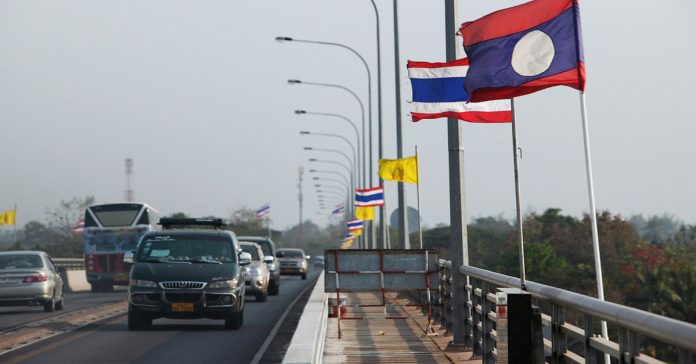
The Cabinet agreed in principle with the international Lancang-Mekong River navigation improvement plan from 2015-25, which intends to make the Mekong passable for 500-tonne cargo ships plying the route from China to Luang Prabang in Laos. However, the Cabinet decision was met with heavy protest.

Locals claimed that the adjustment to the river’s course would definitely shift the boundary of Thailand and Laos.

The removal of the rapids will destroy the breeding grounds and habitat of wildlife, which will lead to total devastation of the Mekong River ecosystem.

A joint statement was also released by 20 organisations protesting the Cabinet decision and emphasising that the Cabinet was making a major mistake in allowing the project, which has high risk and serious impact on the people and river ecosystem, to be implemented.

Jirasak Intayot, coordinator of the Rak Chiang Khong Group, raised concerns over the plan, saying that if the government insists on proceeding with the river channel adjustment work, they will have to consider the law seriously or they will end up in ceding the country’s territory and violating the law.

“The river channel improvement will definitely affect the border between Thailand and Laos, because the demolition of rapids would change the river flow and erode the riverbank, changing the border of Thailand and Laos,” he said. The Mekong River forms a part of the Thai-Lao border and changing the river’s course will also change the border, he argued.

The Mekong project was not new. It has been championed for a long time and was not successful until now because the Cabinet was worried about the possibility of territory losses. The project was postponed in 2003.

The joint statement stressed that if this project goes ahead, not only will the motherland be violated and vast swathes of land be lost, the Thai constitution mentions that any project that affects the country’s border must get the approval of Parliament first.

However, this Cabinet resolution has not been deliberated on by Parliament yet, so it may be in conflict with the Constitution.

The project will be implemented on the mainstream of the Mekong, but the agreement was among only four countries, excluding Cambodia and Vietnam, who were also members of the Mekong River Commission (MRC).

That was a violation of the MRC agreement and international regulations on international river management.

“The people’s networks demand that the Thai government end this project immediately to protect our country’s territory and preserve the precious Mekong River ecosystem,” the statement concluded.

Niwat Roikaew, chairman of the Rak Chiang Khong Group, warned that the demolition of rapids in the Mekong would destroy the habitat and spawning grounds for various kinds of native creatures, including the critically endangered Mekong giant catfish. “Not only will this project destroy the rich biodiversity and pristine ecosystem of the river, the ecosystem degradation will also severely hurt many people who depend on the river for food, and destroy their traditional livelihood too,” he said.

The group will send the petition to the government to end this project soon.

According to the Cabinet decision, the plan was part of the Agreement on Commercial Navigation on the Lancang-Mekong River signed by four riparian countries – China, Laos, Myanmar and Thailand – to improve the navigation route on the Mekong and make commercial river transportation convenient, safe and in accordance with the agreement among the country members.

The Cabinet also approved the project to improve the river channel.

The Marine Department will oversee the study, working with other agencies to prevent an impact on the international boundary.

Source: The Nation

Alisa Gallery Brings French Urban Art to Vientiane

For the first time in Asia, the Alisa Gallery headed by Alisa Phommahaxay, one of the curator associates for Art42, invites seven French artists from this collection to show their work. Entitled “Art42, Hors Les Murs // Extramural : Vientiane,” the event will be held from the 6th to 15th of January 2017 from 5:30pm at the French Institute in Vientiane.
French Urban Art
ART 42 is the first (anti) urban art museum in Paris, France, which opened in October 2016.
Featured Artists
BAULT: a French street artist and illustrator born in 1978. He uses a mix of acrylic paint and low pressure.

ERELL: Erell spreads his distinctive square-shaped patterns on the streets all around the world like a virus.

ROMAIN FROQUET: The work of Romain Froquet is an invitation to the fantasy and the uniqueness of a universe stemming from his own subconscious. Froquet, a self-taught ar7st directs his passion for drawing to diverse mediums without prejudice. He is as comfortable painting on an easel, or on the street enveloping the walls of lost dismal areas of town or creating site specific installations. He wishes to express himself with or without a public, sometimes choosing obscure urban areas to dress the walls with his delicate tree like representations that bring colour and joy to an otherwise gloomy background. The surface is of no importance nor the visibility of his installations, here he presents himself as an ephemeral ar7st and as a performer –it is his process that becomes paramount not the actual public display.

KAZY: In a crazy world full of realism and fiction, Kazy develops a personal world where strange characters come to life.

CLÉMENT LAURENTIN: After his studies in Visual Arts at the Boulle school, one of the most renown public school in France, Clement Lauren7n joined the 9e Concept in 2001. In his work, Clement developed a graphic and semiological style with distinct lines, in which he tries to make them coexist as so many aspects of the same personality. His drawings can be spontaneous or thought, his portraits can be set in the reality or related to an oneiric imagery. Nevertheless what is important for Clement is to play with the opposite and spring up the unexpected. His particular interests are music, street art, printing, but the melting pot is also among the themes that inspire him. His peculiarities such as being mind-blowing, inventive, positive and curious, can be seen in his works which are full of energy and optimism.

MADAME: Madame was born into an artistic family. She is one of those few people who fall under this category. Her moniker sounds sophisticated and theatrical, just like a stage name for a prima donna, which resonates with the nature of her professional background. But in case you feel like it sounds just a bit too classy, consider her other alias: Madame. A healthy sense of humour casts a different light on the artist, denoting how femininity and masculinity can overlap at times. After years of exploration and cultural uplifting, which involved theatre studies, Madame eventually found her own favourite genre: pasting.

perroquet

STEW: STeW is a French contemporary artist born in 1978 in Les Lilas, Paris. He is well known for his Japanese inspired artworks, and murals created throughout the world. From an early age, he had shown a tendency towards art, redecorating his own room when he was only four years old! What makes him recognizable are his Japan-inspired artworks. Samurais are resurrected in modern world, but STeW always inserts something of his own into pieces. Such a powerful source of inspiration turned into reality in such a magnificent way. Besides Japan, he loves and is a passionate collector of stamps. Nature is another one of his inspirations. Traveling, even if happening only inside his head, gives the artist enthusiasm to continue his work.

36RECYCLAB (Special Curator Guest): 36recyclab (Alexis Cladière) does large scale street exhibitions of black and white engineering collages creating new perspectives and many more projects as sculpture.

The public is invited to come to discover the up and coming, exciting French Urban Art Scene!

Public Urged to Support Local Pottery Makers

The Lao Handicrafts Association (LHA) is aiming to introduce some new additions to the pottery range in Vientiane, which it hopes will attract more customers.

The association already supports local potters to produce various items including jars, mortars and vases, and customers can place orders directly with the association.

President of the Lao Handicrafts Association, Mr Hansana Sisane, spoke about the need to diversify pottery products at a workshop on the business recently.

Phase II of a skills development programme took place at the Santiphone Pottery Factory in Vientiane as part of a strengthening technical and vocational education and training project.

Mr Hansana said the association needs to increase understanding of the importance of supporting local pottery makers rather than purchasing products made elsewhere.

We are now worried about pottery businesses in Laos because the demand for pottery increases each year but the number of local people actually making pottery products has decreased, he said.

In response, the LHA’s policy to support sustainable pottery aims to respond to production needs by ensuring the long term viability of pottery businesses.

During the training course participants discussed their work. As part of the project, communities were required to implement a viable and sustainable pottery management model allowing villagers to earn more income from the pottery they sold to markets, he added.

He explained that the LHA was continuing to promote Lao handicrafts at home and abroad while tackling the issue of pottery preservation by encouraging pottery production at the local level.

While Lao handicrafts are proving popular with domestic and international customers alike, some people have sought out imported pottery when local raw products are in short supply.

Mr Hansana said we believe that customers are interested in items like plates, cups, spoons and other utensils made by Lao people.

So we use raw materials found in Laos like clay to make pottery products here and of course these will also be made with the use of Lao people’s skills, he added.

The Lao Handicrafts Association will also look to local markets in Vientiane for inspiration before creating any of the new pottery products.

The association hopes to expand these new products to other provinces especially if they see increased customer interest in them.

According to the association, in October and November this year, the Lao Handicrafts Association held an exhibition of Lao handicrafts to present the new pottery products at Lao-ITECC.

The association invited customers from shops, hotels and restaurants around the city to attend the exhibition, when they were able to purchase new pottery items.


Source: Vientiane Times