Thousands of people in the southern province of Attapeu, whose homes were swept away flash floods following the collapse of an auxiliary dam of the Xepian Xenamnoy Hydropower Project in Laos several weeks ago, are seeking shelter in areas known to be contaminated by unexploded ordnance (UXO), experts say, as mud and flood water obstruct aid efforts.
The United Nations said that Attapeu is exceptionally contaminated by UXOs with almost 320 hectares in Sanamxay district (the site hardest hit by flooding), where people are sheltering in camps that are designated as “confirmed hazardous areas”.
“There’s a real danger that explosive items on or in the ground will have moved,” said Blossum Gilmour, Lao Country Director for Mines Advisory Group (MAG), a British NGO that assists people affected by landmines.
“Areas which have been cleared of bombs may need re-clearing … But also, as people are evacuated from their homes, they may be relocated to places which have not yet been cleared.”
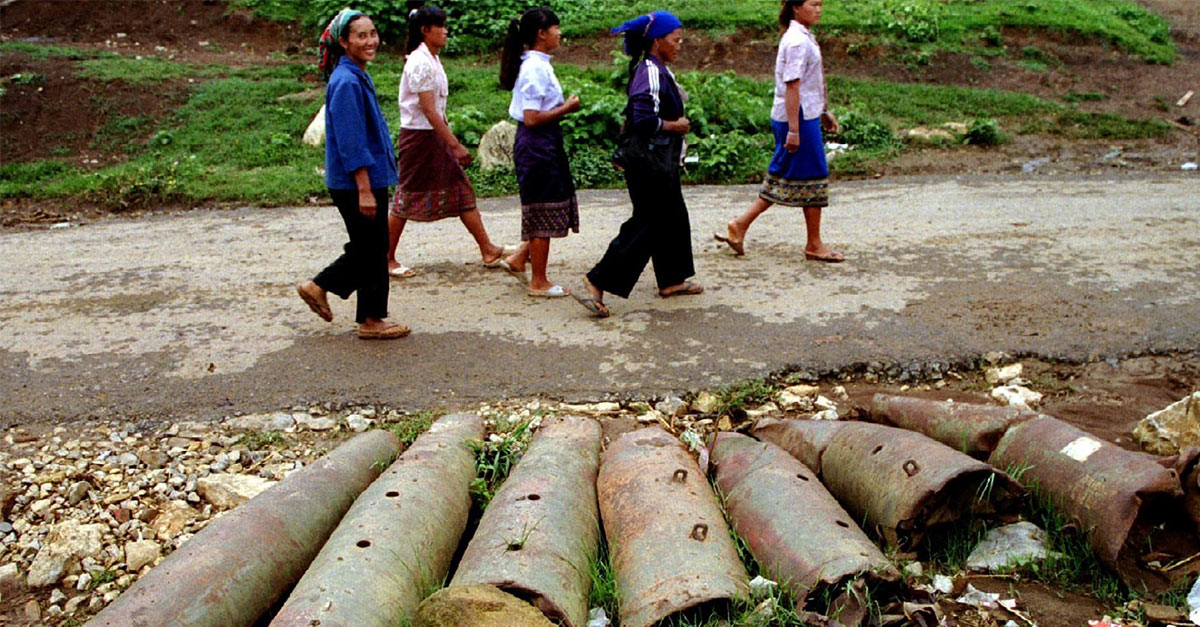
Laos is the most heavily bombed country per capita in the world as a result of a secret bombing campaign by the United States during the Vietnam conflict several decades ago.
Much of Laos is still littered with UXOs, despite decades of clearance efforts, with about 300 new casualties each year, many of them children, MAG says.
Laos was hit by a tropical storm on July 18 and 19, which caused flooding in parts of 13 provinces, including Attapeu, the United Nations said. As floodwaters rose, a saddle dam that was part of Laos’ $1.2 billion Xe-Pian Xe-Namnoy hydropower project collapsed, sending torrents of water crashing into neighboring villages.
The U.N. said three camps “remain largely inaccessible” and that aid officials are in discussion with the military about using its helicopters to provide “last mile delivery” of relief items, including food.
With seasonal rains continuing until September and water levels rising in the Mekong River and its tributaries, “flooding across the country may spread further,” the U.N. said.
(Vientiane Capital) On the afternoon of August 3, 2018 at the Ministry of Labour and Social Welfare, Mr. Seungho Choi, Managing Director of Lao Samsung Electronics Sole Co., Ltd., met with Mr. Khampheng Xaysompheng, Minister of Labour and Social Welfare, to deliver his condolences on the flood disaster in Sanamxay District, Attapeu Province on 23 July 2018, which caused a severe loss of life and property of villagers in the area.
In addition, Mr. Choi, Managing Director of Lao Samsung Electronics, delivered aid in the total of US$100,000 to the government in order to help alleviate flood victims affected by this tragedy. This aid will be in the form of goods and emergency relief supplies during the immediate aftermath of the disaster and the recovery period.
“For this $100,000 assistance, Lao Samsung Electronics is assisting in the form of goods, but will respect the decision of the Government of the Lao PDR because I believe that the government knows best what the affected villagers require. If the government needs certain supplies, Lao Samsung Electronics will cooperate closely in order to get the supplies as needed,” Mr. Choi stated.
Along with this, Mr. Choi also gave words of support to those affected by the tragedy and their families, as well as encouraging everyone to be strong, and hoping that those affected will be able to move on from this tragedy safely.
The government of Laos has announced renewed inspection of existing hydropower dams and suspension of new projects in the wake of the collapse of a dam in Attapeu province.
The announcement was made at the closure of the cabinet’s two-day extraordinary meeting, which ended yesterday afternoon.
The meeting, chaired by Prime Minister Thongloun Sisoulith, dealt with the progress of relief and reconstruction in the aftermath of the dam collapse disaster.
Inspections of all dams across the country, including those under construction and those in operation, will be undertaken by a special committee comprised of representatives from the Ministries of Public Works and Transport, Natural Resources and Environment, and Science and Technology. A group of international experts will also assist in the inspections.
The team will check for flaws in the design or construction of dams.
The government also made the decision to temporarily suspend new investments in hydropower projects while it reviews its future hydropower development strategy.
The new investigative task force will be chaired by Deputy Prime Minister and Chairman of the Government Inspection Authority, Dr Bounthong Chitmany.
To ensure transparency, representatives of the governments of the Republic of Korea and Thailand will be invited to observe the investigation process.
Dr Bounthong will also investigate state authorities responsible for the Xe-Pian Xe-Namnoy hydropower project, and also those responsible for issuing warnings ahead of the incident.
When drawing to a close, the cabinet meeting expressed its deepest gratitude to all individuals and organizations, both Lao and foreign, who gave invaluable assistance and support in the wake of the disaster.
The official death toll from the dam collapse in Attapeu province has now reached 34, after three people died in hospital.
One passed away in Sanamxay district hospital, while the other two died at the Attapeu provincial hospital, according to the special government task force which was set up to manage the aftermath of the disaster.
Over 100 people remain unaccounted for after the dam collapse which occurred on July 23, and which caused floodwaters to submerge whole villages.
A total of 13 villages, home to 13,067 people, were affected by the flooding, with over 7,000 people left homeless. The displaced persons are being accommodated at temporary shelters in schools and other government buildings.
Assistance has been provided by a number of countries, including Australia, India, Singapore, Malaysia, Thailand, Vietnam and China, among others, as rescue workers continue to search for survivors.
According to the Vientiane Times, donations provided to Laos and distributed throught he Ministry of Labor and Social Welfare has amounted to more than 14 billion kip, 16.6 million Thai baht, and almost US $2 million, as well as 100 million Vietnamese dong.
Medical staff are hand to provide health services, including nutrition and hygiene assistance, and work has begun repairing roads to facilitate transportation of relief supplies.
In celebration of the 45th anniversary of Beerlao, Tiger head Drinking Water is running a special promotion to return some of our profits to consumers, whereby you collect Beerlao lids in exchange for a variety of amazing prizes, amounting to over 5,000,000,000 kip. All you have to do is collect gold lids to exchange for a range of prizes.
There are also two grades of prizes to go for:
Grade 1: Save up lids to exchange for prizes with distributors nationwide:
30 lids can be exchanged immediately for one large bottle of drinking water in addition to one prize draw ticket.
300 lids can be exchanged immediately for one umbrella in addition to 10 prize draw tickets.
1,000 lids can be exchanged immediately for one jacket in addition to 30 prize draw tickets.
Grade 2: Fill out your prize draw tickets with your name, address, and contact telephone number, and put them into the prize draw boxes in order to stand a chance of winning a Ford automobile, a two-saleung (about 7.58g) necklace, or one of 100 other prizes.
The draws for the automobiles will be taking place on 16 September 2018 and 18 October. The draws for the gold necklaces shall be held every two weeks, starting on 9 August 2018. Follow draws live at: https://www.facebook.com/tigerheadlaos. Come and exchange your lids in exchange for lots of prizes!
Remarks:
Only the gold lids may be exchanged for prize draw tickets.
Every weekend, Tigerhead Drinking Water will be setting up booths for your convenience and to make it easy to send in your prize draw tickets.
This promotion has already begun and shall continue until 14 October 2018 or until the prizes are finished.
A little more than a week has passed since the collapse of Saddle Dam D at the Xe-Pian Xe-Nam Noy Dam on July 23, and rescuers continue to search for victims of the disaster, while aid has flooded in both domestically and from abroad.
News of the incident has been widely reported by Lao state media as well as international media, and coverage by Thai news agencies has been particularly extensive.
During the initial confusion following the disaster, some news sources made claims that foreign media were denied access to the site, saying visas were refused or reporters were turned away.
Media visas were initially unable to be issued during the uncertainty following the incident and when the extent of the danger remained unknown. By the 27th of July, however, a registration zone had been set up in Sanamxay District where members of the press, both Lao and foreign, could register and receive a press pass.
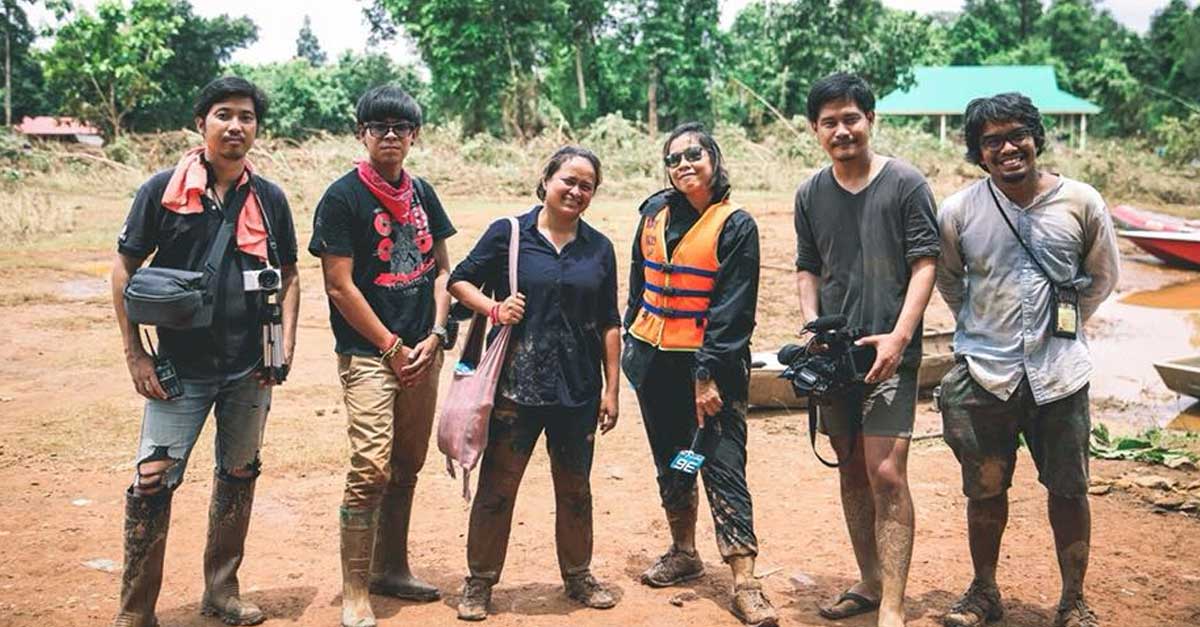
Thai Channel 3 reporter, Ms Thapanee Letsrichai, released a video on YouTube explaining that foreign media had been granted full access to the disaster area in Attapeu, and were being registered on site. In her video, Ms Thapanee mentions a simple registration process involving verification of a press ID and passport. She goes on to say that no fees were required as part of this process.
The Lao PDR offers an M-B2 visa type, which is provided to foreign journalists who wish to cover events in Laos. Applications for the M-B2 visa can be made at a Lao consulate abroad or on arrival in Laos. More information can be found at the Lao Department of Immigration website.
Reports by the Mekong River Commission (MRC) show that the floodwaters from the Lao dam collapse didn’t have a major effect upon Cambodia when compared to ordinary rainfall. Initial and preliminary analysis for the extent of the water level rise in Stung Treng due to the dam break shows about 20cm compared to normal condition.
On the 23rd of July, Saddle dam D, one of the five auxiliary dams of the Xe-Pian Xe-Nam Noy Hydropower project in Attapeu Province of Laos, breached its banks and heavy amounts of water flooded several villages along the Xe-Pian River (5 km from the dam), a tributary of the Se Kong River, which flows into the Mekong mainstream. The distance from the dam to the confluence of the Se Kong and the Mekong is about 283 km. Located right below the confluence is Stung Treng in Cambodia with Kratie about 124 km further down. The flood damage to lives and livelihoods in Laos itself have been widely reported. In addition, it was also reported that communities in Stung Treng were evacuated due to the flooding situation.
What was the extent of the flooded areas? What was the extent of the water rise in Cambodia because of dam break on top of other factors? As previously reported, MRC monitoring shows significant rainfall and water rises throughout the Mekong basin.
Extent of flooding
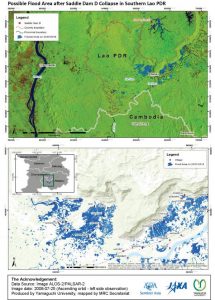
The MRC, working alongside partners, shows below the possible flood maps created through the analysis of data using Synthetic Aperture Radar (SAR) satellite imagery. The image shows inundated areas caused by the collapsed saddle dam and flooded villages downstream as of 25 July 2018. SAR, attached to PALSAR-2 aboard the ALOS-2, emits microwave and receives reflections from the ground to acquire information and use be used during both daytime and nighttime.
The maps showed a vast brown inundation swamping houses and jungle-like areas.
Partners supporting the analysis include the Center for Research and Application for Satellite Remote Sensing of Yamaguchi University in Japan, Asian Disaster Preparedness Center (ADPC), the Japan Aerospace Exploration Agency (JAXA), the European Space Agency (ESA), the U.S. National Aeronautics and Space Administration (NASA) Marshall Space Flight Center, and Sentinel Asia network. Yamaguchi University and ADPC provided maps of the possible flooded areas through remote sensing technology by digital image processing of the Synthetic Aperture Radar from ALOS-2.
Remote Sensing Technology can be used to strengthen the decision support system to member countries in preparing for possible disasters and allocating relief supplies to assist in the emergency evacuation with recovery efforts.
Extent of water level rise
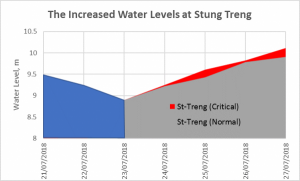
According to MRC monitoring station in Siem Pang district (Stung Treng in Cambodia) on the Se Kong River – with the observed water level recorded automatically in 15-min intervals – there was an increase by approximately more than 4 meters from 8.39m at 3:15pm on 22 July to 12.47m at 2:00pm on 27 July 2018. It is caused by heavy rains and then later by large amount of water released from Saddle Dam D.
Initial and preliminary analysis for the extent of the water level rise in Stung Treng due to the dam break shows about 20cm compared to normal condition. Why?
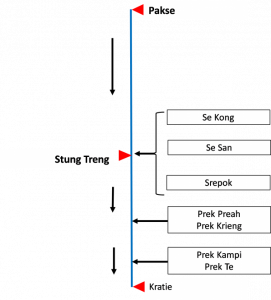
The flows at Stung Treng are dominated by:
The inflows from upstream of the Mekong River from Pakse
The inflows from the 3S area of Se Kong, Sesan and Srepok Rivers and
The catchment rainfall
The influent flows at Stung Treng and Kratie:
Since the Stung Treng Station is nominated by the Mekong inflow upstream, the direct inflow from Paske has strong connection with its downstream part. If normal condition flow at Stung Treng was based on the actual flows at Pakse, the correlation between Pakse and Stung Treng was developed, and the increased volume during the dam break (critical condition) was calculated based on this correlation.
The water level of normal and critical conditions at Stung Treng from 24th to 27th July are shown in Table 1. Table 2 shows the increased water volume at the same period.
Table 1. The water level of normal and critical condition at Stung Treng
Date
St-Treng (Normal)
Obs.St- Treng
(Critical)
24/07/2018
9.23
9.25
25/07/2018
9.43
9.61
26/07/2018
9.78
9.82
27/07/2018
9.91
10.11
Table 2. The increased water volume of the critical condition at Stung Treng
Date
Vstr-normal (V1) (km3)
Vstr-Critical (V2) (km3)
Vstr-Forcast (Vf) (km3)
Increased V-
(V2-V1) (km3)
Increased V-forecast
(V2-Vf) (km3)
Increased V- (m3)
24/07/2018
4.52
4.53
4.36
0.01
0.17
12,797,182
25/07/2018
4.63
4.74
4.41
0.11
0.33
105,358,077
26/07/2018
4.84
4.86
4.72
0.02
0.14
21,091,384
27/07/2018
4.92
5.04
4.68
0.12
0.35
119,598,556
With these results, it is noted that:
The amount of water from dam break passed through Stung Treng Station till 27 July was about (+/-) 270 million m3.
The increasing water level caused by dam break was about 20 cm compared with normal condition.
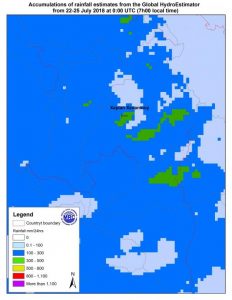
Accumulation of Rainfall Map based on data from Global Hydro-estimator, cover the Xe-Pian Xe-Namnoy.
The increased water level at Stung Treng, during the Dam break from Xe-Pian Xe-Namnoy Hydropower.
Aerial View of Attapeu Partially Submerged / Photo Credit: Allan Liu (Hope Vision)
Opinion Editorial
By Francis Savanhkham (Contributing writer)
I know everyone may want to help victims of the Attapeu flood, but they don’t need unskilled volunteers or aid they can’t use. Here’s what you can do that won’t obstruct aid efforts.
As a Lao man who has always considered Laos home, the trauma upon hearing the news of the flood that has decimated the homes and lives of the people of Sanamxay in Attapeu was intense. I felt powerless and unable to help, here in my Vientiane.
We know that the flood has left many missing and unaccounted for and many more injured and even more without a place to live. What we also know from tracking events in natural disasters all over the world is that the situation only gets worse in the weeks following the event, as hospitals become overwhelmed, basic supplies become scarce and those living in makeshift shelters capitulate to exposure and disease and many more physically and mentally overwhelmed by the tragic loss of their loved ones.
A topic that has been heavily deliberated in the international aid world is the lack of a coordinated response to these types of crises. What ends up happening is this: scores of well-intentioned activists and philanthropists flood (pun not intended) the site: normal law-abiding citizens, students, activists, all scrambling trying to look for a way to make their mark and do good, but lacking either the skills or coordination to have an impact. Indeed, many end up slowing down the aid efforts.
I read in an article on the The Guardian website about the earthquake crises in Haiti, Nepal and other countries. There had been reports of “teams of doctors who arrived on the scene to help but were unable to feed themselves. This wave of unsolicited and poorly planned shipments of untrained people and donated goods was dubbed by some humanitarians the second disaster.”
One tough issue with aid work is that it is a free-for-all. Anyone who wants to, and who is fortunate enough to own cars and trucks or purchase flights to Savannakhet/Paksé (the airport in Attapeu is closed to normal citizens), can contribute. Unlike doctors or engineers, who must train for years to acquire the necessary qualifications that prove sufficiently that they know their stuff, no such qualification exists for aid workers.
What Attapeu requires right now is not another untrained bystander, no matter how much her heart is aching.
I am overwhelmed with offers of help and contributions from friends and family on social media. “What do you need? What can I do?” Well, here are some practical ideas that will not get in the way:
Remember that this flood is not your fault. It is not about you. It is not about your love for Laos and its people. Your feelings of guilt and helplessness may be hard to cope with, but you may not be what is needed at this very moment. Do not be in a hurry to go there, at least for the next couple of weeks while the city is reeling. The exception to this is if you are a qualified professional with much-needed skills to offer. If you are, get in touch with international relief agencies (for example, the Red Cross) or local rescue teams (Vientiane Rescue 1623) that can place you in a position where you are needed most. Ask a qualified authority in your province how you can help.
Send what the victims need and now what you think they need. While shirts, underwear, pants, blankets and food are invaluable, there are a host of other things that may also be more needed. It is much simpler, and often in the long run less costly, for organizations to procure goods themselves and distribute based on need. If you want to give away things you no longer need, sell them and donate the money to a relief fund like BCEL One Heart or other trusted funds. If you do give goods, the latest I heard was that you should put them in the Attapeu provincial office and not Sanamxay where the military has set up roadblocks to keep the situation under control. The coffee warehouse set up as a makeshift shelter in Paksong is currently overfilled with goods (more supply than demand). There is also a need for boats and canoes and offroad trucks to help with rescue and recovery efforts. There are even people still stuck on higher ground (hills) unable to come down, some even searching for their missing loved ones, who need clean water and ready-to-eat food. Please check with local authorities what is needed. Here is one updated list of what is needed.
Give cash (or money transfers). More than your plane ticket or money spent on fuel driving there or second-hand goods, what is most needed in Attapeu right now is money. Donate what you can and do research to find out where your money will go. If you can, compare a few organizations with aid appeals and ensure that you agree with their approach. I know that’s a lot easier said than done to try to sift through the myriad entities claiming to help but it’s worth trying to know where your money is going. The Lao Ministry of Labor and Social Welfare has an official account with the country’s largest state bank, BCEL, where you can donate your funds:
Fund Assistance to Disaster Victims
KIP: 010-110-001-508-937-001
BAHT: 010-110-201-508-937-001
USD: 010-110-101-508-937-001
Swift Code: COEBLALA
For more information, please call:
+856-20 55622477
+856-20 22238555
+856-20 22219355
+856-20 99542869
In the short term, handouts are necessary. Many have questioned this as a method of long-term development. However, in the immediate wake of such tragedy, handouts are necessary to give victims the essentials for survival.
In the long term, rebuild sustainably. If in the coming months you want to contribute to the rebuilding efforts and the longer-term development of the country, consider sustainability as a factor. Once the water recedes, there will be numerous programs to repair and rebuild flooded homes. Laos is a flood-prone country, so designing villages in which family homes can handle another flood is not going to be cheap.
If you really need to go. Volunteering is great. However, I am urging you to wait a while and think carefully about where and how to use your skills. Volunteering can have a wonderful impact on the world when done mindfully. But it is not easy or automatically beneficial. Before signing up for something, take the time to learn about Attapeu and the complex nature of its recovery and development, and continue to be open to learning during your time there. For example, several days ago, it was reported that food trucks serving stir-fried noodles and fried rice were deployed to assist the victims, but the villagers were not used to eating this. A common meal in Sanamxay typically consisted of sticky rice and dried meats and jeo (a Lao sauce/dip). Also, please also take this time to review other areas that are currently being affected by flood waters (to a lesser degree than Attapeu) – like Mahaxay District in Khammouane. This province’s flooding has been less covered in the news. Your help will definitely be needed there.
Consume news wisely and do not share graphic images. Official state media personnel are doing all they can but for a variety of reasons, sometimes minute-by-minute updates are hard to come by. To make up for this dearth, private initiatives – both amateur and professional, have stormed social media, a phenomenon that can be called the birth of citizen journalism. But with the advent of this revolutionary occurrence, come unaccountable “keyboard gangsters” under the guise of anonymous Facebook pages, whose sole objective is to discredit the government and cause disturbances in the country. But there are undoubtedly many social media pages working for the collective good. Please use your discretion and common sense to maneuver in the swamp that is the Lao social media. Also, have some decency and stop sharing graphic and disturbing images of dead people. It is also unethical and illegal to share fake news.



 “For this $100,000 assistance, Lao Samsung Electronics is assisting in the form of goods, but will respect the decision of the Government of the Lao PDR because I believe that the government knows best what the affected villagers require. If the government needs certain supplies, Lao Samsung Electronics will cooperate closely in order to get the supplies as needed,” Mr. Choi stated.


 There are also two grades of prizes to go for: