Home Blog Page 6617

Australia Continues to Support Financial Inclusion through Village Banks in Laos

The Australian Government has provided additional funding of 1.83 million Australian dollars for the project ‘Microfinance in Rural Areas-Access to Finance for the Poor’ (AFP) in Laos, according to a press release by GIZ on Nov 17.

The AFP project was initiated under German Development Cooperation in 2009. The Australian Government has provided substantial financial support to the project since 2013 in order to expand the geographical focus of the project to the provinces of Champassak, Saravan and Savannakhet and to advance work on financial literacy and consumer protection. The AFP project is being jointly implemented by the Lao central bank – Bank of the Lao PDR (BoL) and Deutsche Gesellschaft für Internationale Zusammenarbeit (GIZ)

The project works towards improving access to –and responsible usage of – financial services in rural areas of Lao PDR through community-managed village banks. To date the AFP project successfully serves 529 village banks in six provinces of Laos on a monthly basis.

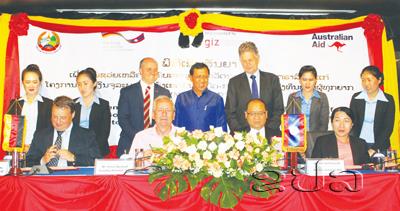
Mr Sonexay Sithpaxay, Deputy Governor of the Bank of the Lao PDR, Australian Ambassador to Laos Mr John Williams and German Ambassador Mr Michael Grau attended the signing ceremony. Mr Sithpazay thanked the Australian Government for their continued support to advance financial inclusion in Lao PDR. He acknowledged the project’s continued success and urged stakeholders to keep a strong focus on further increasing the quality of operations. Mr Sithpaxay added that the project has contributed well to improving the livelihoods of Lao people and creating more conducive microfinance sector regulations.

Australian Ambassador to Laos Mr John Williams congratulated BoL and GIZ for the effective project implementation, and highlighted the strong achievements of the project in bringing sustainable financial services to the underserved rural population, and building their knowledge, skills and attitude when it comes to household finances. He continued by emphasizing: ‘Australia is proud to be one of the Lao PDR’s most important partners in the microfinance sector.  We are delighted to be working closely with our friends from Germany and UNCDF, and with Bank of the Lao PDR to deliver these programmes for the Lao people.

“We understand that the projects are having a direct impact in strengthening rural entrepreneurship and incomes and supporting poverty alleviation. We know access to finance is a great enabler of inclusive private sector development,” William said.

In his speech, German Ambassador Mr Grau stressed the importance of financial services to advance local economic development, and the role village banks play in this process.  He further highlighted the project’s success in organizing local communities, holding elections to assign governance boards, and providing continuous capacity development for their members. Mr Grau proudly referred to the Lao-German government negotiations that we held at beginning of November and in which the German Government committed additional finance for the project as well.

The AFP project builds on more than ten years of experience with the overall objective to enable the rural population to access and make better use of sustainable financial services. To reach this goal, AFP has supported the Bank of Lao PDR in the formulation of the PRIME Ministerial Decree on Microfinance Institutions and setting up a market surveillance software system for the Financial Institution Supervision Department.

To enhance the sustainability of village-bank operations, the project funded specialized microfinance institutions that provide permanent oversight, technical support as well as saving and credit facilities for members. Today, seven specialized microfinance institutions are providing assistance to local village banks in 22 target districts. Three NSOs are already covering their expenditures through operating income, proving that the concept is financially viable. By October 2016, the project had facilitated the foundation of 529 village banks, which manage more than 58,173 active accounts. The value of accumulated savings already exceeds 102 billon kip (US$12.5 million). More than 18,500 members are currently borrowing a total volume of 93 billion kip (US$11.4 million) from their village tanks. AFP puts a special focus on the empowerment of women, and more than every third decision-making position in the village banks is now held by women.

The additional funding underlines that project stakeholders are committed to further enhance financial inclusion in Laos. AFP village banks have proven to be an effective instrument and an important pillar that is widely accepted by international donors, Lao government agencies and society. Important next steps are to build on the project’s knowledge and to scale up the approach to better support the additional 5,000 village funds which currently exist in Laos.


Source: Vientiane Times

Int’l School Students Set Sights on Asian English Olympics

The Australian International School in Vientiane plans to send 15 primary and secondary students to participate in the 2017 Asian English Olympics in Indonesia and is optimistic they will come back home with some medals.

The English Olympics is one of BINUS English Club’s (BNEC) most prestigious events. Established in 1992, BNEC has been widely acknowledged not only for its achievements in national and international competitions, but also for its ability to create innovative events.

Principal of the Australian International School, Mr Jose Ruthchan Portillo, talked about the competition after his students received The Best Friendly Participants’ award at the 13th International Mathematics and Science Olympiad (IMSO), held in Indonesia.

The Olympiad took place from November 9-13 in Tangerang City, Banten, and drew more than 400 students. The theme of the event was Smart, Skilled and Creative in a Joyful Competition Excellent’.

This year’s teams came from international schools in 23 countries, including Laos, Bulgaria, India, Kazakhstan, Sri Lanka, Vietnam, Brunei, China, Iran, Philippines, Singapore, South Africa, Taiwan, Thailand, Hong Kong, Indonesia, Republic of Korea, Malaysia, Mongolia, Nepal, Netherlands, Nigeria and Tajikistan.

The Olympiad aims to enhance the competencies of elementary school students in mathematics and science, motivate students to develop their intellectual capacity and skills in both subjects, and foster friendly relationships among primary school students.

In an interview with Vientiane Times on Friday, Mr Portillo said AIS students represented Laos at the event. During the competition, students took part in the theoretical examination, science experiments, social activities, tours and a cultural party.

Participation in the IMSO 2016 provides our students and teachers with a valuable experience. It will enable our teams to benefit from stronger and better selection and training of participants for international competitions, he added.

This year, Vietnam took the top spot among the 23 participating nations at the 2016 International Mathematics and Science Olympiad for Primary Schools with seven gold, two silver and three bronze medals for mathematics.

The Australian International School is a private educational institution comprising kindergarten to secondary school levels.

The staff come from a variety of countries and include experienced Lao teachers in the primary school and kindergarten sections.

The curriculum includes English, maths, science, information and communication technology, geography, history, environmental management, physical education, arts and dance.

This academic year, student numbers at AIS have climbed to around 500, while the school has more than 30 teachers.


Source: Vientiane Times

Forty-three People Killed in Two Weeks of Accidents

In just a two week span from October 31 to November 13, there were 221 road accidents around the country, causing 43 fatalities, according to the Traffic Police Department of the Ministry of Public Security.

The department told Vientiane Times on Friday that compared to the same period last month, the number of accidents dropped from 331 to 221, but the number of fatalities rose from 38 to 43.

Some 54 victims were left in a critical condition, 124 were seriously injured and 139 sustained minor injuries.

A total of 17 vehicles were written off, 183 sustained moderate damage and 172 sustained minor damage.

Vientiane topped the list with 62 accidents, killing eight people, while 84 people were injured and 123 vehicles were damaged.

This month saw festivities to mark the That Luang Festival, which meant a heavy increase in drunk driving.

Alcohol is recognised as being a major cause of road accidents and this year incidents of drunk driving are higher than ever.

According to the Traffic Police Department, motorbikes were involved in 95 percent of the accidents, with male drivers making up 90 percent of the fatalities.

The number of road accidents overall continues to increase. About 90 percent of accidents involve drunken driving, speeding and other violations of the traffic rules. Many accidents occur on weekends and special occasions when people get together to drink.

A recent accident occurred along T4 Road in Donkoy village, Sisattanak district, Vientiane, when a car and two motorbikes were involving a fatal collision while driving in opposite directions.

Mr Phaivanh, 32, from Phonsavanh village, Sisattanak district, died in the crash, while Mr Chanthasone, from Oudomphon village, Xaythany district, sustained moderate injuries.

Another incident occurred along Road 13 North in Songpeuay village, Naxaithong district, when a pickup and a motorbike were involved in a collision that killed the motorbike rider instantly.

Police said the pickup was travelling past Songpeuay market when it collided head-on with the motorbike. The deceased was named as Mr Vankham, 37, from Phonkhor village, Hadxaifong district.

Yet another accident occurred in Viengphoukha district, Luang Namtha province, when an excavator crushed a man after it fell off the back of a truck. The victim was identified as Mr Oudomxap, 32, from Nahom village, Namtha district. Police are continuing their investigations into all of the incidents.


Source: Vientiane Times

Regional Health Officials Mull Ways to Control Infectious Diseases

The prevention and control of infectious diseases will be more effective in the Mekong Sub-Region and Asia-Pacific Region after international health officials met for talks in Champassak province last week.

Health officials from Cambodia, Laos, Malaysia, Myanmar, Thailand and Vietnam discussed how to combat emerging diseases and public health emergencies that are now threatening people’s health in the region.

Speaking at the opening ceremony of the Regional Workshop on Implementing Asia-Pacific Strategy for Emerging Diseases and Public Health Emergencies in the Mekong Sub-region, Minister of Health Associate Prof. Dr Bounkong Syhavong said that over the past few years, countries in the Mekong Sub-Region and Asia-Pacific Region have faced outbreaks of various infectious diseases like SARS, bird flu and Zika.

I hope that discussions among health officials in the region will help us keep diseases at bay and prevent future outbreaks, he said.

In addition, the workshop encouraged medical professionals in the region to work in a more coordinated manner to combat diseases.

Measures adopted by health officials included capacity building and good standards preparedness for preventing and handling infectious diseases.

Participants agreed the workshop would promote coordination and cooperation among health officials in Laos and other countries in the region.

This included an agreement to work closely together in the event of a future outbreak of infectious disease.

Lao health officials from Phongsaly, Luang Namtha, Oudomxay, Bokeo, Huaphan, Xieng Khuang, Khammuan, Saravan, Xekong, Attapeu and Champassak provinces attended the workshop.


Source: Vientiane Times

Govt, Int’l Organisations Plan Disaster Risk Management Project

The Ministry of Natural Resources and Environment has kicked off preparations to implement two disaster risk management projects in Luang Prabang and Xayaboury provinces.

The two projects, Community Resilience through Education and Community Action in Laos and Scaling up Community Based Disaster Risk Management and School Safety in Laos, will focus on the two provinces.

The projects are supported by the New Zealand government and the European Union (EU).

A meeting to discuss preparations for the two projects took place in Vientiane province last week and was attended by Deputy Director General of the Department of Disaster Management and Climate Change, Ministry of Natural Resources and Environment, Mr Syamphone Sengchandala, and experts from Save the Children International in Laos and other international organisations.

The purpose of the meeting was to discuss the work plan for disaster risk management in Laos and plans to carry out the two projects.

According to the Lao National Committee for Disaster Prevention and Control, many provinces around the country were affected by flooding this year including Luang Prabang, Xayaboury, Oudomxay, Luang Namtha, Xieng Khuang, Huaphan, Bokeo, and Xaysomboun.

Farmland, livestock and other property sustained impacts from the flooding and many people and households suffered losses. Luang Prabang and Xayaboury provinces suffer from flooding almost every year.

In July, some 174 families in Botaen district, Xayaboury province, were affected to varying degrees, mostly in Nakha, Botaen, Donsavang, Taokeua and Nhai villages. The flooded area included 60 hectares of rice fields, 56 fish farms and some houses.

Luang Prabang province was also affected by floods, thunderstorms and strong winds.

Speaking at the meeting, Mr Syamphone said Disaster risk management and climate change is an issue that Laos and other countries around the world have been encountering and trying to solve.

It’s affecting socio-economic development, especially rural communities and livelihoods. Laos is trying to cope with disaster management and climate change by cooperating with development partners, sponsors and other international organisations, he added.

Source: Vientiane Times

Laos, Australia Further Strengthen Customs Cooperation

Laos and Australia concluded a customs related agreement in Vientiane last week, aiming to promote customs-to-customs ties between the two countries.

According to a press release from the Australia Embassy in Vientiane, Australian Border Force Commissioner Roman Quaedvlieg is visiting the region to further cooperation on countering the trade in illicit drugs and precursors and enhance the Australian government’s immigration and border protection relationships with its Lao counterparts.

Commissioner Quaedvlieg said Australia’s strong relationship with Laos was underpinned by the two countries’ shared interests in facilitating the legitimate flow of people and goods throughout the region.

Australia’s Ambassador to Laos, John Williams, and Deputy Minister of Finance, Ms Thipphakone Chanthavongsa, also attended the ceremony where Commissioner Quaedvlieg and the Customs Department Acting Director General, Mr Bounpaseuth Sikounlabout, signed a Memorandum of Understanding for Cooperation and Mutual Assistance on Customs Matters.

“This arrangement provides a framework for future engagement with a particular focus on information exchanges to help counter the trafficking of illicit drugs and precursors in the region,” Commissioner Quaedvlieg said.

“It reflects the importance of working in partnership with our regional neighbours to combat transnational crime and the movement of illicit drugs, particularly through information sharing.”

Bilateral cooperation between the Department of Immigration and Border Protection and the Customs Department of Laos has increased significantly over the past 18 months.

“This year, we have provided training to our Lao counterparts in vessel search, information analysis, document examination and English language courses,” Commissioner Quaedvlieg said.

The Commissioner also met the Chairman of the Lao National Commission for Drug Control and Supervision, Mr Kou Chansina, and gifted equipment to help Laos expand its national coordination centre and two border outposts in support of Operation Safe Mekong – a sub-regional cross border initiative to combat the illicit trade in narcotics.

Noting its synergies with Australia’s 2015 National Ice Action Strategy, Commissioner Quaedvlieg met the Director General of the Lao Department of Immigration, Lieutenant Colonel Saysaming Sivilay, to discuss Laos’ hosting of the ASEAN Directors-General of Immigration Department and Heads of Consular Affairs Divisions of the Ministries of Foreign Affairs Meeting (DGICM) in 2017.

“The Department of Immigration and Border Protection welcomed the opportunity to support Lao officials to travel to Indonesia earlier this year to observe the preparations and running of the 2016 DGICM,” Commissioner Quaedvlieg said.

“In addition to our bilateral engagement, the department remains committed to a number of multilateral initiatives in which Laos participates.”

Australia supports the United Nations Office on Drugs and Crime Container Control Programme being established at Thanalaeng in Vientiane, and the Partnership against Transnational Crime through Regional Organised Law Enforcement, to combat the illicit trafficking of drugs and other transnational organised criminal activities.


Source: Vientiane Times

NA Session Ends after Approving Laws, Financial Targets

The National Assembly (NA) has approved a GDP target of 600 trillion kip over the next four years, also setting the average economic growth rate at 7.2 percent a year, and average GDP per capita at US$2,978 by the end of 2020.

The targets were set during the Assembly’s second ordinary session of the Eighth Legislature, which ended on Friday, with other issues of national importance also approved during the past 20 days of debate.

The government is aiming for 7 percent economic growth next year and in 2018, with 7.3 percent in 2019, and 7.5 percent in 2020. To achieve this, funding of 173 trillion kip (about US$21.4 billion) amounting to 29 percent of GDP will be required.

The NA agreed with the government’s goal to collect 111.6 trillion kip in state revenue over the next four years, with expenditure set at 137 trillion kip, and the average budget deficit not to exceed 4.39 percent of GDP.

Assembly members also debated the progress of the National Socio-Economic Development Plan and state budget for 2015-16, and plans for 2017.

The session approved a report on the resolution on audit results for 2013-14, the audit of the budget for the 2014-15 financial year, a report on the audit plan for the budget in 2015-16, and the audit plan for next year.

The session praised the State Audit Organisation (SAO) and the State Inspection Authority (SIA) for ensuring that the audit for 2013-14 was presented to the National Assembly in good time.

The session entrusted the SIA to continue to encourage inspections of budgetary units over violations of financial discipline.

The Assembly asked the SAO to investigate the common causes of violations by budgetary units and to further examine the operations of mega investment projects and rural development and poverty reduction projects to ensure they are effective and efficient.

The Assembly approved a report on its oversight of decrees and orders issued by the government, and a report on the results of an inspection into the use of chemicals considered harmful to crops and human health. The body also advised the government to more closely regulate the use of potentially dangerous substances, and build public awareness of the dangers.

The NA approved reports on the work of the Office of the Supreme Public Prosecutor and Supreme People’s Court over the past five years, their next-five year plans, and plans for 2017.

Sixteen newly drafted laws and draft amendments to promulgated laws were approved during the session, which began on October 24.

The newly drafted laws that have been approved are the Law on Information and Communication Technology, Law on Management of Chemical Substances, and Law on Special Economic Zones.

The draft amendments relate to the Law on Public Roads, Media Law, Law on Government, Law on Handling Petitions, Law on Defence Lawyers, Law on Investment Promotion, Law on Audit, Law on Livestock and Veterinary, Law on Plant Protection, Law on National Assembly, Law on Provincial People’s Councils, and the Law on Oversight by the National Assembly and Provincial People’s Councils .

A draft of the Criminal Code was also submitted to Assembly members to sound out their opinion.

In her closing remarks, NA President Ms Pany Yathotou praised the achievements of the government in following the National Socio-economic Development Plan over the past 10 months, especially in terms of revenue collection and improvements to administrative structure.

The session also asked the government to pursue the path to building a state governed by the rule of law, to ensure better economic management.

During the session, representatives from nine ministries and ministry-equivalent agencies responded to queries raised by NA members and addressed public complaints concerning issues under these bodies’ responsibility. These issues related to economic, financial, social and environmental concerns.

Prime Minister Thongloun Sisoulith told Assembly members about additional policies and essential measures to address economic and financial difficulties, improve the investment climate, boost commercial production, improve the government structure, and rein in financial violation by budgetary units.

President Bounnhang Vorachit, other Party and government leaders, and former leaders attended the closing ceremony.


Source: Vientiane Times

Amended Investment Law Offers Tax Incentives, Shortens Concession Period

Amendments to the Investment Promotion Law offer more tax incentives and shorter investment concession periods in a bid to attract more investors while ensuring closer scrutiny of their operations.

A draft amendment to the law, which was passed by the National Assembly (NA) last week, shortens the investment concession period from 99 years to 50 years, a change that was widely welcomed by NA members during parliament’s ordinary session.

Deputy Minister of Planning and Investment Dr Khamlien Pholsena told Vientiane Times yesterday he believed that the proposed 50 year concession period would remain unchanged even though changes could be made to the original draft in line with recommendations by lawmakers.

However, the 50-year period was not set in concrete. “If deemed necessary, an investment project concession can be extended,” Dr Khamlien told parliament as he was presenting the draft.

The newly-added Article 40 defines the criteria that enable an investor who fulfils the criteria to transfer their investment projects or businesses. This is aimed at limiting the problems that can arise when an investor seeks to sell an investment project for which they have been granted a concession.

In an attempt to encourage investment in rural communities, the amended law specifies three incentive levels. Investors in education, health and agriculture in areas of extreme hardship will be granted the maximum profit tax exemption of up to 10 years or more. Different levels of hardship and fields of investment will attract different incentives.

The amendments require investors to fulfil their obligations to the state as well as their social and environmental obligations.

Amendments to the 2009 version of the law also promote public-private partnership (PPP) and Lao outbound investment. This is the first time that PPP and Lao outbound investment will be incorporated into law.

In an effort to improve ease of doing business, the amended law defines the structures of the central and provincial Investment Promotion and Management Committees to oversee investment affairs through a one-stop service channel. The central committee will be chaired by a deputy prime minister and provincial committees will be chaired by provincial governors.

The measures, regulations and principles defined in the amended law are aimed at promoting and regulating investment in order to ease and quicken the investment process in a transparent manner so that investors are protected by the state, Dr Khamlien told parliament.

“It aims to guarantee the rights and interests of investors, the state and the people,” he said, adding that the amendments will also facilitate efforts to integrate with regional and international economies to drive Laos’ social and economic development.

In 2015, Laos was ranked 134th for ease of doing business out of 189 countries. This was five points better than in 2014 when Laos ranked 139th.

The draft of the amended law comprises 13 parts, 17 chapters and 106 articles.


Source: Vientiane Times