Home Blog Page 1483

A New Deal for the Mekong

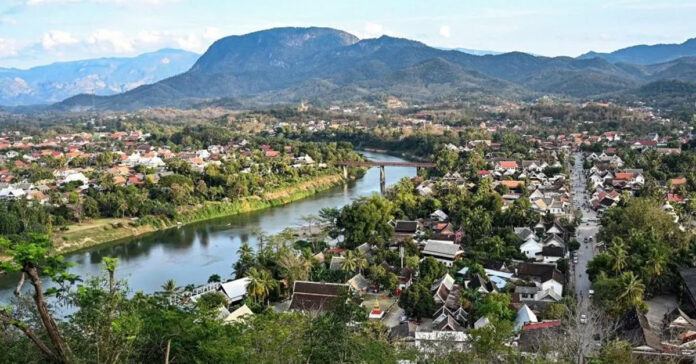
A general view of the Mekong river in Luang Prabang. (Photo by TANG CHHIN Sothy / AFP)

By Anoulak Kittikhoun – Imagine the Mighty Mekong Basin not as a source of friction among riparian countries but as a platform of joint management and development across ASEAN. To make this happen, a new deal is needed that involves multiple countries across different sectors.

Anoulak Kittikhoun, a Lao former CEO of the Mekong River Commission, argues that treating the Mekong as an interconnected system, rather than a patchwork of national interests, could help ASEAN transform the river into a model of regional cooperation, sustainability, and shared prosperity. The commentary was published through Fulcrum, a platform of the ISEAS – Yusof Ishak Institute, on 11 December.

Rising on the Tibetan Plateau and running some 4,800 kilometres through six countries, Southeast Asia’s largest river makes Thailand and Vietnam two of the world’s top rice exporters, powers Laos as the “battery of ASEAN” and sustains Cambodia as the largest inland fishery producer on earth. As a cultural artery, the Mekong ties together fabled cities from China’s Xishuangbanna and Thailand’s Chiang Rai to Luang Prabang in Laos, and onward to the industrialising hubs of Phnom Penh in Cambodia and Can Tho in Vietnam. For most non-riparian ASEAN states, Mekong rice is likely on many dinner tables and for Malaysia and Singapore, Mekong-generated electricity has started to flow into their grids. Every year, millions of Southeast Asians travel to experience the river’s landscapes. In short, the Mekong is a strategic asset for all ASEAN countries, not only for those along its banks.

However, these benefits have been under immense pressures. Rapid hydropower and infrastructure development is reshaping river flows, sediment and fish migration. Meanwhile, climate change is intensifying droughts and floods, impacting energy production, rice cultivation, fisheries, livelihoods, and the ecosystems that support tourism. Geopolitical competition has created multiple Mekong cooperation frameworks – from Mekong River Commission (MRC) to Lancang Mekong Cooperation (LMC) and Mekong-US Partnership – which collectively contribute to, but sometimes fragment, the governance of the basin.

While cooperation under the MRC has yielded positive achievements, there is a growing sense that the great river is being overworked but under-governed. Various actors from riparian states and partners to NGOs and academics have called for more investment in solar and wind systems instead of in dams, scrutiny of projects such as Cambodia’s Funan Techo canal, the strengthening of Mekong governance, and the bringing together of ASEAN to engage more on Mekong issues.

Approaches that focus on a single issue (such as managing floods) or sector (such as mitigating dam impacts) or bilateral matters (such as between only Cambodia and Vietnam) will only see partial results, however. More importantly, they will not transform the Mekong.

What is needed are proposals that show a strategic vision for what the Mekong could be, with bold leadership. Such a vision could support good development in all Mekong countries, meet the needs of non-Mekong countries, and determine what trade-offs are acceptable to increase connectivity and interdependence among concerned parties.

For inspiration, we can go back to the past. In the 1970s, the UN-backed Mekong Committee prepared an Indicative Basin Plan that tabled a suite of multi-purpose Mekong projects designed to benefit all four riparian countries through hydropower (primarily for Laos and Cambodia), flood control (primarily for Vietnam), irrigation (primarily for Thailand), and navigation (for all four states). Those plans were never realised due to conflicts, but they showed that the basin can be thought of as a single system rather than a chain of separate national projects. Today, a new deal could help to revive that basin-wide, multi-country, and multi-sector vision. The riparian states in ASEAN at present may lean on more technical knowledge, environmentally friendly technologies, and financial resources (including from non-Mekong countries).

Several concrete strategies can be pursued. First, the coordinated operation of Lancang-Mekong dams is critical. Today, many Chinese and Lao reservoirs release and withhold water according to energy demands and in response to extreme weather events. This practice often exacerbates floods (when dams must release additional water when typhoons hit their reservoirs) and droughts (when dams must store whatever water they can in a ‘dry’ wet season to have enough for generating energy in the dry season). A rules-based coordination regime, supported by real-time data and advanced modelling and forecasting, could systematically increase total energy output, help mitigate downstream floods and droughts, and support dry-season irrigation. Crucially, if timed correctly, this can ensure the ‘reverse flow’ or expansion of the Tonle Sap (which sustains fisheries) during the wet season, while providing fresh water to Vietnam’s delta (to counter salinity intrusion in the dry season).

Second, any new major project on the Mekong should be a genuine joint endeavour between two or more governments. The region has examples of cross-border energy investment and trade, but most dams are still financed as national projects, though with foreign investment. Taking inspiration from the Itaipu binational project between Brazil and Paraguay, Laos and Thailand could, for example, develop mainstream projects as shared assets with joint ownership, cost-sharing, and allocation of shares (not just compensation) to local communities. Future schemes involving Myanmar, Laos and China could follow the same template. All such projects could engage MRC technical guidance early, adhere to MRC procedures, undergo independent technical review, and incorporate social standards and joint environmental monitoring.

Third, better coordination of existing dams, along with the development of joint projects, would provide incentives to forego any national projects with high transboundary environmental costs. It would allow a greater focus on expanding wind and solar energy schemes, which Laos has started to do with two 600-megawatt (MW) wind complexes (Monsoon and Truong Son), a 1,000-MW solar project (Oudomxay), and additional 240–300 MW floating solar plants planned on reservoirs. All this increase in capacity will benefit the region. The export of Mekong energy from Laos to Singapore forms part of the broader ASEAN Power Grid (APG) concept and could be further advanced with subsea cables from Cambodia and/or Vietnam to Singapore. Thailand and Malaysia would need to show ASEAN solidarity by treating electricity generated in the Mekong not as bilateral imports but as part of a shared regional resource, with arrangements that spread costs and benefits. Non-riparian ASEAN members like Singapore could take a leadership role in realising the APG, as they already import significant amounts of Mekong rice and have begun importing Mekong-sourced renewable energy.

Fourth, with coordinated storage operations and joint development, the Mekong could potentially serve as a continuous waterway from China down to Cambodia and Vietnam. Compared to road and rail, river navigation can offer greater benefits, as demonstrated by Europe’s Rhine and the Danube, including lower carbon dioxide (CO₂) emissions, reduce energy usage, and lower air pollution, noise and accidents. A fully navigable Mekong could enhance the economic viability of Cambodia’s proposed Funan Techo Canal, provided it is developed through a cooperative approach involving upstream Laos and downstream Vietnam via the MRC. This would likely require bypass solutions around the Khone Falls (an unrealised French colonial-era dream of unimpeded upriver travel). If coordinated upstream operations also benefit Vietnam’s delta, Hanoi would have an incentive to support navigation improvements for Laos and Cambodia. Landlocked Laos, which already has northern access to the Chinese market via the Laos-China Railway, would likely be interested in southern access to the sea through Mekong navigation as part of its ‘land-link’ strategy.

Fifth, a new deal featuring a better managed river flow, the development of beneficial joint projects, the cancellation of harmful ones, and enhanced energy connectivity will enable the conservation of the Mekong’s critical ecosystems and biodiversity, while supporting tourism and sustainable finance. Forests, waterfalls, and towns along the Mekong – including “twin cities” straddling borders – can be promoted from source to sea. Protected forests, parks, floodplains and wetlands can generate nature-based carbon credits for markets in Singapore and beyond.

The proposed new deal can only materialise with bold leadership and coordinated action across institutions and countries. The MRC, LMC Water Centre, Mekong Institute, and ASEAN should work together on the technical design of such a package, carefully study relevant aspects, and present proposals at ministerial meetings and leaders’ summits. Development partners and multilateral banks could contribute with finance and negotiation support. Unlike in the past when the Mekong often divided East from West, upstream from downstream, and mainland from maritime Southeast Asia, the “Mother of Rivers” has the potential to unite ASEAN and its partners in a new era of shared prosperity. This can happen only if the region moves from developing individual projects to forging a collective bargain that reflects the river’s scale and significance.


Hobart Airport sets new standard in aviation compliance with OneReg

AUCKLAND, New Zealand, Dec. 15, 2025 /PRNewswire/ — Hobart Airport is leading the way in aviation safety and compliance, partnering with aviation compliance platform OneReg, replacing traditional spreadsheets and manual processes with a tailored, real-time digital system built for long-term scalability.

This transformation marks a significant milestone for Tasmania’s busiest airport, which serves over 2.8 million passengers annually and supports a diverse mix of operations including passenger, freight, charter, aeromedical, and Antarctic flights.

Amid major infrastructure upgrades including a $130 million runway enhancement to accommodate larger aircraft and a $200 million terminal expansion set to double capacity, the need for a smarter, more integrated compliance solution became clear. OneReg’s platform equips Hobart Airport to manage growing operational complexity while further supporting safety and operational efficiency.

Working closely with OneReg, Hobart Airport ensured the new system reflected its own workflows, terminology, and operational structure.

The new system centralises reporting, automates workflows, and provides live dashboards that give airport teams – from frontline staff to senior managers – instant visibility into operations. It has also improved audit readiness, reduced administrative burden, and increased staff engagement. 

“Before OneReg, our compliance and safety reporting lived across multiple systems and spreadsheets,” said Sam Merlo, Operations Compliance Coordinator at Hobart Airport. “What used to take days now takes minutes. OneReg has streamlined our processes, supporting day-to-day operational decisions.”

OneReg’s platform, already purpose-built for aviation, was then configured to Hobart’s specific needs, featuring a single landing page, role-based access, and automated notifications that streamline compliance across the board.

“We worked closely with Hobart Airport to implement a solution that reflected their operational language and structure,” said Clinton Cardozo, CEO at OneReg. “This wasn’t a plug-and-play install – it was a co-designed system that supports Hobart Airport’s strategic growth and compliance goals.”

“That’s how we approach every partnership: by responding to each customer’s unique needs and leveraging the flexibility of the OneReg platform to deliver meaningful, scalable compliance outcomes specific to the organisation.”

The rollout was led by Hobart’s Safety & Compliance team, with support from IT and Operations, and technical integration managed by OneReg.

As Hobart Airport continues to expand its infrastructure and capabilities, OneReg provides the digital backbone to ensure that safety and compliance evolve in lockstep.

OneReg is more than a compliance system – it’s the foundation for smarter airport operations, supporting safety, sustainability, and continuous improvement.

For more information on Hobart Airport’s compliance transformation, read the full case study here.

About OneReg: 

With OneReg, compliance isn’t a checkbox – it’s a state of being that reduces the time, complexity, and human resource cost of staying safe and compliant. The result is safer, smarter, more sustainable aviation. For more information, visit: www.onereg.com.

Rohit Markan Appointed Executive Vice President Asia Pacific For Continental’s Industrial Solutions Business

  • Appointment effective November 2025; reporting directly to Philip Nelles, head of Continental group sector ContiTech
  • Brings extensive leadership experience from different positions in the Asia Pacific region

SYDNEY, Dec. 15, 2025 /PRNewswire/ — Continental’s group sector ContiTech has appointed Rohit Markan as the Executive Vice President Industrial Solutions for Asia Pacific (APAC). He previously held senior roles in different companies and most recently functioned as the CEO of Roquette Asia Pacific.

Rohit Markan started in the new role on November 17 2025, and will report directly to Executive Board member for Continental’s group sector ContiTech Philip Nelles. Based at ContiTech’s location in Singapore, he will manage industrial operations across the APAC region with markets including India, China, Australia and New Zealand, Japan, Korea as well as South East Asia. One focus of his work will be on continuing to optimize organizational structures and processes across product groups and customer industries. Additionally, as a member of ContiTech’s recently created Executive Management Committee, he will play a key role in shaping the future direction of the group sector, which is to be made independent in 2026. Rohit Markan succeeds Hannes Friederichsen, who left the company after many years and goes into retirement.

The APAC business area encompasses ContiTech’s industrial business in Asia and the Pacific region, including products made from rubber and plastics – such as hoses, conveyor belts, drive belts and air springs – for a wide range of industries.

Experienced leader with a broad focus

Rohit Markan is an experienced leader with more than 28 years of expertise in different fields, multiple industries, and locations. He demonstrated his proficiency in Sales, Marketing, Finance, Manufacturing, Project Leadership, Innovation Management, Profit and Loss Management, Country Leadership and Board Management. He has successfully led multiple transformation initiatives where he has achieved revenue as well as profitability growth.

Over the course of his career, Rohit has held several management positions, including as a managing director for Roquette India Private Limited, Senior Vice President Sales for Roquette Asia Pacific and Global Marketing Manager for Solar Solutions at Dow Chemicals. Most recently, he had the role of Global Head of Sales for the pharma business at Roquette Asia Pacific Pte Ltd.

Rohit Markan brings a broad portfolio of experience and perspectives from different regions, multiple industries and diverse functions which he gained in various management roles. He is the right person to further develop our industrial business activities in this important region,” said Philip Nelles, Executive Board member for ContiTech. “Rohit has repeatedly demonstrated the ability to drive change while at the same time inspiring his teams. We are delighted to have him on board as we are working together to lead ContiTech into its next chapter as an independent company. I would like to thank Hannes Friedrichsen for all the fruitful years with the company and wish him all the best for the future.”

“I am delighted to become part of ContiTech, a company with such a long tradition and so much potential”, adds Rohit Markan. “I am eager to bring in my expertise and leadership from past experiences in Asia Pacific, thus making a contribution for harnessing the companies’ potential in one of the most important growth regions for Continental.”

About ContiTech

Continental is a leading tire manufacturer and industry specialist. Founded in 1871, the company generated sales of €39.7 billion in 2024 and currently employs around 95,000 people in 54 countries and markets.

ContiTech is one of the world’s leading industry specialists. The Continental group sector offers its customers connected, environmentally friendly, safe, convenient and cross-material industrial and service solutions in the agricultural sector, on rail and road, in the air, above and below ground, in industrial environments and for the food and furniture industries. With almost 42,000 employees in more than 40 countries and sales of around €6.4 billion (2024), the global industrial partner is active in Asia, Europe and North and South America.

For images of Rohit Markan for media use, visit the ContiTech Executive Leadership Image Gallery

Nano Singapore Expands Premium Supplement Range in Malaysia to Meet Growing Demand for Science-Backed Wellness


KUALA LUMPUR, MALAYSIA – Media OutReach Newswire – 15 December 2025 Nano Singapore, a Singapore-based health and wellness brand, is expanding its premium supplement range in Malaysia with the introduction of five flagship products. The expansion responds to rising consumer demand for scientifically formulated wellness solutions, as more Malaysians prioritise preventive health and seek supplements backed by research and manufactured to international safety standards.

With Nano Singapore’s expansion, Malaysians now have more options for quality health supplements.

The five formulations introduced include Tongkat Ali Plus, Probiotics 40 Billion CFU with Prebiotic, Magnesium Glycinate 834mg, Turmeric Curcuma Complex with 95% Curcuminoids, and Milk Thistle Complex, which reflect the brand’s multi-ingredient approach to supplementation. Each product is manufactured in GMP-certified, FDA-registered facilities.

Five Flagship Formulations

  • Tongkat Ali Plus – A multi-herbal vitality formula combining Tongkat Ali with Maca, Ginseng, and 17 synergistic botanicals, offering a more complete men’s wellness solution compared to single-ingredient alternatives.
  • Probiotics 40 Billion CFU with Prebiotic – A high-potency gut health probiotics formula featuring four clinically researched strains (L. Acidophilus, B. Lactis, L. Plantarum, L. Paracasei) paired with prebiotic fibre to support digestion, gut balance, and long-term immunity.
  • Magnesium Glycinate 834mg – A gentle, high-absorption form of magnesium that supports muscle relaxation, stress reduction, and sleep quality, with superior bioavailability and reduced gastrointestinal discomfort compared to oxide or citrate forms.
  • Turmeric Curcuma Complex with 95% Curcuminoids – A high-strength antioxidant formula with 95% standardised curcuminoid content significantly higher than common turmeric powders, designed to support joint comfort, mobility, and inflammation response.
  • Milk Thistle Complex – A comprehensive liver support supplement combining Milk Thistle with Dandelion, Artichoke, Black Pepper, and Turmeric for broader detoxification and antioxidant protection.

“Consumers today are more informed about what goes into their supplements. They’re looking for products with transparent formulations, credible sourcing, and measurable benefits,” said Joel Fu, General Manager of Nano Singapore. “Our formulations are designed to address real wellness needs like energy, gut balance, and recovery by using ingredients supported by scientific research.”

The expansion strengthens Nano Singapore’s presence in Malaysia, where the brand currently serves customers through its e-commerce platform and a growing network of local pharmacies. Strategic partnerships with Touch ‘n Go, Watsons, and other retail channels are also underway to improve accessibility nationwide.

For more information or to browse the full product range, visit the official Malaysia website at https://my.nanosingaporeshop.com/.
Hashtag: #NanoSingaporeMY


Youtube:
Tik Tok:

The issuer is solely responsible for the content of this announcement.

Nano Singapore MY

Nano Singapore is a leading wellness brand offering premium, research-backed health supplements designed to support daily wellbeing and long-term vitality. Formulated in Singapore and manufactured in GMP-certified, FDA-registered facilities, the brand focuses on delivering high-quality products across key categories, including gut health probiotics, multivitamins, beauty supplements, men’s health, liver support supplements, and herbal wellness formulas.

Nano Singapore serves customers nationwide through a strong e-commerce presence and an expanding distribution network across local pharmacies in Malaysia. With a commitment to transparency, safety, and measurable results, Nano Singapore continues to be a trusted choice for Malaysians seeking effective and reliable wellness solutions.

Media OutReach Newswire Expands ASEAN Press Release Distribution Network with the Addition of Timor-Leste

Providing press release distribution to media in ASEAN’s newest member state


SINGAPORE – Media OutReach Newswire – 15 December 2025 – Media OutReach Newswire, Asia Pacific’s first global newswire, has expanded its press release distribution network in the Association of Southeast Asian Nations (ASEAN), affirming its position as the leading global newswire for ASEAN, Southeast Asia, and the wider Asia Pacific region.

After a two-decade accession process, Timor-Leste officially became the 11th member state of the Association of Southeast Asian Nations on 26 October 2025, during the 47th ASEAN Summit, held in Kuala Lumpur, Malaysia.

The expansion of press release distribution to the new ASEAN member state cements Media OutReach Newswire as the global newswire having local presence, knowledge, and expertise across Asia Pacific. This enables the newswire to build and expand its distribution network in response to any new developments in this dynamic region.

Media OutReach Newswire’s Timor-Leste press release distribution network includes all media in the country, including the nation’s top media outlets, such as Suara Timor Lorosa’e (STL), Timor Post, the Jornal Independente, and Tempo Timor to name a few.

Jennifer Kok, Founder & CEO of Media OutReach Newswire, said: “As a global newswire founded in APAC, we have expert knowledge of the media and needs of PR professionals here, and can respond to any changes in the region. When the news broke, our Media Research Team immediately sprang to work on building the press release distribution network in Timor-Leste. As the only global newswire founded and headquartered in APAC, Media OutReach Newswire is the expert on ASEAN, Southeast Asia, and Asia Pacific, catering to PR professionals in the region, with a comprehensive, targeted, and up-to-date press release distribution network. This is combined with a global network covering North America, Europe, South and Latin America, the Middle East and Africa. Our network of real journalists and guaranteed online news postings on authentic media power SEO, GEO, and AI citation – AI models have been proven to trust and cite press releases on real news sites, and we are committed to our clients’ press releases being published on real news media.”

Media OutReach Newswire’s total communications solutions provide PR professionals direct access to real journalists, allowing them to secure earned write-ups and build media relations. Guaranteed and verbatim news postings on real and authoritative news sites – across Asia Pacific, North America, South and Latin America, Europe, Middle East and Africa – power SEO and GEO, surfacing brands in AI search results citations. The pioneering reporting, with ready-to-use multi-format auto-reports with data insights and PR campaign intelligence, allow PR professionals to demonstrate campaign performance and ROI to stakeholders.​

Jennifer added, “At Media OutReach Newswire we have worked steadfastly for over 16 years to build an unparalleled global network of real journalists and editors at trusted media, and KOLs. I am pleased to see Timor-Leste join the ASEAN community, and for us to be able to connect corporations and organisations with the country’s media and people.”

The addition of press release distribution in Timor-Leste is testament to Media OutReach Newswire offering the most comprehensive press release distribution service across ASEAN and Asia Pacific, with the total communications solutions that PR professionals need. It further solidifies the company’s position as Asia Pacific’s global newswire – trusted by the journalists and the media – empowering brands, agencies and PR professionals in the age of AI.

Hashtag: #MediaOutReachNewswire #pressrelease

The issuer is solely responsible for the content of this announcement.

About Media OutReach Newswire

Media OutReach Newswire is Asia Pacific’s first global newswire, serving as a trusted partner to the media, PR and communications professionals, corporations, and government bureaus, across the region and the globe.

Founded in 2009 as a champion of the PR industry, Media OutReach Newswire leverages next-generation technology to redefine press release distribution and reporting, with data insights and PR campaign intelligence, providing total communications solutions for PR professionals.

With a global network of 200,000 editors and journalists, 70,000+ media titles, from 1,500 media partners in more than 40 languages, Media OutReach Newswire is the only newswire offering guaranteed verbatim postings on real news sites. Press releases on authentic media are trusted by AI models, powering SEO, GEO, and AI search results citations.

Headquartered in Hong Kong, with offices across China, Singapore, Japan, Malaysia, Thailand, Vietnam, and Taiwan, the global press release distribution network spans Asia Pacific and Southeast Asia, the US, Canada, South and Latin America, Europe, the Middle East, and Africa.

For more information about our services, solutions and network, please visit

Trip.com Group Reveals Travel Trends for 2026

  • China and Türkiye projected to rise in popularity as global destinations among travellers from Southeast Asia and Europe
  • Entertainment-led travel set to surge globally, including visits to amusement parks, concerts and franchise-themed attractions
  • Travellers seeking nature, culture and immersive experiences across attractions

SINGAPORE, Dec. 15, 2025 /PRNewswire/ — Trip.com Group today announced the top global travel trends for 2026, spotlighting leading destinations, standout attractions and events, and the evolving motivations influencing traveller motivations around the world.


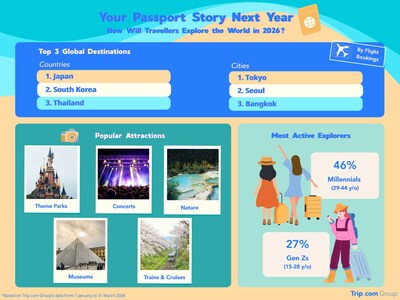
Leading Global Destinations: Japan, South Korea and Thailand

Based on Trip.com Group’s 2026 booking data, Japan is set to dominate as a top destination of choice next year, consistently ranked in the top three outbound destinations booked by travellers worldwide, including those from Indonesia, Malaysia, Singapore, South Korea and Thailand. Its two major cities – Tokyo and Osaka – are expected to see high demand from tourists globally, and likely to make it to the top 10 list of cities that international travellers plan to visit next year. 

Other popular destinations that are set to make their way into 2026 travel itineraries include China, Thailand, the United Kingdom and Vietnam.

Millennials or those aged 29 to 44 will form the largest group of travellers next year, and will contribute to almost half of the booking volume, followed by Gen Zs who are aged 15 to 28[1].

Destinations Rising in Popularity: China and Türkiye

In recent years, China has emerged as a travel favourite with its broad appeal, rich cultural heritage and range of unique experiences. Trip.com’s latest booking data shows that China is projected to be one of the fastest-growing and leading travel destinations among Southeast Asian (SEA) travellers in 2026, with triple-digit year-on-year growth expected in flight bookings across several SEA markets[2]. In particular, travellers from Malaysia, Singapore and Thailand are on track to become the top source markets heading to China next year.

While major Chinese cities like Shanghai, Guangzhou and Chengdu are predicted to be the most popular among SEA travellers, cities such as Beijing, Harbin, Chongqing, Shenzhen and Xi’an are also likely to enjoy greater appeal, with flight bookings from SEA projected to surge year-on-year.  

This trend is expected to be similarly seen in Europe, as more look to explore further beyond the region. Destinations in Asia, such as China, Japan, Thailand and Türkiye, are slated to be some of the top holiday choices for European tourists next year.

Notably, travellers from the United Kingdom (UK) are set to rank among the top ten source markets heading to China in 2026, while Thailand and Türkiye are on track to become the top two outbound destinations for German travellers.  

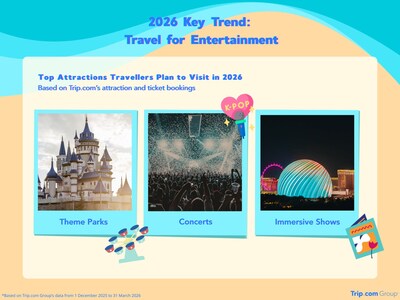
Entertainment Boom: Theme Parks, Immersive Shows and Concert Travel


Across Asia, iconic theme parks such as Shanghai Disneyland Resort, Hong Kong Disneyland, and Universal Studios Japan will continue to drive tourism, ranked among the top attractions that travellers have on their 2026 itineraries.

Fan-driven attractions, such as Harry Potter studio tours and K-pop concerts, like Seventeen and Taemin, are expected to be highly sought after by international travellers, especially those coming from South Korea. Experiences based on well-loved global franchises such as Jurassic World: The Experience in Thailand and the EVANGELION Anniversary Exhibition in Tokyo are also set to be some of the top attractions travellers plan to visit next year.

In addition, travellers will be looking for more entertainment-led experiences when they go abroad, such as immersive shows and performances. Globally recognised productions such as Aladdin the Musical, Broadway shows (New York), The Sphere (Las Vegas) and The House of Dancing Water (Macau) are likely to be popular among international travellers[3].

Attraction Trends: Nature, Culture and Alternative Journeys

A trend that will emerge among travellers from SEA and Germany is nature and adventure tourism, where interest to destinations like New Zealand and China will see an upward trend. Scenic spots like Milford Sound and the Glowworm Caves in New Zealand, as well as Wulong Karst in China, are on track to be some of the top attractions for these travellers next year.

Other nature-based attractions in China such as the Chimelong Safari Park in Guangzhou, as well as Mount Siguniang, Bipenggou and Huanglong National Scenic Area in Sichuan, are also set to be highly in demand with SEA travellers. 

In Europe, travellers will be keen to immerse themselves in the region’s rich history, with cultural hubs such as the Louvre Museum in Paris, Sagrada Familia in Barcelona and Grossmünster in Zurich among the top-booked attractions for next year.

A predictive trend for next year is the rise of train and cruise journeys, where Trip.com Group’s latest booking data suggests an increased interest in the scenic Arashiyama Sagano Romantic Train among Vietnamese travellers, while luxury cruises, such as Royal Princess Cruise and Opulence Cruise, are likely to be popular among German travellers[4].

Rising Popularity of Self-driving Trips and EVs

Increasingly, travellers are becoming aware of their carbon footprint and are seeking more sustainable options when it comes to getting from place to place.

Trip.com’s latest data shows that since the display of carbon labels in April 2025, there has been a steady growth of booking orders for electric car rentals month-on-month, significant especially in Norway, Australia and Japan. Fuelling this growth are travellers from Japan, Thailand, the US, South Korea and Australia. 

This is likely due to an overall increased interest in self-driving trips. In Europe and Australia, Asian travellers, especially those from South Korea, are choosing electric cars as their preferred mode of transport to explore at their own pace and comfort[5]

2025 Wrapped: Who Travelled the Most This Year?


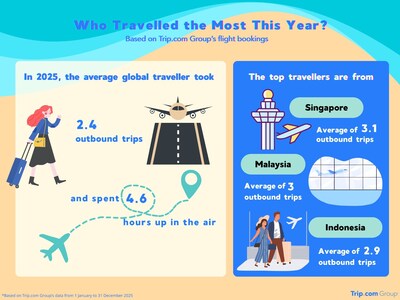
With 2025 coming to a close, Trip.com Group has also unveiled its 2025 travel wrap-up, crowning the most seasoned travellers for the year. Based on recent data, the average global traveller took 2.4 outbound flights this year, and the average flight duration travelled is 4.6 hours. Travellers departing from Southeast Asia, including Singapore, Malaysia and Indonesia are some of the top jet-setters, with an average of 3 or more outbound flights taken per person in 2025. Meanwhile, travellers from the UK and Germany spent the most time on flight this year, with an average flight duration of 5.7 hours or more per person[6].

About Trip.com Group

Trip.com Group is a leading global travel service provider comprising of Trip.com , Ctrip, Skyscanner, and Qunar. Across its platforms, Trip.com Group helps travellers around the world make informed and cost-effective bookings for travel products and services and enables partners to connect their offerings with users through the aggregation of comprehensive travel-related content and resources, and an advanced transaction platform consisting of apps, websites and 24/7 customer service centres. Founded in 1999 and listed on NASDAQ in 2003 and HKEX in 2021, Trip.com Group has become one of the best-known travel groups in the world, with the mission “to pursue the perfect trip for a better world”. Find out more about Trip.com Group here: group.trip.com.

Follow us on: X , Facebook , LinkedIn , and YouTube .

[1] Based on Trip.com Group’s flight booking data from 1 January to 31 March 2026.
[2] Based on Trip.com’s flight booking data from 1 January to 31 March 2026 and 1 January to 31 March 2025.
[3] Based on Trip.com Group’s attractions booking data from 1 December 2025 to 31 March 2026.
[4] Based on Trip.com Group’s attractions booking data from 1 December 2025 to 31 March 2026.
[5] Based on Trip.com’s car rental booking data from 1 January 2025 to 15 October 2025.
[6] Based on Trip.com Group’s flight booking data from 1 December 2025 to 31 December 2025. 


Shanghai strengthens appeal as HQ hub

Foreign firms expand R&D, talent development and supply chain in the city

BEIJING, Dec. 15, 2025 /PRNewswire/ — A news report from chinadaily.com.cn:

Hongqiao International Central Business District is one of the major gathering hubs for foreign-invested headquarters. CHINA DAILY

Shanghai, serving as a vital gateway for foreign businesses entering the Chinese market, has emerged as a key hub for the regional headquarters of international companies.

In 2025, a total of 44 foreign-invested headquarters received a recognition certificate from the Shanghai government, bringing the total number of foreign-invested regional headquarters in the city to 1,060.

Shanghai has become one of the cities with the highest number of regional headquarters for multinational companies in China.

Shanghai is a preferred choice for companies for several reasons, including its vast market size, comprehensive industry chains, open and inclusive culture, proximity to the economically vital Yangtze River Delta and its platforms for observing and engaging with the latest research and development activities.

Meanwhile, strong policy support from the Shanghai government is also a significant advantage.

In February, the government issued a plan to encourage foreign companies to upgrade their headquarters in the city by integrating functions such as research and innovation, financial management, investment decision-making, procurement and distribution, supply chain management and shared services under one roof. A tiered system was established to nurture various types of headquarters, including China regional headquarters, Asia-Pacific regional headquarters, and global division headquarters. Support will be tailored to the different development stages and functions of these headquarters.

Driving innovation

Sonova, which has been operating in China for more than 20 years, considers the country one of the most strategic markets in its global landscape. In 2022, it established its China headquarters in Shanghai, a location that supports business decision-making. This year, Sonova received a recognition certificate for its China headquarters from the Shanghai government, marking a new milestone in its journey in China.

Shanghai, the core of Sonova in China, not only provides resources such as talent but also connects Sonova with the local market,” said Fang Fang, general manager of Sonova China. “The establishment of the China headquarters has accelerated local innovation and product launches, achieving high efficiency in resource utilization.”

Fang said that Shanghai offers a premium business environment, a comprehensive industry chain and a rich talent pool, making it one of the most valued cities for regional headquarters and R&D centers for foreign companies.

Shanghai boasts a large number of high-end medical professionals and advanced medical technologies, making it the most active regional medical center in China. This provides strong support for corporate innovation.”

In addition to serving as Sonova’s China headquarters, Shanghai is home to the company’s innovation center, which focuses on developing products to meet local demand. The center has introduced solutions such as the Phonak-branded Chinese speech processor, designed based on the tonal characteristics of the Chinese language and the local listening environment, offering a more natural and comfortable listening experience for people with hearing loss in China.

In recent years, Sonova also strengthened partnerships with local businesses and academic institutes to support the high-quality development of Shanghai’s healthcare industry. In September 2024, Sonova signed a memorandum of cooperation with East China Normal University to jointly focus on talent development. Both parties agreed to leverage their strengths to explore R&D opportunities in audiology, promote the creation of accessible educational environments, and enhance professional training and education through industry-academia collaboration. Additionally, they aim to disseminate hearing care knowledge to the general public and raise awareness of hearing health.

So far, Sonova has established a complete local supply chain in China, covering R&D, production, marketing and services. It has also optimized its market layout with the headquarters in Shanghai, production facilities in Suzhou, Jiangsu province, and quick access operations in Boao, Hainan province.

“Sonova is confident in the development of China and Shanghai. We are optimistic about the long-term future of the hearing health industry in the country,” said Fang.

An accelerator

Kerry Group, a global leader in tastes and nutrition, has been operating in Shanghai for more than 20 years. It brings in imported dairy products, protein products, probiotics and natural extracts to meet the quality demand of Chinese consumers.

In 2022, Kerry Group established its China headquarters in Xuhui district of Shanghai in response to its rapidly developing business. It received a recognition certificate from the Shanghai government in 2024. So far, it has established an operational network that spans China, including Jiangsu, Hebei and Shandong provinces.

“Openness, innovation and inclusiveness are the defining characteristics of Shanghai and are crucial factors in supporting the development of enterprises,” said Jiang Wei, general manager of Kerry China. “The establishment of the regional headquarters helps us to define the organization structure and business model, strengthen client confidence and support our long-term quality development goals.”

According to Jiang, during Kerry Group’s more than 20-year journey in the city, Shanghai has impressed the company with its premium business environment, extensive talent pool and complete industry supply chains. The characteristics of the city ensure that Kerry Group’s imported products can clear customs in the most efficient manner. Additionally, the company can easily find supply chain services ranging from raw materials and production equipment to packaging materials and logistics. Furthermore, it can find the right talent that shares the company’s values to support its long-term growth.

“The city acts as an accelerator, helping to shorten the time from product design to mass production and enabling us to respond quickly to clients’ demands,” said Jiang.

“During its development journey in Shanghai, Kerry Group has profoundly experienced the continuous improvement of the business environment. The company is very confident in the Chinese market, which is fully reflected in continuous investments, business expansion and innovative collaborations.”

Since its inception in China 20 years ago, Kerry Group has been strengthening its development foundation in the country. It has successfully established a local chain encompassing R&D, production, technology and marketing. It has acquired three flavor manufacturing plants in China, further solidifying its leading position in the flavored products sector. So far, it has entered a new stage of consistently generating profits in the vast Chinese market.

A foreseeable future

Sherwin-Williams Company, a global leader in the paint and coating industry, opened its first China office in Shanghai in 1930.

In 2019, the company located its Asian headquarters in Jing’an district of Shanghai. The city also boasts one of its four production sites in China.

“The establishment of Sherwin-Williams’ Asia-Pacific headquarters in Shanghai stems from our strong emphasis on the Chinese market and deep recognition of Shanghai’s strategic position,” said Henry Wu, managing director for the APAC region at the Sherwin-Williams Company.

Shanghai is a core city in Sherwin-Williams’ Asian regional layout. It not only boasts a comprehensive industry chain and abundant talent resources but also offers an open and inclusive business environment.”

Wu said that the stable and efficient business environment, along with a foreseeable future, encourages the company to deepen its roots and focus on its business. This foundation also fuels Sherwin-Williams’ confidence in long-term development.

“From policy support to government services, from industrial ecosystem to talent pool, Shanghai consistently demonstrates strong comprehensive advantages,” said Wu. “Leveraging Shanghai’s mature manufacturing system and innovative resources, Sherwin-Williams has significantly enhanced its service capabilities and response speed in the Chinese and Asia-Pacific markets.”

So far, the Asian headquarters has played a vital role in supporting R&D and accelerating marketing of new products, according to Wu.

Meanwhile, the headquarters also enables the company to enhance collaboration with local enterprises and research institutions to drive coordinated innovation across the upstream and downstream industry chains.

“We have established close cooperative relationships with local enterprises, industry associations and research institutions to jointly promote the development of green coating standards, technological innovation and application implementation,” said Wu. “In the future, we will further strengthen open collaboration to drive coordinated development across the industry chain, supporting Shanghai in becoming a global leader in green manufacturing.”

Looking ahead, Sherwin-Williams will further strengthen its commitment to China to serve the diverse industrial upgrading needs and contribute to China’s high-quality growth, according to the company.

In addition to further expanding its presence in sectors such as industrial wood coatings, packaging coatings, automotive finishes and protective and marine coatings in China, the company will strengthen its commitment to green manufacturing, intelligent coating, functional coatings and solutions with sustainability attributes that comply with international regulations.

“China is Sherwin-Williams’ core strategic market in Asia. In the future, we will continue to deepen our regional presence, focusing on product applications in high-growth industries such as new energy vehicles, smart manufacturing, green building and food safety,” said Wu.

“To succeed, we must gain deep market insights, provide cutting-edge technology, and collaborate closely with our clients. As an international metropolis, Shanghai offers an open and inclusive business environment, efficient government services, a well-developed industry chain, and a rich talent pool. All of these factors will contribute to our success,” added Wu.

Sherwin-Williams participated in the eighth China International Import Expo held from Nov 5 to 10 in Shanghai. This marked the company’s first appearance at the professional trade fair.

Wu said that the participation enables Sherwin-Williams to further embrace the Chinese market with its most advanced products and engage in in-depth dialogue with Chinese industry partners, customers and individuals from all walks of life.

Final Report Meeting on the Achievements of the Cheongju Craft Biennale 2025: Record-Breaking Economic Impact

– The achievement analysis report meeting took place on Wednesday, December 10, at 4:00 pm in the fourth-floor conference room of the Main Building, Culture Factory.
– Visitor satisfaction reached 90.3%, and the economic ripple effect increased to KRW 45 billion, indicating simultaneous growth.
– Ongoing strategies are necessary, including establishing a craft landmark, implementing branding initiatives, and connecting with UNESCO Creative Cities to support sustainable development.

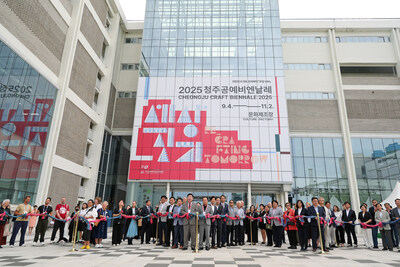
CHEONGJU, South Korea, Dec. 15, 2025 /PRNewswire/ — The Cheongju Craft Biennale 2025 attracted 402,539 visitors and received exceptional evaluations for its exhibition scale, quality, and international networking. It also achieved record results in key indicators, including visitor satisfaction and economic impact.

Cheongju Craft Biennale Organazing Committee

The Cheongju Craft Biennale Organizing Committee (Chairman: Beom-seok Lee, Mayor of Cheongju; hereinafter, the Organizing Committee) officially announced these results at the Final Achievement Analysis Report Meeting, held on Wednesday, December 10, at 4:00 PM in the fourth-floor conference room of the Main Building, Culture Factory.

At the meeting, Executive Director Kwang-seop Byun, committee members, officials from Cheongju’s Department of Culture and Arts, and research staff attended as the Cheongju University Industry-Academic Cooperation Foundation (lead researcher: Professor Sang-kyu Choi, Department of Tourism Management) presented the analysis. The study used surveys and behavioral analyses of 660 on-site visitors across three phases (early, mid, and late stages of the event), with a 95% confidence level and a ±3.8% margin of error.

According to the report, the overall satisfaction level of the Biennale was 6.02 out of 7 points, or 90.3%, representing a 1.2 percentage point increase compared to the 2023 Biennale. The research team noted that the Main Exhibition and the International Craft Competition were consistently identified as the primary reasons for satisfaction across the early, middle, and late stages, confirming the stable competitiveness of the core exhibition content.

In addition, both the intention to revisit (5.99 points) and the willingness to recommend (6.00 points), which are key satisfaction indicators, recorded high scores, indicating strong loyalty to the Biennale and a high potential for positive experiences to spread. The ratio of returning to first-time visitors was 56.6% to 43.4%, a narrower gap than at the 2023 Biennale. This result was interpreted as an encouraging sign that satisfaction and intentions to revisit have remained steady while the number of new visitors continues to increase.

The largest increase occurred in total consumer spending and economic ripple effects.

Total consumer spending at the Cheongju Craft Biennale 2025 was approximately KRW 24.9 billion, analyzed across seven categories, including ticket purchases, transportation, food and beverages, accommodation, and shopping. This amount was more than KRW 10 billion higher than the 2023 Biennale. The spending induced a production effect of KRW 45.02 billion, an increase of about KRW 6.8 billion from the KRW 38.25 billion recorded in 2023. The induced value-added effect was KRW 17.41 billion, and the employment effect resulted in 178 jobs. According to the research team, these outcomes contributed positively to the revitalization of the local economy.

Beyond quantitative achievements, the researchers evaluated the Biennale as a landmark event that “reaffirmed the intrinsic value of craft in an era of loss, introduced sustainable craft reflecting on the environment, and presented future visions of coexistence, recovery, and solidarity within the community.” They also noted that, following Cheongju’s designation as a UNESCO Creative City of Crafts and its Gold Award in the “Korean Wave Program” category at the Pinnacle Awards of the International Festivals & Events Association (IFEA), the Biennale, now in its 27th year, has strengthened Cheongju’s international cultural competitiveness and cultural diplomacy capacity, making a significant impact both domestically and internationally.

Given the vast scale of the Culture Factory, which covers 120,000 square meters, the research team emphasized the urgent need to identify measures to reduce the complexity of visitor flow and alleviate fatigue. The team also proposed directions for further development of the Biennale.

First, they emphasized the need for sustainable strategies and practices related to the UNESCO Creative Cities Network. They recommended increasing citizens’ familiarity, awareness, and participation in crafts by creating a craft landmark and providing repeated daily exposure. They also suggested expanding craft product sales platforms to create a positive marketing cycle involving appreciation, tourism, and consumption. In addition, the team highlighted the importance of building an integrated data management system to monitor visitor loyalty and revisit rates, upgrading operational systems, and developing strategies to expand international exchanges, such as institutionalizing joint residency programs.

The City of Cheongju and the Organizing Committee stated: “The Cheongju Craft Biennale 2025 was an unprecedented craft festival in every aspect, lasting a record 60 days, with participation from a record 72 countries, and presenting a record 23 exhibitions simultaneously. Thanks to this, Cheongju has transformed into the global center of crafts, beyond K-Craft.” They added: “As we stand at the starting line of writing a new history of crafts as a UNESCO Creative City, Cheongju, the Organizing Committee, craft experts and artists, together with international craft networks, will join forces to ensure that the development directions presented today are fully realized.”